You're sore, your car needs repairs, and the insurance adjuster wants the police report. You have a crumpled slip of paper with a case number, but searching it online gets you nowhere. That doesn't tell you whether the report exists, whether you're using the wrong system, or whether the agency hasn't released it yet.
To find a police report with case number, start with the department that investigated the crash, not a general internet search. Then work through its release rules, request process, and delivery timeline. Meanwhile, preserve your own evidence and deal with insurance deadlines separately. Waiting for a document shouldn't become your entire claim strategy.
Why the Case Number Is Only the Starting Point
A case number is a filing-cabinet key, not a universal lookup code. It helps the agency locate and track an incident, but you still need to know which agency owns that filing cabinet. Entering the number into an unrelated police portal can produce an empty result even when the correct department has a report.
Keep the number exactly as the officer wrote it. Preserve the hyphen, leading zeros, and any letters rather than “cleaning up” the format. Photograph the slip now, especially if it's already torn, faded, or sitting among discharge papers and repair estimates.
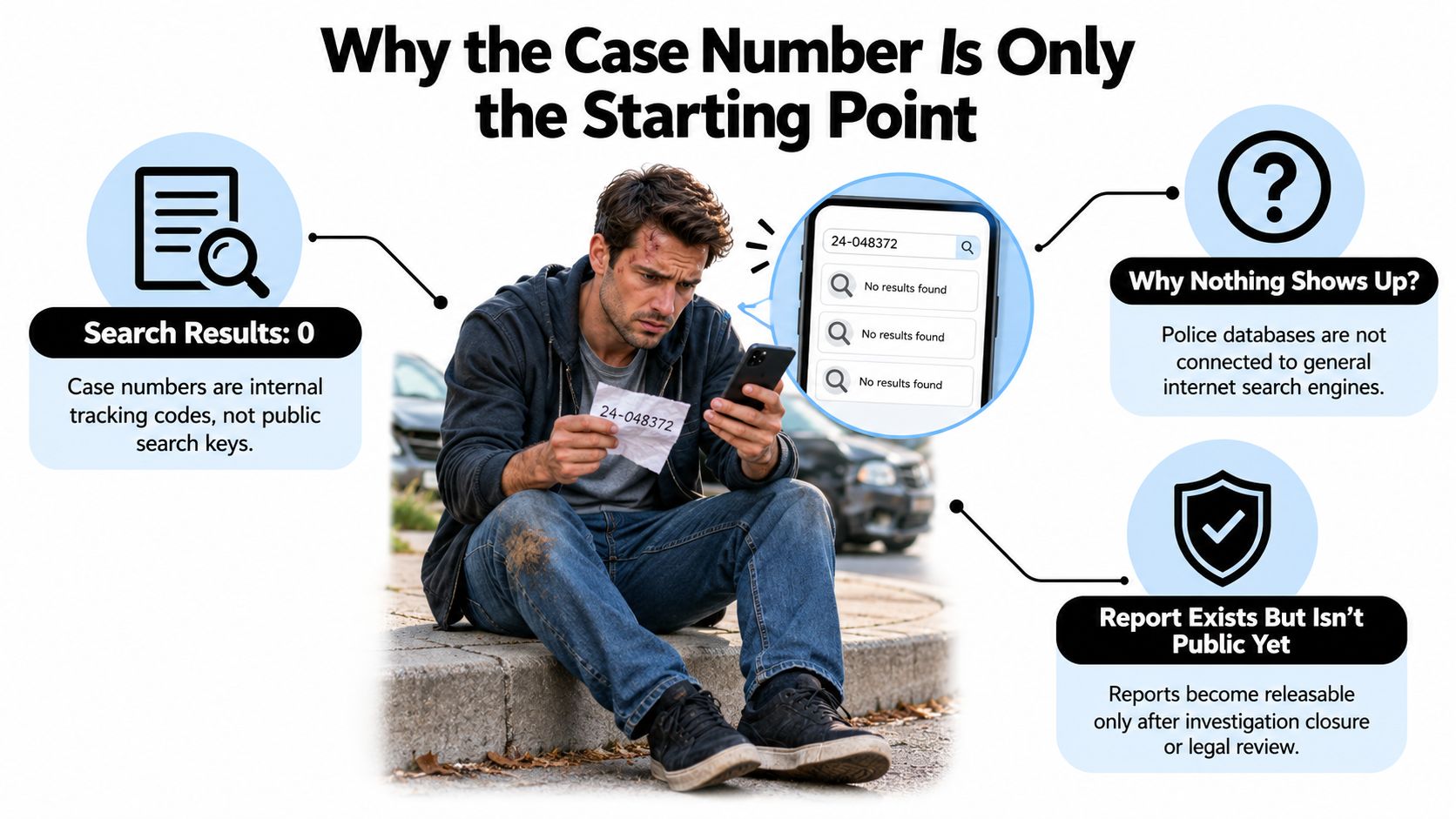
Match the number to its custodian
Look for the department's name on the officer's card, crash exchange sheet, citation, or other paperwork you received. Don't assume the closest police station handled the incident. Your useful starting point is the agency that responded and created the record.
Once you identify a likely department, contact its records unit and ask whether it recognizes the number. Ask for the official request page or form before sending identification or payment. A search result that accepts a number isn't proof that the website holds the report.
Practical rule: Confirm the investigating agency before submitting a records request. A correctly entered number in the wrong system still won't retrieve your document.
Understand what a national search cannot do
Federal crime-data systems and local report retrieval serve different purposes. Agencies submit standardized information for statistical reporting; those systems aren't a public document portal that returns an individual crash report when you enter its case number. You need the custodian's request process, not a national crime-data search.
Keep your immediate recovery tasks separate from this records task. The after-accident guidance can help you organize injury documentation and insurance questions while you establish where the report is held.
My recommendation is straightforward: save the number, identify the department, and create a dedicated folder for the crash. Put the officer's information, accident date, location, and correspondence together. Don't pay a website merely because it promises a case-number search, and don't interpret an empty result as confirmation that police never wrote a report.
Identifying the Right Agency and Confirming the Report Is Releasable
Call the records office of the investigating agency first. City police, county sheriffs, state police or highway patrol, and campus police are possible custodians, but location alone doesn't settle jurisdiction. A highway crash isn't automatically a state-patrol report, and an incident inside city limits isn't automatically held by city police.
Use the location to narrow your inquiry, then ask the agency to confirm that it investigated the crash. If it didn't, ask which department responded or where you should direct the request. That's more useful than submitting identical applications to every nearby office.
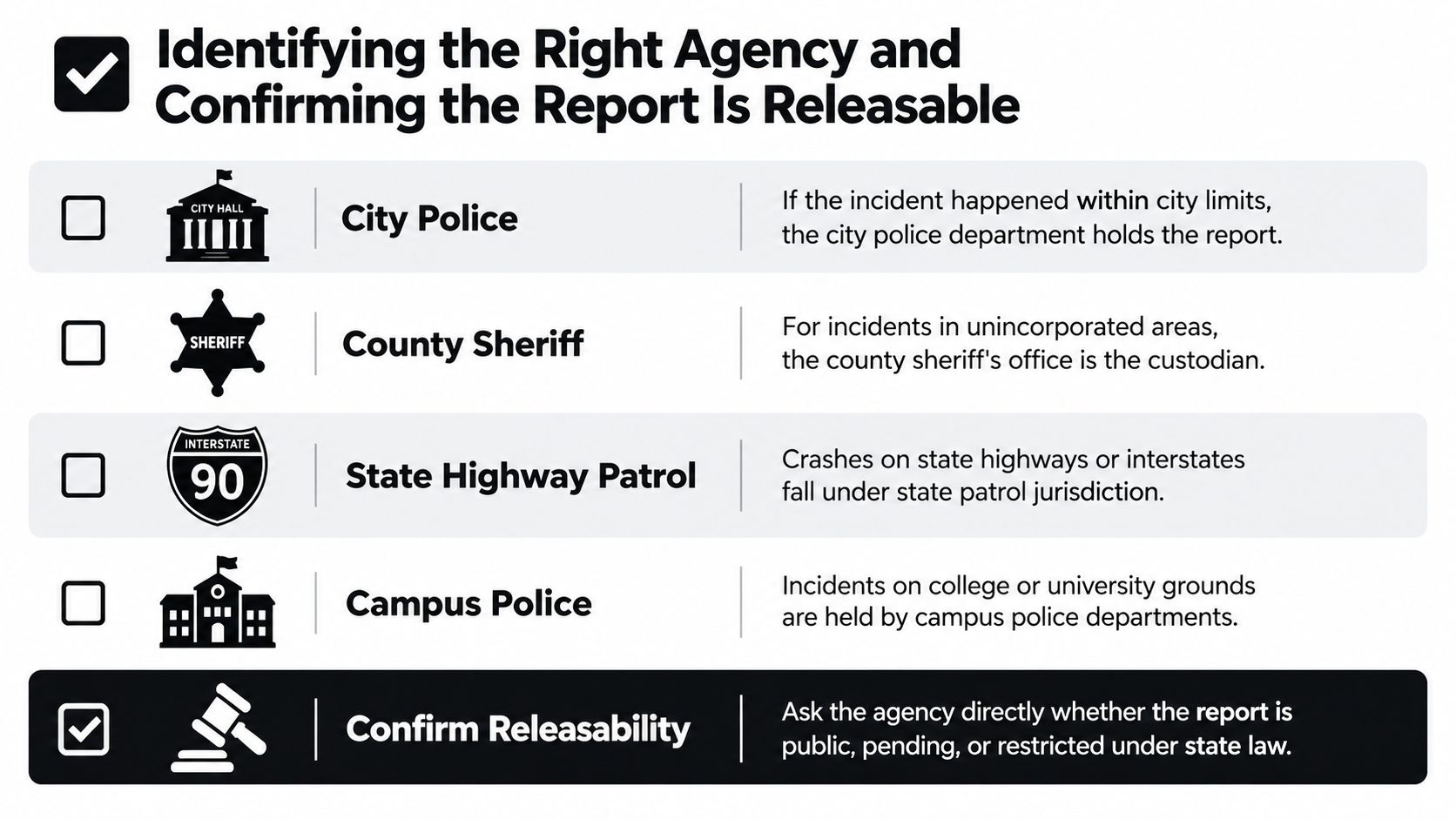
Give records staff enough information to distinguish your crash
Have the case number ready, but also prepare the incident date, approximate time, intersection or address, involved names, and officer's name if available. If the number is unreadable, say so rather than guessing. Ask the custodian which substitute details it needs to search.
Be careful with paperwork from another system. A DMV reference, insurance claim number, or court file number may not be the police incident identifier. Tell the records employee where the number came from so they can determine whether it belongs in their search field.
Separate existence from eligibility and release
Ask whether the report is still being prepared, awaiting supervisory approval, or restricted because of an ongoing case. Fairfax County's Central Records guidance states that reports generally cannot be disseminated while the associated case remains open. Don't assume every agency follows that exact rule, but do ask what its current restriction means for your request.
Also establish whether you personally qualify to receive the document. Involvement in a crash and public access to the resulting records aren't interchangeable questions. The agency should explain the application category and supporting documents that apply to you.
Before submitting, confirm:
- Custodian: This agency investigated the incident and holds the requested record.
- Identifier: Your number is its police or crash-report reference, not another organization's number.
- Status: Staff have explained whether the report is approved, pending, or restricted.
- Requester category: You know whether to apply as an involved driver, passenger, representative, or other requester.
- Verification: You know which identification or authorization documents the agency requires.
If staff say “not available,” ask what that means. A pending report calls for follow-up; an eligibility problem calls for different documentation; a denial calls for a written explanation. Those aren't the same obstacle.
Submitting the Request Through the Right Channel
Use the agency's official instructions, not whichever route looks fastest. An online portal, records-counter visit, mailed application, or email request can work only if that agency accepts it. Sending an informal email when a signed form is required creates avoidable friction.
Prepare a complete request packet: the case number, incident details, requested document, contact information, and whatever identification or authorization the custodian requires. Use its approved submission method for sensitive documents. Don't attach a driver's license to an unverified email address.
Choose a channel you can document
- Online portal: Check the agency name and report type before entering information. Save the confirmation page and any reference number.
- In-person records counter: Confirm counter hours and required documents before traveling, particularly if your injuries make the trip difficult.
- Mail: Use the current application and payment instructions. Keep a copy of everything you send and retain proof of delivery.
- Email: Confirm that email requests are accepted and whether the office needs a signed attachment rather than a message alone.
The traffic-collision report online guidance is useful for understanding the portal route. It doesn't replace the investigating agency's current requirements.
Know what payment actually purchases
Fees differ, and payment isn't the same as approval or delivery. Illinois, for example, lists a $5 statutory fee plus a service fee, requires approval rather than automatically producing the report after payment, and provides a redacted copy through its public-records process, according to its crash-report payment guidance.
Agency fees for crash and police reports
| Agency | Fee | Requester type | Notes |
|---|---|---|---|
| Illinois State Police | Statutory fee plus service fee, as cited above | Requesters using the listed crash-report process | Approval is required; the public-records copy is redacted |
| Investigating local department | Confirm before submitting | Depends on agency rules and requester status | Ask whether supplemental materials require separate requests |
| State crash-records custodian | Confirm with the relevant state system | Depends on the report and access rules | A search transaction may differ from purchasing a copy |
Request the crash report, not merely confirmation that an incident occurred. Then ask whether separately releasable photographs, supplemental narratives, diagrams, reconstruction materials, or later amendments exist. A basic report may not include those records, and a redacted copy may omit information you expected to receive.
Don't confuse obtaining the police report with completing your own accident-reporting obligations. For Massachusetts crashes, Shea Culgin Law's resource on when to file accident report within 5 days addresses a separate reporting task worth checking.
Keep the receipt, submission date, completed application, and confirmation email together. Those documents let you show exactly what you requested and when, without relying on memory.
Understanding Realistic Timelines and Why Reports Get Delayed
Report written and report releasable are different statuses. An officer may have completed the narrative while the agency still needs approval or a release review. Your request can be properly submitted without the document being ready for delivery.
A state database introduces another possible wait. The investigating agency's record and the state system's searchable copy aren't necessarily available at the same time. Ask whether the date you've been given refers to report preparation, request processing, or database entry.
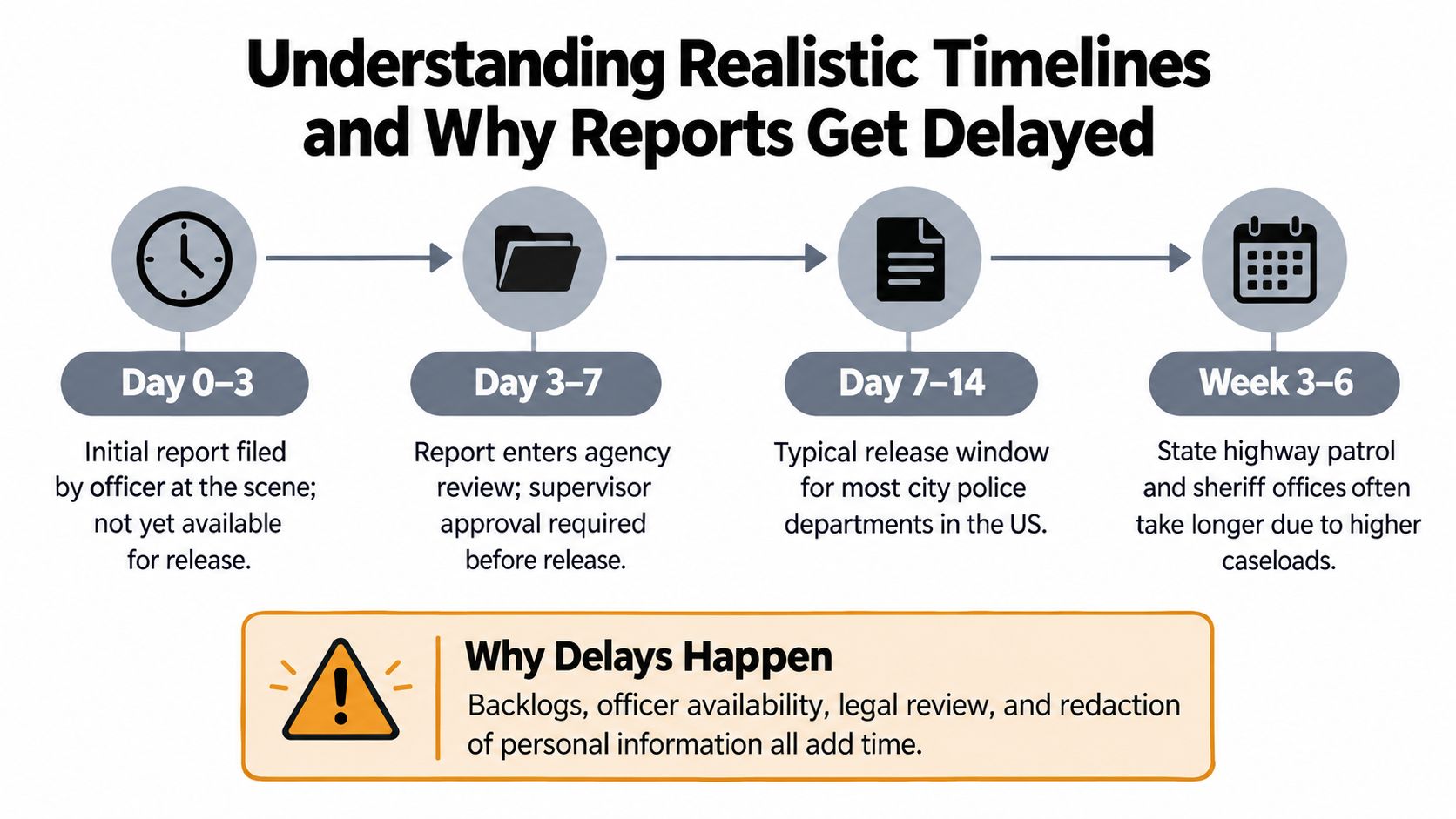
Use the jurisdiction's benchmark, not a universal countdown
Treat broad timeline illustrations as orientation, not a promise. The relevant deadline is the one published or confirmed by your custodian for your report type. Preserve distinctions between calendar days, business days, and working days.
New York illustrates why that matters: electronically filed New York City crash reports may take at least 14 days, paper police reports at least 30 days, and motorist reports at least 60 days to appear in the DMV database, according to New York City's collision-report guidance.
| Retrieval stage | Timing question to ask | What the answer tells you |
|---|---|---|
| Investigating agency | Has the officer completed the report and has it been approved? | Whether the underlying document is ready |
| Records unit | What processing period applies to my submitted request? | When a follow-up is appropriate |
| Release review | Is redaction or an investigation restriction delaying delivery? | Whether waiting alone will resolve the obstacle |
| State DMV database | When should this report type become searchable? | Whether you're checking the state system too early |
Follow up on the actual bottleneck
Pending supervisory approval, privacy redactions, investigation restrictions, and separate database entry each require a different question. Ask records staff which stage applies and whether any portion can be released now. A repeated “check back later” answer gives you little to work with unless you also know the reason.
For Hawaii-specific timing questions, Olson & Sons' guide for Kona accident victims provides local context rather than a nationwide delivery promise.
Ask for written confirmation that the report is pending, or an incident-verification letter if the agency offers one. Neither replaces the full report, but either is more useful than an undocumented telephone assurance.
Set your follow-up around the agency's stated processing period. If an insurance or legal deadline arrives sooner, tell records staff the date and ask what confirmation or partial record they can provide. Don't assume they can accelerate release, and don't assume their delay extends your separate obligations.
What to Do When the Report Is Not Yet Available
A missing police report doesn't automatically freeze your claim. Notify the insurer and preserve evidence while the records request is pending. The police narrative is an important document, but it isn't the only material you can organize or submit.
Agency rules still control when you can request it. Pennsylvania advises waiting at least 15 days after a crash, then requires an application, approval within up to 7 business days, and payment before release, according to its crash-report search instructions. Start preparing immediately, but don't assume every agency accepts a formal request on the day of the crash.
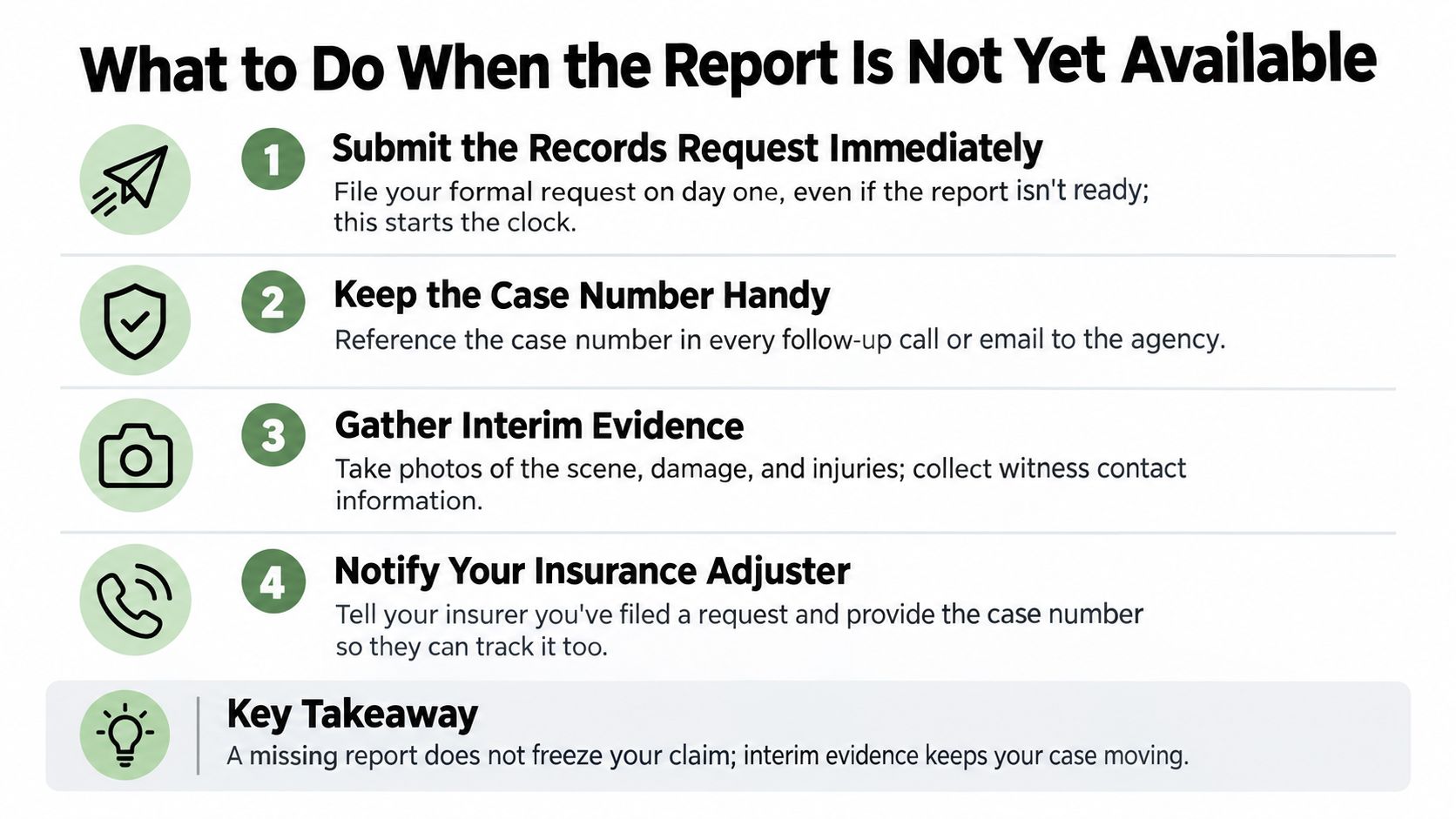
Build an interim evidence packet
Collect what you already have rather than trying to reconstruct everything after the report arrives. Keep original files and make separate copies for sharing. Label documents clearly without changing their contents.
- Scene and damage photographs: Preserve images of vehicle positions, road conditions, signs, damage, and visible injuries.
- Video: Save available dashcam or phone footage. If you know another person or business may have footage, ask promptly about preservation.
- Witness information: Record names, contact details, and what each person says they observed. Don't coach anyone's account.
- Medical documentation: Organize treatment records, discharge instructions, bills, and your symptom notes by date.
- Vehicle records: Retain repair estimates, towing paperwork, storage correspondence, and other damage documentation.
Include an officer's diagram or exchange sheet if you received one. Identify it accurately; don't describe a preliminary document as the completed police report.
Tell the adjuster what is pending
Use a short written update that separates the missing document from the evidence you can provide:
I've requested the crash report from [investigating agency] under case number [case number], and the agency says release is pending.
I'm providing the available supporting documents now and will supplement them when the report is released.
That's a suggested script, not a statement attributed to an agency. Adapt it to what you know, and don't claim a request was submitted if you've only checked a portal.
Ask the adjuster to identify any outstanding document requests and deadlines in writing. Don't speculate about fault to compensate for the missing report, and don't treat an evidence request as a reason to sign a settlement release before understanding its consequences. If a legal deadline is approaching, get jurisdiction-specific advice instead of waiting for records staff to finish.
Escalating Through FOIA, Clerks, and Legal Help
Escalate when you can identify the problem: an unanswered request beyond the stated processing period, a denial without a clear explanation, or a deadline that makes ordinary follow-up inadequate. Another generic search won't resolve those issues. Direct the next request to the person or office that can address the blockage.
The scale of national reporting doesn't create a federal shortcut. In 2023, more than 16,000 agencies submitted Uniform Crime Reporting data covering approximately 94.3% of the population, while 14,039 of 19,196 agencies, about 73.1%, submitted at least a month of NIBRS data, as described in the Congressional Research Service overview of crime reporting. Those are statistical reporting systems, not substitutes for the local records custodian.
Request a written records decision
For state or local police records, ask about the applicable state public-records process. Don't assume a federal FOIA request is the correct mechanism just because people use “FOIA” as shorthand for any records request.
Keep your request specific. Identify the incident, document categories, and prior request reference, then ask for the reason any material is withheld and the available review or appeal process. A formal request isn't a guarantee of disclosure, and it doesn't automatically override privacy or investigation restrictions.
Escalation cue: Ask the custodian to distinguish records it doesn't hold, records it hasn't completed, and records it is withholding. Each answer points to a different next move.
Use clerks and legal assistance for different tasks
A court clerk becomes relevant if there's an actual court proceeding with documents in its file. Ask what has been filed under that court case number. Don't expect the clerk to supply police materials that were never submitted to the court.
Legal assistance is useful when the missing report sits alongside a disputed claim, unclear exemption, or approaching deadline. A lawyer can evaluate the appropriate records procedure and whether litigation tools are available. A demand letter or subpoena isn't a magic bypass; the proper route depends on the law and procedural posture.
Alongside direct custodian follow-up and any available administrative review, AskLegally offers a free case review for eligible people who haven't retained an attorney and can help connect them with participating personal injury lawyers. Its ask-a-lawyer pathway is an option for evaluating whether the report delay is affecting your injury claim, not a police-report retrieval service.
Bring the request, receipt, agency responses, and relevant deadlines to that conversation. The goal is to solve the claim problem, not send a more forceful version of the same application.
A Practical Checklist You Can Save
Your records folder should let someone else understand the request without making you retell the crash. Keep a short status note at the front: who holds the report, what you requested, when you submitted it, and what remains unresolved. Update that note after each meaningful response.
Tick off the retrieval chain
- Confirm the custodian: Identify the agency that investigated the crash.
- Preserve the identifier: Save the case number exactly as issued and photograph the original paperwork.
- Verify access: Establish your requester category and any identification or authorization requirements.
- Check release status: Ask whether the document is approved, pending, or restricted.
- Use the accepted channel: Submit the official form through the agency's designated process.
- Clarify the document: Request the crash report and ask separately about additional releasable materials.
- Save the transaction: Retain the application, payment receipt, confirmation, and correspondence.
- Schedule follow-up: Use the custodian's stated processing period rather than checking repeatedly.
- Protect the claim: Organize independent evidence and address insurance requests while waiting.
- Escalate deliberately: Seek a written decision, the proper records review, or legal advice based on the obstacle.
Recognize when another request isn't enough
Professional help deserves priority if the agency gives an unclear denial, an insurer pressures you to provide a recorded statement you don't understand, or a filing deadline is approaching. These are reasons to evaluate your broader position, not proof that the report itself will solve the dispute.
Don't guess your statute of limitations or assume a pending request pauses it. A free case review can help you determine whether obtaining the report is the next useful move or whether protecting the claim needs attention first.
AskLegally offers practical accident-claim guidance and a free case review for people who may have a personal injury claim and haven't hired an attorney. If your report request is stalled, gather your case number, submission confirmation, agency response, and deadline information, then visit AskLegally to explore appropriate legal help.