
In most U.S. states, you have roughly 1 to 6 years after a car accident to file an injury lawsuit, but insurer notice and crash-reporting deadlines can be much shorter, often days rather than years. Delayed pain doesn't automatically prevent a claim, and it doesn't automatically give you extra time.
You may be reading this because you felt fine at the scene, went home, and only later noticed something was wrong. Now you're trying to arrange medical care while wondering whether saying you weren't hurt has closed the door on compensation.
The useful question isn't just “How long after a car accident can I claim injury?” It's also which action you need to take, who needs to receive it, and which deadline applies to that action.
Why the Answer Depends on Where and When You Were Hurt
Suppose you're rear-ended at a red light. You exchange information, drive home, and feel relieved that everyone seems all right. Days later, your neck becomes stiff and headaches interrupt your work.
That situation raises separate questions: Should you update the insurer? Did you need to report the collision to a government agency? How long do you have to start a court case?
Those aren't interchangeable tasks. Treating them as the same thing is where much of the confusion begins.

Identify what you mean by claiming
People use “file a claim” to describe several different actions:
- Reporting the collision: Giving information to police, a motor-vehicle agency, or another authority.
- Notifying an insurer: Telling an insurance company about the crash and a possible injury claim.
- Filing a lawsuit: Starting formal court proceedings against the appropriate defendant.
You might complete one task without completing either of the others. An insurance claim number, for example, isn't the same as confirmation that court proceedings have started.
Start with your circumstances
Write down where the collision happened, who was involved, whether an injured person is a child, and when symptoms first appeared. Flag any government-owned vehicle rather than assuming an ordinary driver-to-driver process applies.
These details belong together because the right deadline depends on more than the injury's seriousness. Your location and the identity of the person or organization you're claiming against matter too.
Start with the action, not the number: Ask what must be submitted, who must receive it, and what confirms completion.
If you're unsure what to do first, prioritize health concerns and prompt reporting. Use the court-filing rules to identify your outer deadline, the reporting requirements to identify earlier obligations, and your symptom history to prepare for medical and legal questions.
How the Statute of Limitations Sets Your Filing Deadline
A statute of limitations sets the time allowed to start a lawsuit. It's like an expiration date printed on a ticket: having a good reason to use it doesn't necessarily make it valid after it expires.
The important distinction is between preparing a claim and starting a court case. Collecting bills, speaking with an adjuster, and discussing compensation are activities you may undertake before litigation, but they aren't themselves court filing.
Find the starting point before calculating the end
The starting point is often the accident date. Depending on the jurisdiction, the period may instead run from when the injury was discovered or reasonably should have been discovered through reasonable efforts, as explained in Cornell Law School's definition of a statute of limitations.
That doesn't mean you should calculate a deadline from whichever date feels fairest. The legally relevant starting point may differ from the date of your first appointment, scan, or written diagnosis.
For a useful deadline check, distinguish:
- The collision date: When the event happened.
- The symptom date: When you first noticed a problem.
- The diagnosis date: When a clinician identified the condition.
Keep all of them available. A local professional can assess which dates matter under the applicable law rather than relying on your best guess.
England and Wales illustrate what filing means
In England and Wales, the ordinary personal-injury limitation period is 3 years from the cause of action or, if later, the relevant date of knowledge; for a person under 18, the period generally runs from their 18th birthday, subject to applicable exceptions under the Limitation Act 1980 personal-injury provisions.
The required step is issuing court proceedings. Merely calling an insurer, completing an online insurance form, or discussing settlement isn't the same action.
That example is useful even if your collision happened elsewhere: always identify what legally satisfies the deadline. Don't assume that an open insurance file means you've preserved every option.
A practical question for legal advice is: “What must happen before my limitation date, and who is responsible for making it happen?” Ask for the answer in writing so you can distinguish an estimated date from a confirmed one.
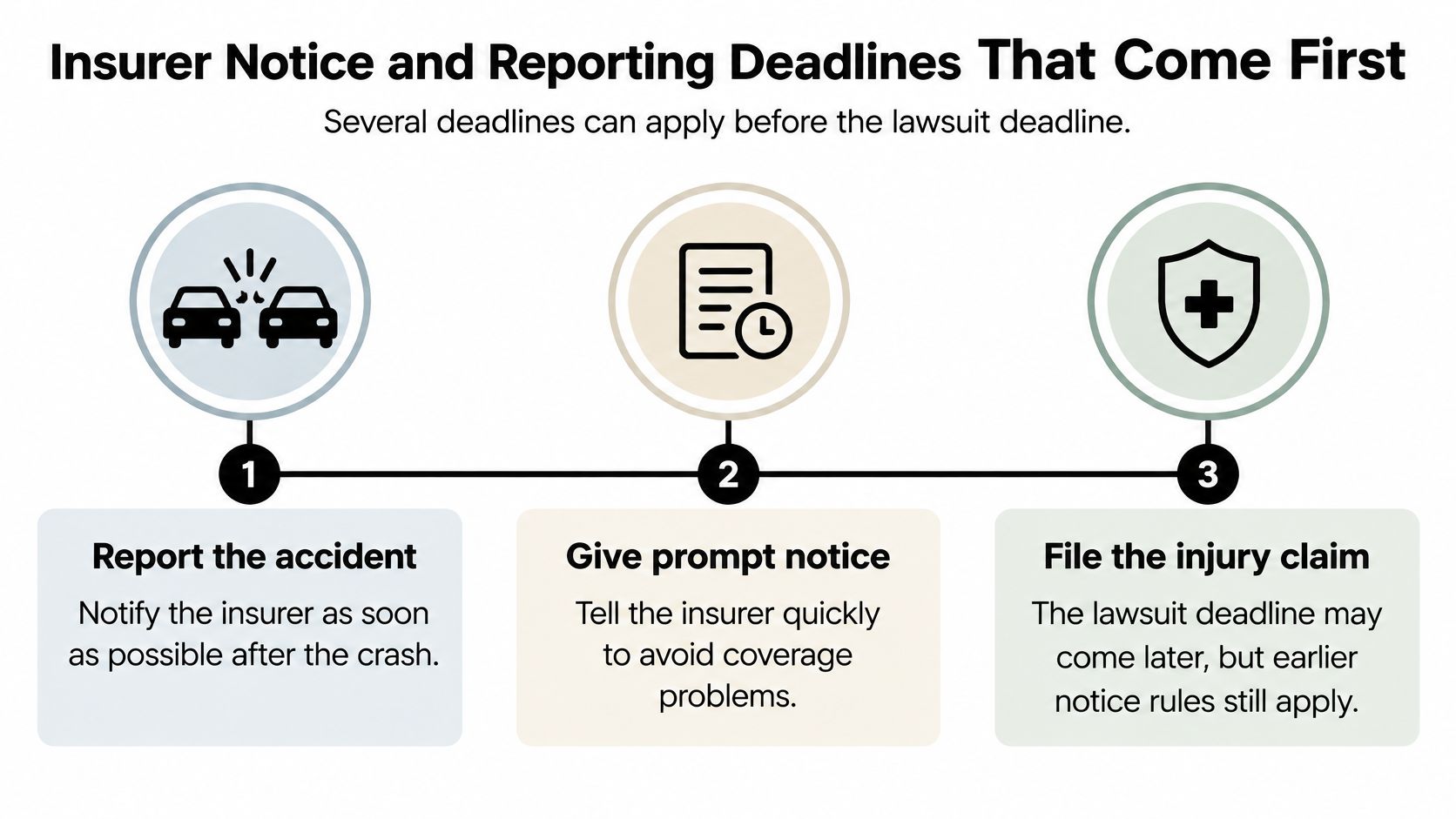
Insurer Notice and Reporting Deadlines That Come First
Your lawsuit deadline may be the most consequential date, but it may not be the first deadline you face. Reporting obligations and insurance-policy conditions need separate attention.
Use this timeline as an organizational aid, not a substitute for checking your actual policy and local requirements.
Match each task to its recipient
| Action | Who receives it | What you need to check |
|---|---|---|
| Crash reporting | Police or the relevant government agency | Whether a report is required and who must submit it |
| Insurance notice | The relevant insurance company | Policy wording, reporting method, and confirmation |
| Lawsuit filing | The appropriate court | Applicable limitation rules and filing requirements |
For example, California's insurance regulator's guide states that crashes involving injury or more than $750 in vehicle damage must be reported to the DMV within 10 days; verify the current reporting requirements directly before relying on that threshold, using the California Department of Insurance's accident guidance.
That administrative report isn't a bodily-injury lawsuit. Likewise, reporting to police shouldn't be treated as proof that your insurer received notice.
For the insurance task, read the notice provision in your policy rather than relying on a generic internet deadline. Ask how to report symptoms that appeared after your initial notification, and save the response.
Keep coverage questions separate from timing questions
If you're trying to understand Florida coverage, you can check Florida's minimum auto insurance limits through Forever Florida Insurance. Use that resource for coverage context, not as a replacement for checking your reporting or filing obligations.
Our guide to how to file an insurance claim can help you organize the insurance side of the process. Keep a record of what you submitted rather than assuming a telephone conversation completed every required step.
The following video is another resource to consider alongside your written checklist.
If a public vehicle or agency was involved, flag that immediately when seeking advice. Government-related notice requirements need their own check, separate from both policy notice and ordinary court filing.
How Delayed Symptoms Affect the Claim Clock
A roof may begin leaking after a storm has passed. The later appearance of water doesn't tell you, by itself, whether the storm caused the damage.
Delayed symptoms raise a similar question. Their timing matters, but timing alone doesn't establish the medical cause or determine when the legal filing period began.
Separate a medical explanation from a legal exception
Delayed injury symptoms are possible. A 2025 medical case report discussing delayed-onset diffuse axonal injury cites research in which 17 of 122 patients, or 14%, experienced a lucid interval or delayed symptoms, as described in the published diffuse axonal injury case report.
That finding concerns patients with that specific injury. It isn't an estimate of the likelihood that an apparently uninjured crash survivor has a brain injury, and it shouldn't be used for self-diagnosis.
Our guide to hidden injuries after an accident offers additional context for readers whose concerns emerged later. The immediate priority is medical assessment, not choosing a diagnosis that seems to fit an online description.
A discovery rule, where available, addresses when an injury or its connection to an event could reasonably have been recognized. It doesn't automatically restart the clock whenever symptoms become worse or a diagnosis becomes more precise.
A later diagnosis and a later legal start date aren't necessarily the same thing.
Make the sequence understandable
Consider an illustrative situation: you notice discomfort after a collision, try to continue your usual routine, and seek care when the discomfort persists. A useful account explains that sequence without claiming you knew the diagnosis from the beginning.
An insurer may question whether another event caused the symptoms. Your medical chronology should therefore include relevant intervening events, not just facts that appear helpful.
- What you noticed: Describe the symptom in ordinary language.
- What changed: Record whether it persisted, spread, or affected normal activities.
- What else happened: Include another accident, strenuous activity, or a relevant prior condition.
If you're comparing crash-related discomfort with exercise soreness, MEDISTIK's explanation of how to manage DOMS provides separate background on that topic. Don't use an exercise-soreness explanation to dismiss symptoms following a collision.
The goal isn't a perfectly polished story. It's an accurate sequence a clinician can assess and a legal professional can evaluate.
State Deadlines and Exceptions for Minors and Government Vehicles
State deadlines are like speed limits on a road map: crossing into another jurisdiction can change the rule. A number that was relevant to someone else's collision may be wrong for yours.
General personal-injury tables are starting points, not personalized car-accident deadline calculations. The particular claim and applicable exceptions still need review.
Compare general periods carefully
The following comparison reflects the general personal-injury periods listed in Enjuris's state-by-state limitations overview, including 1 year for Kentucky, 2 years for California, Alabama, Arizona, and Illinois, 3 years for New York, and 6 years for Maine and New Jersey; that overview also flags government notice periods that may be as short as 30 to 180 days. These entries shouldn't be treated as confirmed automobile-injury deadlines, particularly where a state or claim-specific rule differs.
Typical U.S. Personal-Injury Filing Periods by State
| State | Typical filing period in the referenced overview | What to watch for |
|---|---|---|
| Kentucky | 1 year | Confirm the rule specifically applicable to motor-vehicle injuries |
| California | 2 years | Check public-entity involvement and other exceptions |
| Alabama | 2 years | Confirm the claim type and legally relevant start date |
| Arizona | 2 years | Check whether a separate government notice rule applies |
| Illinois | 2 years | Verify age-related and defendant-specific rules |
| New York | 3 years | Check the defendant's identity and any special procedures |
| Maine | 6 years | Confirm that the general period applies to your claim |
| New Jersey | 6 years in the overview | Don't rely on this entry for a bodily-injury deadline; obtain claim-specific confirmation |
The table's purpose is to show why location matters, not to invite readers to select the longest available period. You can't safely choose a deadline by matching only the state name.
Check exceptions before marking your calendar
For an injured child, ask how age affects the deadline under the relevant law. Don't assume the England and Wales calculation described earlier applies in a U.S. state, or that every related obligation waits until adulthood.
For a government vehicle, identify the organization involved as precisely as possible. A collision with a city vehicle, for example, should prompt questions about special notice procedures rather than an assumption that the ordinary lawsuit period is the only concern.
Ask a local professional:
- Which rule applies? Specify that the injury arose from a motor-vehicle collision.
- Which defendant matters? Provide the driver's details and any organization named on the vehicle.
- What must be delivered? Ask about the required notice, recipient, and submission method.
- Which date is confirmed? Distinguish a preliminary estimate from a calculation based on your facts.
Missing an applicable limitation deadline can eliminate the ability to bring a lawsuit even where the underlying injury claim is otherwise strong. If you're already worried that time has passed, seek a specific assessment rather than concluding on your own that nothing can be done.
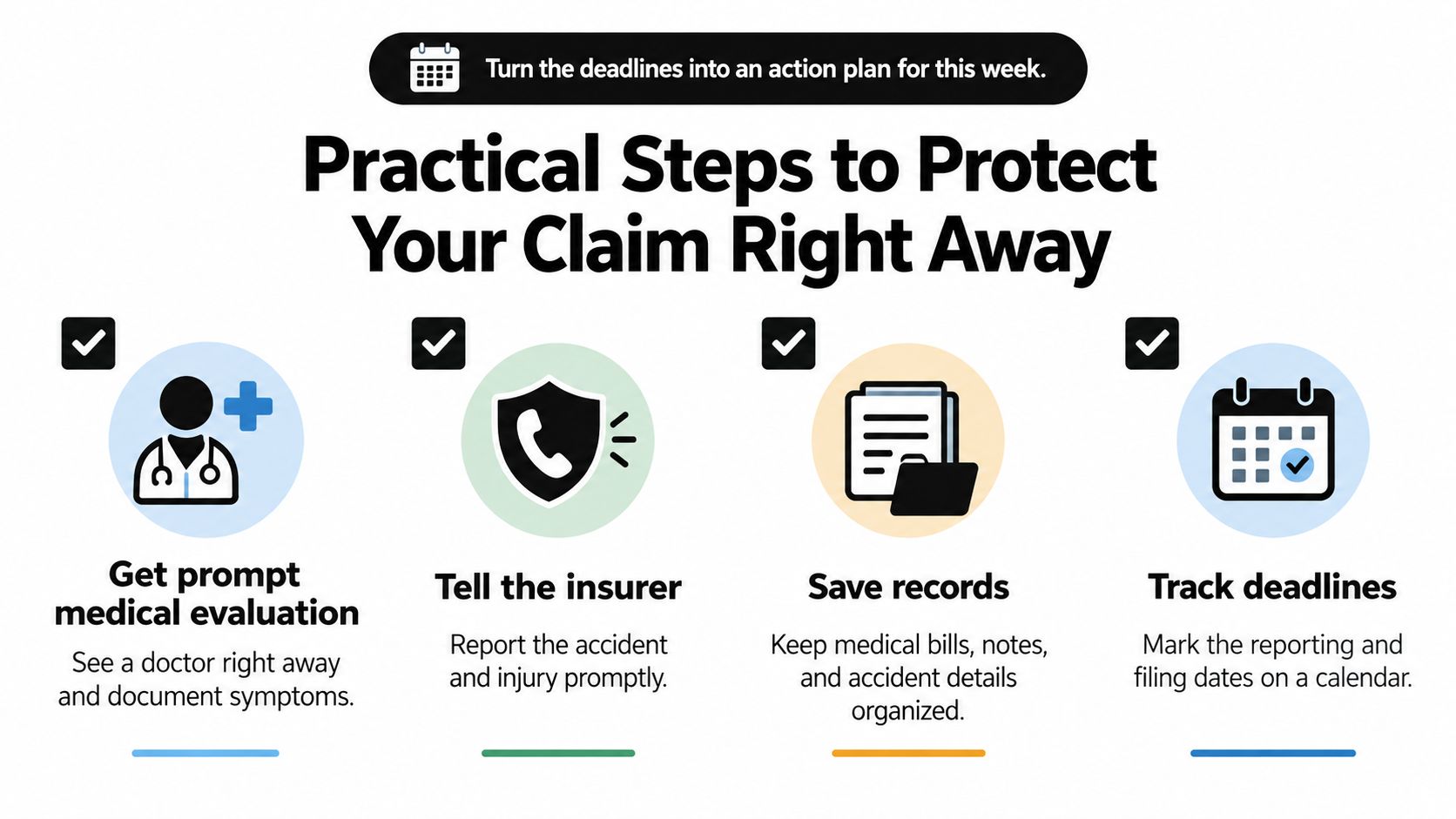
Practical Steps to Protect Your Claim Right Away
The most useful action plan creates a clear record while helping you obtain appropriate care. You don't need to solve every legal question before you start organizing what happened.
Keep the checklist somewhere you can update it as appointments, symptoms, and insurance communications develop.
Put medical needs first
Seek prompt medical evaluation and describe the collision. Explain what you felt immediately afterward, what appeared later, and what activities are now difficult.
NHTSA materials describe whiplash symptoms involving the head, neck, shoulders, and arms, note that onset may be delayed and visible lesions may be absent, and distinguish muscle or ligament trauma from possible longer-term nerve involvement in its technical discussion of whiplash injury.
Seek urgent medical care for worsening headache, confusion, weakness, numbness, severe dizziness, or trouble walking. Don't postpone urgent assessment while gathering paperwork or waiting for an insurance response.
A clinician, rather than an online checklist, should determine whether you need imaging, specialist care, or other treatment. Describe symptoms accurately without minimizing them or guessing at a medical explanation.
Build a usable record
- Create a dated timeline. Record the collision, first symptoms, changes, appointments, and any relevant intervening activity.
- Save the accident material. Keep the report, photographs, driver information, and relevant messages together.
- Document financial effects. Preserve medical bills, receipts, wage-loss records, and work-restriction notes.
- Keep treatment records consistent. Follow medical advice and record practical reasons for any missed appointment or treatment gap.
- Preserve insurer communications. Save submissions, acknowledgments, claim references, and written follow-up to calls.
A folder with clear filenames is more useful than scattered screenshots. For instance, label a document by its date and purpose rather than leaving it as an unnamed download.
For broader insurance questions after the immediate reporting task, QuoteFii's guide to post-accident insurance offers an additional resource. Keep those questions separate from documenting your injury and checking legal deadlines.
Keep original records intact. If you discover an error, request a correction rather than changing the original document yourself.
Finally, put confirmed obligations on a calendar with reminders. Beside each date, record who supplied it and what action must be completed, so a reminder leads to a specific task rather than another round of uncertainty.
When to Talk to a Lawyer and Your Next Step
You don't have to decide whether to sue before asking a lawyer about timing. A focused conversation can help you understand what needs attention while you continue medical care and organize the insurance file.
The strongest reason to seek early advice is uncertainty with consequences. If you can't identify the applicable deadline or the correct party, waiting doesn't resolve either problem.
Recognize situations that need an individual review
Consider speaking with a personal injury lawyer when:
- A government organization is involved. Ask about the correct defendant and any special notice procedure.
- The insurer disputes the injury or fault. Bring the insurer's actual explanation rather than relying on your recollection of a call.
- A deadline is close or unclear. Give the lawyer every relevant date, including when symptoms began.
- A child was injured. Ask which obligations apply now and which age-related rules may matter later.
- Your condition is still developing. Explain what remains medically uncertain and what treatment is planned.
These aren't reasons to assume your claim will succeed. They're reasons to get advice based on the facts rather than rely on a general deadline chart.
Our guide to legal advice for car accidents can help you prepare questions. A useful opening question is: “Which action do I need to take next to preserve my options?”
Prepare a focused request for help
Have the crash date, location, symptom timeline, insurance correspondence, and available medical records nearby. You don't need a perfectly complete file before requesting guidance, but identify anything you don't yet have.
Ask how the lawyer would determine the filing date, what information is missing, and who would handle any required notices. If you're considering representation, ask how fees are handled and what responsibilities you'd retain.
We offer a free Accident Claim Value Assessment that reviews the facts that can affect how an accident claim is handled, with immediate guidance and no contact details required. Treat it as a starting point for understanding your situation, not as a court filing or confirmation that a deadline has been preserved.
If the collision also raises a work-injury question, you can request a review even if you've never filed a workers' compensation claim. That doesn't mean workers' compensation rules and car-accident injury rules are interchangeable.
You don't need to know the final medical outcome to begin asking informed questions. Focus on what you know now, clearly identify what remains uncertain, and get the applicable deadlines checked rather than waiting for every uncertainty to disappear.
Write down your crash date, where it happened, and when each symptom first appeared before visiting AskLegally. Our free Accident Claim Value Assessment offers immediate guidance on facts that can affect your claim, with no contact details required, so you can begin identifying your next step while arranging a specific deadline check.