
You've left the crash scene thinking it was minor. Then your neck starts hurting, the insurer is asking for details, and you're trying to figure out whether you have days, months, or years to act. The answer depends on which deadline you mean. Reporting the accident to an insurer, meeting a special notice requirement, and filing a lawsuit are separate tasks with separate clocks.
If you're asking how long after an accident you have to file a claim, don't rely on one general number. The safest move is to report the crash promptly, get medical care for new symptoms, and verify the deadlines that apply where the accident happened.
Why There Is No Single Deadline After an Accident
A minor collision can lead to several deadlines at once. You may need to notify your insurer under your policy, make a required police or DMV report, meet a special deadline for no-fault benefits, and preserve your right to file a personal-injury lawsuit. Each requirement has a different purpose, and meeting one doesn't automatically meet the others.
In the United States, there's no single nationwide deadline for filing an accident claim. State law generally sets the lawsuit deadline, while your policy and other local rules may set different reporting requirements. The National Association of Insurance Commissioners' auto insurance guidance distinguishes insurer notice from the time allowed to file a lawsuit.
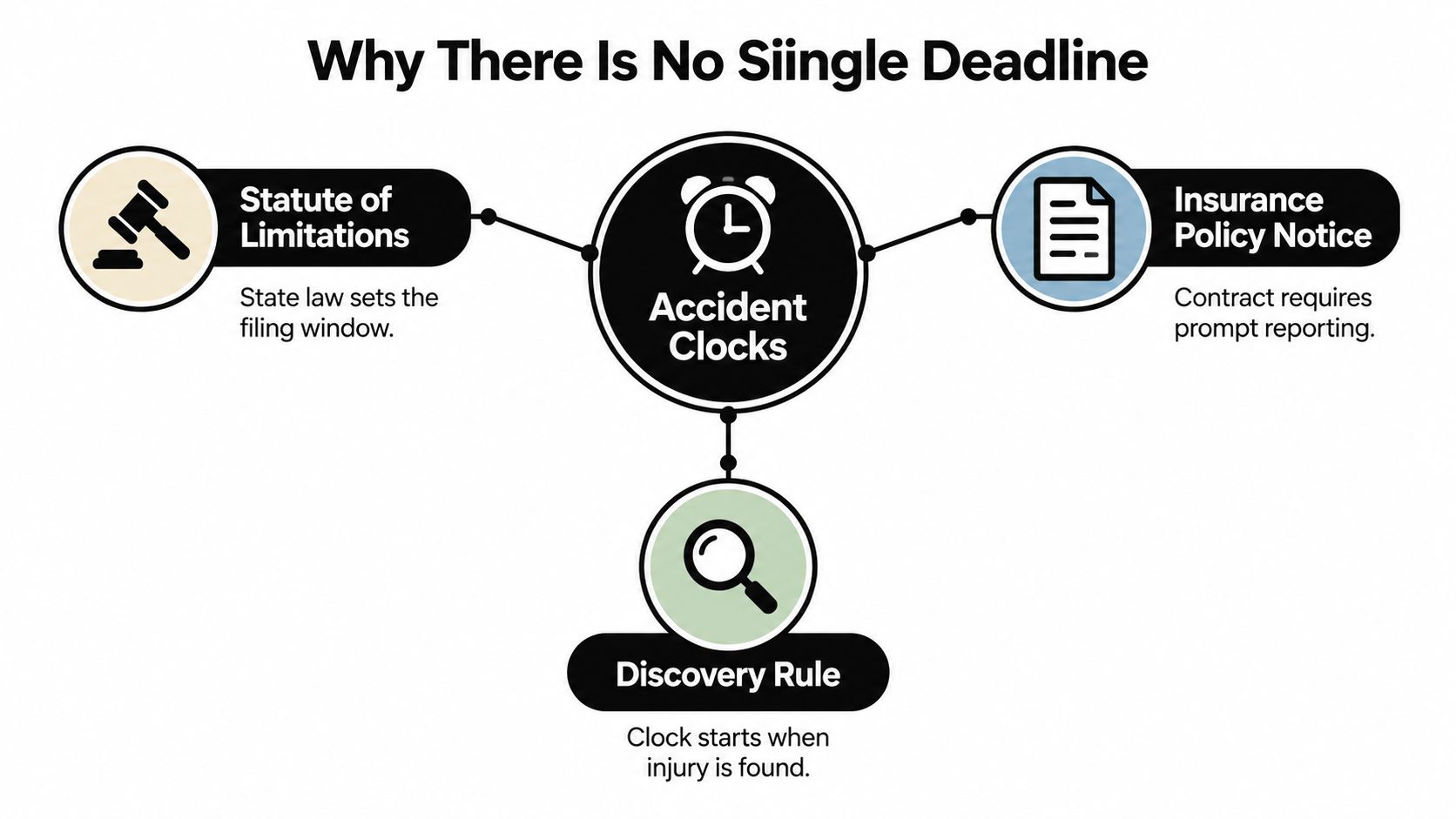
Four clocks to check
- Insurance notice: Your policy may require you to report the collision promptly, as soon as practicable, or within a stated period.
- Police or DMV reporting: A local rule may require you to report a particular type of crash, even if you've already contacted your insurer.
- No-fault or other benefit notice: Some places require separate notice or paperwork to access specific benefits.
- Lawsuit filing: The statute of limitations sets the period for starting a case in court. An open insurance claim or ongoing negotiation doesn't necessarily pause it.
A fifth concern can arise if a government vehicle or agency is involved. A separate notice-of-claim process may apply, and its deadline can differ from the ordinary lawsuit period. Don't assume you can use a standard accident timeline for a public-agency claim.
Practical rule: Treat every deadline as its own task. Reporting the crash isn't the same as filing a lawsuit, and filing an insurance claim doesn't automatically preserve every legal right.
Reporting the Accident to Your Insurance Company
Call your insurer as soon as you can, using the number on your insurance card. Your policy controls the notice requirement. It may say to report an accident promptly, as soon as practicable, or within a specific period. Read the actual policy wording rather than relying on what another driver's insurer, an online forum, or a friend says.
Prompt notice gives the insurer a chance to inspect the vehicles, preserve relevant evidence, speak with witnesses, assess fault, and consider whether an injury is related to the collision. The NAIC's guidance on filing an auto claim warns that delay can make those steps harder.
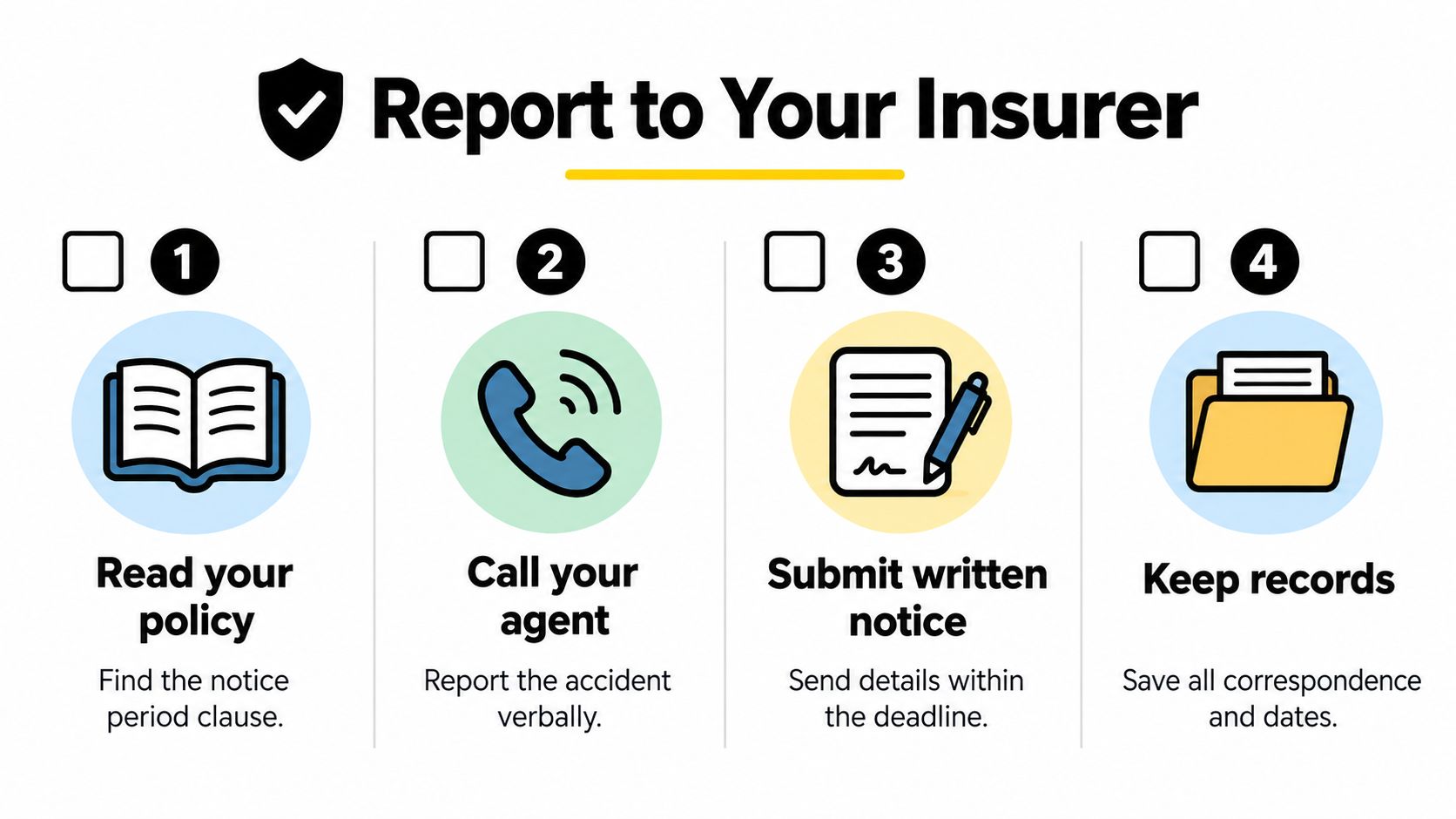
When you report the accident, stick to facts you know. Give the date and location, identify the vehicles and people involved, describe any injuries you're aware of, and share the police-report details and photographs if you have them. If symptoms appear later, update the insurer and provide relevant medical records. Don't guess about fault or make confident claims about your prognosis before you know more.
Keep a record of the date you called, the claim number, the adjuster's name, and any instructions or documents the insurer requests. Confirm important conversations in writing. For a step-by-step overview of the process, see this guide on how to file an insurance claim.
Opening a claim isn't accepting a settlement. You can report the accident while you're still gathering information and receiving care. If your vehicle has lost value after repairs, this overview of how to claim your car's hidden loss may help you understand a separate part of a vehicle-damage claim.
A delay can create trouble with insurance coverage even if your lawsuit deadline hasn't expired. South Dakota's insurance regulator notes that failure to meet policy duties, such as promptly reporting an accident and cooperating with an investigation, may affect coverage. The policy's exact terms matter, so review them early.
State-by-State Statutes of Limitations
A statute of limitations is the legal deadline to start a lawsuit. It's separate from your insurer's claim-handling process. If the period expires, you may lose the right to ask a court for compensation, even if you're still speaking with an adjuster or believe the other driver was clearly at fault.
The deadline depends on the jurisdiction and the kind of claim. Personal injury, vehicle damage, wrongful death, and uninsured or underinsured motorist claims may not share the same time limit. The accident location is an important starting point for identifying which law may apply. Confirm the rule with a reliable jurisdiction-specific source, not a state list meant as general guidance.
| State | Typical personal-injury deadline | Why it matters |
|---|---|---|
| Tennessee | One year for many personal-injury actions | A short period makes early verification especially important. |
| Texas | Two years | Don't confuse the lawsuit deadline with your policy's notice requirement. |
| Florida | Two years | Confirm that the deadline fits your claim type and circumstances. |
| Pennsylvania | Two years | A separate claim or exception may have different requirements. |
| Ohio | Two years | Check the specific cause of action, not just a general summary. |
| Vermont | Three years | A longer period still doesn't make delay a good strategy. |
| Utah | Four years for certain claims | The cited period applies only to certain Utah claims. |
These examples come from a state-law compilation of car-accident limitation periods. They illustrate variation, not a substitute for checking the rule that governs your case. If more than one type of loss is involved, verify each deadline separately.
Don't wait until a deadline seems close to find out what applies. An insurance claim, settlement discussion, or adjuster's investigation doesn't necessarily stop the clock for filing suit. For broader background on how legal time limits work, consult this guide to statutes of limitations.
Delayed Symptoms and the Discovery Rule
Pain may not show up at the scene. Plenty of people walk away from a collision feeling fine and develop neck or back pain days later. If that happens to you, get a medical evaluation and write down exactly when the symptoms began. Don't assume the lawsuit clock automatically resets to the day you first felt pain.
Many states apply a discovery rule for injuries that weren't immediately apparent. Under this rule, the limitation period may start when you knew, or reasonably should have known, about the injury and its connection to the crash. The test varies by jurisdiction, and delayed symptoms don't guarantee extra time. The discussion of discovery rules in accident claims explains why the timing depends on the legal test your state applies.
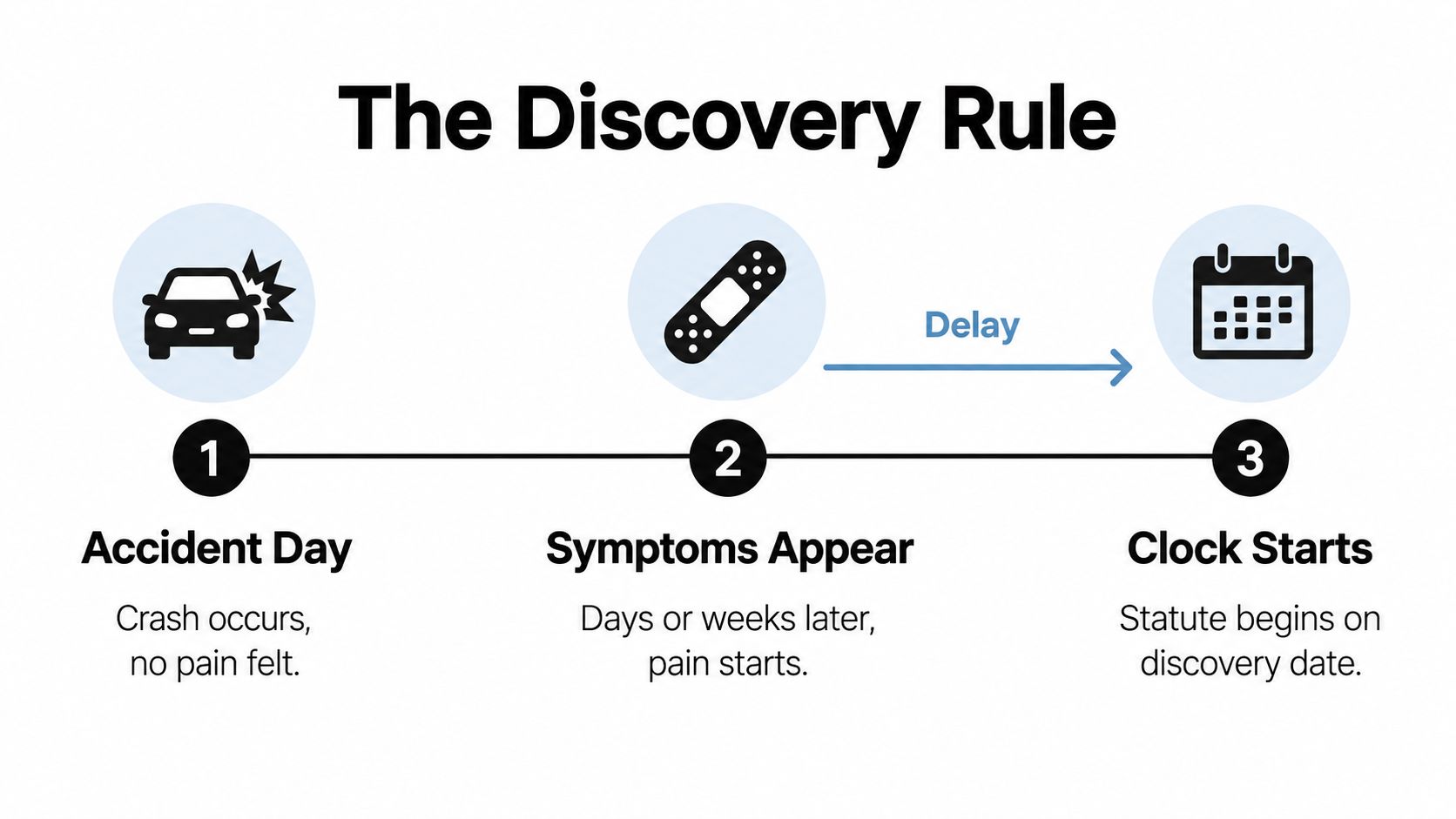
Here is the part people get wrong. The discovery rule concerns only one clock: the lawsuit deadline. It does nothing for the notice window in your insurance policy, a no-fault benefit filing, or a government claim notice. Those clocks keep running from the accident date no matter when your symptoms appear, which is why each deadline needs its own check.
Say you wait several months for neck pain to fade before seeing a clinician. The delay doesn't prove the injury is unrelated to the crash, but it makes the timeline harder to establish. A clean medical record showing when you first reported the symptoms, what the clinician found, and whether they connected the condition to the collision gives you far more to work with.
What to document
- Symptoms: Write down when they began, how they changed, and how they affect ordinary activities.
- Medical visits: Keep appointment records, test results, diagnoses, and treatment notes.
- The connection to the crash: Save any clinician's documentation discussing whether the condition may be related to the accident.
- Insurer updates: Report newly identified injuries promptly, and keep a copy of what you sent.
For plain-language information about injuries that aren't obvious right away, see this guide to hidden injuries.
For comparison, England and Wales uses a different test: under the Limitation Act 1980 the limitation period may run from the later date when the injured person first had the required knowledge of the injury and its cause. That rule is specific to that legal system and does not apply to US claims. The Official Injury Claim limitation guidance describes the general three-year period for an adult whose injury and its cause are apparent immediately.
Exceptions That Change the Deadline
A general deadline is a starting point, not a safe answer for every case. Check for exceptions before you rely on an online summary, especially if a government agency is involved, the injured person is a child, or the claim includes a death.

Situations that need a separate check
- Government vehicles or agencies: A crash involving a public vehicle or agency can trigger a separate notice-of-claim process before a lawsuit. Don't assume the ordinary personal-injury deadline is the only one that matters. Identify the agency and check its notice rules right away.
- Children: Limitation rules for a child may differ from those for an adult. The Official Injury Claim guidance identifies special rules for people injured while under 18. A parent or caregiver should check the child's position directly rather than assume the adult deadline applies unchanged.
- Wrongful death: A fatal accident can involve a separate legal claim with its own deadline and rules about who may bring it. Confirm the applicable requirements instead of using an injury deadline as a substitute.
- Tolling or other exceptions: Some legal systems allow a deadline to pause or change in limited circumstances. Whether an exception applies depends on the law and the facts. Don't treat a possible tolling argument as permission to wait.
There may also be distinct deadlines for property damage, no-fault benefits, or uninsured-motorist claims. A person could meet one deadline while missing another. Review the policy and the relevant state rules together, and ask specifically about any government notice requirement if a public entity may be responsible.
The same care applies when symptoms appeared later. A discovery rule may affect a limitation period in some jurisdictions, but it doesn't erase every other deadline. Keep the accident date, medical records, and insurer correspondence together so the person reviewing your case can assess the full timeline.
Practical Steps to Protect Your Claim on Time
The immediate job is to create a reliable record and find out which deadlines apply. Don't wait until you know the full extent of your injuries to notify the insurer or ask whether special reporting rules may apply.
Today
- Get help for injuries: Seek medical care for new or worsening symptoms. Tell the clinician about the crash and keep the visit records.
- Preserve the scene information: Keep photographs, the other driver's details, witness contact information, and any police-report information you have.
- Notify your insurer: Call using the number on your insurance card, then follow the policy's instructions for written notice or documents.
This week
- Build a timeline: Note the crash date, when symptoms first appeared, each medical visit, and every conversation with an insurer.
- Save claim records: Keep the claim number, adjuster's contact details, emails, letters, repair estimates, and records of expenses or missed work.
- Check special reporting rules: Some states require separate notices. For example, New York has a 30-day written no-fault notice requirement and a 45-day medical-expense notice after treatment, while California requires certain crashes involving injury or more than $750 in damage to be reported to the DMV within 10 days. These are jurisdiction-specific examples, not nationwide deadlines, as described in this overview of car-insurance claim deadlines.
Before any legal deadline
Identify the state law and claim type that apply, and verify the lawsuit deadline independently from your policy's notice requirement. If a government vehicle, no-fault benefits, or another special claim is involved, check for an additional filing or notice process. If you're unsure, get jurisdiction-specific advice rather than guessing.
Be careful with a recorded statement or an early settlement offer. You can ask what information the insurer needs, take time to understand the request, and avoid signing a release before you know what rights it closes. An insurer's timeline isn't a substitute for your own deadline checklist.
When to Get a Lawyer Involved
Some situations call for a lawyer before your first claim call ends. Get legal advice promptly if a government vehicle or agency may be involved, fault is disputed, the insurer denies the claim, or you're being pressed to settle before your injuries are clear. A consultation also makes sense when your injuries may exceed available coverage or you suspect a deadline has already passed.
The strongest reason to call early is the shortest clock. A lawyer can confirm whether a government notice-of-claim deadline, which may run only a few months, arrives before the lawsuit deadline in your state. Miss that notice window and a claim against a city or state agency can end while the statute of limitations still has years left on it.
Two moments especially justify a call:
- A statement or release is already in play: If the adjuster has recorded a statement from you, or a release form is on the table, a lawyer can tell you what signing it would give up before you sign.
- Your injuries surfaced late: If symptoms appeared weeks after the crash, a lawyer can determine which date controls your filing deadline, as the delayed-symptoms discussion earlier explains.
Legal help clarifies risks and options, but it cannot revive a missed deadline or guarantee an outcome. Bring the accident date, insurer correspondence, medical records, and policy documents to any consultation. Then ask the lawyer to map each clock separately: insurer notice, lawsuit deadline, and any special filing that could expire first.
AskLegally offers practical information about accident claims and a free case review that can help you understand your options and connect with a participating personal-injury lawyer. If you're unsure which deadline applies or what to do next, visit AskLegally to start reviewing your situation.