How to Report Nursing Home Abuse and Protect Your Loved One
The first, and most critical, step in reporting nursing home abuse is learning to spot the warning signs. For many residents who can't speak up for themselves, you are their voice and their best line of defense. This means being vigilant and paying close attention to everything—unexplained bruises, a sudden change in their mood, or even missing personal items.
It's all about noticing the things that just don't feel right.
Understanding the Red Flags of Mistreatment
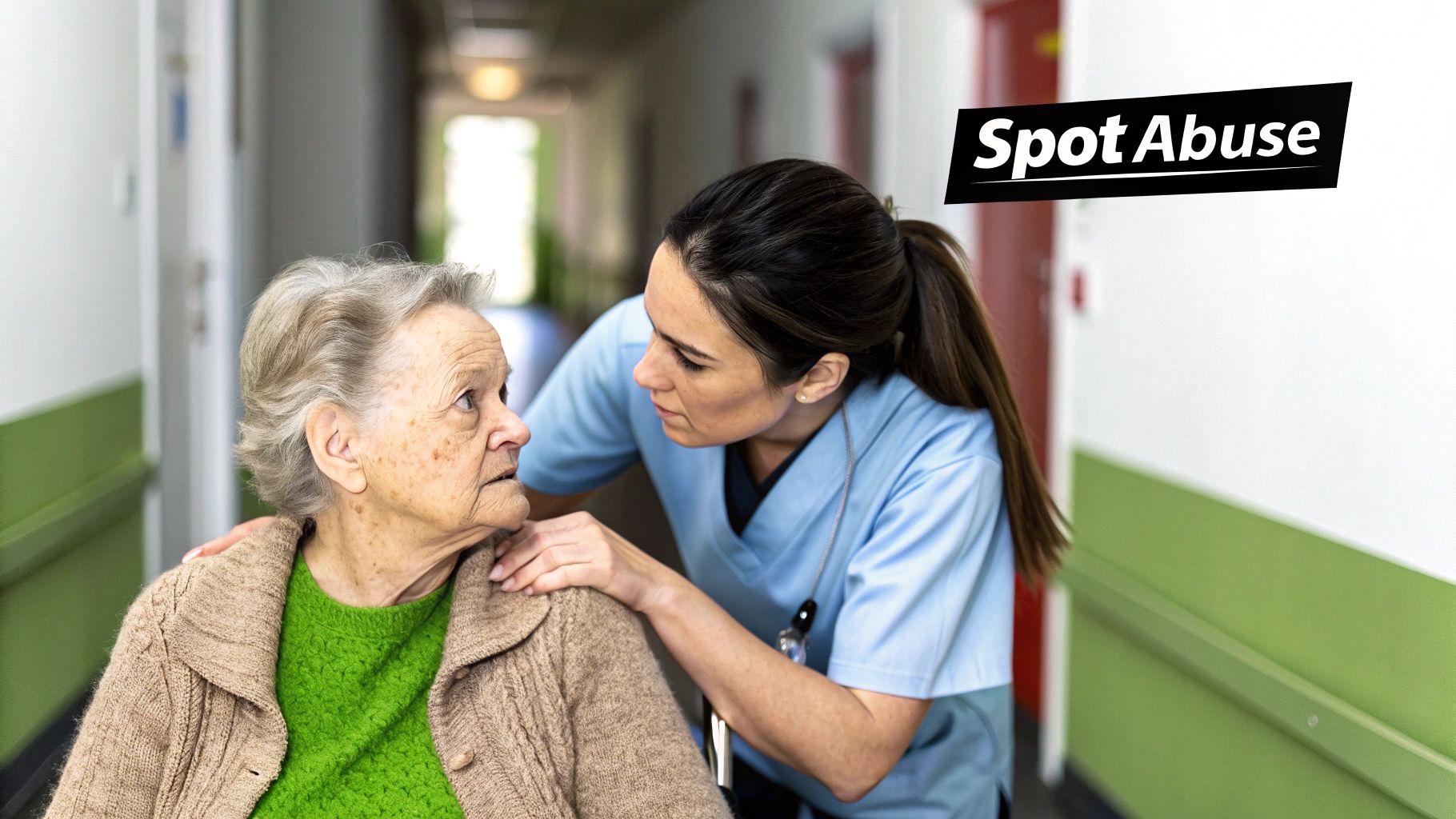
Before you can take action, you need to know what you’re looking for. Some signs of abuse are obvious, like a visible injury. But most of the time, the clues are far more subtle. Mistreatment isn't just physical; it can be emotional, financial, or the result of devastating neglect.
It’s easy to dismiss a small change as just a part of aging, but your gut instinct is a powerful tool. If something seems off with your loved one’s health, behavior, or environment, it's worth investigating.
Identifying Different Types of Nursing Home Abuse
To help you connect the dots, it’s useful to understand the different forms abuse can take. Each one comes with its own set of clues. The table below breaks down the most common types and what you should be watching for.
| Type of Abuse | Physical Signs | Behavioral & Emotional Signs |
|---|---|---|
| Physical Abuse | Unexplained bruises, cuts, broken bones, or marks from restraints on wrists or ankles. Frequent, unexplained ER visits. | Flinching at touch, fear of a particular caregiver, hesitation to be left alone. |
| Emotional Abuse | No direct physical signs, but may be accompanied by neglect (e.g., weight loss). | Sudden withdrawal, depression, mood swings, rocking or mumbling, fearfulness. |
| Neglect | Bedsores (pressure ulcers), poor hygiene, malnutrition, dehydration, unsanitary living conditions, untreated medical needs. | Apathy, listlessness, confusion, withdrawal from social activities. |
| Financial Exploitation | Missing jewelry or personal items, unexplained bank withdrawals, sudden changes to a will or power of attorney. | Confusion about finances, new "friends" who show excessive interest in their money. |
Knowing how to spot these signs is essential. They provide the foundation for any report you might need to make later on, turning vague suspicions into concrete evidence.
Psychological abuse is disturbingly common, with studies showing that about 33% of residents have experienced it. Physical abuse is also a major concern, as nearly 24.3% of family members have reported seeing at least one incident.
Your vigilance is their protection. Many residents are too scared or physically unable to report abuse themselves. Spotting these signs is the first, most crucial step toward ensuring their safety.
Behavioral and Emotional Clues Are Key
Sometimes, the most powerful evidence of abuse isn't physical at all—it's in how a person acts. Has a loved one who was always social and talkative suddenly become quiet and withdrawn? Do they seem unusually anxious, agitated, or unwilling to speak in front of certain staff members? These shifts are major red flags.
Imagine this real-world scenario: Your normally cheerful father suddenly becomes tense and fearful every time a specific caregiver enters his room. That’s not just a bad mood. It’s a specific, targeted reaction that signals a serious problem and demands immediate attention.
Observing these interactions gives you the context you need to build a credible report.
If you’re seeing these warning signs and wondering about other options, learning more about in-home support to avoid nursing home care can be a helpful resource. Recognizing these subtle but powerful changes empowers you to take the next step: documenting everything you’ve seen to build a strong case.
Documenting Evidence of Abuse Without Raising Suspicion
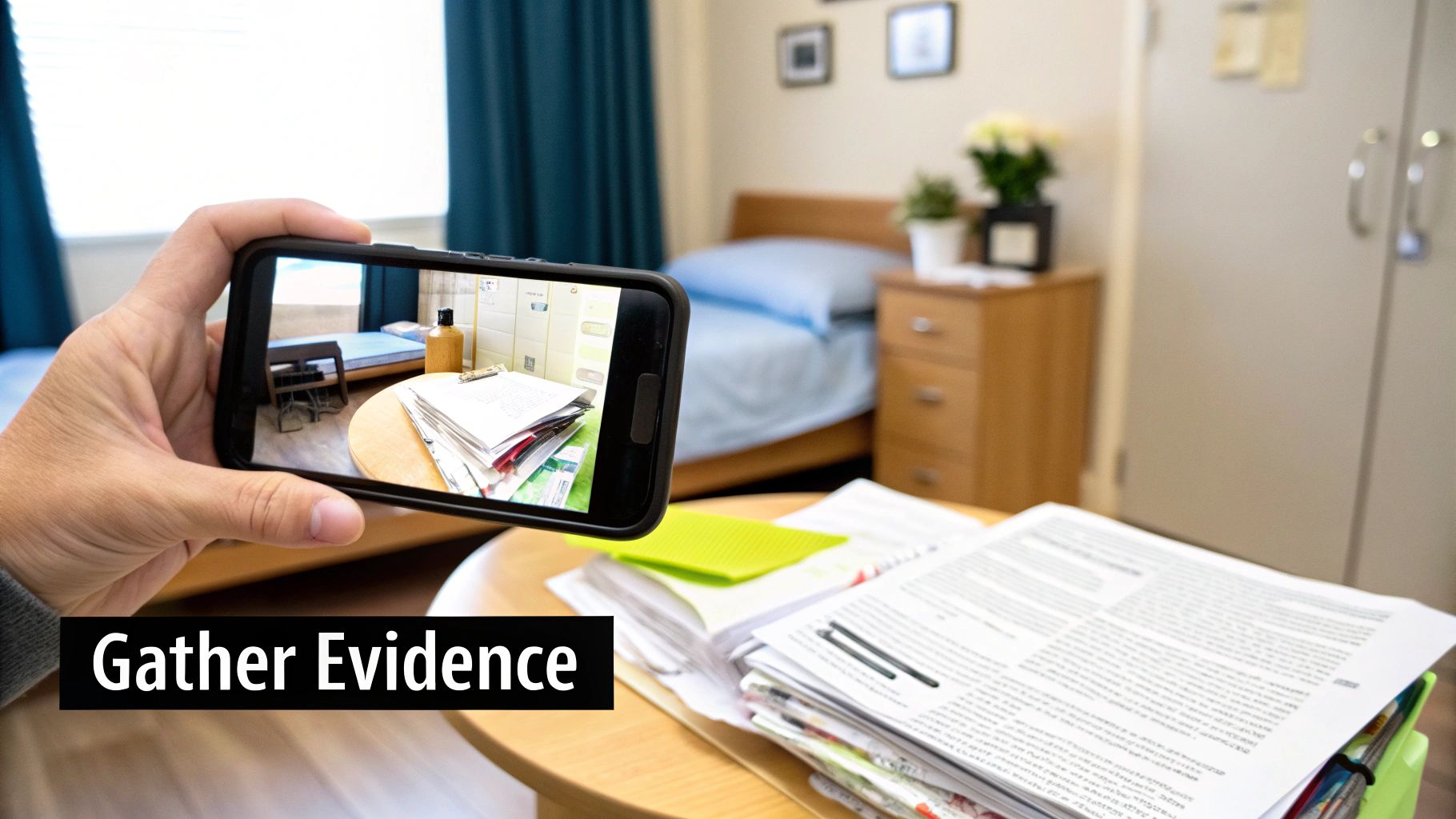
When you suspect abuse, your observations are your most powerful tool. But turning those gut feelings and troubling moments into a solid, credible record is the most critical step you can take. You have to do this quietly, without tipping off the facility staff. Alerting them could put your loved one in more danger or give the facility a chance to hide what’s really happening.
Think of yourself as a quiet, careful observer. Your job is to collect the facts. Every little detail you notice, no matter how insignificant it seems at the time, helps build the bigger picture that will prove your concerns are valid.
Start a Detailed Log Immediately
The very first thing you should do is start a private log. It doesn't need to be fancy—a simple notebook or a password-protected note on your phone works perfectly. The goal is consistency and objectivity. Stick to the facts and save your emotional reactions for later.
For every single entry, make sure you capture:
- Date and Time: Pinpoint the exact date and time of the visit or incident.
- Specific Observations: Be descriptive. Instead of just writing "the room was dirty," document what made it dirty: "a strong urine smell hit me at the door, the bed linens were visibly soiled and on the floor, and the trash can was overflowing."
- Staff on Duty: If you can, get the names of the nurses, aides, or other staff who were present. Who was responsible for care at that moment?
- Your Loved One's Condition: How did they seem, both physically and emotionally? Note any new bruises, signs of anxiety, or anything they say that seems out of character.
This log does more than just record isolated events; it builds a timeline. Over time, that timeline can reveal undeniable patterns of neglect or abuse, making it an incredibly powerful tool when you decide to file a report.
Your log isn't just a diary—it's a legal record in the making. It shows you've been consistently concerned and gives investigators specific, verifiable details they can't easily ignore.
Gather Visual and Documentary Evidence
A written log is your foundation, but a picture is hard to dispute. Photos and official documents can provide the kind of concrete proof that powerfully backs up your notes. The key here is discretion. You don't want to create a confrontation.
When you have a safe and private moment, use your phone to take pictures of:
- Visible Injuries: Any unexplained bruises, cuts, bedsores, or marks that look like they came from restraints.
- Unsanitary Conditions: Filthy rooms, soiled bedding, cluttered hallways, or anything that looks hazardous.
- Signs of Neglect: This could be anything from torn clothing and broken glasses to full meal trays left untouched for hours.
Make sure the timestamp feature on your phone's camera is on. This links each photo directly to the corresponding entry in your written log.
Collect Key Paperwork
Beyond photos, certain documents are essential for building a strong case. As a family member or legal representative, you have the right to access many of your loved one's records. Politely ask for copies, and if the staff gives you the runaround, note their resistance in your log.
Focus on getting your hands on:
- The Official Care Plan: This is the facility’s own roadmap for the care they are legally and contractually required to provide.
- Medical Charts and Records: Look for evidence of medication errors, untreated infections, or injuries that were never explained.
- Financial Statements: If you're worried about financial exploitation, carefully review bank records and facility bills for any strange charges, unexplained withdrawals, or sudden changes.
Having this paperwork allows you to compare the facility's official story with what you're seeing with your own eyes. Those discrepancies are often where neglect and abuse come to light. This documentation isn't just for filing an initial report; it's the bedrock for any legal action you might take down the road.
So, you've gathered your notes and documented your concerns. What now? The next step is getting that information into the right hands, and knowing who to call can feel like a maze. Your goal is simple: get your report to the people who can launch an official investigation and protect the person you care about.
This is a bigger deal than you might think. According to the U.S. Department of Justice, a shocking 1 in 10 adults over 60 will face some kind of elder abuse. Even worse, only about 1 in 24 cases ever get reported. When you speak up, you're not just helping your loved one; you're breaking a dangerous cycle of silence. You can see the latest findings on nursing home abuse to understand just how much your voice matters.
Your First Call: The Long-Term Care Ombudsman Program
For most families, the best place to start is with their local Long-Term Care Ombudsman. Think of them as a dedicated, government-appointed advocate for nursing home residents. Their entire job is to investigate complaints and fight for the rights of people living in these facilities.
Ombudsmen are experts. They know residents' rights inside and out and are trained to handle everything from nagging quality-of-care issues to the most serious abuse allegations. They can often mediate a solution directly with the facility, but they also serve as a formal channel to escalate your complaint when necessary.
Reaching Out to Adult Protective Services
Another vital resource is Adult Protective Services (APS). Every state has an APS agency tasked with investigating reports of abuse, neglect, and exploitation involving vulnerable adults. While an ombudsman's world is long-term care, APS has a much broader mandate.
When you contact APS, a caseworker will be assigned to look into your claim. This usually means they'll visit the facility, interview your loved one privately, talk to staff, and go through records. It’s a thorough process designed to get to the bottom of what’s happening.
Pro Tip: Filing a report with both the Ombudsman and APS is often the most effective strategy. These agencies frequently collaborate, and logging your complaint in multiple official systems ensures it gets the attention it deserves.
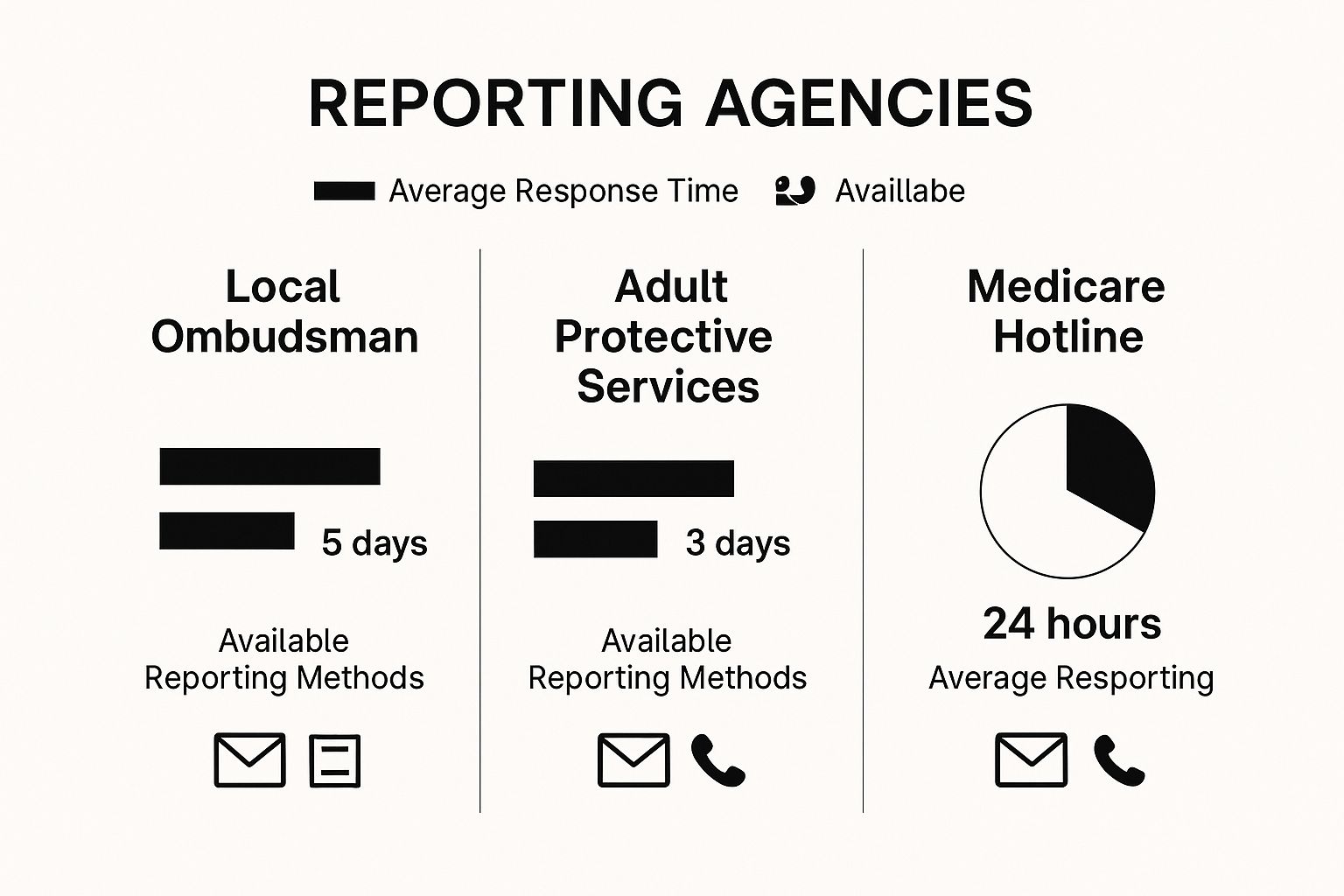
Figuring out the best channel can be tricky, so let's break down the primary agencies, what they do, and when you should contact them.
Reporting Channels for Nursing Home Abuse
| Agency/Entity | Primary Role | When to Contact |
|---|---|---|
| Long-Term Care Ombudsman | Resident advocate; resolves complaints within long-term care settings. | This is your go-to for most quality-of-care, neglect, or rights violation issues. An excellent first call. |
| Adult Protective Services (APS) | Investigates abuse, neglect, and exploitation of all vulnerable adults. | Contact them for any suspected abuse, especially if you need a formal state investigation launched. |
| Law Enforcement (911) | Responds to immediate criminal threats and emergencies. | Call immediately for physical/sexual assault, life-threatening danger, or any active criminal act. |
| State Licensing Agency | Enforces state regulations and can penalize facilities for violations. | File a formal complaint here to trigger inspections and hold the facility accountable at a regulatory level. |
Each agency plays a unique role, and using them in combination can create a powerful response to protect your loved one and hold the facility accountable.
Don't Hesitate: When to Call the Police Immediately
Some situations are simply too dangerous to wait. If you see a direct act of violence, suspect a sexual assault, or believe your loved one is in immediate, life-threatening danger, your first and only call should be to 911 or the local police.
This isn't the time to contact an ombudsman or APS. These are crimes in progress that demand an immediate law enforcement response to keep the resident safe and preserve crucial evidence.
Call 911 if you encounter any of these scenarios:
- You witness a staff member hitting, shoving, or improperly restraining a resident.
- Your loved one has a severe, unexplained injury like a broken bone or deep gash.
- You have any reason to suspect a sexual assault has occurred.
- A resident has been abandoned and is in obvious medical distress.
Once your loved one is safe and the police have been called, then you should follow up by reporting the incident to the ombudsman and the state licensing agency.
Holding the Facility Accountable: Report to State Licensing Agencies
Every nursing home needs a state license to operate. The agency that issues that license—usually a Department of Health or similar state body—is also in charge of investigating complaints and making sure facilities follow the law.
Filing a complaint here can trigger a formal, unannounced inspection of the entire facility. If investigators find the facility broke the rules, the consequences can be severe.
Depending on the violation, a nursing home could face:
- Hefty fines and official citations.
- A ban on admitting new residents.
- A legally mandated plan of correction.
- In the worst cases, losing their license to operate.
You can usually find the right contact information by searching online for "[Your State] nursing home complaint hotline" or "[Your State] department of health." This is a powerful move that can lead to real, systemic change that protects not just your family member, but every resident in that facility.
Navigating the Common Fears of Reporting Abuse
Taking the step to report suspected abuse is one of the toughest things you’ll ever do. It’s completely natural to be hit with a wave of fear, guilt, or second-guessing. Are you making things worse? Will the staff retaliate? Am I just overreacting?
These feelings are not just valid—they’re almost universal for families in this position. The first step to moving past them is simply acknowledging that they exist. You aren't alone, and having a plan to manage these emotions is key to becoming a powerful advocate.
The Fear of Retaliation
For many families, the most paralyzing thought is that speaking up will somehow make the care even worse. It’s a terrifying prospect, the idea that staff might become hostile or even more neglectful as a form of punishment.
While this is a very real concern, it’s crucial to know that retaliation is illegal. Federal and state laws are in place to specifically protect residents from this kind of retribution. When you file an official report with an agency like the Long-Term Care Ombudsman or Adult Protective Services, you create a paper trail. That report puts the facility under a microscope, making it far more difficult—and risky—for them to get away with any form of retaliation.
Remember this: Silence is what allows abuse to continue and escalate. Speaking up, while scary, is the only way to break the cycle and bring in outside oversight that ensures your loved one's safety.
Dealing With Guilt and Self Doubt
It's also incredibly common to be weighed down by guilt. You might find yourself replaying the decision to choose that facility, or you might beat yourself up for not connecting the dots sooner. This can easily spiral into self-doubt, making you question your own judgment.
The best way to push back against this is to ground yourself in the facts. Go back to the log you’ve been keeping. Look at the photos again. Reread the notes from doctor’s visits. This is your evidence, and it’s objective. It will reaffirm that your concerns are rooted in real observations, not just emotion.
Building a Strong Support Network
You absolutely should not go through this alone. The emotional toll is immense, and a solid support system is vital—not just for your own sanity, but for making your advocacy more effective.
- Lean on Family and Friends: Talk to people you trust. Just having someone to listen can make a world of difference, and they might offer perspectives you hadn't considered.
- Find an Advocate: The Long-Term Care Ombudsman program is a free and confidential resource designed for exactly this situation. They can guide you through the reporting maze.
- Talk to a Lawyer: Consulting with a nursing home abuse attorney can give you a clear, strategic path forward. They can take over the stressful communication with the facility and ensure every action is taken to protect your loved one.
These emotional barriers are a big reason why so many abuse cases fly under the radar. In fact, some studies show that reporting rates can be as low as 4%. This is made worse by systemic problems like chronic understaffing—an issue that plagues an estimated 84% of facilities. These high-stress environments can breed neglect and discourage staff from speaking up. You can find more details about nursing home challenges on theseniorlist.com.
By acknowledging your fears and building a plan to face them, you give yourself the strength to act. Your voice is your loved one’s most powerful defense.
So You've Filed the Report. Now What?

Filing a report is a huge, emotionally taxing step. It's also the start of a new chapter, not the end of the story. Once you hit "send" or hang up the phone, the waiting game begins, and frankly, it can be nerve-wracking. Knowing what happens behind the scenes can help you manage your expectations and stay ready to advocate for your family member.
Don't expect your phone to ring the next day with a full resolution. The first week or so is often quiet. The agency, whether it’s Adult Protective Services (APS), the state licensing board, or an Ombudsman, needs time to process your complaint and assign an investigator.
The Investigation Gets Underway
Once an investigator is on the case, their job is to get to the truth. They have to be impartial, gathering facts from every angle to see if your report can be substantiated. A key part of their playbook is showing up unannounced. This is crucial—it prevents the facility from putting on a show and allows the investigator to see what a normal day really looks like.
You can expect the investigation to cover a few key areas:
- Private Conversations: The investigator will want to speak confidentially with your loved one (if they are able), other residents who might have seen something, and staff members at all levels.
- A Deep Dive into Records: They'll be combing through medical charts, facility incident logs, staffing schedules, and the official care plan. All that documentation you did? This is where it shines.
- Reviewing Your Evidence: The photos, notes, and timelines you provided are now vital pieces of the puzzle. The investigator will cross-reference them with facility records and what they observe firsthand.
Your job now is to be a reliable point of contact. The investigator might call with follow-up questions. When they do, be ready to answer clearly and stick to the facts you’ve already documented.
What to Do While You Wait
It's tempting to call for daily updates, but that can actually hinder the process. A better strategy is to follow up thoughtfully. If you haven’t heard anything within a week or two, a polite call or email to check on the case status is completely appropriate. Be sure to ask for the investigator's name and a case number to make future communication easier.
An investigation is methodical by design. The goal isn't speed; it's to build an airtight case based on solid evidence. Your patience gives the investigator the space they need to do their job right.
During this period, keep up your visits and continue to document everything. Any new incidents, odd conversations, or concerning observations are still incredibly important. If a new, serious issue arises—especially anything that puts your loved one in immediate danger—contact the investigator directly. This new information can be added to the active case.
What Are the Possible Outcomes?
When the investigation is over, the agency will issue a formal finding. You should receive a letter or some official notice explaining what they concluded. The results can vary widely depending on what they were able to prove.
Here are the most common outcomes:
- Substantiated Report: This means the agency found credible evidence of abuse or neglect. The facility could face serious consequences, like hefty fines, official citations, or a mandated plan of correction to fix the issues.
- Unsubstantiated Report: This is a tough one to hear. It means the investigator couldn't find enough evidence to legally prove the abuse happened. It does not mean your concerns were wrong.
- Criminal Charges: If the investigator uncovers evidence of a crime—like a physical assault or proven financial exploitation—the case gets handed over to the police for potential criminal prosecution.
Regardless of the outcome, you've now created an official record of problems at that facility. This is a powerful step in holding the nursing home accountable. It also provides critical evidence if you decide to take the next step and pursue legal action with a nursing home abuse attorney.
Common Questions About Reporting Nursing Home Abuse
When you suspect a loved one is being mistreated, a million questions probably run through your mind. It’s a deeply stressful situation, and knowing what to expect can give you the confidence to take the right steps. Let's walk through some of the most common concerns we hear from families.
Can I Report the Abuse Anonymously?
Yes, you absolutely can. Most agencies, including Adult Protective Services (APS) and the Long-Term Care Ombudsman, are set up to take anonymous reports. They understand that people often fear retaliation against their loved one or themselves, and they want to remove any barrier that might stop someone from speaking up.
That said, while anonymity is an option, providing your contact information can make a big difference. It gives the investigator a way to reach you for follow-up questions or to clarify details, which can be critical for building a solid case. If you're worried, you can always ask for your identity to be kept confidential.
What if I’m a Mandated Reporter?
Some jobs come with a legal duty to report suspected abuse. If you're a healthcare provider, social worker, caregiver, or even a clergy member, you're likely considered a mandated reporter.
This isn't just a professional guideline; it's a legal requirement. Failing to report could lead to fines or even jail time. The good news is that the law also protects mandated reporters. As long as you file a report in good faith, you are shielded from retaliation, so you don't have to worry about your job for doing the right thing.
For family members, anonymous reporting is a choice. For mandated reporters, however, identifying yourself is a legal and professional obligation to protect vulnerable adults.
What if My Loved One Is Scared to Say Anything?
This is incredibly common, so don't be discouraged. Residents often keep quiet out of fear of how the staff might treat them afterward. Others might feel embarrassed or, due to conditions like dementia, may not be able to communicate what's happening. Many victims of abuse are non-verbal, making them completely dependent on you to be their voice.
This is precisely why your own documentation is so vital. If your loved one can't or won't confirm the abuse, the detailed notes, photos, and records you've kept become their testimony. Investigators are trained for these delicate situations and will use your evidence as the foundation for their work.
What Happens if an Investigation Doesn’t Prove My Claim?
You won’t get in trouble for filing a report based on a genuine suspicion. The system is designed to encourage people to act on their concerns without fear of penalty. As long as you aren't knowingly making a false claim to cause trouble, you are protected.
Sometimes, a case is closed as "unsubstantiated." This doesn't mean the abuse didn't happen—it just means the investigator couldn't gather enough concrete evidence to meet the required standard of proof. Your report still matters. It creates a paper trail and can help establish a pattern if other complaints surface against the facility down the road.
Should I Let the Nursing Home Know I’m Filing a Report?
It's usually best to hold off on telling the facility's management. Giving them a heads-up can backfire badly. It might give them time to cover their tracks, get their stories straight, or even intimidate your loved one into changing their story.
Your first call should be to an outside agency like the Ombudsman program or APS. Let them launch an official investigation. They will notify the facility at the appropriate time, ensuring the process is handled properly and without bias.
At AskLegally, we know that nothing is more important than your family's safety. If you've seen the warning signs of abuse or neglect, we can connect you with skilled nursing home abuse lawyers who will advocate for the justice you deserve. Find out how we can help at https://asklegally.com.
Article created using Outrank