How to Report Nursing Home Neglect: Your Essential Guide
Recognizing the signs of nursing home neglect is the critical first step, but it’s often the hardest. The indicators can be subtle, easily dismissed as part of the aging process, or hidden from plain view. To build a case that authorities will take seriously, you need more than a gut feeling—you need proof. This means becoming a meticulous observer and record-keeper.
Recognizing and Documenting Signs of Neglect
Before you can pick up the phone to file a complaint, you have to know what you’re looking for. Neglect isn’t always a dramatic, clear-cut event. More often, it’s a slow erosion of care, a pattern of inattention that reveals itself in quiet, troubling changes to a resident’s health, hygiene, or emotional state.

The reality is that neglect is tragically common in long-term care facilities. While an alarming 44% of residents have reported abuse, a staggering 95% have either experienced neglect firsthand or have seen it happen to another resident. Despite this, experts estimate that only about 1 in 24 cases of elder abuse or neglect are ever formally reported.
Your voice is essential in closing that gap.
Different Faces of Neglect
Neglect shows up in several distinct ways, and knowing the categories helps you focus your attention and document your concerns more effectively. A single missed meal might be an oversight, but a consistent pattern of issues points to a much bigger problem.
- Neglect of Basic Needs: This is the failure to provide the fundamental necessities for a dignified life. Look for consistently soiled bedding or clothes, poor personal hygiene (uncombed hair, body odor, untrimmed nails), or a frequently messy or dirty room.
- Medical Neglect: This is a serious failure in providing necessary healthcare. It can range from untreated bedsores and infections to missed medications or a failure to get a resident to their doctor’s appointments.
- Emotional or Social Neglect: This is when staff consistently ignores a resident, leaves them isolated in their room for long periods, or fails to provide the social stimulation they need. Unexplained depression, sudden withdrawal, or a new fear of certain caregivers are huge red flags.
Spotting medical neglect can be particularly challenging. It helps to be informed about what proper care looks like, so you can recognize when it’s absent. For example, learning about identifying and preventing medication errors can equip you to ask better questions and spot potential problems before they become severe.
To make this easier, here's a quick reference guide to help you identify and record what you see.
Table: Key Signs of Neglect and What to Document
This table breaks down the common warning signs for each type of neglect and tells you exactly what kind of evidence you should be gathering.
| Type of Neglect | Common Warning Signs | Evidence to Document |
|---|---|---|
| Basic Needs | Poor hygiene, dirty clothes/bedding, weight loss, dehydration, unsafe living conditions. | Photos of unclean room, dated notes on hygiene issues, log of unanswered call lights. |
| Medical | Untreated bedsores, frequent infections, missed medications, refusal to take resident to doctor. | Photos of injuries, list of missed medications with dates/times, names of staff who dismissed concerns. |
| Emotional/Social | Sudden withdrawal, depression, unusual fear/anxiety, staff ignoring resident. | Dated notes on emotional changes, specific quotes from your loved one, names of staff involved. |
Use this as a starting point. The more specific and factual your documentation, the stronger your report will be.
Building a Strong Record of Evidence
Your observations are the heart of your complaint, but without proper documentation, they're just words. A vague report is easy for an overwhelmed agency or a defensive facility to dismiss. A detailed, chronological log, on the other hand, is a powerful tool that demands attention.
The moment you suspect something is wrong, start a dedicated notebook or a digital file. This isn't the time for generalities. For every single concern, no matter how small it seems, log the following information:
- The Date and Time: Be as precise as possible. "Tuesday afternoon" isn't as good as "Tuesday, October 26th, at 2:15 PM."
- The Specifics: Don't just write, "Mom seemed sad." Instead, document what you actually saw: "Mom was crying in her room alone at 2:15 PM. Her call light was on. She said no one had checked on her since her breakfast tray was dropped off."
- Photos and Videos: A picture is undeniable. Use your phone to take dated photos of unsanitary conditions, visible injuries like bruises or bedsores, or spoiled food left in the room. Just be sure to respect the privacy and dignity of your loved one and any other residents in the background.
A strong report is built on a foundation of consistent, detailed evidence. Your meticulous notes can transform a simple concern into an undeniable case for investigation, ensuring your loved one’s safety is taken seriously.
Finding the Right Agency to Contact
You've done the hard work of documenting everything. Now, who do you actually call? This can feel overwhelming, but figuring out the right agency is key to getting your report into the right hands and seeing action taken.
This is where all your notes and photos come into play. They stop being just personal records and become the official evidence you'll submit.
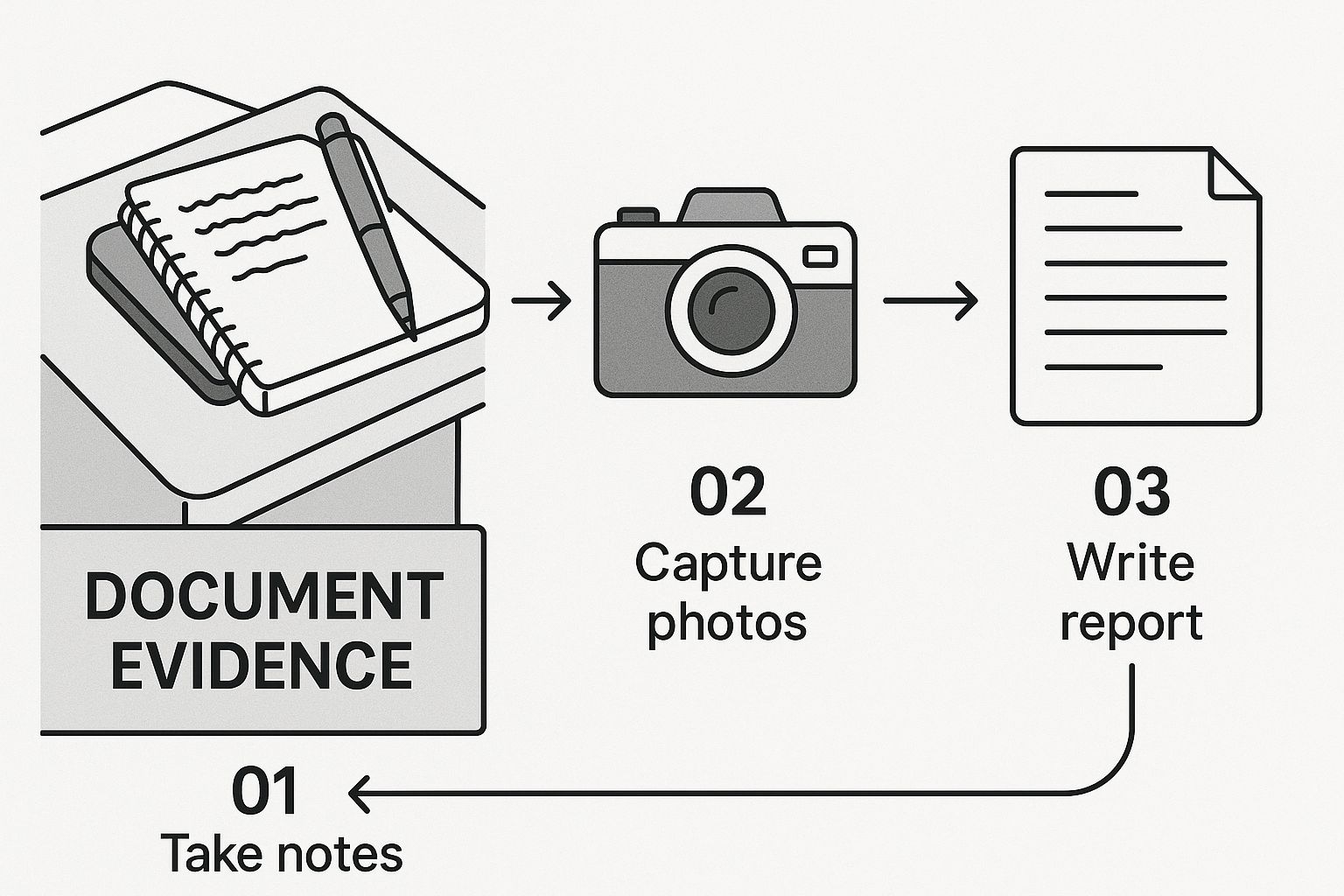
As you can see, what you've gathered is the foundation for everything that comes next.
Your First Stop: The Facility Itself
I know it can seem counterintuitive, especially if you're frustrated, but your first formal step should often be with the nursing home's management. Don't just mention it in passing to a nurse. Schedule a sit-down meeting with the Director of Nursing or the facility administrator.
Bring your documentation and calmly lay out the facts. This isn't about confrontation; it's about resolution. By doing this, you give the facility a clear chance to fix the problem right away. More importantly, you create an official paper trail showing you tried to solve the issue internally before escalating things.
When to Go to Outside Agencies
If management doesn't act, or if the situation is too serious to wait, it's time to bring in outside help. Different agencies have different jobs, so picking the right one from the start is crucial.
- Long-Term Care Ombudsman Program: This is probably your most valuable resource. Ombudsmen are independent advocates for residents, and their services are completely free and confidential. They investigate complaints, mediate problems, and can be an incredible guide on how to report nursing home neglect to the correct state authorities if things don't improve.
- Adult Protective Services (APS): If your loved one is in immediate danger, call APS first. Period. They are the state-level first responders for elder abuse and neglect and have the authority to intervene quickly to ensure a resident's safety.
- State Licensing Agency: Every nursing home is licensed by a state agency, usually the Department of Health. These are the people who handle complaints about violations of care standards—things like unsanitary conditions, staffing shortages, or major medication errors. They have the power to investigate and issue penalties.
Your goal is to find the agency with direct authority over your specific complaint. An Ombudsman is a fantastic starting point for almost any issue, while APS is the emergency line for immediate safety concerns.
And this isn't a small problem. In 2023, U.S. nursing homes were hit with 94,499 health citations. A staggering 8.1% of those were directly tied to abuse or neglect. All told, facilities were fined $153 million, which shows that these regulatory bodies do take action when violations are proven. You can find out more about these widespread issues and the data behind them.
What to Have Ready Before You Call
Making that first call can be stressful. Being prepared makes it infinitely easier and more effective. Before you pick up the phone, have this information in front of you:
- Resident's Info: Your loved one’s full name and date of birth.
- Facility's Details: The nursing home’s complete name and address.
- Your Documentation: Your log of dates, times, specific incidents, and names of staff members involved.
- A Clear Summary: Practice boiling down the core problem into just a few clear sentences.
Having these details organized and ready to go helps the intake specialist grasp the situation immediately and get the ball rolling on a formal report without any delays.
How to Craft an Effective Report
A clear, well-structured report gets results. It's that simple. After you’ve gathered your evidence and figured out who to contact, the final step is putting it all together in a way that’s impossible to ignore. Whether you're filling out an online form or talking to an investigator on the phone, your goal is to come across as professional, credible, and clear.

Think of it less like telling a story and more like presenting a case. An organized complaint is much easier for an investigator to digest and, more importantly, to act on quickly.
Key Components of a Strong Complaint
Your report needs to lay out the situation logically, starting with the basics and then building a fact-based narrative. If you structure it this way, nothing important will get lost in the shuffle.
Make sure to include these core elements in a clear, sequential order:
- Resident and Facility Information: Get right to the point. Start with the resident’s full name, date of birth, and their room number. Then, clearly state the full name and address of the nursing home.
- A Factual Summary: In just one or two sentences, summarize the core issue. For example, "This report details ongoing medical neglect, specifically the failure to treat developing bedsores and provide necessary wound care for my mother."
- Chronological Timeline: This is the heart of your report. Using the log you kept, lay out the events exactly as they happened. Stick to the dates, times, and observable facts you recorded.
- List of Evidence: Briefly reference the proof you have. You don’t need to attach everything upfront, but mention it. For instance, "I have photographs of the untreated sores taken on three separate dates" or "I have a log documenting 15 unanswered call light incidents."
This methodical approach makes your report easy to follow. If you're managing a lot of information, implementing a personal knowledge management system can be a great way to keep all your notes, photos, and observations organized and ready to use.
Using Language That Strengthens Your Case
The tone you adopt is just as crucial as the facts you present. It's completely understandable to be angry and emotional, but a report driven by accusations can sometimes work against you. Investigators are trained to respond to clear, objective information.
So, instead of writing, "The lazy staff never checks on my dad, and they don't care if he's in pain," frame it with facts.
Try this instead: "On May 10th at 3 PM, my father reported severe pain. His call light remained on for 45 minutes before staff responded. This is the fourth documented instance this month of a response time exceeding 30 minutes."
Key Takeaway: Stick to the facts. A report built on objective, documented observations is far more powerful and credible than one that’s purely emotional. Let your evidence do the talking.
By presenting a calm, organized, and fact-based account, you make it easy for the agency to see just how serious and valid your complaint is. This professionalism establishes you as a serious advocate and dramatically increases the chances of a prompt and thorough investigation into the neglect.
What Happens After You File the Report
Taking the step to report nursing home neglect is a huge, and often brave, decision. So, what happens after you hit "submit" or hang up the phone? Your report kicks off a formal process, and knowing what to expect can make a world of difference.
Once your complaint is received, an investigative agency takes the lead. They'll typically assign an investigator to your case, and one of their first moves is often an unannounced visit to the nursing home. This surprise element is key—it lets them see the facility as it truly is, without giving staff a chance to cover their tracks.
The Investigation in Action
The investigator's job is to be a neutral fact-finder. They aren't there to take your side or the facility's side; their only goal is to gather concrete evidence to either confirm or deny the allegations you've made.
You can expect them to take several actions:
- Speaking with people: They'll confidentially interview your loved one (if they're able), other residents who might have seen something, and staff members at all levels, from aides to the director of nursing.
- Digging into records: Investigators have the authority to pull and examine all sorts of crucial documents. This includes medical charts, medication logs, staff schedules (to check for understaffing), and any internal incident reports.
- Observing the environment: They'll do a walk-through of the facility, looking at everything from general cleanliness and potential safety hazards to how residents are being treated in the common areas.
The findings from these investigations can be life-or-death. A recent study highlighted a chilling statistic: 50.6% of long-term care residents who died within 90 days of an assessment showed clear signs of neglect. This is a stark contrast to the 21.9% rate for those who survived longer. You can explore the full study about this alarming correlation to see just how high the stakes are.
Staying Involved and Watching for Retaliation
While the official investigation is underway, your role as an advocate is more important than ever. It's okay to follow up, but you need to be strategic. I usually suggest waiting a week or two after you file the report before making that first call. When you do reach out, just ask for a quick status update and see if the investigator needs anything else from you.
A major worry for families is the possibility of retaliation against their loved one. It's completely illegal, but sadly, it still happens.
The image below shows the homepage for the National Long-Term Care Ombudsman Resource Center, an organization that acts as a powerful ally for residents and their families.
This program is specifically designed to solve problems for residents, making them an essential partner if you even suspect retaliation is happening.
Keep a close watch for any sudden, negative shifts in your loved one's care or disposition after you've made the report. This could be anything from call lights going unanswered, staff giving you the cold shoulder, or a noticeable decline in their personal hygiene.
If you spot any of these red flags, document everything immediately. Note the date, time, and what you observed. Report it to the investigator handling your case and contact your local Long-Term Care Ombudsman right away.
There are times when the situation becomes so tangled that you may need to explore your legal rights. Our guide on a nursing home negligence lawsuit offers valuable insight into when taking legal action might be the next necessary step.
Knowing When to Seek Legal Help
Sometimes, filing a report just isn't enough. You’ve done everything right, you’ve alerted the authorities, but the neglect continues or the damage is already done. This is the point where the system can feel like it’s failing your loved one, and it might be time to think about your legal options.
Taking this step isn't about revenge. It's about holding a facility accountable and getting the resources your family member needs to recover from the harm they’ve suffered.
Red Flags That Signal It's Time to Call an Attorney
So, when is that tipping point? While any instance of neglect is unacceptable, certain situations are clear signals that you need to escalate things. If you see any of the following, it’s probably time to have a conversation with a lawyer who specializes in this field.
- Serious Injury or Wrongful Death: This is the most obvious and tragic sign. If your loved one suffered a severe fall, developed a Stage 3 or 4 bedsore, got a life-threatening infection, or passed away because of the facility's carelessness, administrative agencies can only do so much. Legal action is often the only way to get real accountability.
- The Facility Won't Change: You've reported the problems. Maybe you even got the state involved. The nursing home promised to do better, but nothing has actually changed. When a facility repeatedly fails to fix known issues, it’s a sign of a deep, systemic problem that often only responds to the pressure of a lawsuit.
- Financial Abuse: Discovering that a staff member has been stealing money or manipulating your loved one into changing wills or bank accounts is a serious breach of trust. This is a form of elder abuse that almost always requires legal help to try and recover the stolen assets.
Taking legal action does more than just seek compensation. It forces a facility to fundamentally change its policies and culture, which can protect countless other families from going through the same ordeal. A lawsuit sends a clear, powerful message: substandard care will not be tolerated.
Finding the Right Legal Partner
Once you decide to explore your options, getting the right attorney is everything. This isn't a job for a general practice lawyer; you need someone who lives and breathes this specific area of law.
Start your search for an experienced nursing home neglect lawyer. They will be able to give you a clear, honest assessment of your case.
Most offer a free initial consultation, so use that opportunity to ask some tough questions. Find out about their experience with cases just like yours. Ask how they get paid—most work on a contingency fee basis, which means you don’t owe them anything unless you win your case. A good attorney will walk you through the process, manage your expectations, and give you the information you need to decide what’s best for your family.
Finding Support for You and Your Family
Going to bat for a loved one is draining. There's no other way to put it. The endless documentation, the phone calls, the constant worry—it can feel like a full-time job on top of your actual full-time job, leaving you completely exhausted and alone.
It’s so easy to get lost in the fight for them that you forget about yourself. But you can't pour from an empty cup. To be the strong advocate your family member needs, you have to build a support system for yourself first.
This Is a Marathon, Not a Sprint
Taking on a neglect case will test your emotional limits. You're going to feel a mix of everything—anger, guilt, anxiety, and pure exhaustion. Those feelings are valid and completely normal, but you can't just push them aside. Recognizing the emotional weight of this is the first real step to managing it.
Connecting with People Who Understand
It might feel like it, but you are not the only person going through this. Thousands of families face these same heart-wrenching battles every year. Finding them can be a lifeline.
Simply sharing what you’re going through with someone who truly gets it can feel like a massive weight has been lifted.
Here’s where you can find your people:
- Caregiver Support Groups: Check with local senior centers, hospitals, or your regional Area Agency on Aging. These groups offer a confidential space to talk, listen, and learn from the experiences of others on the same path.
- Online Forums and Communities: Look for groups on social media or dedicated websites for elder care advocates. They provide round-the-clock access to a community that can answer questions, let you vent, and offer solidarity when you need it most.
Don't Neglect Your Own Mental Health
The constant stress can do a number on your mental well-being. It's okay—and incredibly important—to admit when you need professional help to sort through the trauma and anxiety.
A good therapist can give you practical coping strategies and a safe space to process everything you're feeling. The emotional toll of dealing with neglect is immense, so make sure you and your family have access to essential mental health resources.
Building your own support network isn't a distraction from the fight; it's a critical part of it. A strong support system provides the emotional resilience you need to see this through and continue being the powerful advocate your loved one needs.
Seriously, be kind to yourself. Step away when you need a break. Acknowledge the small wins. Lean on the people who are there for you. Protecting your own well-being is the only way you can effectively protect your loved one for the long haul.
Answering Your Questions About Reporting Neglect
When you're faced with the possibility of nursing home neglect, a million questions can run through your mind. It’s a stressful and confusing time. Getting clear, straightforward answers is the first step toward taking action and protecting the person you care about.
What's the Real Difference Between Abuse and Neglect?
This is a really common question, and the distinction is important. Think of it this way: abuse is an action, while neglect is a failure to act.
Abuse involves a direct, often intentional, act to cause harm. This could be physical, like hitting or improper restraint, or emotional, like yelling and verbal threats.
Neglect, on the other hand, is about the absence of care. It's the failure to provide the basic necessities a resident needs to live safely and with dignity. This can be intentional, but it’s often the result of a facility being chronically understaffed, poorly trained, or just plain disorganized.
- Example of Abuse: A staff member getting frustrated and shoving a resident into a chair.
- Example of Neglect: A resident developing painful bedsores because staff consistently fails to reposition them as required by their care plan.
Both are completely unacceptable, violate a resident's fundamental rights, and need to be reported right away.
Can I Report This Anonymously?
Yes, absolutely. Almost every state has protections in place that allow you to file an anonymous report, especially when you contact an agency like Adult Protective Services (APS). This is designed to protect you—and your loved one—from any fear of retaliation.
There is a small trade-off to consider, though. When you provide your contact information, it gives investigators a way to reach you for follow-up questions. That extra detail can sometimes make their investigation much stronger.
Ultimately, the choice is yours. If providing your name helps build a more thorough case, that's great. But if your main concern is safety and anonymity gives you the confidence to make the call, do it. An anonymous report is infinitely better than no report at all.
How Long Will an Investigation Actually Take?
This is one of the most frustrating parts of the process because there’s no single answer. The timeline really depends on the severity of the situation and the current workload of the investigating agency.
If your report suggests an immediate, life-threatening danger, an investigator could be on-site within 24 to 48 hours. For claims that are serious but not immediately critical, it might be several days before they make an initial visit.
From start to finish, a full investigation can take anywhere from 30 to 90 days. My advice? When you file the report, ask the person you're speaking with for a general timeline. They can usually give you a realistic estimate.
Your gut feeling is your most important tool. You don't need a folder full of proof to make a call. The agency's job is to investigate the facts; your job is to sound the alarm when something feels wrong.
It's also smart to keep legal deadlines in mind. States have specific time limits, called statutes of limitations, that can impact your ability to pursue legal action later. Learning the details of a lawsuit statute of limitations now can help preserve your family's options down the line.
What if I’m Not 100% Sure It's Neglect?
Report it anyway. Let me say that again: report it anyway. You are not expected to be a legal expert or a medical professional. The standard for reporting is suspicion, not certainty.
Investigative agencies would much rather check out a hundred concerns that turn out to be unfounded than miss one legitimate case of neglect. Don't let self-doubt stop you from being a voice for someone who might not be able to speak for themselves.
If you’re on the fence, a fantastic, impartial resource is your local Long-Term Care Ombudsman. Their services are free and confidential. They can listen to your concerns, help you figure out if what you're seeing could be neglect, and advise you on the best steps to take.
At AskLegally, we understand how overwhelming this can be. We're here to help families find their footing in these tough situations. If you believe a loved one is being neglected in a nursing home, we can connect you with dedicated attorneys who will fight for their safety and dignity. Visit us at https://asklegally.com to get the support you deserve.