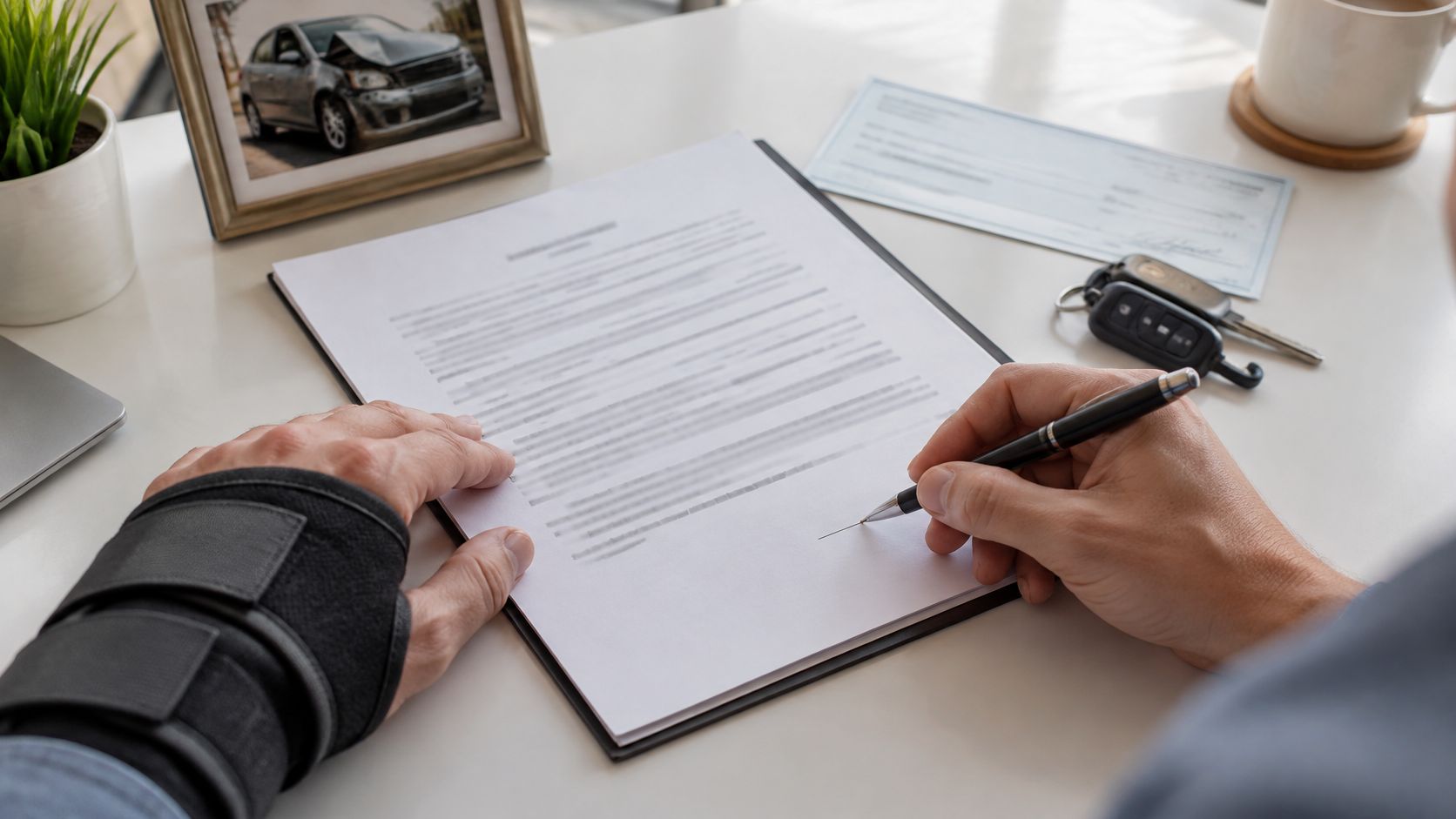
A settlement agreement is a voluntary contract. One side usually pays money, and the other side gives up the right to keep pursuing the same claim. The release inside that contract is the part that typically closes off future claims from the same incident, including problems that are not visible yet.
The offer is probably in front of you now. An adjuster sent a figure, a signature line, and a short form that looks like the last step before payment. The check may be attached, or it may be promised after you sign. Either way, that form is the agreement.
Suppose you were rear-ended two weeks ago. Your neck still aches, the clinic billed the first visit, and you missed three shifts. The offer covers those bills and a little extra, so it feels like progress. Signing can also close the account on injuries that have not appeared and on bills that have not arrived. The release works like a one-way door. Once signed, it may shut off your ability to reopen the same claim, even for a symptom that appears later.
The money can shrink before it reaches you, too, as liens and fees are paid first. Read the release before you sign. A signature can settle more than the bills in front of you.
What a Settlement Agreement Means in Plain English
The figure at the top of the offer is a label for the deal, not the cash that lands in your account.
A settlement agreement is a contract both sides sign to end a dispute for a stated exchange. The insurer usually pays. You give up the right to keep pursuing that claim. A court judgment is a judge's decision after a hearing or trial, and it does not need your signature. A court may later write the signed deal into a consent judgment. Until then, the paper can bind you on its own.
Inside that contract you will find the incident, the payment, the deadlines, and the release. The release hands over the claim. It works like a bill of sale: you trade the right to ask for more from this crash for the amount written on the page.
Doctors, health plans, and sometimes a lawyer are paid from that same amount, so you keep less than the number you signed. If the release covers injuries not yet known, and the governing law allows that wording, later symptoms can fall outside the claim you sold.
Practical rule: You do not have to accept the proposed terms. The figure and the wording stay negotiable until your signature.
After you sign, the paper is the last word on that claim, not a partial payment you can reopen when the next bill arrives.
The Parts Every Settlement Agreement Contains
Match the form in your hand against this list before you initial a single line.
| Part | What It Does | What to Check |
|---|---|---|
| Parties and incident | Names who is settling and which crash is covered | Confirm the date, location, and every person or company named |
| Claims resolved | Lists the claims being closed | Check that injuries, vehicle damage, and lost wages are listed or excluded |
| Payment amount and timing | Sets the sum and when it arrives | Note the deadline and whether payment is one lump sum or installments |
| Release | Gives up future claims arising from the same incident | Read the scope before signing |
| Liens and medical bills | Says who must be repaid from the money | Confirm who is responsible for each repayment |
| Confidentiality or non-disparagement | Limits what you can say about the case | Check whether it restricts talks with doctors or employers |
| Dismissal or reserved claims | Ends any lawsuit and may keep some claims open | Confirm which claims stay open and what notice is required |
| Tax and benefits language | Describes tax or benefit effects of the payment | Ask whether the payment affects disability or other benefits |
How to mark each row
Start with parties and incident. The date, the intersection, and every driver, owner, employer, and insurer should match the crash you had. A missing name can leave someone out, or pull in someone you didn't mean to release.
Claims resolved should show injuries, vehicle damage, and lost wages as included or expressly left out. Silence is not a reservation. Payment amount and timing should state the figure, the deadline, and whether you receive one lump sum or installments.
The release row is the clause that gives up future claims, so read its scope before anything else. Liens and medical bills should name who gets repaid from the check. Confidentiality or non-disparagement can limit what you say, including to a doctor or an employer. Dismissal or reserved claims should say whether a lawsuit ends, which claims stay open, and what notice you must give. Tax and benefits language should say whether the payment touches disability or other benefits.
Go row by row and mark anything blank, vague, or missing.
How the Release Decides What You Give Up
The release is the technical heart of the contract. You give up identified rights in return for payment, and that give-up can be conditional on the other side performing.
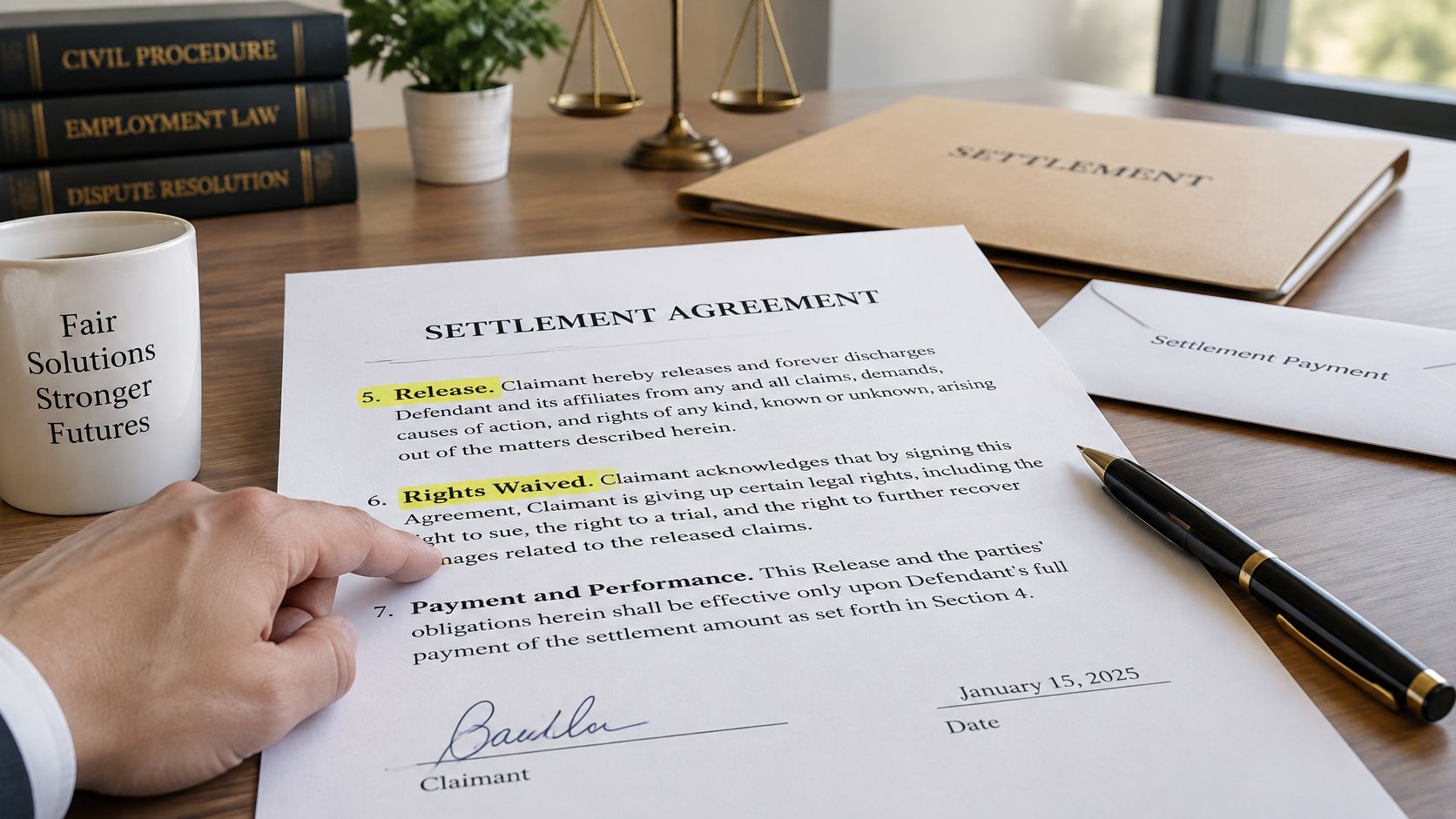
Cornell's Legal Information Institute describes a settlement as a legally binding contract that resolves a disputed or anticipated claim for specified consideration, typically payment, plus duties such as dismissal, confidentiality, or cooperation. The release is the piece that controls what you can still sue for later. Check whether it covers only known medical expenses or all present and future claims from the collision.
| Release Wording | What It Likely Covers | Risk for Accident Victims |
|---|---|---|
| All claims, known or unknown, arising from the accident | Every present and future claim from the crash | Later-found injuries and new treatment may be unrecoverable |
| Claims for medical bills incurred to date | Only expenses already billed when signed | Future care may fall outside the payment and outside any remaining claim |
| Named parties only | Releases only the people or companies listed | Other drivers, employers, or insurers may remain open to claims |
| Reserved or excluded future medical care | Some claims stay open by express terms | Reserved claims may still require notice or a deadline to act |
| Release effective only after payment clears | Release takes effect on a stated condition | Check what happens if payment is late or fails |
What a broad release can close
A release of all claims, known or unknown, can extinguish later-discovered injuries, extra treatment, lost earning capacity, and related damages. That result turns on governing law and the exact words.
Say a driver with a neck strain signs an $8,000 settlement that releases every claim from the crash, then needs $25,000 of surgery months later. Those figures are only an illustration. Whether any claim survives depends on the wording already signed, not on how unfair the gap feels afterward.
Some releases can be attacked when they were obtained through fraud, deception, misrepresentation, or overreaching. That fight is risky and fact-intensive. Don't plan on winning it after the check is cashed.
Before you sign, verify each of these:
- Incident description: date, place, and how the crash is described.
- Released parties: every person and company named, matched against who might be responsible.
- Payment: amount, deadline, and lump sum or installments.
- Medical liens: who must be paid from the recovery.
- Tax or benefit effects: disability and similar benefits.
- Reserved claims: anything the release expressly leaves open.
What Signing Changes Once the Deal Is Done
Until you sign, the claim is still an uncertain negligence dispute. Fault and damages remain unproven, and the dollar outcome stays open.
A signed settlement generally turns the original injury claim into an enforceable contract to pay, so your remedy becomes enforcing the payment terms. The signed paper works like an IOU that replaces the lawsuit. You stop asking a court who caused the crash. You ask whether the insurer paid the fixed amount, on the schedule the document already set. An injury that shows up later is outside that fight if the release already closed it.
Federal tort-claim rules show the same model in operation. Under federal claims regulations, payment generally requires an executed agreement stating that the amount is accepted in "full and final satisfaction" and that acceptance is a "complete release" of claims from the same subject matter. Cashing the check can itself operate as that release.
A signature can surrender your right to sue the named parties, even when the check has not cleared yet.
Read the full release before any money changes hands. If payment will arrive late, put installment dates, lien handling, default, and enforcement into the document itself. Those clauses are what you can still use after the crash dispute is gone. How long each of those steps takes is laid out in this settlement timeline guide.
Once the release is signed and the funds are accepted, reopening the claim is usually very hard. The timing of the signature is the decision that matters.
Where the Money Goes Before You Keep It
The strongest settlement isn't always the largest headline number. It's the offer that leaves the most in your hands after everyone else with a legal claim on the money is paid.
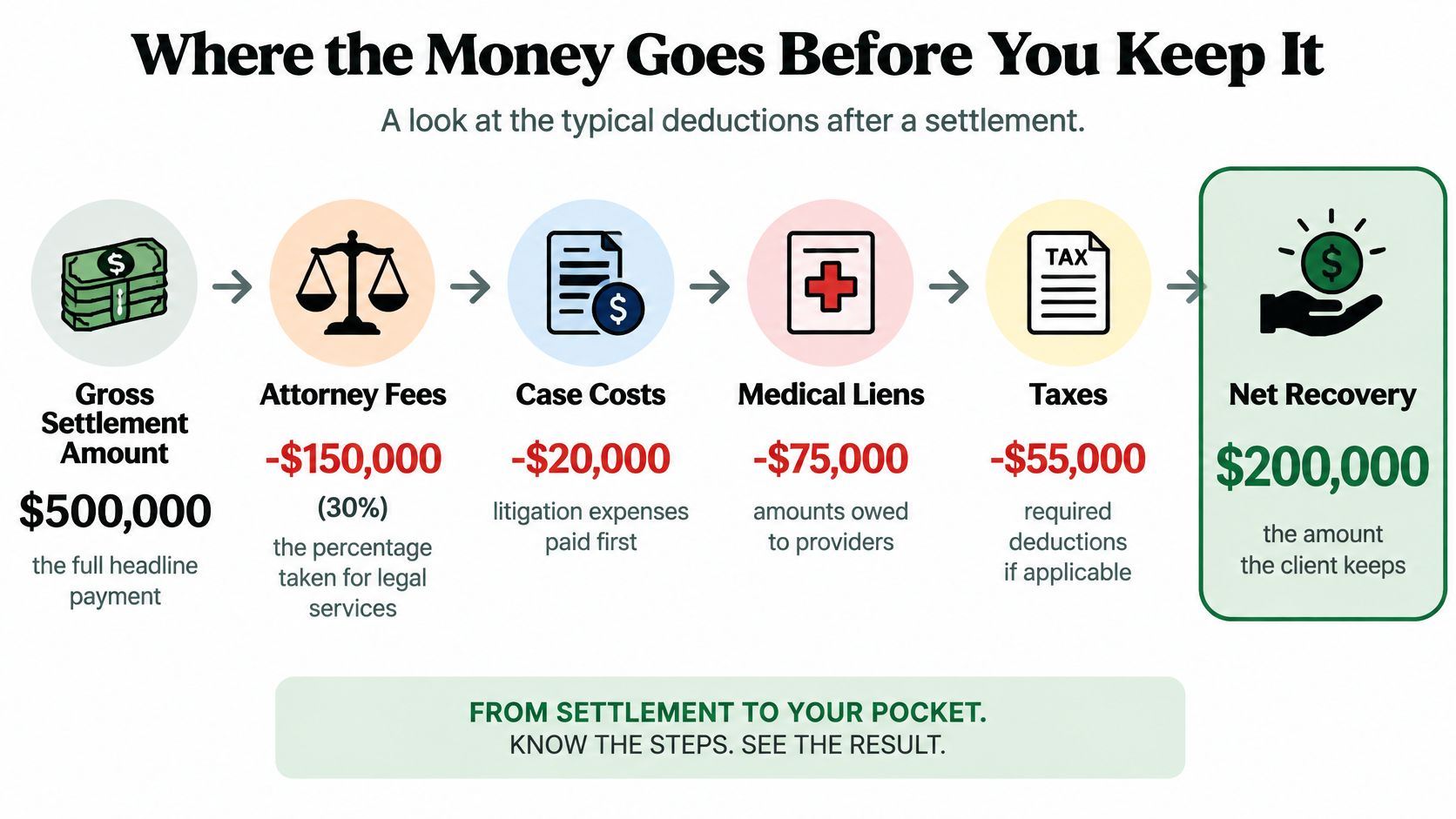
The check moves through a chain. Gross settlement is what the insurer agreed to pay. Attorney fees and case costs come out if you have a lawyer. Hospitals, clinics, health insurers, Medicare, Medicaid, and other lienholders may claim reimbursement from what's left. Only then do you see a net recovery.
WSB-TV's guide to medical liens makes one point that surprises a lot of crash victims. Medicare conditional payments must be repaid after a settlement, judgment, or award, even if you didn't realize Medicare had covered the treatment. Accepting an offer that looks adequate, without listing those claims first, can leave far less for lost wages, future care, and household bills. The same risk hits uninsured and underinsured people hardest.
| Money Item | Who May Claim It | Question to Ask |
|---|---|---|
| Gross settlement | Insurer pays the agreed figure | Is this the total, or is anything already deducted? |
| Attorney fees and case costs | Your lawyer, if you have one | How are fees calculated and which costs come out first? |
| Medical provider bills | Hospitals, clinics, and doctors | Are any balances still open, or are unrelated charges included? |
| Health insurer or Medicare, Medicaid | The payer that covered treatment | Has a repayment claim been filed, and for what amount? |
| Other lienholders | Providers or others with a lien on the recovery | Which liens attach, and can any be reduced or waived? |
| Net recovery | What the claimant keeps | Does the remaining amount still cover lost wages and future care? |
A worked example of the net
Say the gross figure is $30,000. A $10,000 fee, $4,000 in case costs, and $9,000 in liens would leave $7,000. That remainder may still have to cover missed wages and care you haven't had yet. These numbers are hypothetical. Real fees, lien priority, and reductions follow your contract and your state's rules, so don't treat a generic online formula as your result.
The path from filing through payment is mapped in this personal injury claim process guide. Before you distribute a dollar, watch how each deduction lands.
Request an itemized ledger for every lien. Challenge charges that aren't from this crash. Get written confirmation when each lien is satisfied, and don't sign a release or hand out proceeds until that list is complete. Case-specific legal advice beats a template here.
How to Review an Offer and When to Wait
If your injuries are still changing, don't sign yet. Ask whether you've reached medical stability or at least a clear prognosis. Pain, disability, and treatment needs often show up days or weeks after a collision, and a fast check trades that risk onto you in exchange for cash today.
A car-accident settlement commonly swaps payment for a promise not to pursue the covered claims later. Consumer Financial Protection Bureau guidance on debt settlements makes a related point that travels well. Get the promises in writing before you pay, because an oral assurance is a weak tool once the deal can be enforced. The same habit belongs on an injury release. If you want a closer look at how adjusters frame offers, these insurance settlement strategies walk through the negotiation side.
Eight checks before you sign
- Get the full writing. Ask for the complete agreement and the full release, not a cover letter or a phone summary. You can't review a sentence you haven't seen.
- Mark every claim, party, and time period. Include future medical care. Match each released name against possible defendants and insurers. A common slip is releasing "all persons" when only one driver should be on the page.
- Confirm the gross figure and every deduction. Write down the payment date and any installment schedule. If a number on the offer letter doesn't match the release, stop.
- List every lien and open bill. Include insurer repayment claims, and request itemized ledgers. An unresolved Medicare or health-plan claim can shrink the net after you've already given up the lawsuit.
- Document symptoms that are still active. Notes, referrals, and work restrictions should exist before you waive future care. Signing on a guess about next month's pain is the mistake people regret.
- See which claims are reserved. If something stays open, check whether you must send notice, and by when. A reserved claim with a missed deadline is effectively closed.
- Put oral promises on paper. If the adjuster says the insurer will "handle the liens," that sentence belongs in the agreement before you sign. A voicemail won't amend a release.
- Get an independent review when the release is broad, treatment is ongoing, or liens aren't resolved. An unrepresented person is the one the form was written for, not with.
A quick signature can move the risk of a late diagnosis from the insurer onto you.
Also read payment deadline, confidentiality, indemnity, tax language, and any dismissal duty. When the review is done, no line is blank, every released party is matched, and every deduction is explained in writing.
Confirm the Release Before You Accept Any Money
Don't accept funds, and don't sign, until the release, the payment terms, and every lien have been reviewed in writing. Put the offer letter, the draft release, medical bills, provider lien notices, and the insurer's emails in one folder so nothing gets "clarified" later by phone.
If you have a possible injury claim and you haven't hired an attorney, we offer a free case review. You can bring a written settlement offer and any documents you were asked to sign. Sending them in doesn't create an attorney-client relationship or guarantee representation. Getting matched with an attorney through AskLegally doesn't commit you to anything.
The test is simple. The better settlement is the one whose full terms, including the release and the net you would keep, you understand in writing before you sign.
AskLegally helps people injured in car accidents read a settlement offer, understand what a release closes, and see when an attorney may be worth talking to, before any signature. If an insurer has asked you to sign, bring that paperwork to a free case review and get a plain reading of what you'd be giving up. Visit AskLegally to start.