
Stop searching for the typical payout and comparing your offer to it. That's the most popular advice about workers comp settlement amounts, and it's the fastest way to misjudge a deal. A settlement isn't a price tag for an injury. It's a trade. You give up some future benefits, the insurer pays cash now, and the release defines exactly what ends. Judge the trade, not the headline number.
Why Averages Mislead About Your Claim
Many begin by looking for a single figure to use as a benchmark. You'll find plenty. We state plainly that figures circulated online as average workers' comp settlements typically mix states, injury types, and years, and they say nothing about an individual claim. A minor sprain resolved in weeks and a permanent back injury shouldn't share a benchmark, yet a blended average treats them as if they belong together.
National totals don't fix the problem. The Social Security Administration workers' compensation supplement reports that programs in the 50 states, the District of Columbia, and federal jurisdictions paid $61.9 billion in benefits in 2015, equal to $0.86 for every $100 of covered wages. That total includes both medical and cash benefits across millions of claims. It tells you the system is large. It doesn't tell you what your future treatment will cost or how many weeks of wages you'll lose.
What a Settlement Actually Settles
There's also a key distinction readers often miss. A workers' compensation decision resolves a disputed issue. A settlement is an agreement between you and the insurer that, once approved, generally defines what is owed and what is closed out. That's why two offers with the same dollar amount can mean opposite things. One leaves medical care open. The other closes it and shifts every future bill to you.
A fair offer isn't the one closest to an online average. It's the one that reasonably replaces the specific benefits you're giving up.
So your real question isn't, "Is this average?" It's, "What would I likely receive if I didn't settle, and does this lump sum replace it?" That calculation is case-specific. It includes expected wage-loss benefits, permanent impairment or disability benefits, anticipated medical care, and any legal rules governing approval in your state. The sections below build that calculation one piece at a time, so you can test any offer against your own claim instead of someone else's.
What a Settlement Can Replace
A claim can pay for several different losses. A settlement may address some of them, all of them, or only the disputed part. Our guide explains that workers' compensation covers medical care for a work-related injury or illness, partial wage replacement, benefits for lasting impairment, and vocational or return-to-work help in some states. Before you value an offer, you need to know which of those lines are on the table.
Workers comp benefit types and what a settlement usually closes
| Benefit | What It Covers | Usually Closed by a Settlement? |
|---|---|---|
| Medical benefits | Treatment for the work injury | Often closed in whole or in part under the release |
| Temporary total disability | Partial wage replacement while unable to work | Accrued weeks paid, future weeks closed if the release says so |
| Temporary partial disability | Partial wages lost while working restricted duty | Future weeks closed if covered by the release |
| Permanent partial disability | Pay for lasting impairment, often scheduled by body part | Often the largest share of settled value |
| Permanent total disability | Long-term wage replacement when no work is possible | Frequently hardest to settle, check state approval rules |
| Vocational rehabilitation | Retraining or job placement where a state offers it | Closed only if the release waives it |
| Death benefits | Payments to dependents and burial allowance under statute | Not part of an injured worker's offer |
Reading the Table Against Your Release
Start with medical benefits, because that's where the biggest surprise hides. If future treatment stays open, the insurer keeps paying approved care. If it's closed, the lump sum must carry that cost. Next are the wage-loss lines. Wage-replacement benefits are a portion of prior earnings, calculated under a state formula and usually subject to a state maximum, so you won't replace your full paycheck. You can review how those pieces fit together in our workers' comp guide.
Permanent partial disability compensates lasting impairment after you've stabilized, while permanent total disability applies when no work is possible. Vocational help matters when you can't return to your old job but could train for another one. Death benefits belong to dependents under statute, so don't let them confuse your own calculation.
Your test is simple to write down. List each row. Mark whether the offer pays for it, closes it, or leaves it open. An offer you can't map this way isn't ready to accept, because you don't yet know what you're trading away.
How to Estimate an Offer Step by Step
You don't need a calculator that invents a number. You need seven short steps, each with a reason and a common slip to avoid.
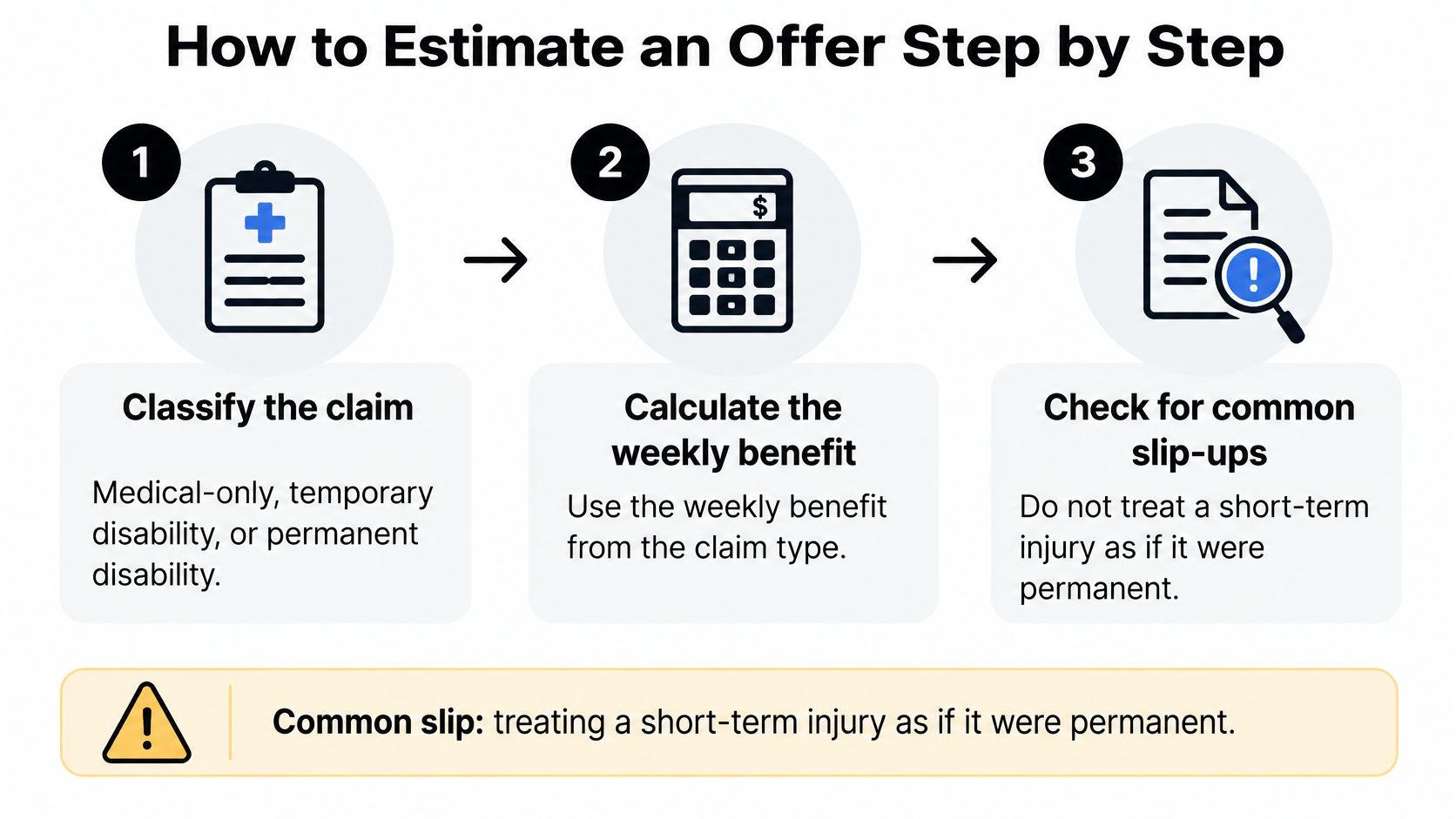
Classify the claim. Decide whether it's medical-only, temporary disability, or permanent disability. This sets which benefits drive value. Common slip: treating a short-term injury as if it were permanent, or assuming permanence before the medical record supports it.
Calculate the weekly benefit. Use your pre-injury wages and your state's formula, then check the state maximum. The weekly rate is the building block for every projection that follows. Common slip: using take-home pay instead of the wage figure your state uses.
Estimate weeks of lost wages. Base this on documented restrictions and expected recovery, not hope or pressure to return. Multiply the weekly rate by a realistic number of weeks. Common slip: picking a recovery date your doctor hasn't endorsed in writing.
Request a written medical projection. Ask what future treatment is reasonably expected, including surgery, therapy, medication, and follow-up care. A written projection turns a guess into a number you can compare. Common slip: relying on a verbal comment that you'll be fine.
List what the release closes. Write down whether it closes future medical care, future wage loss, vocational help, and any right to reopen. This step matters because the same lump sum changes meaning with each item it closes.
Compare lump sum with projected benefits. Add projected wage loss, impairment benefits, and medical costs, then consider that money paid years from now is worth less than money today. That's discounting to present value. Common slip: comparing the offer with a headline average instead of your own projection.
Confirm approval and reopening terms. A workers' comp settlement is not final until the agency or a judge approves it in most states. Some states allow a claim to be reopened within a defined period if the condition materially worsens, and some settlements waive that right. Confirm both points before you sign.
Turning Steps Into One Comparison
Finish by stating each step's result in one line. Claim type, weekly rate, estimated weeks, medical projection, closed benefits, projected total, and approval terms should fit on one page. If any line is blank, you don't have an estimate yet.
Practical rule: If you can't write the projection and the list of closed benefits on one page, you aren't ready to judge the offer.
How State Rules Change the Numbers
Workers' compensation is state-by-state. Eligibility, benefit amounts, time limits, and procedures differ by state, so a number borrowed from another jurisdiction can mislead you even when the injury looks identical.
The Upjohn Institute multi-state study of compromise-and-release settlements found that among claims involving more than seven days of lost work, reported average settlements ranged from approximately $13,115 to $49,096 across the examined jurisdictions. It also found lump sums were, on average, materially below the expected value of benefits obtainable through adjudication, with an estimated annual discount rate of approximately 24%. That spread isn't noise. It reflects different formulas, schedules, medical rules, and approval standards.
One Injury, Two States
Say two workers tear the same knee ligament, earn the same wages, and miss the same weeks. In State A, the weekly maximum caps wage replacement lower, so each week of disability pays less. In State B, the schedule assigns more compensable weeks to a knee impairment, so permanent partial disability pays more. Same knee, same paycheck, different settlement value, because the state formula sits between the injury and the check.
Many states publish a schedule assigning a number of compensable weeks to particular body parts. There's no single national figure for a knee, shoulder, or hand. The state maximum also acts as a ceiling. Higher earners don't keep getting a higher weekly benefit once they hit it, which compresses settlement value for wage loss.
State rules change. Benefit amounts and time limits are revised regularly, often every year, so an old chart you found online may already be stale. Some states also restrict or structure lump sums differently, and approval standards aren't identical.
Look up three things on your official state workers' compensation agency site:
- Current maximum weekly benefit: Write it beside your calculated weekly rate.
- Body-part schedule: Note the weeks assigned to your injury if your state publishes one.
- Settlement approval rules: Confirm who must approve and whether reopening is allowed.
Put those beside your seven-step estimate. Now the numbers reflect your jurisdiction, not a national blend.
How Injury Type and Duration Shift Value
Duration and claim type move value more than the name of the injury. The Minnesota Department of Labor and Industry workers' compensation analysis reported that indemnity claims represented 27% of paid claims but generated 92% of total benefits, and for 2022, average benefits were approximately $46,800 for indemnity claims versus $1,510 for medical-only claims. The same report documented a 15% decline in settlement benefits per indemnity claim from 2004 to 2024.
That gap makes sense once you see what's being paid. Medical-only claims cover treatment without wage loss. Indemnity claims add lost wages, permanent disability, and longer treatment. Medical bills alone don't explain the difference. Time away from work does most of the work.
Claim categories and what drives their value
| Claim Category | What Drives the Value | Minnesota 2022 Average Benefit |
|---|---|---|
| Medical-only | Treatment bills and short recovery | About $1,510 per claim |
| Indemnity (wage-loss) | Lost wages, impairment rating and claim duration | About $46,800 per claim |
| Repetitive-strain or occupational illness | When the condition began and proof that work caused it | Not reported separately |
Three Paths to Three Valuations
A medical-only claim with short treatment is valued mainly on bills and a quick recovery. A temporary disability claim is valued on weeks of lost wages plus treatment until you return. A permanent disability claim turns on the impairment rating, lasting restrictions, and future earning capacity. If you're unsure how a rating translates into benefits, our disability ratings guide walks through that link.
Say a warehouse worker strains a back muscle lifting a box, gets six weeks of lifting restrictions, then returns without limits. Value centers on treatment and six weeks of partial wage replacement. Now say another worker tears a rotator cuff, needs surgery, and keeps a permanent overhead-lifting limit. Value must account for surgery, longer recovery, impairment, and reduced earning capacity. You can't price the second claim with the first claim's logic.
Repetitive-strain and occupational-illness claims add a different problem. They're recognized in many states, but proving when the condition arose and that work caused it is usually harder than with a single incident. That proof issue affects negotiation because the insurer may dispute causation or start date.
Use the Minnesota contrast as a sorting tool, not a prediction. First classify, then quantify wage loss and restriction duration. Historical settlement benefits also move over time, so check any older figure you find against current state data before you rely on it.
Medical Care After a Lump-Sum Deal
The riskiest assumption is that treatment ends when the settlement signs. The CDC-hosted report on lump-sum recipients found most surveyed recipients were still receiving treatment before settlement or restarted treatment afterward, and 43 respondents said the settlement did not adequately cover treatment costs, compared with 31 who said it did. It also notes indemnity payments per claim rose 3.1% in FY 2025, while temporary-total-disability payments per day rose 6.6%.
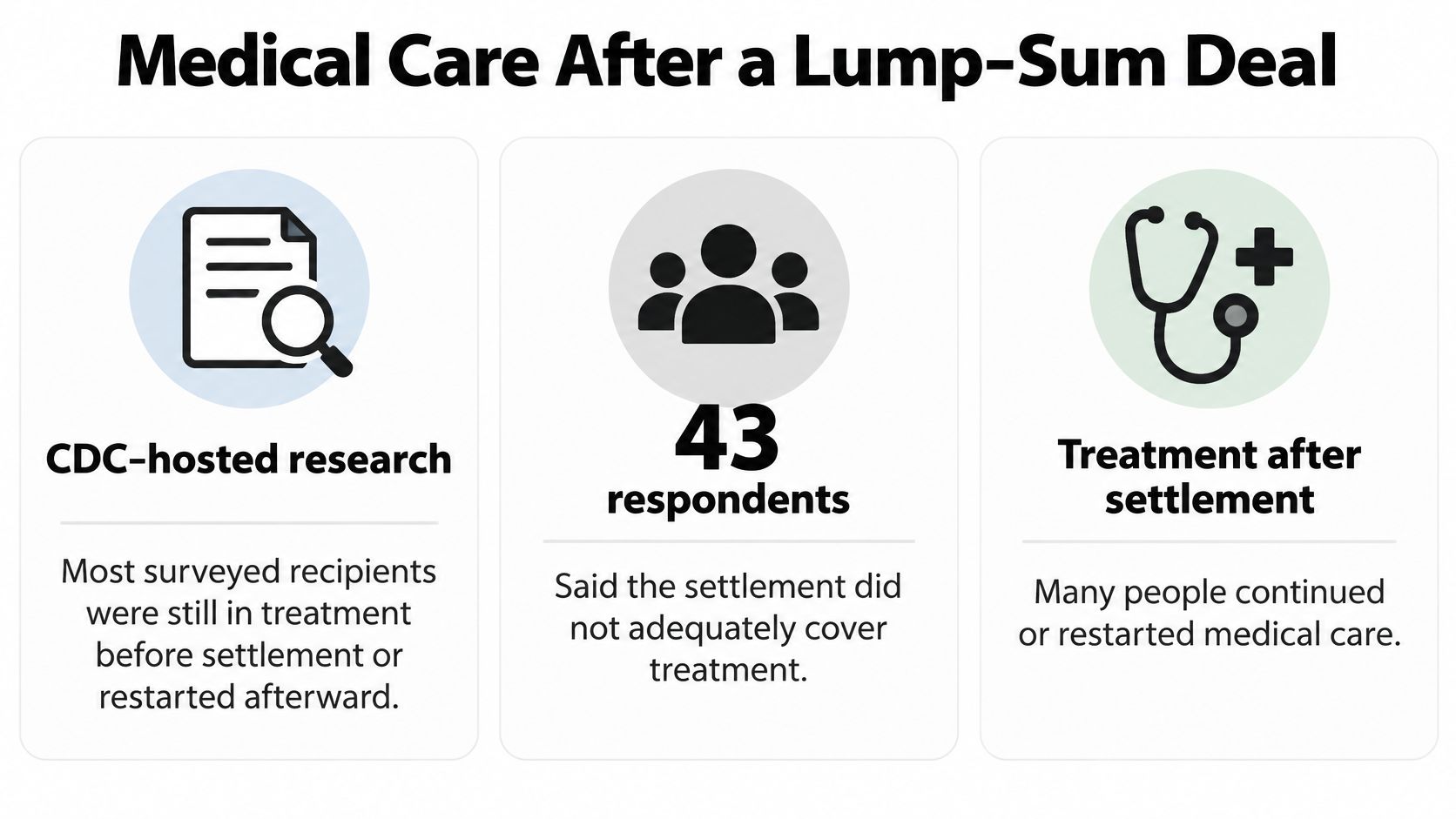
That shortfall happens for ordinary reasons. Surgery, medication, rehabilitation, and chronic pain care can continue for years. Prices rise. A treatment plan changes after a setback. If your release closed medical benefits, those costs land on you even when they stem from the original work injury.
Open Medical Versus Closed Medical
An open-medical settlement leaves the insurer responsible for approved future care, within the terms agreed. A closed-medical settlement pays cash and ends that responsibility. Don't judge them by cash alone. The closed version must be large enough to carry care the open version would have paid directly.
Public benefits add another layer. Settlements may attempt to resolve future medical payments, and concerns arise about whether Medicare or Medicaid could later become responsible for treatment costs. If you receive or expect those benefits, get advice on approval or set-aside issues before signing. Equipment coverage can raise similar coordination questions, so it helps to understand Medicare power wheelchair denials before assuming another program will pick up a cost your release closed.
Disputes at the treatment stage usually involve whether treatment is reasonable and necessary, whether the condition is work-related, or whether you can return to some form of work. Resolve those questions while they're still negotiable.
Before signing, request a written medical-cost projection, confirm in plain words whether medical care stays open or closes, account for benefit inflation, and get Medicare-related advice where it applies. Don't ask only whether the headline amount sounds fair. Ask what care it has to buy.
Questions to Answer Before You Accept
Use the written offer, not a phone summary. We provide guidance on what to consider before agreeing to a settlement, including future medical care, approval, other benefits, and finality. Answer each question below from the document itself. A missing answer is information, too. It tells you the offer isn't clear enough yet.
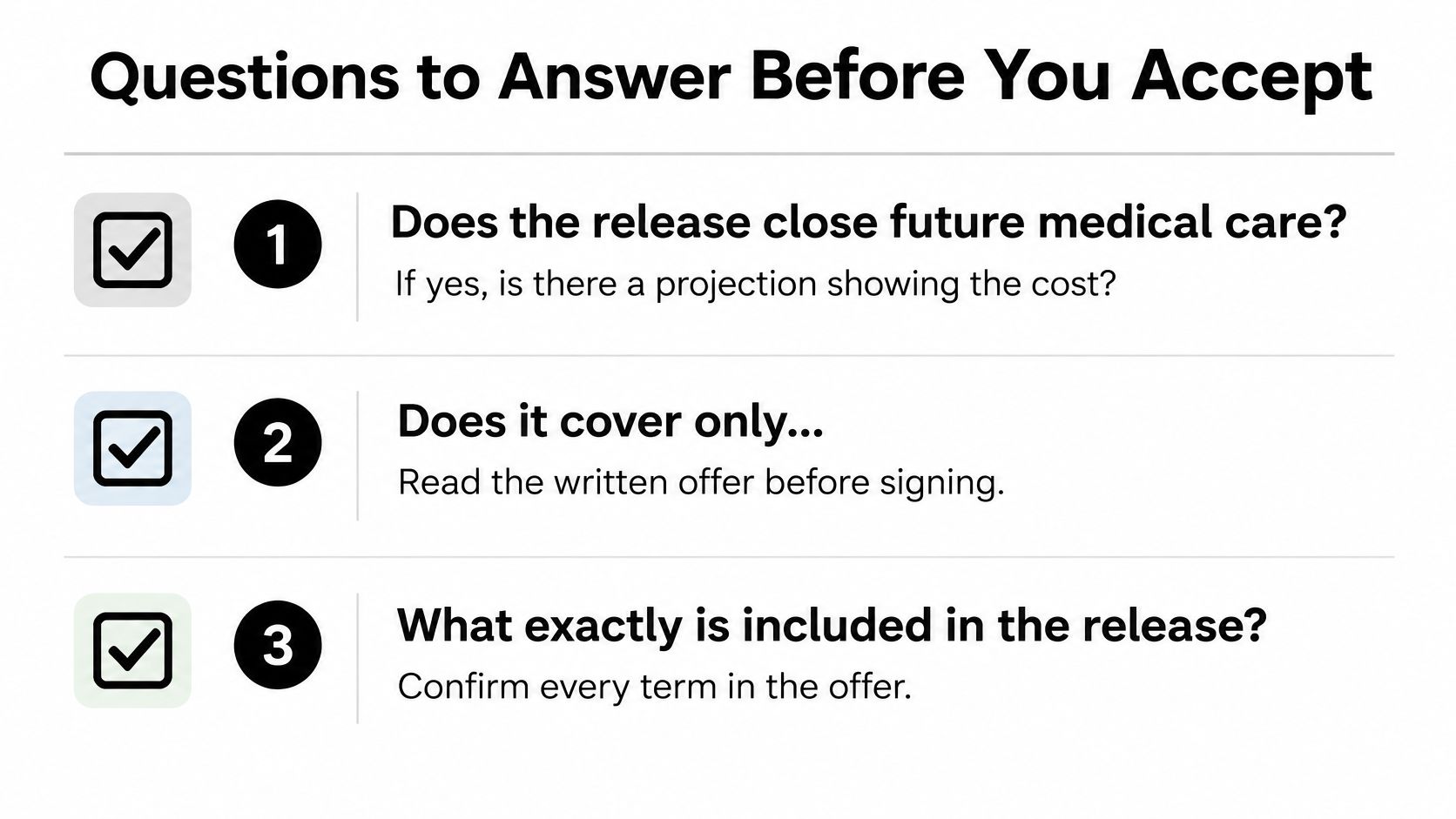
- Does the release close future medical care? If yes, is there a written projection showing expected cost?
- What benefits does it cover? Does it address only wage loss, or also medical, vocational, and impairment benefits?
- Who must approve it? Does it need agency or judge approval, and how long could that take?
- Is it final? Does it waive the right to reopen if your condition materially worsens?
- How does it compare with projected benefits? Does the lump sum reflect the discounted value of payments you'd otherwise receive over time?
- How are attorney fees calculated? Fees in comp cases are regulated in most states, so ask how they work and confirm the fee in writing before signing.
Match each answer to your estimate. A yes on medical closure with no projection is a reason to pause. So is a waiver of reopening rights when your condition isn't stable. If you want another plain-language way to test the overall balance, you can check whether your settlement is fair and compare its questions with your own notes.
Keep the offer and your answers together in one file. Those notes let any adviser see your reasoning quickly and spot gaps without rebuilding the claim from scratch.
Decide to Accept, Negotiate, or Get Help
You may not need a lawyer yet if the claim was accepted and benefits are being paid, treatment is approved without argument, you missed little or no work and expect full recovery, or your state agency's information line can answer your question. In that situation, keep records, follow restrictions, and don't sign a release you haven't mapped against your benefits.

Consider professional help if the offer closes future medical care without a written projection, you have permanent restrictions, the claim was denied, or the offer falls well below the projected value you calculated. Our guide on when to hire a workers' compensation attorney explains those decision points in more detail.
Accept only when your projection, the release language, and the approval terms line up. Negotiate when the structure is acceptable but the amount doesn't replace a specific benefit you've quantified. Name that benefit and show your math. Don't negotiate against an average. Negotiate against weeks, ratings, and treatment costs.
Our free Workers' Comp Settlement Assessment takes about 3 minutes and works through benefits, treatment, ratings, denials, and settlement factors, with immediate guidance and no contact details required. It provides no dollar estimate. Use it to organize questions, then bring your seven-step numbers and checklist answers together before you decide.
If you're weighing workers comp settlement amounts and want to understand what your offer closes, visit AskLegally to use the free Workers' Comp Settlement Assessment and read plain-language guides on benefits, ratings, and settlement decisions. Bring your weekly rate, medical projection, and release terms, and don't sign until each one is clear in writing.