
In the four years to June 2024, the NSW Independent Review Office recorded 8,651 complaints about delays in determining liability, roughly 28% of every workers' compensation complaint it received. Read that in plain terms. The loudest complaint from injured workers wasn't that their payout talks dragged on. It was that the insurer had not yet said whether the claim was covered at all.
That finding reframes the whole question of how long a workers comp settlement takes. Those asking are picturing a negotiation with an adjuster. Many are sitting in a queue for a coverage decision, and the two situations move on different clocks and need different responses.
Ask this before anything else. Is my claim slow because nobody has decided whether it's covered, or because the decision was made and the number is still being worked out?
A claim travels through a fixed sequence of stages, and each stage has its own clock, its own paperwork and its own way of stalling. Knowing which one you're standing in tells you what to do this week.
Typical Settlement Timeline by Stage
A single workers comp settlement timeline does not exist, and any page that hands you one number is describing one stage of one kind of claim. Your case runs on at least three clocks at the same time, and they rarely move at the same speed. When a claim feels slow, the first job is working out which clock is running.
Three clocks that run at once
The reporting clock. Your state sets the deadline for telling your employer about the injury, and it can be short. Miss it and the insurer gets a reason to question causation before anyone reads your medical records.
The liability clock. The insurer decides whether the claim is covered. Treatment authorization, wage replacement and any settlement talk all wait behind that decision, so a stall at this stage is a dispute problem.
The negotiation and approval clock. This one starts when your condition stabilizes enough for someone to put a value on the case. It ends when the agency or a judge approves the agreement, which in most states is the moment a settlement becomes final. A stall at this stage is ordinary settlement work.
Settlement and dispute timing by stage
| Stage | Typical time | Context |
|---|---|---|
| Medical or billing dispute settled through alternative dispute resolution | About a month at the median | Minnesota legislative audit; most such disputes settled this way |
| Administrative settlement division resolution | About seven months at the median | Minnesota legislative audit |
| Failed alternative dispute resolution, then formal hearing | Nearly a year overall | Minnesota legislative audit; the hearing stage adds months after mediation fails |
| Initial federal claim processing | 105 days average in FY2023, 109 days in FY2024 | U.S. OWCP; administrative processing, separate from any settlement date |
| Final settlement approval | 18 days to process a settlement application | U.S. OWCP; the agency or a judge must still approve before the deal is final |
| Settlement after maximum medical improvement | Starts at stabilization, with rating and negotiation after | The disability rating, negotiation and approval set the date |
Federal processing times come from the U.S. Department of Labor's OWCP report to Congress: initial claim processing averaged 105 days in fiscal 2023 and 109 days in fiscal 2024, and a settlement application took about 18 days to process once the paperwork arrived. Those are administrative measurements. A claim can be fully processed and still be nowhere near a negotiated number, because processing decides coverage while negotiation decides value.
The early dispute stage moves faster than injured workers generally expect. National data for 2020 to 2021 in Safe Work Australia's workers' compensation disputes report showed 59.3% of cumulative disputes were resolved within three months of lodgment. That figure measures only the dispute process. Treatment, permanent-impairment evaluation and negotiation can all continue long after the dispute itself is closed.
Read the table by finding your stage first and your state second. A medical or billing dispute tends to resolve in weeks rather than a year. If you already failed alternative dispute resolution and a hearing is on the calendar, the date worth chasing is the hearing date itself. And if your benefits are being paid while talks drag, you are on the negotiation clock. If the insurer still has not said whether the claim is covered, you are on the liability clock, and the remedy is different.
Every figure above is historical and tied to one state or one program. None of them predicts your claim, and none works as a deadline you can hold an insurer to. Your own state's statute sets those.
How a Settlement Moves From Injury Report to Payment
A settlement isn't an event. It's a sequence, and each step produces the document the next step depends on. Here's the full path, in order.
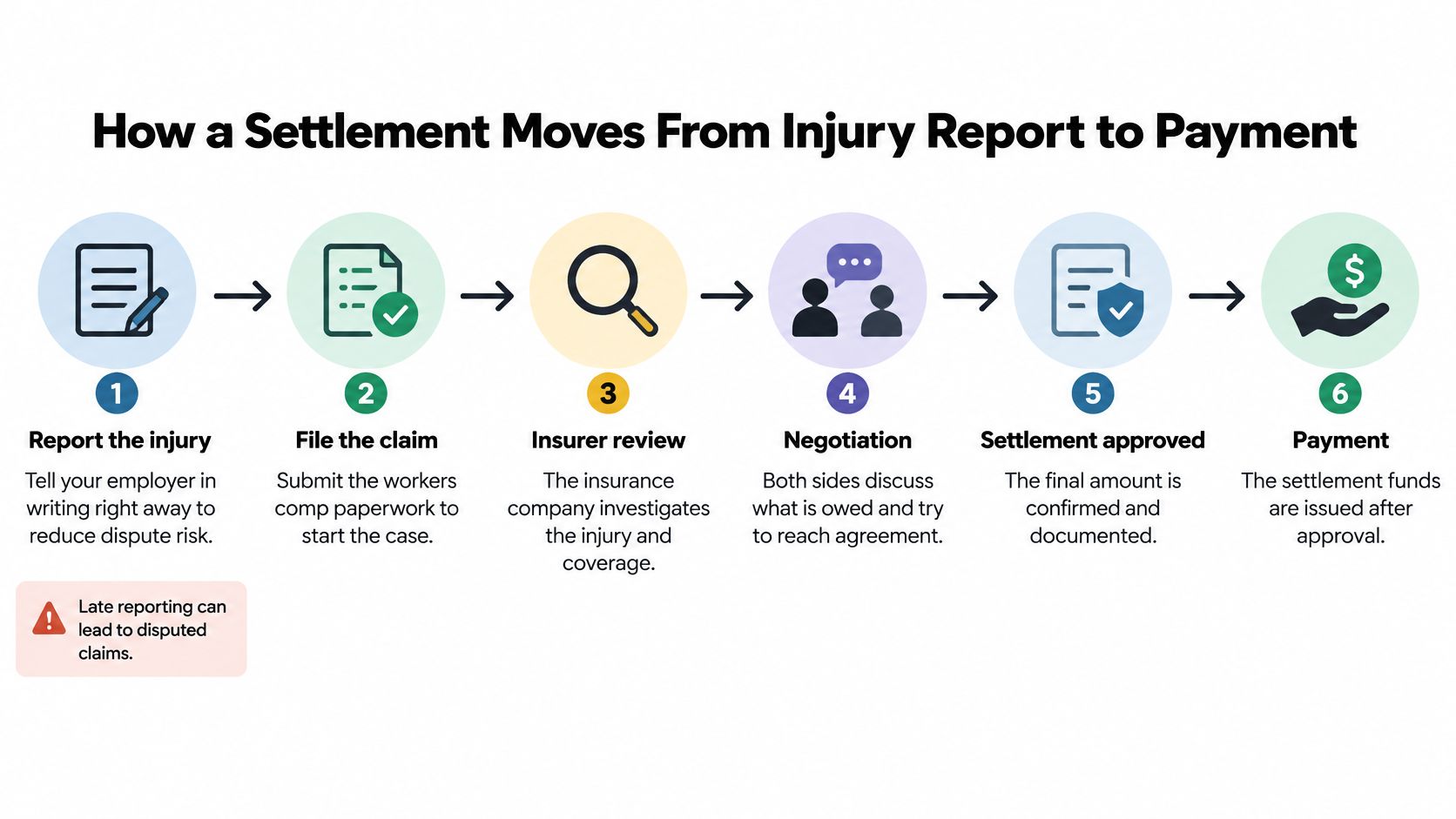
Report the injury in writing. Tell your employer the same day if you can, and put it in writing even if you already told a supervisor out loud. A verbal report that nobody recorded is one of the most common ways a claim starts life as a dispute.
Get medical care and name the cause. Tell the treating provider the injury happened at work and ask them to note it. That note is the first document the insurer reads, and a missing causal statement costs weeks.
File the claim with your state agency. Your employer's insurer may file on your behalf, but confirm it happened and get the claim number. This is the point where the liability clock officially starts running.
Wait for the insurer's decision. The insurer accepts, disputes or delays. Acceptance starts benefits. A denial or a partial dispute opens a separate appeal or hearing process with its own short deadlines.
Treat until your condition stabilizes. Maximum medical improvement is the point at which a permanent rating can be assigned. Signing a settlement before that point is the most expensive shortcut available.
Negotiate the value. The number reflects wage loss, permanent impairment, and whether future medical care stays open or gets bought out. An offer that arrives before you have a rating is a starting position, not a valuation.
Get approval. A settlement isn't final until the agency or a judge approves it in most states. Some states let a claim be reopened within a set period if the condition worsens, and some settlements give up that right.
Payment. Money follows approval, on a timetable your state controls, not the date you signed.
Where the sequence usually breaks
The breaks cluster in two places. The first is step one, where a late or unwritten report turns a routine claim into a causation argument. The second is step six, where a worker accepts a figure before the medical picture is clear.
If you're unsure about the paperwork at the front end, our complete guide to the workers compensation claim process walks through the forms and the order they're filed in.
So, which step are you on right now? Hold that answer, because everything that follows depends on it.
What Speeds Up or Slows Down Your Claim
Six factors decide how fast a claim moves, and they carry different weight. Liability comes first because everything else queues behind it.
Liability is the biggest lever
Take two workers with the same sprained back. The first reports it the morning it happens, sees a doctor that afternoon and tells the doctor it was a work injury. The insurer receives a clean file with a date, a mechanism and a treatment plan, and acceptance usually follows inside the state's decision window, with benefits starting while treatment continues.
The second finishes the shift, waits three weeks, then mentions it. Now the insurer has to work out whether the injury happened at work at all, and the claim moves from processing into investigation. Same injury, months apart in outcome. Reporting the injury late is one of the reasons claims get disputed.
Injury type changes the proof, not just the paperwork
Repetitive-strain and occupational-illness claims are recognized in many states, but proving when the condition arose and that work caused it is harder than with a single incident. The gap shows up in the data. A U.S. Government Accountability Office review found the average period from the claim date to the payment date was 129 days for traumatic injuries and 270 days for occupational diseases. Federal agencies themselves averaged 24 days to process the traumatic-injury claims and 33 days for the disease claims, which tells you the extra time sits in submission, review, correction and payment, not in the first look at the file.
The remaining factors are where most of the avoidable delay lives:
- Documented restrictions. A doctor's note saying "light duty, no lifting over 20 pounds" gives the insurer something to price. A note saying "follow up in six weeks" gives it a reason to wait.
- A settled rating. Negotiation can't finish before an impairment figure exists, and the figure doesn't exist until treatment ends.
- One employer versus several. A shoulder condition that developed across two jobs needs records from both, and each set of records is another information cycle.
- Unpriced future care. Ongoing prescriptions, a possible surgery or psychological treatment make the final number contestable, so offers and counteroffers stretch out.
Most disputes turn on what was documented and when. When a claim stalls, the cause is usually a missing record or a missing date rather than an insurer's mood.
Telling Insurer Delay Apart From a Denied Claim
Six weeks of silence looks identical whether the insurer is weighing an offer or has never accepted the claim. The right next move is completely different in each case, and you can usually tell which one you're in from what has and hasn't arrived.
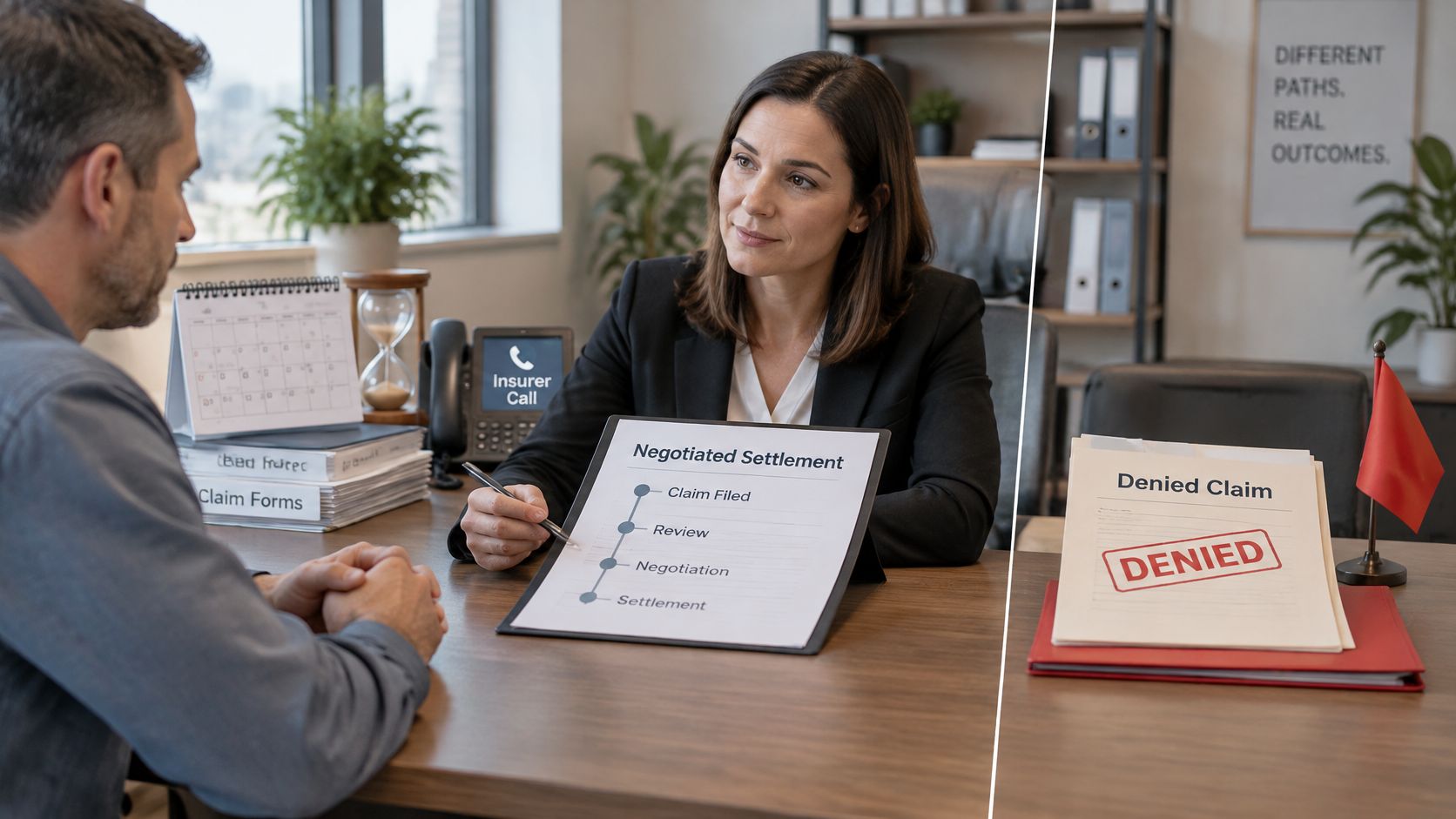
A liability decision is a yes or no about coverage. A settlement is an argument about amount. A claim with accepted liability and open treatment is in ordinary settlement work, which is slow but normal. A claim with no decision hasn't entered the settlement phase at all, no matter how many months have passed.
The size of the open issue drives most of the timeline. A Minnesota legislative audit found cases resolved through the administrative settlement division had a median resolution time of 217 days, while about 87% of narrower medical disputes were settled through alternative dispute resolution with a median of 34 days. Cases that failed alternative dispute resolution and went on to a formal hearing ran roughly 329 days overall, made up of 224 days in alternative dispute resolution plus 105 days in the hearing process.
A billing disagreement needs records. A causation fight needs medical opinions, discovery and a hearing date. That's why "about seven months" tells you nothing until you know which issue is still open.
The symptoms and what they mean
A stalled claim usually announces its cause through one of five symptoms. Here's how to read them.
| Symptom | Likely cause | Next step |
|---|---|---|
| No decision and no benefits after weeks | Liability not yet accepted | Ask the insurer in writing whether the claim is accepted or disputed |
| Treatment approval delayed | Medical dispute or missing records | Send the records and request the reason for the delay in writing |
| Settlement talks stalled over value | Negotiation with unclear future medical needs | Get a current rating and a medical opinion on future care |
| Denial letter received | Liability dispute | Note the appeal deadline and start the hearing process |
| Benefits paid but no settlement offer | Normal negotiation stage | Confirm treatment is stable before discussing a number |
The video below walks through how a claim moves when the insurer pushes back instead of paying.
A checkpoint that produces no written answer is itself information. It means the delay isn't a paperwork backlog you can clear from your side.
Three escalation checkpoints work in almost every state. First, ask in writing whether liability has been accepted or disputed, and keep the reply. Second, request the stated reason for any delay and the specific record or evaluation that's missing. Third, calendar every appeal deadline the day a denial arrives, because those windows are short and missing one can end the claim.
If a denial has already landed, our page on what to do about a denied workers comp claim covers the appeal sequence step by step.
Documents That Prove Delay and Keep Your Claim Moving
Delay is easier to beat when you can point to a date. The file you keep from day one is also the file that gets your settlement valued accurately later.
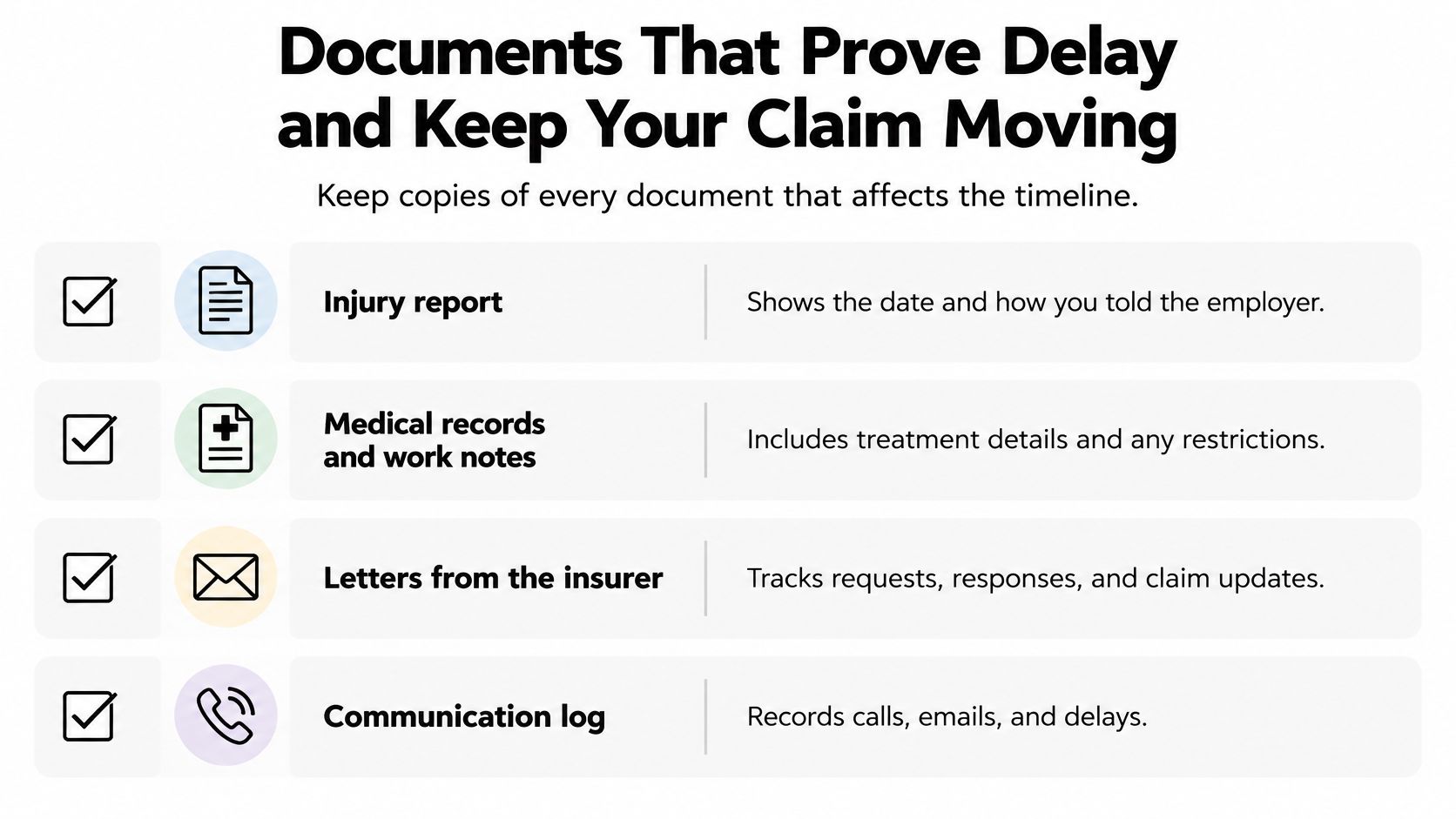
The injury report. A dated record of what you told your employer and when. It answers the first question an insurer asks about any disputed claim, and it takes thirty seconds to create.
Medical records and work notes. Treatment details plus any restrictions, kept in order. A complete treatment chronology removes the "we're waiting on records" delay before it starts.
Every letter from the insurer. Each one saved with its date, including the envelopes. This is how you show that a request went unanswered for six weeks rather than two.
Out-of-pocket costs. Prescriptions, mileage, and receipts for missed wages. These turn a vague claim for expenses into a figure someone can approve.
A dated log of calls, appointments and requests. Who you spoke to, what they promised, and when. Contemporaneous notes are far stronger than a reconstruction three months later.
Photos of the scene and the injury. Immediate photos, especially of anything that has since changed. They settle mechanism questions that would otherwise need expert opinions.
When you request your own treatment records, clinics usually want a signed release in a format they recognize. Attorney Assistant publishes sample authorization language for providers that you can adapt, which cuts the back-and-forth that holds up a records request for weeks.
Once the documents are in one place, give each delay a name. Missing records, an independent medical evaluation, wage verification, settlement approval and a hearing date all require different responses, and treating them as one generic "slow claim" gets you nowhere. Review the file once a month, check every open deadline, and send one follow-up in writing per open item.
Whether to Settle Now or Wait for Recovery
Reaching maximum medical improvement does not automatically make settling the right move. A faster signature is not the same as a better outcome. This stage runs on the negotiation clock, not the insurer's liability clock: one clock runs while the insurer decides what it owes, and the other runs while you decide what to accept. An early offer is the insurer trying to close your clock before theirs has finished.
Pennsylvania's 2025 medical-accessibility study identified slower recovery as the most commonly reported consequence of delayed treatment or limited provider participation. Read that against any settlement offer that arrives while treatment is still unresolved. An offer made before your care has run its course deserves close scrutiny, because closing the file early can lock in a recovery that never finishes.
A settlement is a trade, not a finish line. You give up future flexibility in exchange for certainty and cash, and what you give up depends on the language you sign. A negotiated settlement generally defines what is owed and what gets closed out once it is approved, which is a different thing from a decision that resolves one disputed issue and leaves the rest of the claim alive.
What a fast settlement can cost you
The clearest risk sits with workers who still need care. If you have ongoing prescriptions, a surgery on the table, psychological treatment, or a return-to-work date nobody can predict, the value of your future medical coverage may exceed the cash in front of you. A lump sum that looks generous against today's bills can be thin against three more years of them.
Some states allow a claim to be reopened within a defined period if the condition materially worsens, and some settlements waive that right entirely. That single clause can be worth more than the difference you are negotiating over. Public benefits and Medicare coordination matter too, because a settlement can affect eligibility or require a set-aside arrangement, and that conversation belongs with someone who handles it regularly.
The question that decides it. If your condition gets worse in eighteen months, what does this agreement let you do?
Three questions are worth writing down before you sign anything. What medical care do I still need, and does this agreement pay for it? What happens if the condition materially worsens? And which benefit am I giving up in exchange for this number?
Decide Whether to Involve an Attorney Before You Settle
You may not need a lawyer yet. The claim was accepted and benefits are being paid. Treatment is approved without argument. You missed little or no work and expect a full recovery. Your state agency's information line can answer the question you have. In those situations, paying for representation buys you very little.
The signals that call for a review are sharper. A denial. A settlement offer that arrives before treatment is complete. A dispute over future medical care. A deadline that is close enough to matter. Any one of those is a reason to get the file looked at, and the review costs nothing at the front end.
What a consultation actually covers
An attorney will ask how and when you were injured, what work you were doing, how the injury was reported, what the insurer approved or refused, what the doctor said about restrictions, and whether wage benefits were paid. Nothing about that list is a trick. It's the same eight-stage sequence, retold from your side.
Walk in with the documents from the checklist and written answers to those questions, and the consultation becomes a specific assessment instead of a summary of your story. That's the difference between a useful half hour and a confusing one.
A free first pass you can do tonight
Before you call anyone, it helps to know whether your situation is a negotiation problem or a coverage problem. AskLegally's free Workers' Comp Settlement Assessment takes about three minutes and works through benefits, treatment, ratings, denials and settlement factors, with immediate guidance and no contact details required.
If you want to understand when representation typically pays for itself, our guide on when to hire a workmans compensation attorney sets out the decision points.
Gather the documents, write your answers down, then decide. That order keeps the decision grounded in your file rather than in the anxiety of a slow week.
If you're stuck between stages and aren't sure whether your claim is being negotiated or held up, AskLegally can help you sort out where you are in the process and what to ask next. Our free Workers' Comp Settlement Assessment works through your claim status, treatment, ratings, denials and settlement factors in about three minutes, with no contact details required, so you can walk into a conversation with an attorney already knowing what's open and what's closed. Start there, then gather the documents and take the next step with confidence.