
U.S. private-industry employers reported 1,455,600 cases involving days away from work, job restriction, or job transfer in 2024, according to the U.S. Bureau of Labor Statistics. Those outcomes aren't interchangeable, and neither are the benefits that may follow them. Someone who keeps working may still need covered treatment, while someone returning to lighter duties may still have a wage-loss claim.
A useful workers compensation benefits guide starts with that distinction. Benefits are separate categories with separate eligibility rules, not a single payment that covers everything. Knowing which category addresses your current problem helps you ask better questions and spot a missing benefit without assuming you're owed a fixed amount.
Workers Compensation Benefits at a Glance
Workers' compensation pays for covered medical care after a work-related injury or illness and replaces part of lost earnings when the applicable requirements are met. Benefits for lasting impairment, rehabilitation, and surviving dependents may also apply. The Social Security Administration's workers' compensation overview describes this basic structure across separate state and federal systems.
Workers compensation benefit categories at a glance
| Benefit | What it pays for | How the amount is set | When it applies |
|---|---|---|---|
| Medical benefits | Reasonable, necessary treatment for the work injury or illness | Covered costs under the applicable system | While covered treatment remains necessary, subject to state rules |
| Temporary total disability | Part of earnings lost while unable to work | Pre-injury earnings formula with state limits | Medical evidence supports inability to work and waiting-period requirements are met |
| Temporary partial disability | Part of the wage loss from reduced hours or duties | State formula based on qualifying lost earnings | Restrictions reduce earnings during recovery |
| Permanent partial disability | Lasting impairment or loss of earning capacity | State rating, schedule, or other statutory formula | The condition stabilizes and permanent loss is evaluated |
| Permanent total disability | Long-term loss of earning ability | State payment formula and duration rules | The worker meets the state's permanent-total-disability standard |
| Vocational rehabilitation | Approved retraining or job-placement services | State-authorized services and payment rules | The injury prevents return to the old job, in states offering this benefit |
| Death benefits | Survivor payments and a burial allowance | State dependency, wage, and expense rules | A work-related injury or illness causes death |
Separate benefits can overlap
Medical benefits generally pay covered treatment costs, not money you can use for rent. Disability checks address qualifying income loss, while rehabilitation services address the practical problem of finding suitable work.
Say a cook receives treatment for a burn but misses no shifts. The medical category may apply without wage replacement. If the same injury later requires time away from work, a cash-benefit category may become relevant too.
Practical rule: Approval of one benefit doesn't establish eligibility for every other benefit.
No category guarantees your full former paycheck. Even permanent-impairment awards are not a reimbursement for every dollar you might lose in the future, and rehabilitation isn't available on identical terms everywhere.
Use your current stage to choose questions
Identify whether you're receiving treatment, missing work, returning with restrictions, or being evaluated for permanent impairment. Mark the rows that apply now and those that might apply later.
Then turn each relevant row into a specific question: Has treatment been authorized? Has wage eligibility been decided? Is a permanent evaluation needed? Dollar amounts come from the applicable state's rules, not a national benefit rate.
Eligibility Checks Before Any Benefit Is Paid
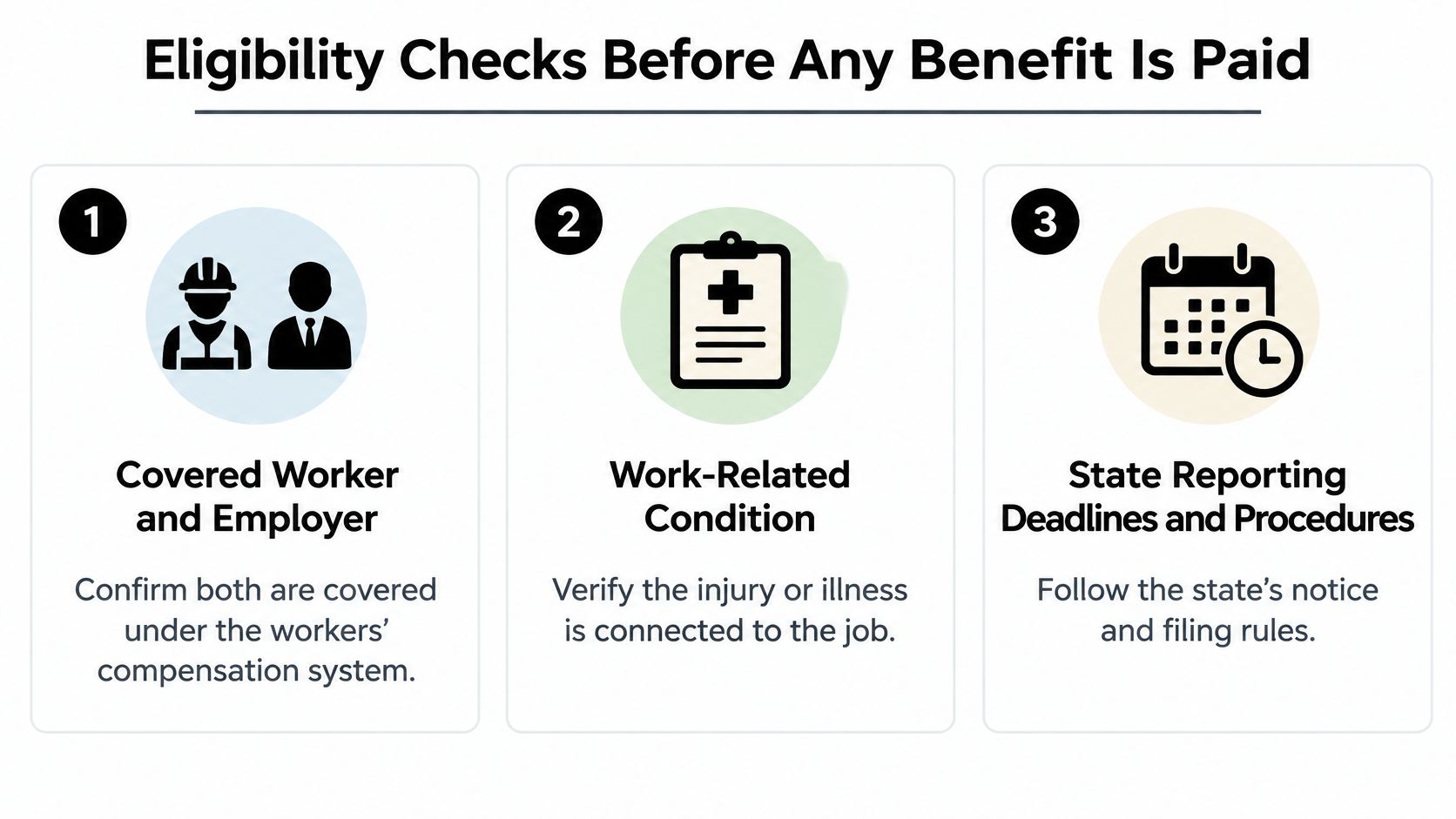
Before calculating a payment, establish coverage, work connection, and compliance with reporting rules. Is the worker covered by the applicable system? Is the injury or illness connected to employment? What notice and filing procedures apply?
Our information is general and state-by-state because eligibility, benefit amounts, deadlines, and procedures differ. You generally don't have to prove employer fault, but you still need evidence supporting the claim.
Use these checks before assuming an injury automatically qualifies.
Resolve unclear employment status
Drivers, delivery workers, freelancers, staffing-agency workers, and people receiving contractor tax forms may encounter a classification dispute before anyone considers benefit amounts. The WorkersCompensation.com discussion of NCCI's legislative tracking highlights classification and portable-benefit proposals as important coverage issues.
Don't treat a contract label as the complete answer. Gather the documents that show how the arrangement works:
- Control over work: Who assigns jobs, sets schedules, supplies equipment, and directs how tasks are performed?
- Payment arrangements: Who pays you, and which business appears on your statements?
- Coverage documents: Is there statutory coverage, an election into coverage, or a private occupational-accident policy?
- Decision-maker: Which state agency determines disputed worker status?
A private occupational-accident policy isn't automatically statutory workers' compensation. Its medical coverage, income payments, exclusions, and appeal protections may differ.
For a staffing assignment, preserve communications from both the agency and the business where you worked. Ask which insurer is handling the reported injury rather than accepting an informal statement that another company is responsible.
Move the claim forward
The usual path starts with reporting the injury to the employer in writing, obtaining medical care and explaining that it happened at work, and completing the required claim filing with the state agency. The insurer then accepts, disputes, or delays the claim. Follow your state's process rather than assuming the employer's internal incident report completes every filing requirement.
If you receive a refusal, keep the notice and identify its stated reason. Our guidance on a denied workers' comp claim can help you organize the next questions.
Before waiting for payment, confirm:
- Coverage: Are both your work arrangement and employer covered?
- Causation: What evidence connects the condition to your job?
- Procedure: What must be reported or filed, and by when?
- Classification: If status is disputed, who will decide it?
Treat an unclear answer as a task to resolve, not a reason to wait indefinitely.
Medical Benefits and the Treatment Disputes Insurers Raise
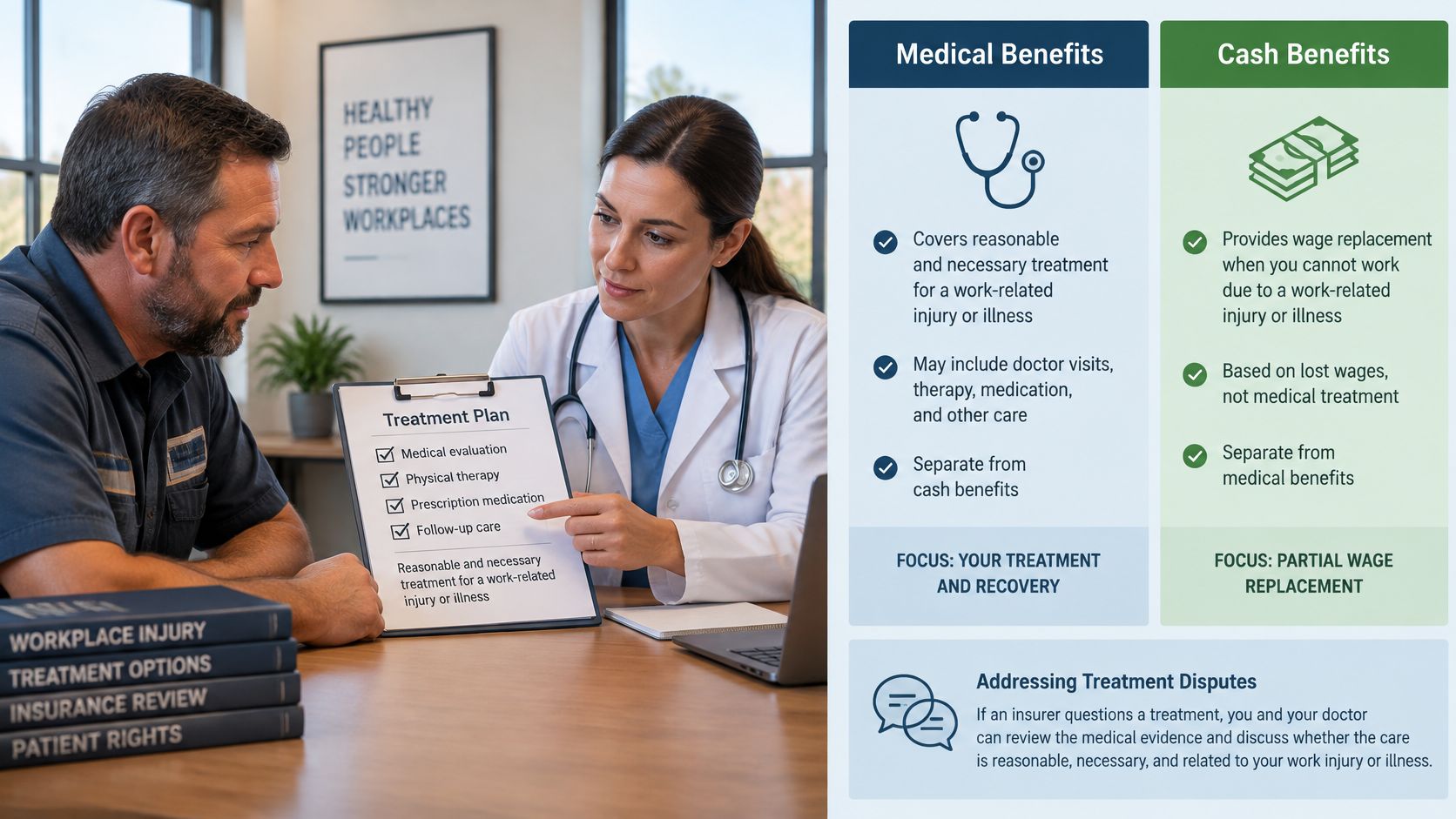
Treatment disputes usually concern medical necessity, work-related causation, or work capacity. The insurer may question whether a procedure is needed, whether employment caused the condition, or whether the doctor's findings support continued restrictions.
The Massachusetts workers' compensation benefits guide illustrates the distinction between medical treatment and disability payments. They serve different purposes, so a disagreement over a prescription isn't necessarily a decision about income benefits.
A treatment discussion should produce a clear plan and written restrictions.
Build a medical file that answers the dispute
State systems can restrict provider choice, utilization, treatment duration, or reimbursement. Before arranging nonemergency care, ask whether the provider and service require authorization and how that authorization is documented.
Keep records that explain both the injury and the proposed response:
- Initial evidence: The injury report, first diagnosis, and description of how symptoms began.
- Treatment documents: Plans, prescriptions, referrals, imaging reports, and authorization requests.
- Functional limits: Work-status notes describing lifting, standing, reaching, or other restrictions.
- Expenses: Receipts and mileage or travel records where reimbursement is available.
Medical records establish causation, severity, and treatment necessity. Payroll and attendance records establish the economic effect, so don't expect a diagnosis alone to prove missed earnings.
For a workplace stair fall, distinguish a description of the event from medical interpretation of the injuries. Texas Autopsy Services' resource on forensic signs after stair falls offers background on injury evidence, but it isn't a substitute for your treating clinician's findings or a benefits determination.
Answer the actual reason for refusal
Suppose physical therapy is denied. Ask for the reason in writing, including whether the issue is authorization, necessity, or connection to the accepted injury.
Give that explanation to the treating doctor. Ask the doctor to address the specific objection, explain the functional problem therapy is intended to improve, and identify the proposed treatment plan. Record the request, response, and follow-up in a dated timeline, and check the applicable review procedure promptly.
Keep the clinical discussion and the claim paperwork connected.
Don't abandon treatment because an authorization stalls. Tell the medical office what's happening and ask who is responsible for the next submission.
Across states, the useful habits remain practical: keep the medical record accurate, follow the restrictions you're given, and document who told you what. Correct errors promptly, especially an incorrect injury history or work-release date.
Wage Replacement and How the Payment Is Calculated
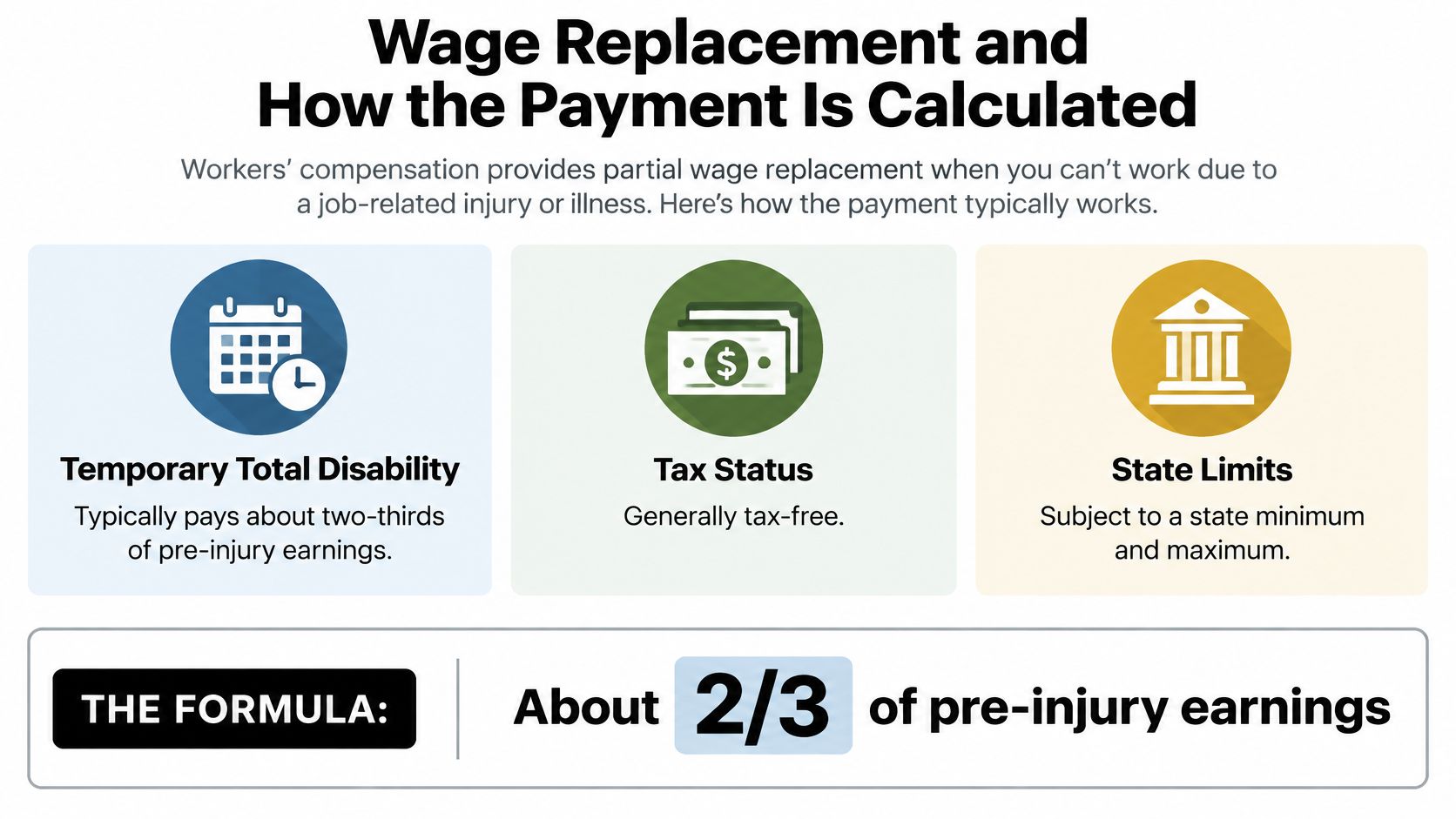
Temporary total disability commonly starts with about two-thirds of pre-injury earnings, generally tax-free and subject to state minimums and maximums, according to the Social Security Administration's comparative benefit tables; waiting periods commonly range from three to seven days. That's a starting formula, not a promise of your payment.
Medical evidence must also support the relevant work limitation. A correct earnings calculation won't establish entitlement if the insurer disputes whether your condition prevents work.
This visual summarizes the basic calculation.
Calculate a starting estimate
Collect the earnings records. Gather pay stubs, schedules, and time records from before the injury. Include records of irregular shifts or additional employment so you can ask what the state counts.
Establish the average weekly wage. Use the state's required earnings period and method, not whichever paycheck looks typical. Check whether regular overtime and other compensation belong in the calculation.
Apply the benefit fraction. Use the applicable temporary-total-disability rate to calculate the initial amount. Keep this separate from the final payable figure.
Check the limits. Compare the result with the applicable weekly maximum and minimum. Confirm which rate applies to your claim rather than assuming the newest published rate controls.
Account for the waiting period. Identify which missed days initially qualify for payment. Ask whether a longer absence changes payment for the initial unpaid period under your state's rules.
Confirm payment timing in writing. Ask the insurer when the first payment is expected and which dates it covers. A waiting period and an administrative delay aren't the same issue.
See what a cap changes
Illustrative weekly benefit with a hypothetical $1,000 weekly cap
These are invented earnings examples, not actual state limits. The calculations show only the stated fraction and hypothetical cap, excluding other eligibility or payment adjustments.
| Pre-injury weekly wage | Two-thirds of wage | Payment after $1,000 cap |
|---|---|---|
| $600 | $400 | $400 |
| $900 | $600 | $600 |
| $1,800 | $1,200 | $1,000 |
The higher-paid worker in this example doesn't receive the full initial calculation because the hypothetical ceiling reduces it. That's why a benefit check can replace a smaller share of a higher earner's wages.
Our explanation of how to calculate lost wages can help you organize the earnings evidence. Keep the underlying records, not just your own total.
Check the inputs: Ask for the earnings period, included pay, benefit rate, applicable limit, and covered dates used to calculate the check.
State limits are revised regularly, often annually. If your payment looks wrong, compare those inputs with your records and request the insurer's calculation in writing before assuming the difference is just rounding.
Disability Benefits From Temporary to Permanent
A warehouse worker injures a shoulder and receives restrictions that initially rule out all work. If the claim requirements are satisfied, the worker may receive temporary total disability while recovering. The important evidence is the doctor's description of what the worker can and can't do.
Later, the doctor allows lighter duties. The employer offers inventory paperwork, but the position brings fewer hours and no usual overtime. Returning to the building doesn't necessarily eliminate the worker's qualifying wage loss.
Follow the changes in capacity and earnings
Temporary partial disability may address that reduced-earnings stage under the state's formula. Keep the actual job offer, new schedule, pay statements, and restrictions together so the difference is documented rather than estimated.
A vocational referral may also become relevant if the shoulder prevents a return to regular warehouse duties. Ask what approved services could help, including job placement or retraining where available, and what participation obligations apply.
Minnesota's Department of Labor and Industry system report found that the average period receiving total-disability benefits was 33% longer in 2024 than in 2004, while vocational rehabilitation participation fell to 21.8% of paid indemnity claims in 2024. Those are Minnesota findings, not predictions for an individual claim, but they underline why work capacity and rehabilitation deserve separate attention.
Understand the permanent evaluation
When the condition stabilizes, the worker may be evaluated for lasting impairment. Maximum medical improvement doesn't necessarily mean the shoulder is normal or that no further care will ever be needed.
A permanent partial award may use an impairment rating and a state schedule assigning benefit weeks to particular body parts. Other injuries and jurisdictions use different methods, so request both the rating and the calculation. Our explanation of workers' comp disability ratings addresses the questions a rating can raise.
If the worker cannot perform gainful employment, permanent total disability requires a separate state-specific evaluation. The Law Office of John P. Sherman, PLLC's legal guidance on accident-related disability claims offers context for understanding the transition from injury recovery to documenting longer-term disability.
Going back to a job and recovering your former earning capacity aren't necessarily the same outcome.
For psychological injuries, check the current rules separately. Covered conditions, eligible workers, and acceptable diagnosing professionals can differ substantially.
Keep a log of earnings, restrictions, vocational referrals, and job-search efforts. Request any permanent rating in writing rather than relying on a verbal description.
Death Benefits for Surviving Family
A worker becomes seriously ill during a hot outdoor shift and later dies. The family may have a workers' compensation death-benefit claim, but the fact that symptoms began at work doesn't settle every issue. The claim must establish the connection between employment and the fatal illness, along with who qualifies as a dependent.
Surviving spouses and children may qualify, and some states recognize other dependents. Survivor payments are set by state law, often using the worker's earnings and statutory maximums, while burial expenses are addressed through a separate allowance.
Build the family's claim file
For the heat-related scenario, preserve information about the shift, working conditions, symptoms, emergency response, and medical treatment. Don't ask family members to supply medical conclusions; gather the records that allow the appropriate professionals to assess causation.
Useful documents include:
- Death certificate: Obtain the official record and keep related correspondence.
- Employer incident report: Include available witness names and details of the final shift.
- Wage statements: Preserve evidence of the worker's earnings.
- Relationship records: Marriage or birth certificates can help establish the claimed relationship.
- Medical records: Gather records from the final illness or injury.
- Earlier claim documents: Include any existing claim number, decisions, or treatment history.
Confirm eligibility and duration
Proof of relationship and proof of dependency aren't always identical requirements. Ask what the applicable state requires for each person seeking benefits, including anyone who relied financially on the worker but wasn't a spouse or child.
Survivor payments may change or end when a dependent reaches a state-defined age or another qualifying condition changes. Don't assume a payment continues indefinitely because the initial claim was approved.
The family may need to communicate with both the employer's insurer and the state agency. Keep copies of every submission and confirmation of receipt.
Contact the state agency or a licensed attorney promptly. Filing periods can be short, and a missed deadline can defeat an otherwise supportable claim.
Third-Party Claims That Can Run Alongside Comp
A work injury doesn't automatically block every lawsuit. Workers' compensation is generally an exclusive remedy against the employer, which usually prevents an ordinary negligence lawsuit against that employer for a covered injury. Narrow exceptions differ by state.
The boundary matters because someone outside the employment relationship may also have contributed. A claim against that third party can sometimes proceed alongside workers' compensation.
Legal review can help distinguish the employer's role from another party's responsibility.

Identify who contributed
Potential examples include:
- A subcontractor: Unsafe work at a construction site may injure another company's worker.
- An equipment manufacturer: A defective machine may cause an injury during ordinary use.
- An outside driver: Another company's delivery vehicle may strike someone working nearby.
- A property owner: Unsafe premises may contribute to a fall, depending on the parties' legal duties.
These aren't automatic lawsuits. Responsibility, legal relationships, and available defenses need evaluation.
A separate injury action may seek damages the comp system doesn't provide. However, the comp insurer may seek reimbursement from a third-party recovery, so the settlement's headline amount isn't necessarily what the worker keeps.
For a jurisdiction-specific example of outside-party injury assistance, The Law Office of Bryan Fagan, PLLC describes its representation for injured North Texas residents. Ask any reviewing attorney how the potential injury claim would interact with existing comp payments before evaluating a proposed recovery.
Preserve both sets of options
Record the incident date and location, identify the people and businesses involved, and preserve photos, witness details, and equipment information. Don't alter potentially relevant equipment yourself; document where it is and who controls it.
Ask whether the third-party filing deadline differs from the comp deadline. Also ask how reimbursement claims could affect the net recovery.
Retaliation for filing workers' compensation is a separate employment issue in many states, with its own protections and remedies. Preserve relevant messages and employment notices rather than assuming the comp claim itself resolves retaliatory treatment.
Document Your Claim and Decide When to Call a Lawyer
Start your file with the employer's injury report, medical records, work-status notes, insurer correspondence, out-of-pocket receipts, a dated timeline, and photographs of the scene or injury. Save originals where possible and keep readable copies in a clearly labeled folder.
Your employer usually supplies the claim form. If that doesn't happen, request it directly from the state workers' compensation agency rather than letting the missing form stall your next step.
Use a claim record you can actually maintain
A simple spreadsheet can track the date, person contacted, issue discussed, document sent, and promised response. Store the related letter or email alongside it so you can verify the entry later.
Use this checklist to connect the paperwork to decisions:
Gather the records in one file. Separate medical, earnings, insurer, and expense documents. Use filenames that include the date and document type so a work release doesn't get buried among appointment reminders.
Record when each benefit starts or stops. Note which treatment, payment, or service changed and preserve the written decision. If someone gives an explanation by phone, send a brief written follow-up recording your understanding.
Check for a legal-review trigger. Look beyond whether money is arriving. A claim can still involve a serious unresolved issue when some benefits are being paid.
Get a review when these problems arise
Consider speaking with a licensed attorney if:
- A claim is denied or benefits stop: Bring the written reason and your payment history.
- Work-related causation is disputed: Gather the incident description and relevant medical opinions.
- You disagree with an impairment rating: Obtain the report, not just the percentage mentioned by phone.
- You can't evaluate a settlement: Identify what would close, especially future medical care.
- Another party contributed: Preserve the evidence needed to assess a separate claim.
- You're pressured to exceed restrictions: Bring the doctor's limits and the actual job demands.
You may not need a lawyer yet if the claim is accepted, benefits are being paid correctly, treatment is approved without argument, and you missed little work with a full recovery expected. A state agency information line may also resolve a straightforward procedural question.
That isn't a reason to ignore a developing problem. A change in work status, a disputed bill, or a proposed final agreement can justify a fresh review even if the claim began smoothly.
Prepare before the consultation
Expect questions about how the injury happened, what work you were doing, when you reported it, what the insurer approved or refused, and what your doctor said about restrictions. Bring wage-payment records and any pending offer so the attorney can identify the actual decision you face.
Ask how attorney fees work before signing a representation agreement. Fees in comp matters are regulated in most states, but you still need to understand the arrangement offered to you.
If a review trigger applies, book a consultation with a licensed attorney before accepting a settlement or signing a release. Organizing the records first helps make that conversation about your available options rather than a search for missing paperwork.
AskLegally offers a free Workers' Comp Settlement Assessment covering benefits, treatment, ratings, denials, and settlement factors, with immediate guidance and no contact details required. Visit AskLegally to work through those questions and, if you haven't hired an attorney, explore a free case review and connections with participating attorneys.