
You got hurt, the adjuster is already asking for bills, and you're trying to figure out whether the number on the screen is fair. Don't start with the offer. Start with the damage, because a car accident settlement only makes sense when it's built from documented losses, not a guess.
If you want to calculate car accident settlement numbers that hold up under pressure, use a worksheet, not a shortcut. The National Highway Traffic Safety Administration's 2019 study put the societal cost of U.S. motor-vehicle crashes at $339.8 billion, with crashes killing about 36,500 people, injuring 4.5 million, and damaging 23 million vehicles, which is exactly why the math has to be careful, specific, and fully documented (NHTSA study). A fast offer might close the file, but it can also leave future care, wage loss, and pain out of the picture.
What a Settlement Calculation Really Means
You're sitting there with a stack of ER paperwork, a repair estimate, and maybe a missed-paycheck notice. The adjuster says they can move quickly if you'll sign. That's where people get burned, because a settlement isn't the same thing as a bill total. It's a negotiated value for provable losses, adjusted for fault, insurance limits, and whether the injury ends when the current invoice stops.
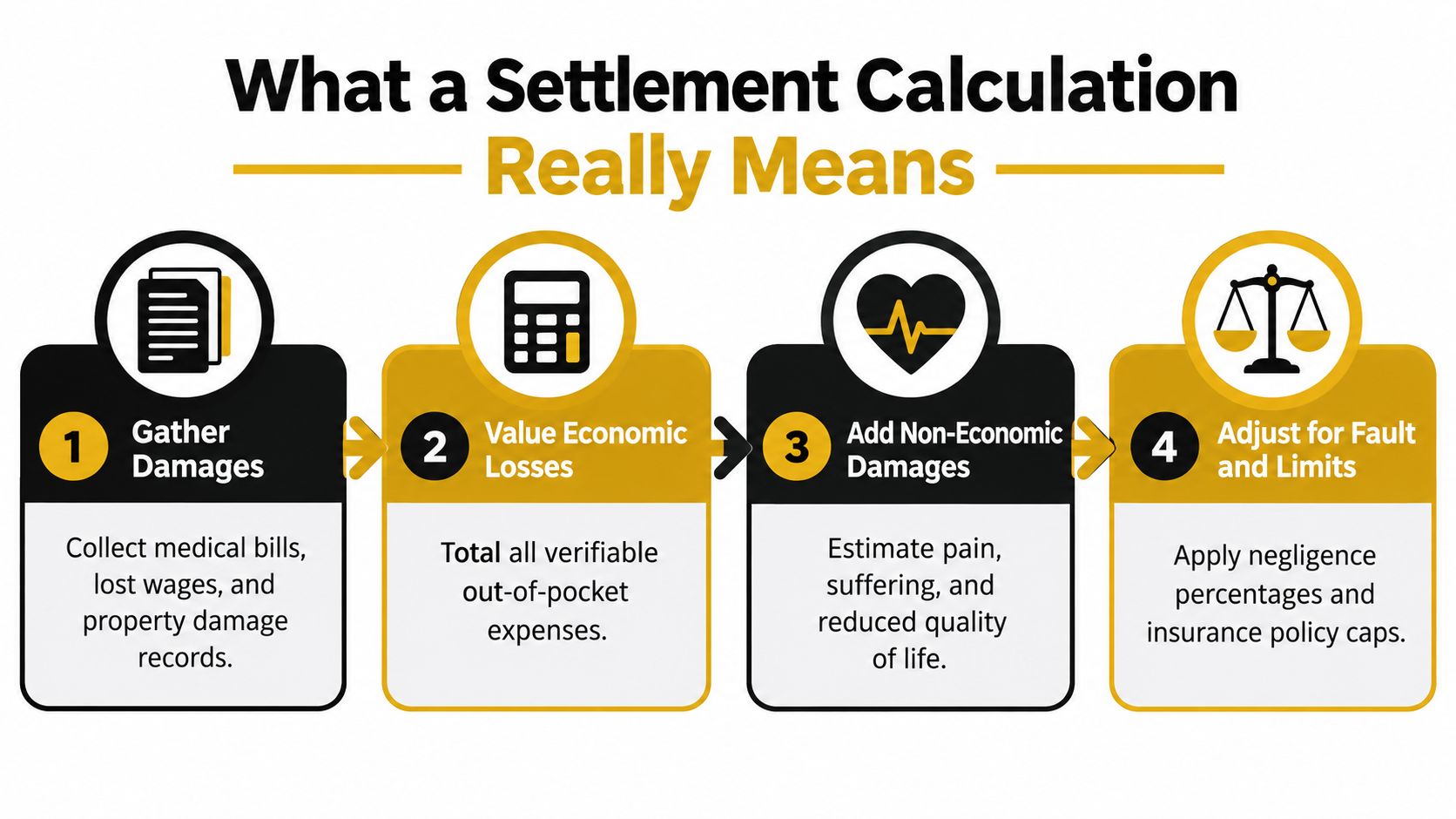
Use a four-stage framework
First, gather damages. That means itemized medical bills, wage records, repair estimates, and every out-of-pocket cost tied to the crash. Second, value economic losses by adding those verifiable numbers into a clean ledger, because insurers take a claim more seriously when every dollar can be traced to a document.
Third, add non-economic damages such as pain, emotional distress, and loss of normal life. Fourth, adjust the total for fault and policy limits, because the number you can prove is not the number you'll collect.
Practical rule: A good settlement model answers two separate questions, what was lost, and what is collectible.
Take a rear-end collision as the running example. If the front driver needs medical care, misses work, and has a damaged bumper, the raw loss might look solid on paper. But that number still has to survive questions about treatment timing, comparative fault, medical causation, and coverage.
For a plain-language resource on settlement structure, advice from SMB Law is useful because it focuses on the same basic problem, turning a pile of losses into an actual claim value. That's the right mindset. Don't chase a magic average. Build a defensible number from the bottom up.
The core distinction is simple. Documented losses can be proved. Speculative losses can't. If a loss isn't backed by records, diagnosis, or a rational future estimate, treat it as uncertain until you can support it.
Adding Up the Economic Damages
Start here, because this is the part you can prove. Economic damages are the receipts, statements, estimates, and payroll records that show what the crash cost you in dollars. If you can't tie the expense to a document, the insurer will push back hard.
Build the worksheet category by category
Use separate lines for each type of loss. Don't mash everything into one number and hope the adjuster figures it out. That's sloppy, and sloppy claims get shaved down.
| Damage Category | Example Amount | Supporting Document |
|---|---|---|
| Emergency room visit | $5,800 | Hospital bill and itemized statement |
| Follow-up visits and therapy | Not assigned here | Treatment notes and provider invoices |
| Prescription medication | Not assigned here | Pharmacy receipts |
| Work loss | $1,690 | Employer letter and wage records |
| Vehicle repair | Not assigned here | Body shop estimate |
| Out-of-pocket transportation | Not assigned here | Rideshare receipts and mileage log |
The CDC's benchmark data is a useful reality check, not a payout promise. It reports average one-year medical spending of approximately $5,800 plus $1,690 in work loss for nonfatal injuries initially treated in an emergency department, while cases requiring inpatient care averaged approximately $52,250 in medical expenses and $7,820 in work loss. Those numbers tell you why a real worksheet has to separate treatment settings and injury severity, not just dump everything into one pile.
If you want a clean wage-loss method, use a dedicated wage-loss guide like this lost wages resource and then keep the math in your claim file. That means pay stubs, employer verification, tax records if needed, and dates showing exactly when you couldn't work. Don't include the same wage loss twice if disability benefits or paid leave already covered part of it.
Do this, not that: List billed charges, payments, and balances separately. Never assume the billed number is the collectible number.
Economic damages also include future treatment when the injury isn't done. That's not a guess job. It comes from medical recommendations, expected therapy duration, and whether symptoms are improving or still unstable. If you can't support future care with medical evidence, leave it out for now instead of inflating the claim.
Valuing Pain, Suffering, and Future Care
Non-economic damages are where discipline slips. People either lowball themselves because the pain isn't on a receipt, or they inflate the number with a random multiplier they found online. Both approaches are weak. Insurers push hardest on this category because that's where subjectivity lives.
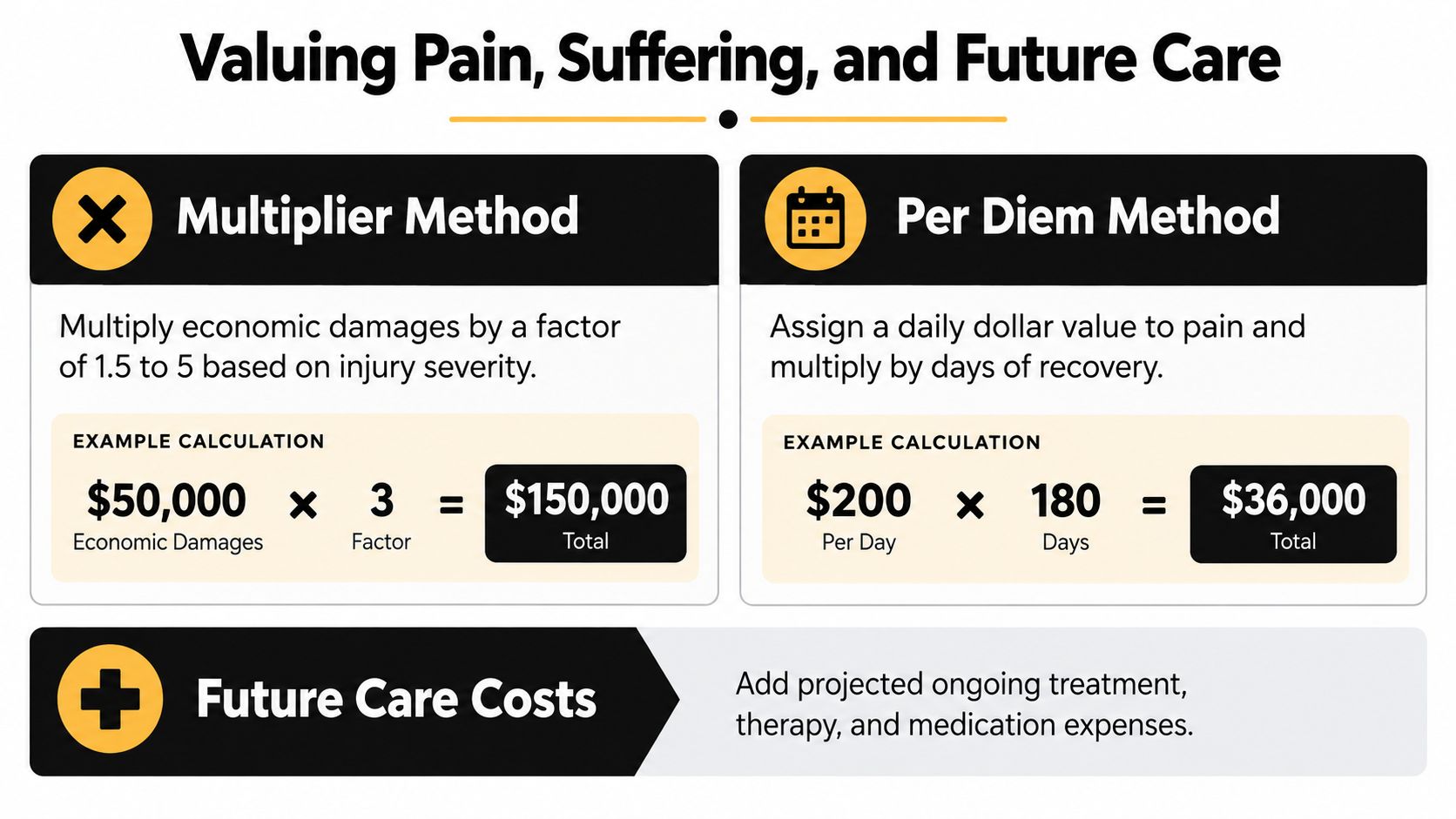
The two methods people actually use
The multiplier method takes your economic damages and multiplies them by a number tied to injury severity and recovery time. In the common range, that factor sits between 1.5 and 5, but don't treat that range like a rule. A soft-tissue claim with a short recovery won't support the same factor as surgery, chronic pain, or lasting impairment.
The per diem method assigns a daily value to pain and multiplies it by the recovery period. If the pain is intense for a fixed period, this method can fit the facts better than a blunt multiplier. Insurers often challenge the daily rate and the number of days, so the argument has to be anchored in treatment notes, activity limits, and symptom progression.
A quick example makes the difference obvious. If economic damages are $20,000, a multiplier of 2.5 gives you $50,000 in non-economic value. Under a per diem approach, a daily amount of $150 for 200 days would yield $30,000. The gap is real, which is why you need to justify the method you choose instead of assuming both produce the same answer.
Future care deserves separate treatment. Projected therapy, follow-up imaging, medication, and reduced earning capacity aren't built from a receipt. They're built from prognosis, medical records, and sometimes vocational analysis. The NHTSA's 2019 fatal-injury study estimated each fatality represented an average discounted lifetime economic cost of about $1.6 million, and about $11.3 million when quality-of-life losses were included (NHTSA fatality cost report). That's not a settlement formula, but it shows why future consequences matter.
If you're using this pain and suffering guide, keep one thing in mind, the number has to match the facts. A claim with ongoing treatment, reduced function, or permanent limitations needs a higher justification than a short recovery with full release.
Adjusting for Fault and Policy Limits
A strong damages worksheet can still collapse if liability is shared or the policy is thin. That's the part people hate, but it's the part that decides the actual check. If you calculate a $100,000 claim and the insurer only has a small coverage layer to work with, your theoretical number doesn't matter much.

Fault cuts the number first
Comparative negligence reduces the recoverable amount by the claimant's share of fault where that rule applies. If the facts say you braked late, made an unsafe lane move, or stopped abruptly, the insurer will use that to trim the value. New Jersey's insurance regulator points to police reports, witness statements, traffic laws, and roadway investigation as the evidence insurers use to assign proportional fault (New Jersey insurance guidance).
That means your job is evidence, not argument. Preserve the report, photograph the scene, save witness information, and keep the physical repair records. Fault disputes are rarely won with attitude. They're won with paper and timing.
Then the policy ceiling takes over
Even after fault is resolved, collection still depends on available coverage and assets. Start with the bodily injury policy on the at-fault driver, then check for umbrella coverage, then look at your own underinsured motorist coverage if the gap is still there. In some cases, the ceiling is set long before the negotiation starts, which is why the final payout can be far below the injury value.
Here's a simple working example. Suppose your proved damages total $60,000, but fault reduces recovery by 20%. That leaves $48,000. If the available policy only supports $25,000, the actual settlement pressure is against the lower number, not the higher one.
The best practical advice is blunt, don't talk yourself into a number that no policy can pay. If coverage is thin, the settlement range is built around collectability. That's why early policy disclosure matters, and why adjusters get so defensive when you ask for limits.
For a practical reminder on insurer conversations, avoid these mistakes with adjusters before you give a recorded statement or agree to a quick release. Once you hand them inconsistent facts, you make the fault fight easier for them.
The Long-Tail Problem Before You Sign a Release
The most expensive mistake is settling before the injury has stabilized. A quick offer can look reasonable if you only count the bills in front of you, but it can be far too low if the actual cost keeps growing. That's the long-tail problem, future treatment, lingering symptoms, work limits, and psychological fallout that don't show up in the first file dump.
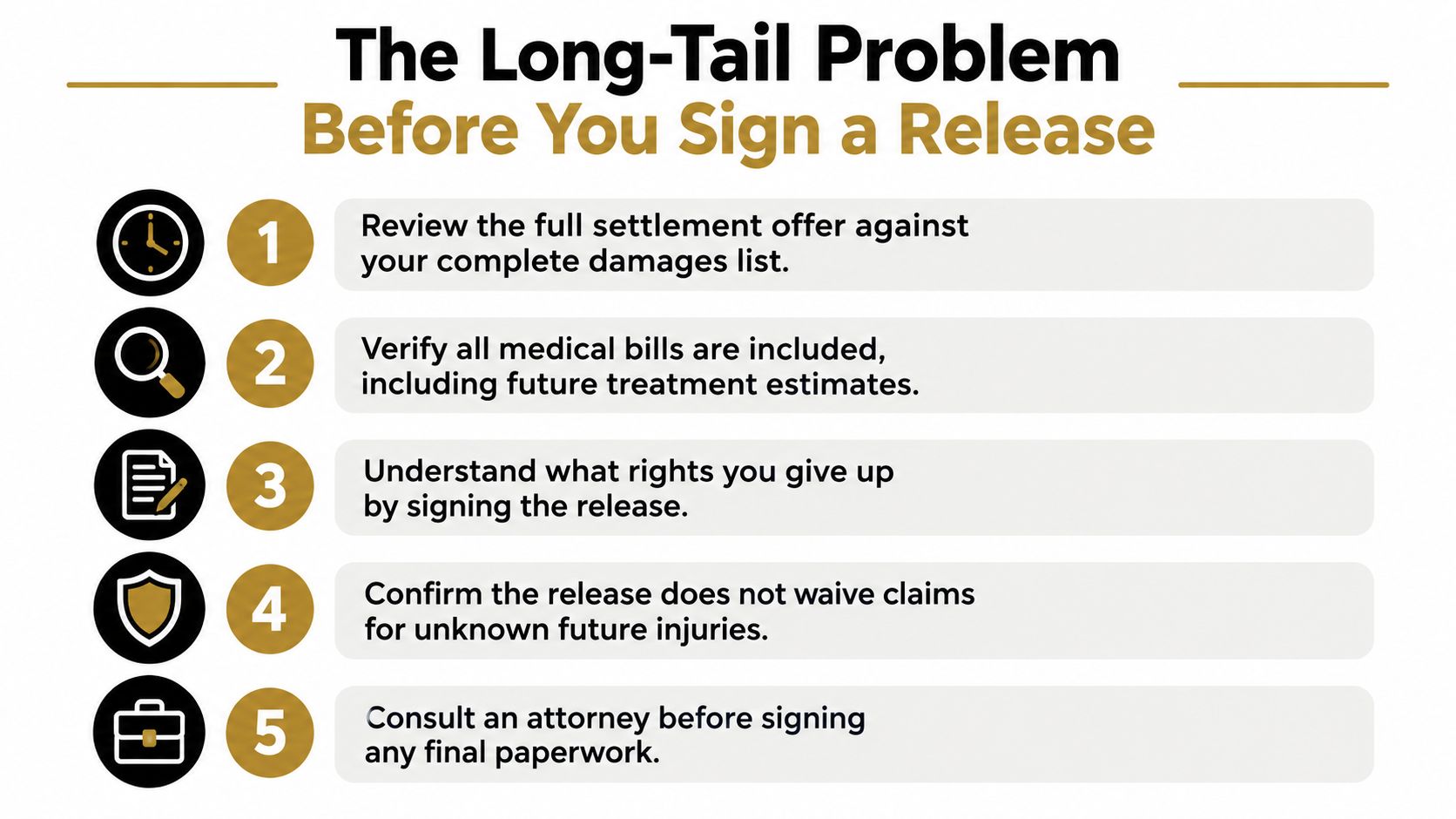
Don't sign away an unfinished claim
Claims data show medical-bill submissions per injured claimant increased 11.7% from Q3 2024 to Q2 2025, while the average third-party bodily-injury payment reached $29,900, up 9.6% from Q2 2024 (claims data summary). The point isn't that every claim is rising by the same amount. The point is that treatment costs and settlement pressure are still moving, which makes early release decisions riskier.
If your symptoms haven't stabilized, don't treat the first offer as a finish line. If you're still in therapy, waiting on imaging, unsure about surgery, or missing work in a way that could continue, the claim is still open. A release usually kills the right to come back later for more money, even if the injury turns out to be worse than expected.
Keep the evidence that shows the injury's full path. That means treatment timelines, symptom journals, photographs, provider notes, and records showing pre-existing conditions versus new complaints. It also means noting whether your work limits are temporary or permanent, because those are not the same thing and they don't get valued the same way.
Bottom line: A release is final. If the medical story isn't finished, the settlement number isn't finished either.
A claimant who signs too early may trade a recoverable future loss for a quick check. That's a bad exchange. Preserve the file until you know what's still changing.
Negotiating Solo Versus Hiring an Attorney
Some claims are simple enough to negotiate alone. Others aren't, and pretending they are usually costs money. If liability is clean, treatment is over, and the policy limit is obvious, solo negotiation can work. If any of those pieces are messy, representation starts to matter fast.
Compare the two paths honestly
A solo claimant keeps the whole settlement but also carries every mistake. That includes giving a recorded statement, missing a future-care argument, undervaluing pain and suffering, or failing to pressure-test the policy stack. A lawyer working on contingency takes a fee, but that fee buys leverage, claim development, and less room for the insurer to dictate the file.
The hard cases are easy to spot. Disputed liability, ongoing treatment, future care, commercial vehicles, rideshare crashes, low limits with stacking questions, and any claim involving vehicle technology belong on the lawyer side of the line. Allianz reported that its analysis of 20,000 motor-liability claims found rear-end collisions in flowing traffic fell by an average of 30% when automatic emergency braking was standard, raising liability questions involving sensor failures, software defects, and manufacturer subrogation (Allianz report). If that kind of technology may have played a role, you need someone who knows how to preserve the right evidence.
If you want a practical negotiation playbook, this settlement strategy resource is the kind of guide that helps before you make a final decision. It won't replace judgment, but it can keep you from making a dumb first move.
One more blunt point. If an adjuster is pushing you to close before treatment settles, that's a sign the file has value they don't want to pay later. Solo negotiators often miss that signal. Lawyers look for it immediately.
Your Settlement Worksheet and Next Steps
Use this short checklist and stop guessing. First, total every economic loss with a document beside it. Second, value non-economic harm with facts, not a random multiplier. Third, reduce the number for fault if the evidence supports that. Fourth, test the result against every likely policy source. If the number still looks solid after those steps, you've got a real settlement range.
In the next seven days, gather your ER records, follow-up bills, prescription receipts, wage proof, repair estimates, photos, the police report, and any note from the doctor about future care. If you're still treating, still losing work time, or still getting new symptoms, keep the file open. If you need organized help pulling records together, virtual paralegals can handle document assembly and timeline support while you focus on treatment.
The single mistake to avoid is simple, don't sign a release before the injury has stabilized. If your adjusted range is above the insurance available, if fault is being disputed, or if the symptoms are still changing, the calculation alone isn't enough. Get the file reviewed before you lock it in.
AskLegally helps injured people organize the facts that drive a settlement, from fault and coverage to treatment, work loss, and future care. If you want to calculate car accident settlement value the right way and compare it with what an insurer can pay, visit AskLegally and use the free case review.