
You walked away from a rear-end collision, exchanged insurance details, and felt well enough to go home. That evening seemed normal. By morning, turning your head hurts, and you're wondering whether something was missed.
Delayed symptoms after a car accident can be medically meaningful, even when you initially felt fine. The useful questions are what has changed, whether you need urgent care, and how to record the sequence accurately without guessing at a diagnosis.
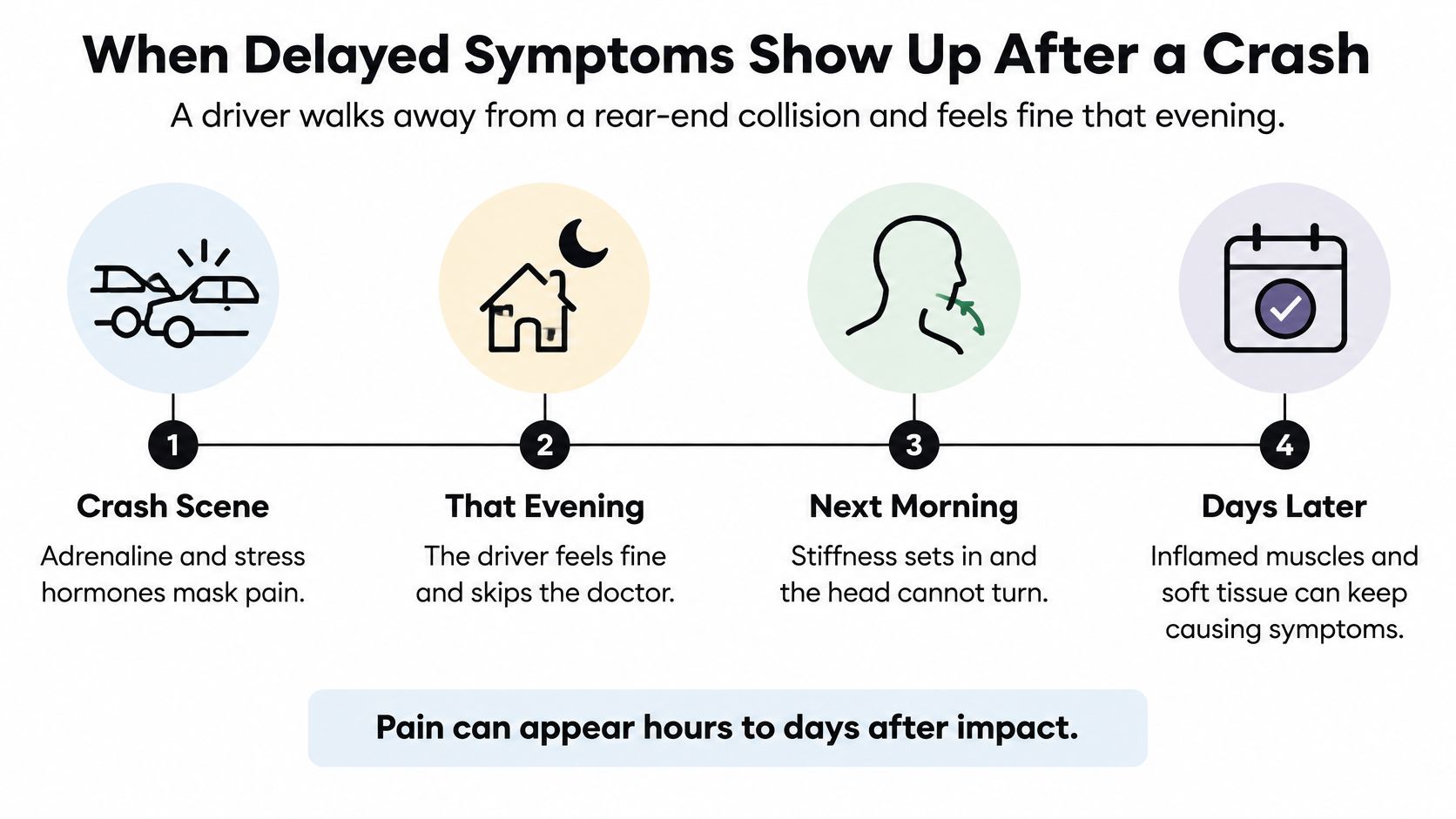
When Delayed Symptoms Show Up After a Crash
Say a driver feels shaken but unhurt at the scene. After sleeping, they notice neck stiffness while backing out of the driveway, followed by a headache at work.
That sequence doesn't necessarily mean the injury suddenly occurred overnight. Stress can make pain less noticeable during the collision's aftermath, while inflammation and muscle guarding can make discomfort more apparent later.
Timing helps, but it doesn't diagnose
Delayed symptom timeline and the right action
| Time After Crash | What Often Appears | Right Move |
|---|---|---|
| Immediately to several hours | The AAPM&R cervical whiplash review reports neck pain or related symptoms immediately or within several hours in up to two-thirds of people involved in motor-vehicle collisions, with approximately one-third experiencing later onset, sometimes as late as 48 hours. | Seek a same-day assessment for symptoms or concerns about injury. |
| Later that evening or overnight | Neck discomfort may become noticeable after the initial stress settles. | Record when you first noticed it and arrange an assessment. |
| The following day or later | Headache, shoulder discomfort, restricted turning, or pain spreading away from the neck may become apparent. | Contact a clinician promptly; worsening symptoms need faster attention. |
| During the days that follow | Dizziness, fatigue, light sensitivity, or difficulty concentrating may become noticeable during ordinary tasks. | Arrange medical review and ask about safe activity. |
| When symptoms aren't improving | Persistent discomfort or symptoms that return with activity need reassessment. | Ask whether the care plan or referral needs to change. |
| During longer-term recovery | Pain or functional limitations may continue beyond the initial recovery period. | Pursue recommended care and document practical limitations. |
These are monitoring windows, not boundaries that establish or exclude an injury. A headache noticed while reading could have a different explanation from neck pain noticed while turning, even if both appeared after the same crash.
The progression can look ordinary before it becomes limiting.
Start with what you actually noticed
Record the crash date, how you felt at the scene, and the first activity that revealed a problem. If you can't remember the exact onset, write that it's approximate rather than assigning a precise time afterward.
For practical comfort measures to discuss alongside your care plan, Thermo Recovery Wear's tips for managing whiplash symptoms offer an additional resource. Self-care shouldn't replace evaluation when pain is worsening or movement is substantially restricted.
Practical rule: Start the timeline with the crash, including periods when you noticed no symptoms. An accurate quiet period is more useful than a reconstructed story.
A normal first day doesn't rule out injury. Equally, delayed pain alone doesn't establish its cause or severity.
Injuries That Hide Behind a Normal First Day
Common delayed injuries, onset and warning signs
| Injury | Typical Onset | Signs to Track | Why It Gets Missed |
|---|---|---|---|
| Whiplash-type neck injury | May become noticeable after the initial stress settles | Stiffness, limited turning, headache near the skull's base | Feels like ordinary soreness |
| Concussion or mild TBI | May become apparent as concentration and activity resume | Headache, dizziness, memory difficulty, light sensitivity | Symptoms can be subtle or overshadowed by pain |
| Low back or disc injury | May become noticeable with sitting, bending, or walking | Back pain, leg tingling, weakness | Initially mistaken for a muscle strain |
| Shoulder or rotator cuff injury | May become noticeable when reaching or lying on the shoulder | Pain lifting the arm, night pain, weak reaching | Dismissed as seatbelt soreness |
| Abdominal or internal injury | Symptoms may not be obvious at the scene | Belly pain, dizziness, belt-line bruising | External bruising can appear minor |
| Psychological injury such as PTSD | May emerge during recovery | Flashbacks, disturbed sleep, avoidance of driving | Mistaken for stress that must simply be endured |
These patterns aren't a way to diagnose yourself. The same symptom can come from different problems, and a clinician needs to consider the examination, crash history, medications, and previous health conditions.
Mild at first doesn't mean brief
In a prospective study of 948 people evaluated in emergency departments within hours of a motor-vehicle collision, 70% reported pain in at least one body region six weeks later, according to the study published in Pain. That finding concerns people assessed in emergency departments, not every person involved in a collision.
A 2025 PubMed-indexed study reported that more than 50% of people diagnosed with whiplash-associated disorder continued to report symptoms 12 months or more after symptom onset. Persistence is possible, but it isn't a prediction of your recovery.
Mental health symptoms also deserve treatment rather than dismissal. A 2024 prospective study in Frontiers in Public Health followed 239 road-crash survivors and found PTSD in 39.6% at six months and 21.1% at 12 months after injury.
Describe the limitation, not just the pain
Useful details include whether you can lift a shopping bag, sit through a meal, tolerate a computer screen, or travel in a vehicle. For emotional symptoms, note nightmares, panic as a passenger, or changes in sleep without trying to diagnose PTSD yourself.
New head-injury symptoms or abdominal pain warrant same-day medical assessment even when the discomfort seems mild. Abdominal pain with faintness, marked weakness, or worsening tenderness calls for emergency evaluation, not home monitoring.
Warning Signs That Need Urgent Care
Feeling worse and not knowing whether to wait can be unsettling. Choose the response based on the symptom and its progression, not on whether you felt fine earlier.
The CDC's traumatic brain injury guidance identifies the emergency neurological signs below and recommends follow-up when concussion symptoms worsen, become more apparent with normal activity, or don't improve within 2–3 weeks.
Red flags and the right response
| Sign | Action | Timing |
|---|---|---|
| Headache that keeps getting stronger | Go to an emergency department | Immediately |
| Repeated vomiting | Go to an emergency department | Immediately |
| Seizure | Call emergency services | Immediately |
| New weakness, numbness, or slurred speech | Seek emergency evaluation; don't drive yourself | Immediately |
| Growing confusion, unusual drowsiness, or unequal pupils | Seek emergency evaluation | Immediately |
| Cannot be woken normally | Call emergency services | Immediately |
| Headache, dizziness, or fatigue that isn't improving | Contact the treating clinician | Arrange reassessment rather than continuing to wait |
| Symptoms worsen after ordinary activity resumes | Reduce the triggering activity and contact the clinician | Promptly |
| Neck pain spreading into the arm or hand | Seek medical assessment | Promptly; new numbness or weakness requires emergency assessment |
| Sleep trouble, flashbacks, or fear of driving | Request medical or mental health support | When symptoms disrupt sleep, travel, work, or daily life |
Match activity to safety
After suspected concussion, indefinite bed rest isn't the default. The CDC's patient discharge instructions recommend a short initial rest period followed by gradual return to ordinary activity, reducing activity if symptoms worsen.
A quiet desk task and operating a forklift aren't equivalent. Ask for individualized medical advice before driving, working at heights, operating machinery, or doing other safety-sensitive tasks if dizziness, slowed thinking, or visual symptoms remain.
Temporary changes may include rest breaks, reduced hours, less screen exposure, or altered duties. Record which task triggered symptoms and what restriction the clinician recommended.
For uncomplicated back soreness after assessment, SunnyBay's heating pad precautions for sore backs can help you consider safer comfort measures. Heat isn't a test for whether an injury is serious.
New neurological changes require action now. Don't wait for an insurer to authorize a response.
How to Get Checked and Record Symptoms
A clear record makes the medical picture easier to follow. You don't need legal language or an elaborate journal, just accurate descriptions that distinguish what you experienced from what a clinician diagnosed.
Build a usable medical timeline
Seek an appropriate assessment. Arrange same-day medical advice after the crash, particularly if you have symptoms, a head impact, or concerns about injury; use emergency care for warning signs. If symptoms emerge after you've gone home, explain that they're new rather than assuming the earlier absence of pain settles the question.
Describe the impact and every affected area because these details help the clinician decide what to examine. Mention head contact, any loss of awareness, neck or back pain, and pre-existing symptoms that have changed, without guessing what structure was injured.
Schedule follow-up before you leave. The Massachusetts mild traumatic brain injury treatment guideline recommends early follow-up within a few days or roughly 7–10 days after mild traumatic brain injury to reassess symptoms and readiness to advance activity. Normal initial imaging doesn't eliminate the need for symptom-based reassessment.
The basic process is straightforward, even when symptoms aren't.
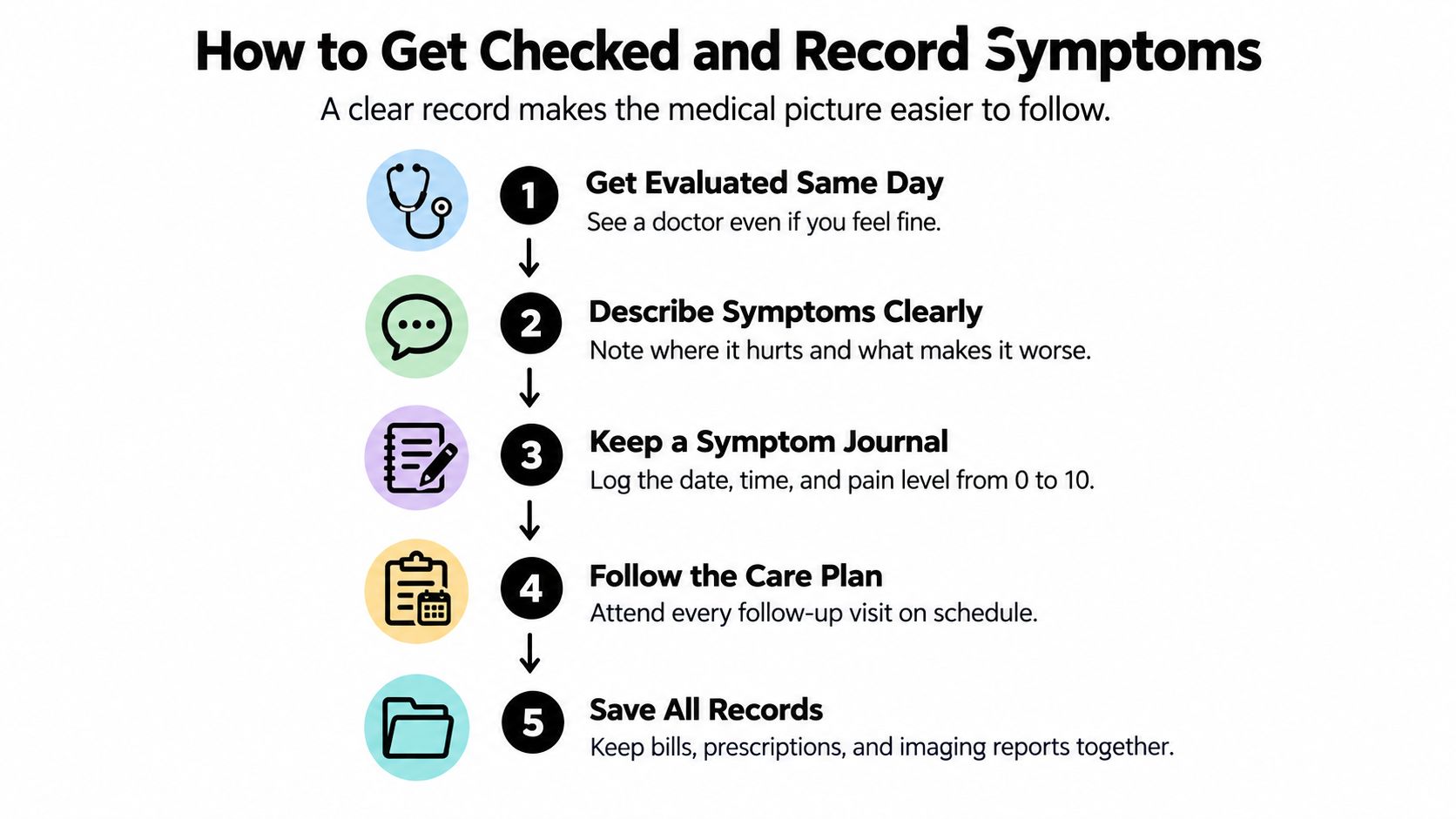
Keep a dated symptom log. Include when the symptom appeared, where you felt it, what you were doing, and what happened afterward. Plain descriptions such as mild, moderate, or severe are useful when paired with a concrete limitation, such as having to stop reading because of dizziness.
Store appointment summaries, prescriptions, work restrictions, receipts, missed-shift records, and pay stubs together so you can match medical advice with its practical effects. Keep crash documents separately within the same folder; our guide to obtaining a police report explains how to request that record.
Follow the care plan and explain interruptions. If cost, transportation, childcare, or appointment availability prevents attendance, tell the clinic and keep a note of the obstacle. Don't continue unnecessary treatment for appearances, but don't silently abandon recommended care either.
Make each entry specific
Say a headache appeared during computer work and eased after stopping. Record the task, the symptom, the change after rest, and any advice you received rather than writing only that you had a bad day.
If symptoms persist, ask whether you need concussion-focused, rehabilitation, balance, vision, sleep, or mental health assessment. Documentation supports medical reasoning, but it doesn't automatically prove that the crash caused every later problem.
How to Protect Your Claim With Insurers and Evidence
An adjuster may ask why symptoms weren't reported at the scene or why treatment began later. A factual sequence helps you answer without overstating what you know.
Keep your correspondence and practical records together.
Report facts and preserve originals
Notify your insurer promptly under your policy's requirements, describing symptoms as still being evaluated rather than naming an unconfirmed diagnosis. Our guide to filing an insurance claim can help you organize the reporting process.
Request the official police report and save the report number, agency, and crash location because these identify the relevant incident. If you notice an error, ask the issuing agency about its correction procedure rather than editing the report yourself.
Save photographs and original files, including vehicle damage, the scene, and visible injuries as their appearance changes. Preserve original timestamps and don't use filters or edits that could obscure what the photographs show.
Before a recorded statement, medical authorization, or settlement release, understand what you're being asked to provide because these documents serve different purposes. Policy cooperation obligations may apply, but an authorization can permit access to records, while a release may end claims against the parties it covers.
A verbal explanation is easier to give when you have your records available.
Keep a dated communication file with adjuster names, claim numbers, emails, letters, and summaries of calls. Confirm important instructions in writing so you aren't relying on memory.
Evaluate a settlement against the diagnosis, treatment plan, and documented losses rather than accepting it solely because it arrives quickly. Ask what the release covers and whether unresolved care needs have been considered.
Separate coverage questions from injury questions
Our workers' compensation guide notes that late injury reporting is one reason those claims get disputed. That's a different system from auto insurance, so don't assume its procedures or deadlines apply to your crash.
For readers reviewing policy expenses separately, Liberty Insurance Associates explains what affects New Jersey car insurance costs. Premium questions don't determine whether a particular injury is covered or establish its value.
These steps help preserve an explainable record. They don't require arguing with an adjuster or promising that every expense will be paid.
When to Talk to a Personal Injury Lawyer
Situations that call for a lawyer consultation
| Situation | Talk to a Lawyer? | Why It Matters |
|---|---|---|
| Diagnosed injury needing ongoing treatment | Yes, early | Future care and costs need careful documentation |
| Insurer disputes the injury or delays payment | Yes | You need to understand the dispute and applicable deadlines |
| Settlement offered before the diagnosis is clear | Yes, before signing | A release may waive later claims |
| Fault or liability is disputed | Yes | Responsibility can affect available recovery |
| Missed work or lost income | Yes | Wage loss needs supporting records |
| Other driver uninsured or underinsured | Yes | Your own policy may provide relevant coverage |
| Soreness resolved, with no bills or other losses | Usually not yet | Keep notes and monitor for changes |
A lawyer is most useful when the injury, financial consequences, or insurer's position is no longer straightforward. A consultation can help distinguish a documentation problem from a coverage dispute or a disagreement over responsibility.
Complexity matters more than dramatic pain
Ongoing treatment can create uncertainty even when pain is manageable. You may need help evaluating unresolved expenses, work limitations, and the implications of a proposed release.
Missed income also isn't limited to a completely missed paycheck. Reduced hours, unpaid appointments, or an inability to perform usual duties can require different supporting records, so preserve employer communications and written restrictions.
Our guide to reasons to get a lawyer after a car accident offers additional decision criteria. Seeking advice doesn't mean you must start a lawsuit.
Bring what you have
You don't need every detail ready before requesting a review. Helpful materials include:
- The injury date and reporting history: Explain when and how the crash and symptoms were reported.
- Claim paperwork: Include coverage correspondence, disputed items, and any proposed settlement documents.
- Medical records: Bring visit summaries, diagnoses, treatment recommendations, and restrictions.
- Income records: Include pay stubs and information about missed or reduced work.
A consultation is a chance to understand your options, not an obligation to hire.
If you've already described yourself as unhurt, tell the lawyer exactly what you said and what happened afterward. Don't revise the original account to make it sound more consistent; the purpose is to evaluate the actual sequence.
For minor symptoms that resolve without treatment costs, work loss, or a dispute, keeping records and monitoring may be reasonable. Reconsider that decision if new symptoms or unresolved expenses appear.
Confirm Your Next Step Today
You don't have to resolve the medical diagnosis and insurance claim at the same time. Finish the immediate tasks, then leave yourself a clear next action.
- Confirm your medical assessment: Arrange appropriate care now if you haven't been checked or new symptoms need review.
- Anchor your symptom log: Include the crash date and distinguish later recollections from entries made at the time.
- Verify the insurance report: Confirm the accident is on file and accurately describe injuries that remain under evaluation.
- Set the next review date: Record your medical follow-up and confirm any applicable claim deadlines.
Choose optional claim guidance when you're ready
Our free Accident Claim Value Assessment reviews facts that can affect how an accident claim is handled, provides immediate guidance, and requires no contact details. It's an optional way to organize claim questions, not a medical assessment or a guarantee of compensation.
For people who haven't hired an attorney, a free case review with a participating personal injury lawyer is also available. You can request a review with the information you currently have.
Handle the medical side first, then the claim side. Whenever symptoms change, update the timeline and choose the next action based on what's happening now, not on how you felt at the scene.
AskLegally offers practical accident guidance and a free case review for people who haven't hired an attorney. If delayed symptoms have left you unsure how to document an injury or respond to an insurer, visit AskLegally to explore your next step.