
You're standing in a tow lot with a sore neck, a phone at low battery, and an insurer already asking for a recorded statement. Or you're home from urgent care, unsure if the stiffness will fade or become weeks of treatment. In that moment, do I need a lawyer after a car accident isn't a legal trivia question. It's a practical decision about money, health, and what you might sign away before you know what this crash will cost you.
The First 48 Hours After a Crash
The first two days usually feel deceptively simple. You exchange insurance details, take a few photos if you can, get checked out, and tell yourself you'll sort the car tomorrow. Then the calls start, the rental question comes up, work asks when you're coming back, and pain that wasn't obvious at the scene shows up while you're trying to sleep.
That mix of adrenaline and decision fatigue is normal. It's also why you shouldn't judge your need for legal help by how the car looks or how you felt in the first hour. A bent bumper can hide a straightforward property claim. It can also hide delayed symptoms, missed shifts, and a dispute about who changed lanes.
What Matters Most Right Now
Get a medical evaluation promptly, even if you're tempted to wait it out. Early records connect symptoms to the crash while details are fresh, and they give you a baseline if your condition changes. Follow discharge instructions, keep appointment paperwork, and note new symptoms with dates rather than relying on memory later.
Be careful with insurer conversations. Report basic facts to your own insurer, but don't speculate about fault, minimize pain, or agree to a recorded statement for the other driver's insurer until you understand why it's being requested. You can say you're still being evaluated and will respond after you've reviewed the information.
- Save everything: Photos, receipts, tow paperwork, discharge papers, and texts can all become evidence.
- Write your own account: Record what you remember about speed, signals, weather, and what each driver said.
- Slow down signatures: Don't sign a release or accept payment described as final until you know what claim you're giving up.
For a practical walkthrough of those immediate steps at the scene and in the days that follow, John Sherman car accident help offers useful context for organizing your first calls and documents.
Practical rule: In the first 48 hours, protect your health and preserve information. You don't have to decide on full representation before you know your diagnosis.
That staged approach is the right frame for the whole claim. Your answer can change as medical facts, fault evidence, and insurer behavior become clearer.
Why the Decision Is Staged, Not Binary
Ask the question as if there's one door marked hire and another marked handle it alone. Real claims don't work that way. Legal help comes in levels, and the useful question is which level matches what you know right now.
Checking for side exits on a highway works similarly. You do not commit to every turn at mile one. You reassess when conditions change, a warning light comes on, or the route you expected turns out to be blocked.
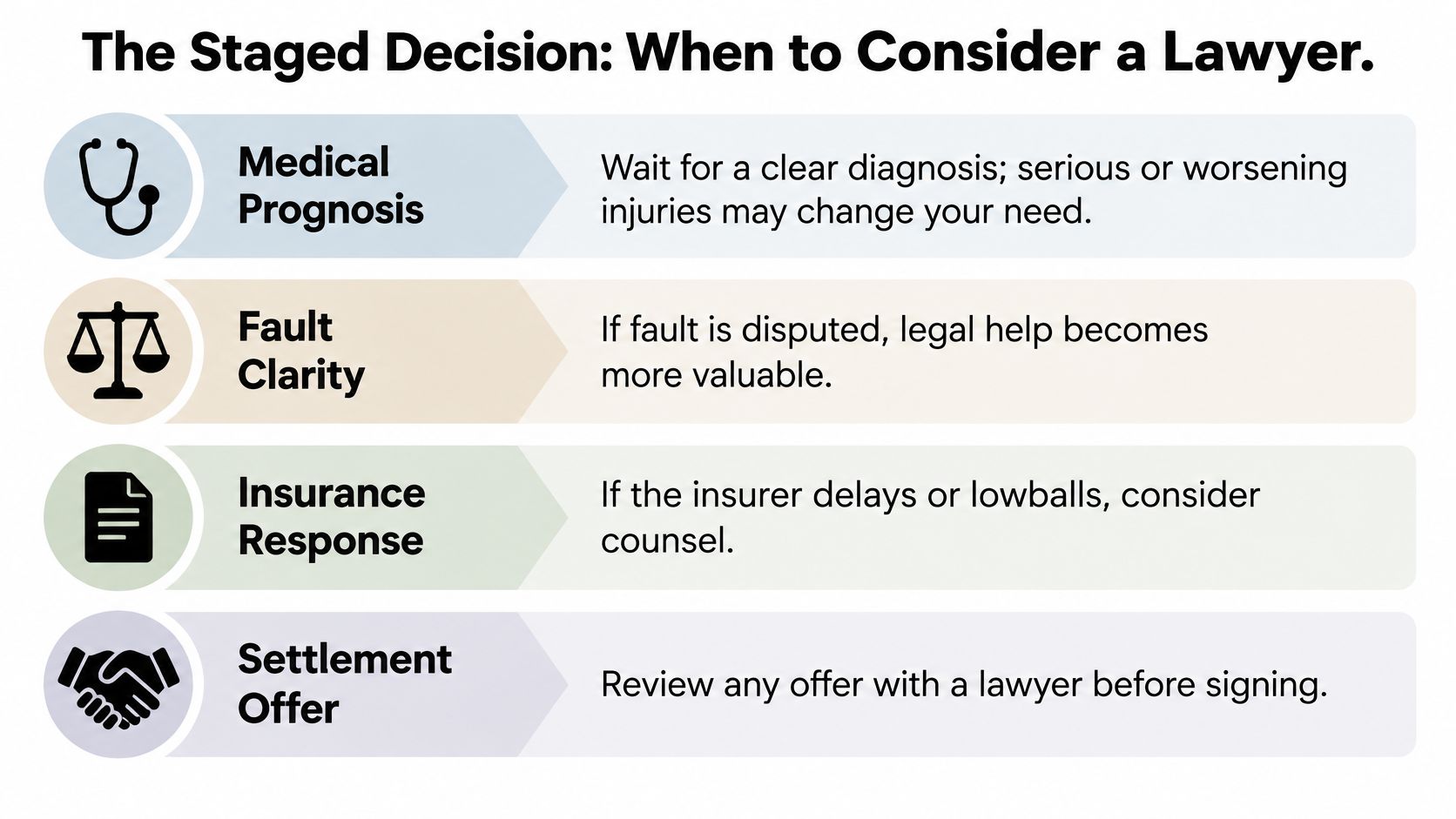
The staged checkpoints below show where a brief consultation may be enough, and where full representation starts to make more sense.
Four Checkpoints to Revisit
First, medical uncertainty. If treatment is finished, symptoms have resolved, and bills are known, valuation is simpler. If you're waiting on imaging, referrals, or answers about future care, settling now means guessing. That guess usually favors the insurer because a release typically ends the claim.
Second, fault clarity. Clear liability with consistent witness and photo evidence is different from a crash where each driver blames the other. Shared fault allegations can reduce or complicate recovery depending on local rules, so disputed facts raise the value of legal advice quickly.
Third, insurer behavior. Delays, requests for broad medical authorizations, pressure for a recorded statement, or a fast offer before treatment ends are escalation signals. A cooperative property damage process may not need counsel. A bodily injury claim that's being minimized is a different matter.
Fourth, deadlines and paperwork. Limitation periods, reporting rules, and policy notice requirements vary by jurisdiction. Missing one can matter more than negotiating skill. Ask early what deadlines apply, even if you plan to manage documents yourself for now.
Timing data supports asking sooner rather than later. Survey reporting found that nearly half of claimants who hired an attorney made contact within days and roughly 80% did so within several weeks, with injury severity and concern about fair compensation as leading motivations and cost as the leading reason people declined.
My recommendation is staged help. Get early advice when uncertainty is high, keep managing simple documentation yourself if appropriate, and escalate if fault, treatment, or negotiations deteriorate.
Scenarios Where a Lawyer Usually Matters
Some patterns should move you from monitoring the claim to getting counsel involved. The common thread isn't drama. It's unresolved exposure, meaning the final medical, income, or liability picture could be substantially different from what an early offer assumes.
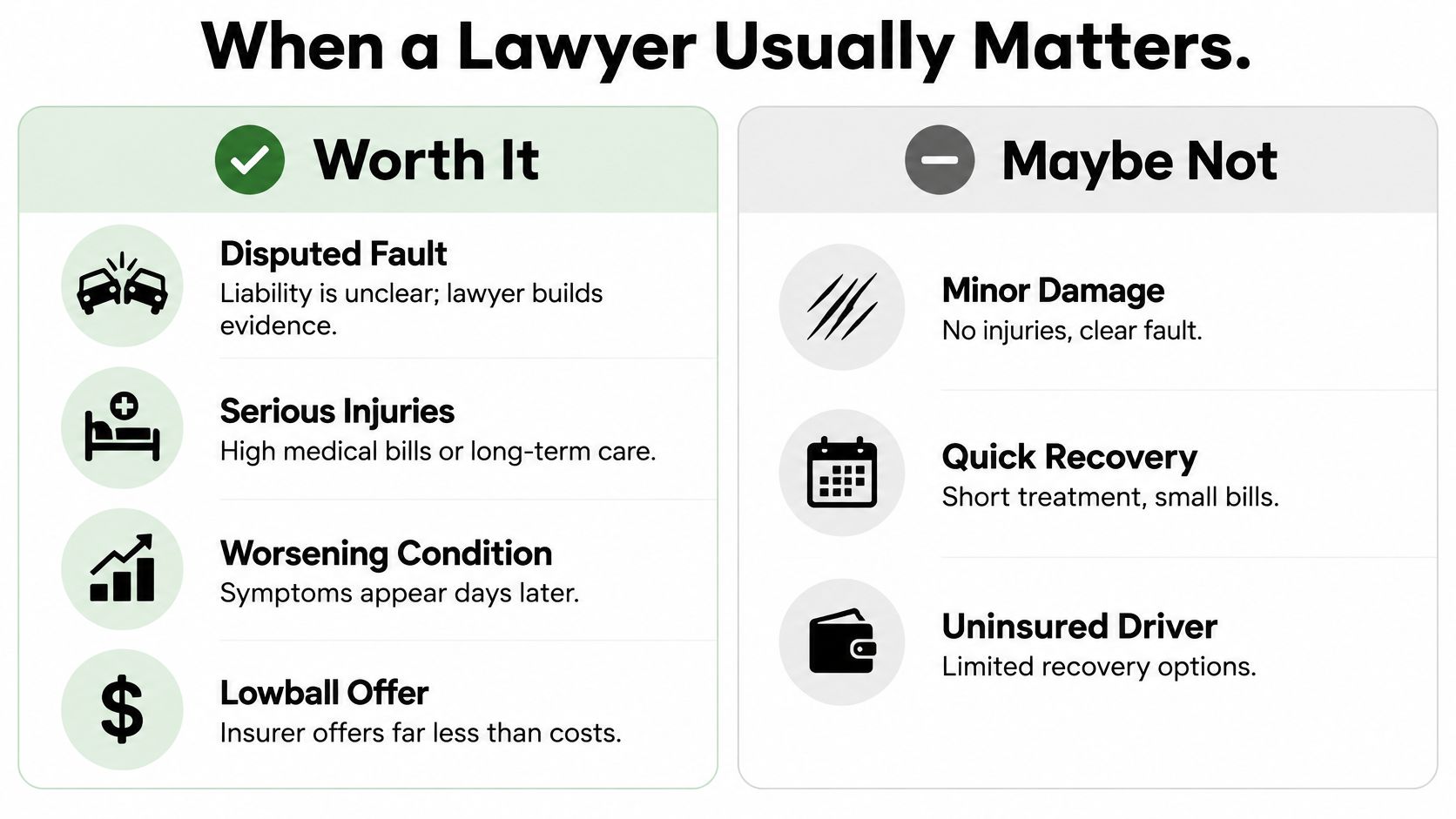
This comparison separates situations where representation commonly changes the work from those where it may add cost without adding much benefit.
High Stakes Patterns
Disputed fault matters because the insurer isn't just pricing your injury. It's contesting whether it owes anything, or how much responsibility its driver bears. A lawyer can develop witness, video, vehicle damage, and scene evidence before accounts harden.
Serious, worsening, or delayed injuries matter because future treatment and work limits drive value. Surgery, injections, prolonged therapy, permanent restrictions, or symptoms that appear days later all make early valuation unreliable. You need medical causation documented clearly, not assumed.
Multiple vehicles, multiple insurers, or commercial and government vehicles add layers of coverage and procedure. Each insurer may point at another, policy limits may be unclear, and notice rules can differ. Coordination alone can justify representation.
Uninsured or underinsured drivers change the source of recovery. Your own policy may become central, which puts you in a negotiation with an insurer you'd normally expect to help you. Don't assume that relationship removes conflict.
The pattern shows up in claims data. In a sample of more than 80,000 auto injury claims closed with payment, 52% of bodily injury claimants hired attorneys in 2017 compared with 39% of no fault PIP claimants. That gap makes sense because bodily injury claims often require proving negligence and valuing future losses.
For a plain language overview of how these scenarios affect your options, watch the video below before you respond to an adjuster's next request.
By contrast, a property damage only claim with clear fault, no injury, and a repair process that's moving normally may not need a lawyer. Do get advice if you're asked for a recorded statement you don't understand. Don't accept an early settlement while treatment, fault, or coverage remains unresolved.
What Lawyers Actually Cost and What the Data Shows
Cost is a legitimate reason to pause. A lawyer isn't automatically a financial win, and any advisor who promises otherwise isn't being straight with you. Your job is to compare net recovery, not the headline settlement number.
Most personal injury lawyers use a contingency fee, meaning the fee is a percentage of money recovered rather than an hourly bill paid upfront. Case expenses may be separate, and medical bills or liens may still need to be paid from the recovery. Ask how each item is handled before you sign, because two offers with the same gross amount can leave you with very different net results.
The Trade Off in the Numbers
A 2026 Insurance Research Council study reported that represented bodily injury claimants waited a median of nearly 440 days for claim closure and netted $1.40 per dollar of medical bills after fees, compared with $1.80 for unrepresented claimants, while total settlements averaged $2.00 per dollar of medical bills before fees. Represented claims also took more than twice as long as unrepresented claims in that study.
| Metric | Represented claimants | Unrepresented claimants |
|---|---|---|
| Median time to closure | Nearly 440 days | Less than half that time |
| Net per dollar of medical bills | $1.40 after fees | $1.80 |
| Total settlement context | $2.00 per dollar of medical bills before fees | Not stated the same way |
Read that table carefully. It doesn't prove representation hurts every claimant. Represented cases may involve more serious injuries, disputed liability, or larger losses that naturally take longer and require more work. It does prove you shouldn't hire counsel for a simple claim on the assumption that a bigger gross settlement always means more money in your pocket.
Use a structured estimate before you decide. A guide to how car accident settlement calculations treat medical bills, lost income, and other losses can help you build a realistic worksheet, then subtract fees, expenses, and amounts owed for treatment.
Don't ask only what a lawyer might recover. Ask what you're likely to keep, how long it may take, and what complexity justifies the trade.
If fault is clear, treatment is brief, and bills are fully documented, handling the claim yourself may be reasonable. If valuation requires future care, wage loss, experts, or a fight over liability, paying for an advantage can be the more rational choice.
Evidence to Gather Before You Call Anyone
Good evidence helps whether you negotiate alone or hire counsel later. Start now, because video gets overwritten, vehicles get repaired, and witnesses become harder to reach. Organize files by date so another person can follow the story without asking you to reconstruct it from memory.
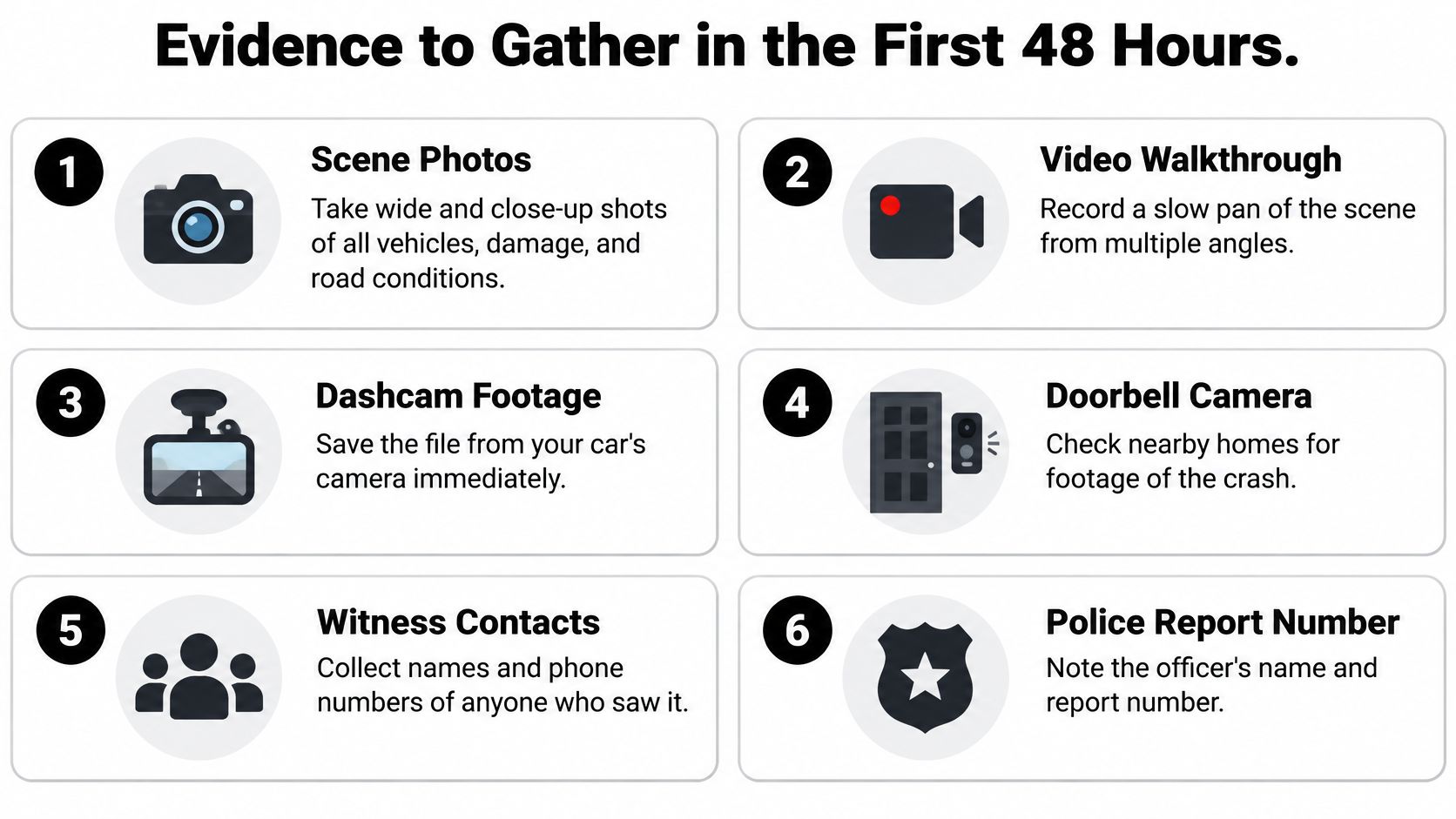
The checklist below covers the first items to secure while the scene and your early treatment are still recent.
Your Evidence File
- Scene photos and video: Capture wide shots, close damage, license plates, signals, skid marks, weather, and road conditions from multiple angles.
- Dashcam and nearby footage: Export your file immediately and ask nearby homes or businesses promptly whether doorbell or security video exists.
- Witness information: Save names, phone numbers, and a short note on what each person saw, not just that they were present.
- Crash report details: Keep the report number and officer information, then review the completed report for errors.
- Medical records and bills: Keep discharge papers, imaging, prescriptions, referrals, therapy notes, and every bill or explanation of benefits.
- Income proof: Save pay stubs, schedules, employer notes, and records of missed shifts or reduced duties from the first absence onward.
- Insurance communications: Log dates, names, claim numbers, requests made, and promises given. Save voicemails, emails, letters, and texts.
If you don't yet have the official report, follow the process for obtaining a police report and checking the details recorded about your crash. A saved text or voicemail can later matter if an adjuster's account differs from yours, and wage documentation is easier to build while your employer still has the schedule in front of them.
The scale of crash documentation is enormous. NHTSA estimated 6,138,359 police reported traffic crashes in 2023, causing 40,901 deaths and approximately 2,442,581 injuries, about five injured people every minute, with injuries 2.5% higher than in 2022.
You can't control how crowded that system is. You can control whether your file tells a clear, dated, documented story.
What a Lawyer Does for You at Each Stage
Representation shouldn't feel like a black box. At intake, a lawyer should identify the parties, insurers, deadlines, treatment status, and immediate risks. You should leave knowing what documents are needed, who will contact insurers, and what decisions remain yours.
During investigation, the firm gathers the crash report, photos, video, witness statements, vehicle information, and policy details. Medical record review comes next, with attention to diagnosis, causation, prior conditions the insurer may raise, future treatment recommendations, and work restrictions. That record work is often where claim value is built or lost.
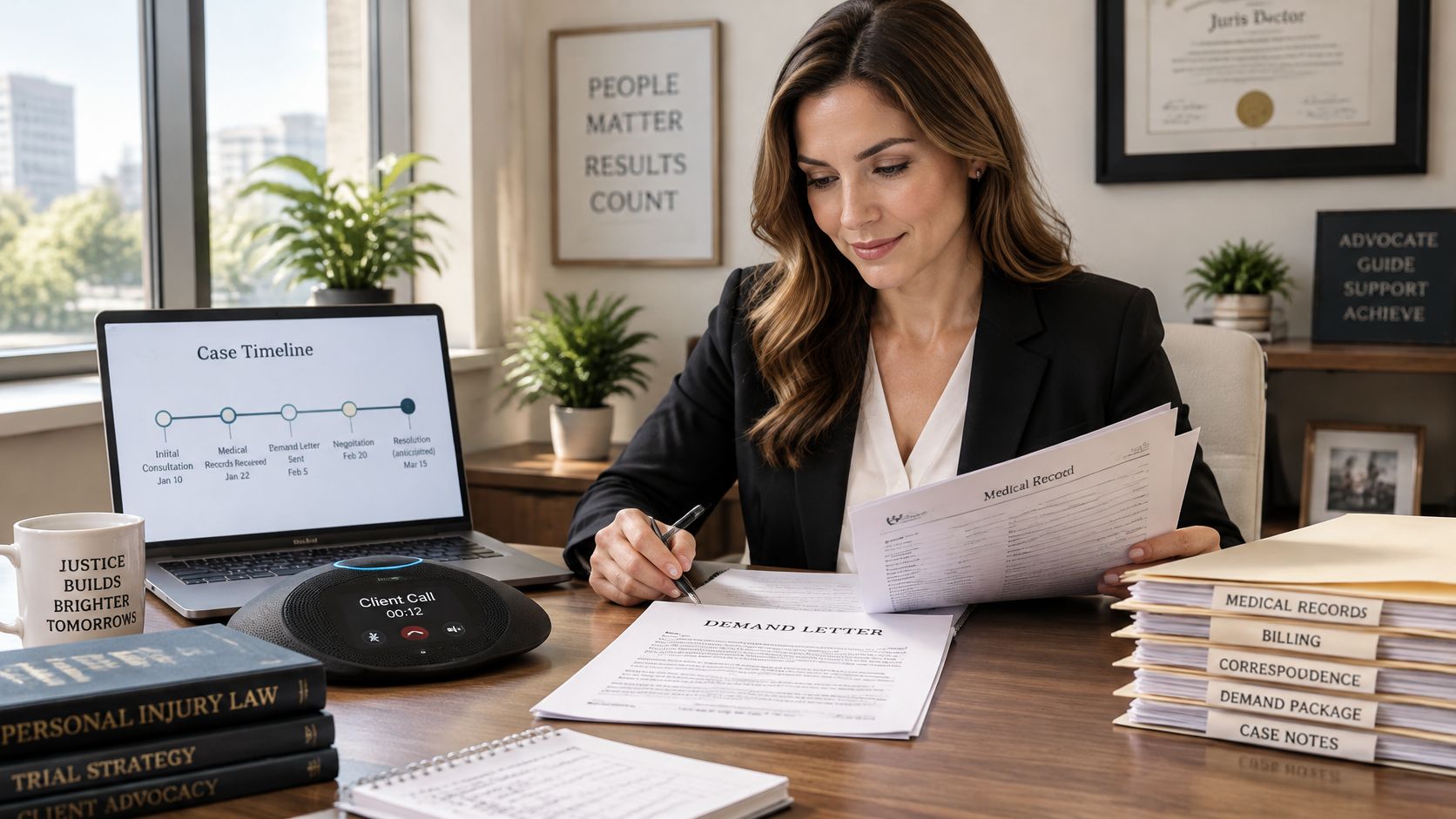
The image below reflects that less visible stage, where treatment records are turned into a documented demand rather than a stack of disconnected bills.
From Demand to Resolution
A demand package typically explains liability, summarizes treatment, itemizes bills and wage loss, and supports the amount requested with records. Negotiation follows. Your lawyer should explain each offer in net terms, including fees, expenses, and medical amounts still owed, before recommending acceptance or rejection.
If talks stall, litigation may involve filing suit, exchanging evidence, taking testimony, and preparing for mediation or trial. That step can increase pressure, but it also adds time, expense, and uncertainty. A good lawyer doesn't treat filing suit as automatic. They explain why the expected benefit justifies it in your case.
At settlement, expect to review a release, which is the document that typically ends claims in exchange for payment. Lien resolution then addresses amounts that may need repayment from the recovery. Ask for a written closing breakdown before funds are disbursed so there are no surprises.
Compare that service to your stage. If you only need a document review before signing, say so. If you need someone to prove fault, coordinate coverage, and negotiate future losses, full representation matches the workload. The best fit is specific, not bundled by default.
Questions to Ask Any Lawyer You Consider Hiring
Interview lawyers like you're hiring a professional to manage a consequential financial claim, because that's exactly what you're doing. Don't default to the first search result or the firm that calls back fastest. Compare two or three options using the same questions.
Start with money. Financial pressure after a crash is common, and claims research reported that 26% of auto insurance customers had deductibles of at least $1,000, 7% avoided filing a claim because they feared higher premiums, and total loss claims rose to 27%, up from 16% in 2022.
Questions That Reveal the Real Terms
- What's your contingency percentage: Ask whether it changes if suit is filed or the case goes to trial.
- Who pays case expenses: Clarify whether expenses are deducted before or after the fee, and what happens if there's no recovery.
- Who handles my case day to day: Get the name of your regular contact and how often you'll receive updates.
- How many similar cases do you handle: Ask about experience with disputed fault, underinsured drivers, or your type of injury.
- What's your trial experience: Even if settlement is likely, trial readiness affects negotiation credibility.
- What timeline should I expect: Ask what could speed it up, slow it down, or change the strategy.
- What documents do you need from me: A clear list signals an organized intake process.
Watch for red flags. Guarantees of a specific dollar amount, pressure to sign immediately, vague answers about expenses, or refusal to explain net recovery should end the conversation. You should also be wary if nobody asks about treatment status, insurance coverage, or deadlines.
For a broader framework on comparing credentials and communication style, use this guide on choosing the right legal partner for your situation. A free case review is an initial screen, not the same thing as formally retaining a firm. Retention begins when you agree to the representation terms, so read them before signing anything.
Your Next Steps This Week
Turn the decision into a sequence you can finish this week. First, complete your medical follow up and write down every symptom, restriction, prescription, and referral. If your condition is worsening or your prognosis is unclear, treat that as a reason to get advice before discussing settlement.
Second, request the crash report and build one folder for photos, bills, wage records, policy pages, and insurer communications. Add a simple log with the date, person, and substance of every call. Organization isn't administrative neatness. It's how you spot missing evidence while you can still get it.
Run Your Own Checkpoint Review
Ask yourself five direct questions. Is treatment complete? Is fault disputed or shared fault being alleged? Has an insurer requested a recorded statement, broad authorization, or signed release? Is available coverage unclear? Are medical bills or lost income still accumulating?
If you answered yes to any of them, book a short decision call before you negotiate further. If every answer is no, your claim may remain suitable to handle yourself while you keep monitoring symptoms and deadlines. That's the staged model in action, and it's more reliable than deciding from vehicle damage alone.
Escalation test: The more unresolved medical, fault, coverage, or income questions you have, the less sense it makes to accept a final settlement now.
One low commitment option is AskLegally, which offers a free case review for people who haven't retained an attorney and may connect them with participating personal injury lawyers if attorney review appears appropriate. Use that kind of review to test your checkpoint answers, not as a substitute for reading a fee agreement carefully.
Finally, verify local deadlines and rules. Limitation periods, reporting requirements, no fault rules, and fee arrangements vary by jurisdiction. Confirm what applies where your crash occurred, put the dates in writing, and revisit the question whenever your medical or insurance situation changes. Do I need a lawyer after a car accident is rarely answered well in one anxious phone call. It's answered in stages, with evidence.
If you're unsure whether your symptoms, disputed fault, or an insurer's early offer justify hiring counsel, visit AskLegally for a free case review that helps you assess your situation before you sign a release or retain a firm. Bring your crash report, medical paperwork, photos, and insurer messages so you can get a clearer next step based on your actual claim, not a generic yes or no.