
The adjuster calls while you're still sore, your car is at the shop, and the medical bills haven't arrived. They ask for a recorded statement, then mention a settlement amount that sounds useful because you've already missed work. You don't yet know whether it covers what the crash will cost.
Learning how to negotiate with an insurance adjuster starts with separating immediate financial pressure from the evidence needed to value your claim. Your strongest position isn't merely a higher demand. It's a documented counteroffer, a clear explanation of disputed losses, and a realistic estimate of what you'll keep after bills, reimbursement claims, and future care.
Gather a Claim File Before You Respond
Say the adjuster calls shortly after the collision. You have an emergency-room discharge sheet and photographs of the bumper, but no specialist's assessment, final repair estimate, or employer letter. You can acknowledge the offer without treating those incomplete records as a complete account of your losses.
Ask for the offer in writing and identify what information you still need. Opening a claim promptly and accepting a settlement are different decisions. You shouldn't delay required notice or forms while gathering records, but you also shouldn't guess at missing damages just to answer a settlement proposal.
Build a file the adjuster can evaluate
Keep a digital folder with documents labeled by date, provider, and document type. Send copies rather than your only originals, and retain the exact attachments you submit.
Claim file documents and what each proves
| Document | What It Proves | Where to Get It |
|---|---|---|
| Police or crash report | Who was involved and how the collision happened | Investigating agency, requested after the report is filed |
| Scene and vehicle photos | Damage, road conditions and vehicle positions | Your phone and any photos from witnesses |
| Repair estimates | Cost to restore the vehicle | Two written estimates from shops you choose |
| Medical records and bills | Injury, treatment and charges | Each provider's records office or patient portal |
| Wage-loss proof | Missed income and reduced hours | Employer letter, pay stubs and schedule records |
| Mileage and receipts | Out-of-pocket costs | Your own records and card statements |
| Symptom journal and timeline | Continuing or delayed symptoms | Your own dated notes |
The crash report, photographs, and witness accounts help establish how the collision happened, but don't assume the report conclusively resolves fault. Repair estimates and medical billing establish identifiable costs, while clinical records help explain why treatment was necessary.
Your symptom journal serves a different purpose. Record specific limitations, such as difficulty sleeping, lifting groceries, or sitting through a shift, rather than repeating that you feel terrible. Tell your treating clinician about new symptoms so your personal notes don't become the only record of them.
Identify gaps before discussing a final amount
Historical automobile-claim analysis from the U.S. Department of Justice examined settlement timing and supports a practical caution: disputed claims can take substantial time to resolve. That isn't a reason to wait arbitrarily. It's a reason to avoid declaring your losses final before you understand them.
Create a missing-records list beside your document index. Mark whether you're waiting for a wage letter, imaging report, specialist opinion, or corrected bill, and record when you requested it.
Practical rule: You don't need a perfect file to communicate with the insurer. You need to know what your file proves and what remains unresolved.
Before the next call, check off what you have and request what's missing. If treatment continues, describe the medical total as incomplete rather than presenting today's bills as your final loss.
How to Negotiate an Offer Step by Step
Aim for a counteroffer the adjuster can evaluate and answer in writing, not a phone argument about whether their number feels fair. The National Association of Insurance Commissioners' auto-claim guide recommends obtaining written explanations when you disagree and explains why vehicle valuation should reflect actual pre-crash used-car value rather than treating book values as definitive.
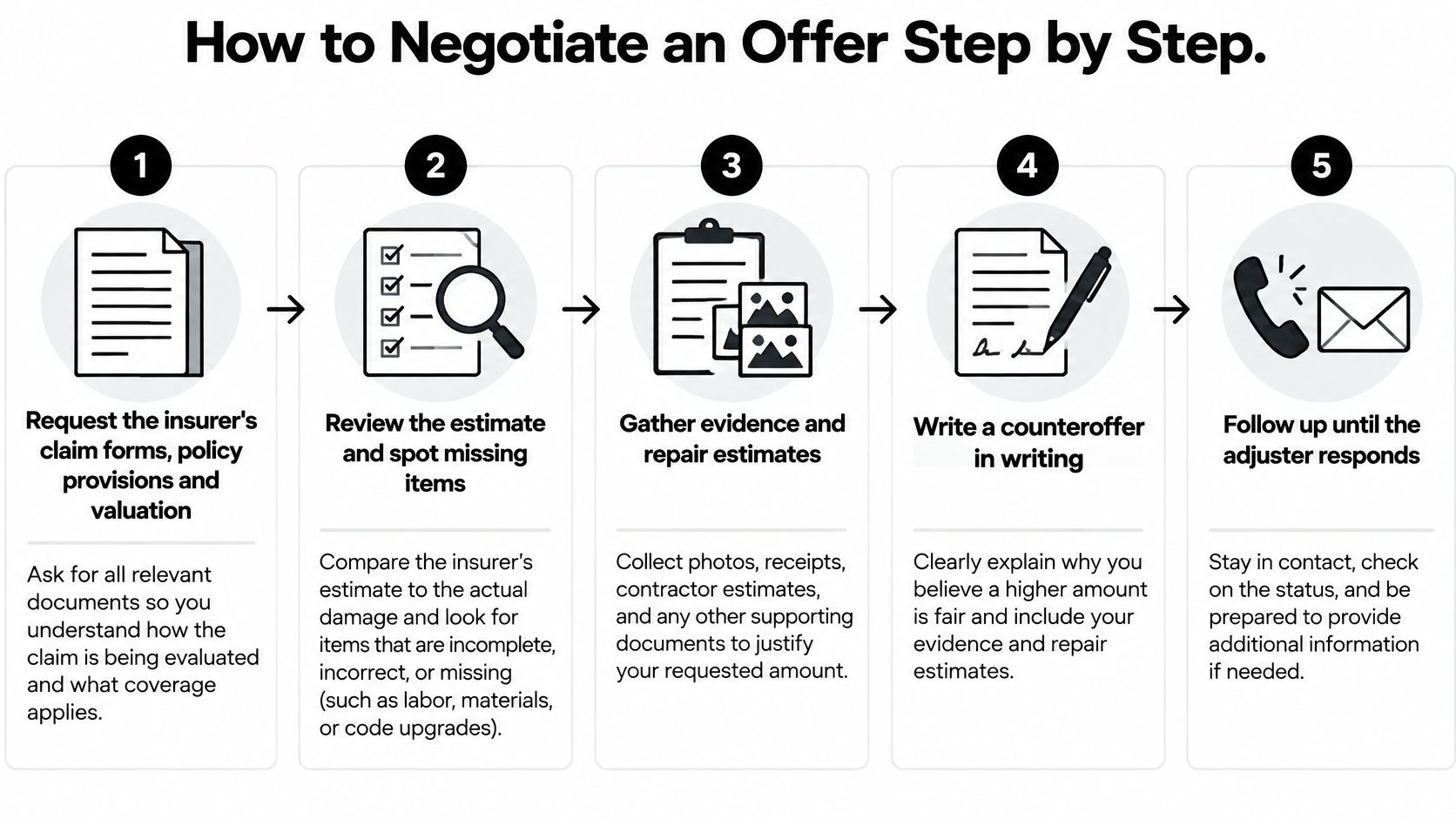
Use this process to move from an unexplained offer to a supported position.
Establish what the insurer is evaluating
Request the claim requirements in writing. Ask for required forms, the coverage or policy provisions the insurer is relying on, its valuation method, and applicable response deadlines. Clarify whether you're dealing with your own coverage or another driver's liability insurer, because the relevant obligations and available information can differ.
Separate agreed amounts from disputed amounts. Identify which expenses the adjuster accepts and which remain contested, keeping vehicle damage and bodily injury distinct. Ask whether an agreed payment can proceed without settling disputed claims, and review any conditions before accepting it.
Get the reductions itemized. Request the calculation behind deductions for depreciation, labor, parts, medical treatment, or alleged fault. A bottom-line offer doesn't tell you whether the disagreement concerns missing evidence, coverage, or the value assigned to an accepted loss.
Preserve the opportunity to inspect vehicle damage. Obtain an independent written estimate and check local comparable vehicles before agreeing to a repair or total-loss valuation. When avoidable, don't authorize permanent repairs before inspection; coordinate necessary safety measures and storage issues rather than allowing preventable costs to accumulate.
Those steps keep unrelated disputes from becoming a single bargaining number. For example, an omitted repair operation needs a shop's explanation, while disputed wage loss needs payroll evidence. Neither is answered by raising the total demand.
Write a counteroffer that can be checked
Tie each requested adjustment to an attachment. State the disputed item, your requested amount or supported valuation range, and the document that supports it. Our guide to writing a demand letter can help you organize the explanation without burying the requested resolution.
Ask for supervisor review if the calculation remains unexplained. Identify the unanswered question and the evidence already submitted rather than forwarding an angry complaint. Request confirmation that the reviewer received the complete packet and ask when you should expect a substantive response.
Hold the release while terms remain unclear. Ask for the proposed settlement agreement alongside the written offer so you can understand the transaction, not just the number. Don't let an adjuster's requested turnaround substitute for reviewing the terms and confirming applicable deadlines.
A common mistake is emailing a higher demand with no supporting attachments. That leaves the adjuster reviewing the same evidence that produced the original offer, with no clear reason to revise it.
A finished counteroffer can begin with a concise cover page organized as follows:
- Disputed item: Identify the omitted expense or challenged reduction.
- Supporting evidence: Name the attachment and relevant page or entry.
- Requested correction: State the amount sought and show the calculation.
- Unresolved information: Explain what remains outstanding and why it matters.
Keep the tone factual. You don't need to describe every exchange or accuse the adjuster of undervaluing you personally. Make it easy for the person reviewing the file to locate the evidence, verify the calculation, and explain any remaining disagreement.
Challenging Each Reduction in an Offer
Start with depreciation and comparable vehicle values because a valuation can look precise while relying on the wrong assumptions. Check the vehicle's trim, mileage, options, prior condition, and location. A comparison with a less-equipped vehicle or an unexplained condition deduction deserves a specific challenge, not a general claim that your car was worth more.
Don't confuse advertised prices with completed sales. Local listings can help test the insurer's valuation, but identify them accurately and account for meaningful differences.
Common reductions and the proof that answers them
| Reduction the Adjuster Gives | What to Ask For | Evidence That Answers It |
|---|---|---|
| Depreciation | Itemized calculation with vehicle age and condition | Maintenance records and pre-crash photos |
| Comparable vehicle values | List of comparable listings with year, mileage and trim | Local listings for similar vehicles |
| Labor rate or parts type | Shop rate and parts source used in the estimate | Written estimate from an independent shop |
| Comparative fault percentage | Basis for the percentage assigned | Crash report, scene photos and witness statements |
| Treatment gap | Dates the adjuster treats as a gap | Doctor note or dated message explaining the pause |
| Medical causation | Reason the injury is not linked to the crash | Treating physician narrative with dated findings |
| Charges called excessive | Reasonable-rate basis for each charge | Itemized bills and provider's accepted-rate statement |
Match the evidence to the actual objection
For depreciation, show the condition the insurer overlooked. Maintenance records can rebut an assumption of neglect, but routine maintenance doesn't necessarily increase value by its full cost. For comparable vehicles, identify the mismatched characteristic and explain why it affects the comparison.
For labor or parts, ask the independent shop to explain the repair operation, parts specification, or rate it considers necessary. A competing total without a line-by-line explanation may leave the adjuster unable to identify the technical disagreement.
A fault reduction needs collision evidence. Ask which actions supposedly contributed to the crash and what supports that conclusion; don't treat an assigned percentage as self-explanatory. Separate disagreement about how the collision happened from disagreement about the applicable state fault rules.
Handle medical objections without overstating the record
A treatment gap doesn't automatically mean you recovered. Say you postponed appointments because your work schedule changed or childcare fell through. A contemporaneous portal message, scheduling record, or clinician's note can explain the interruption, although it won't necessarily resolve every medical question.
Medical causation requires medical support. Ask your treating clinician whether the records can explain symptom onset, examination findings, and the relationship between the crash and the condition being treated. Don't ask anyone to backdate a note or state a conclusion they can't support.
When charges are called excessive, request the basis for each challenged charge and compare it with an itemized provider statement. Check whether an insurer payment was accepted as payment in full or whether a patient balance remains; a billed charge, accepted rate, and outstanding balance aren't interchangeable.
Answer each reduction with a clear explanation and the strongest relevant document. If the adjuster can't support a deduction, request its removal in writing rather than assuming it has disappeared.
Escalating Unanswered Offers, Delays and Denials
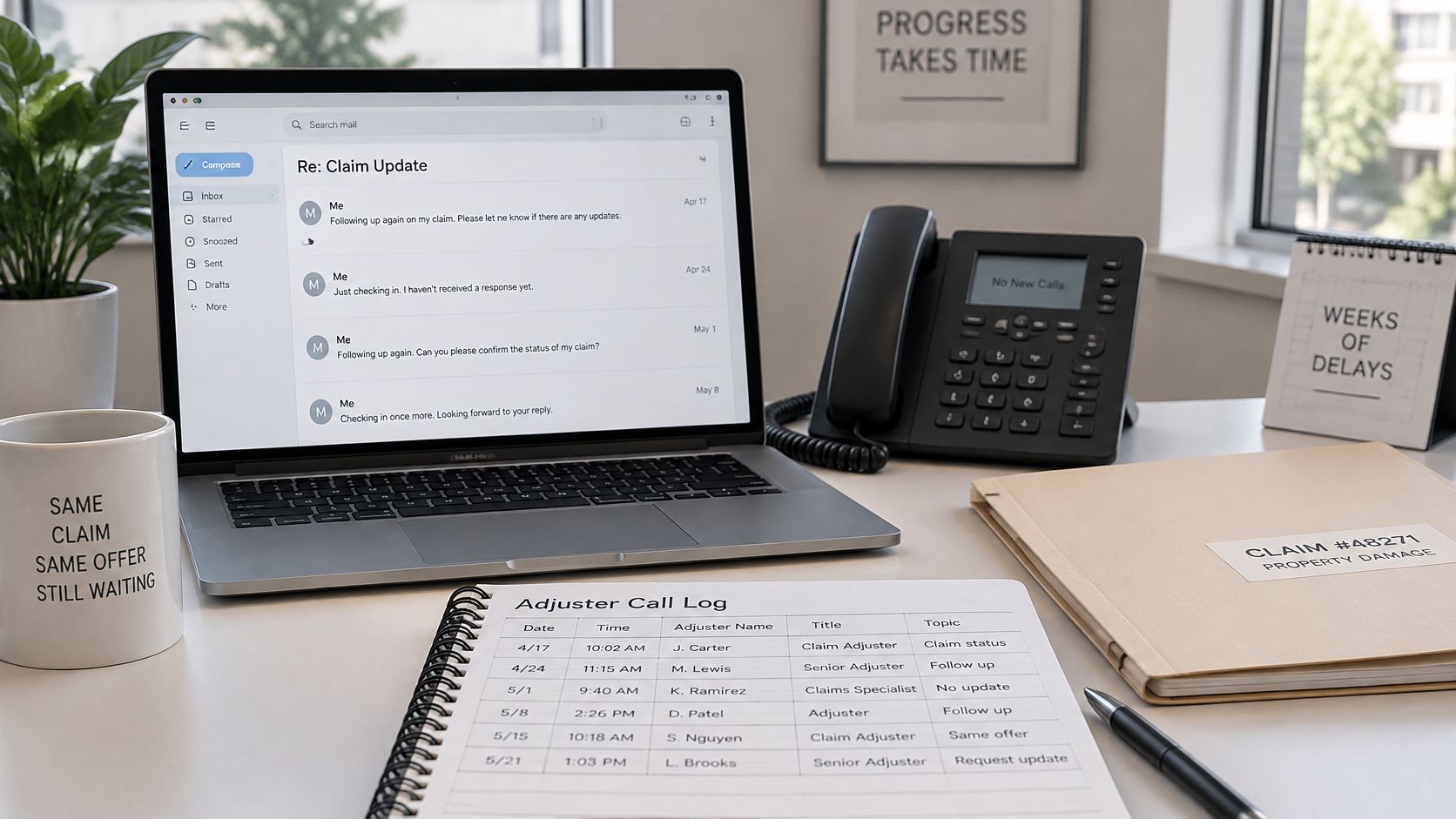
Your calls go unreturned, the insurer hasn't requested anything new, and the offer stays unchanged. More voicemail messages won't necessarily resolve that stall. You need a record showing what the insurer received, what remains unanswered, and who is responsible for the next decision.
Keep your correspondence and call log together so a supervisor or regulator can follow the sequence.
Turn conversations into a usable record
Record the date, time, adjuster's name and title, subjects discussed, and promised follow-up. After a substantive call, email a short summary and invite corrections. Keep the original messages, not just screenshots of selected sentences.
If the adjuster requests a recorded statement early, ask what subjects it will cover, why it's needed, and whether written questions are available. Don't guess about injuries or fault. Before refusing a request from your own insurer, check any cooperation requirements and obtain legal advice if you're unsure.
Claim handling represented 65.2% of all closed complaints in a 2024 compilation of state insurance-department complaint data published by ValuePenguin. These are complaint statistics, not ordinary claim outcomes or a promise that escalating will improve your offer.
Follow a written escalation ladder
Send a focused status request. Confirm the offer, list the documents supplied, and identify the unanswered issues. Give a specific requested response date, while distinguishing your requested date from any legally applicable deadline.
Request supervisor review. If that date passes without a substantive response, send the chronology and unresolved questions to a supervisor. Ask whether the file is awaiting evidence, authority, coverage review, or another identified action.
Use the state insurance department's complaint process. Follow its submission instructions and provide the offer, relevant correspondence, document index, and explanation of the handling problem. A complaint creates an administrative review record; it isn't a substitute for legal advice about the value or enforceability of your claim.
Consult an attorney before rights expire. Get help when a denial or unsupported closure stands, or when the offer ignores documented injuries. Don't assume negotiations, supervisor review, or a regulatory complaint extend a lawsuit or policy deadline.
Keep escalation proportional. A concise request identifying an unanswered medical report is more useful than repeatedly threatening litigation without explaining the dispute.
Use the video alongside your written checklist, not instead of reviewing your claim-specific documents.
Establish whether the claim was denied or merely closed
A denial and a claim closed without payment may require different responses. Ask the insurer to identify its exact position: is it denying coverage, disputing liability, awaiting documents, or treating the file as inactive? Request the factual and policy basis, plus any available review procedure.
Reporting by Insurify on rising consumer complaints highlights why claimants may need to challenge the review process rather than bargain over the amount. If an automated assessment contributed to the result, ask what information it considered, which documents were missing, and who can conduct a human re-review.
Submit a numbered rebuttal that answers each stated reason. Don't merely resend a large attachment bundle and expect the reviewer to locate the contradiction.
Silence, a low offer, or closure isn't automatically bad faith. Policy terms, liability evidence, state requirements, and the insurer's explanation matter. Our settlement timeline guide can help you distinguish ordinary process stages from questions that need direct follow-up, but it doesn't establish your legal deadlines.
Stop handling escalation alone when the dispute threatens your ability to obtain care, preserve a claim, or evaluate a serious injury. Bring the correspondence and proposed release to the consultation.
Check Net Recovery Before You Accept a Settlement
A larger gross settlement can leave you with less usable money if it carries unresolved bills or reimbursement obligations. Net recovery is what remains after collectible balances, liens, reimbursement claims, applicable fees and costs, and money needed for future care are accounted for.
The medical-billing gap is real: Michigan's 2025 auto-insurance reform report describes accident victims facing interrupted care or out-of-pocket payment demands because providers considered reimbursement inadequate. Don't treat an unresolved bill as either fully payable or safely erased.
Calculate what you can actually keep
Net recovery worksheet
| Line item | What it means | Effect on net recovery |
|---|---|---|
| Gross settlement offer | Amount on the table before deductions | Starting point for the net figure |
| Paid medical bills | Already covered by an insurer or by you | No further deduction if settled and no reimbursement is owed |
| Unpaid provider balances | Billed but not yet paid | Subtract collectible balances before counting the net |
| Liens and reimbursement claims | Health plan, Medicare, Medicaid or hospital claims | Subtract the amount the claimant must repay |
| Future care costs | Treatment still expected after settlement | Reserve funds, or negotiate an express carve-out if available |
| Unpaid lost income | Wage loss not yet reimbursed | Add only if separately recoverable and not closed out; don't double-count |
We assess whether an offer is reasonable against the state's formulas, the medical record, and what the settlement closes out. Use our car accident settlement calculation guide to organize those considerations, not to replace a review of uncertain obligations.
Before accepting:
- Classify every bill as paid, billed, denied, or expected, and verify outstanding balances.
- Clarify future treatment and whether the release includes unknown injuries or later symptoms.
- Read every released claim, including whether the agreement closes bodily injury, property damage, or both.
- Ask about disputed charges separately, without assuming the insurer must resolve them outside the lump sum.
Serious or ongoing treatment, disputed fault, denial, substantial liens, or pressure to settle quickly justify attorney review.
The decision: Don't trade a documented future need for immediate cash without knowing what you're giving up.
Before you sign, visit AskLegally to request a free case review and explore whether a participating personal injury lawyer can help evaluate the offer and release. You can also use our free Accident Claim Value Assessment for immediate guidance on facts that can affect claim handling, with no contact details required.