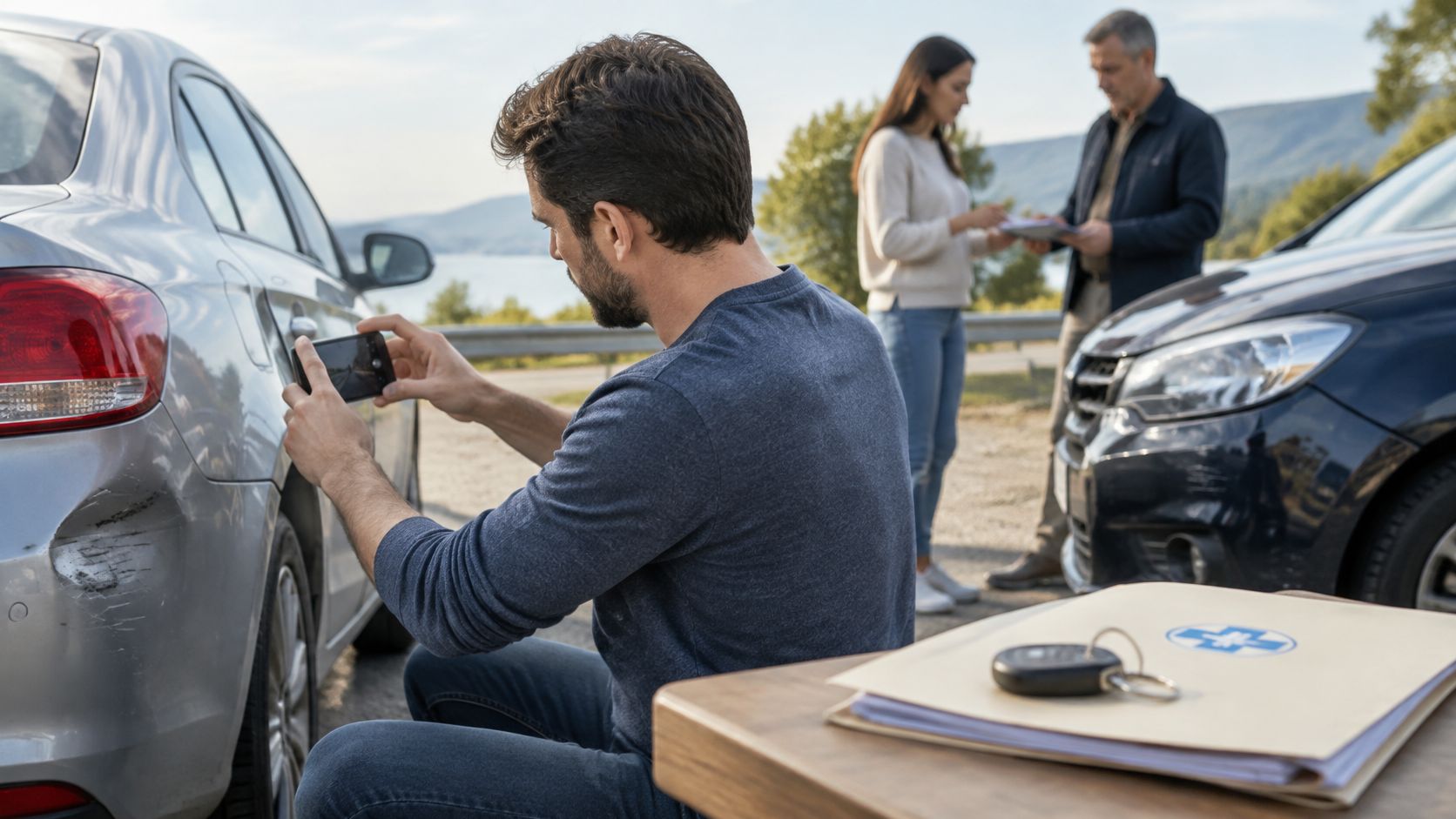
You're standing beside your car, looking at a scuffed bumper. The other driver says it's nothing, traffic is backing up, and you'd like to get home. But you don't yet know whether that scrape is the whole repair, whether soreness will develop, or whether everyone will describe the collision the same way tomorrow.
Knowing what to do after a minor car accident means treating it as a documentation and monitoring problem, not deciding its seriousness by appearance. Make the scene safe, preserve what you can, and leave room to update your account as medical and repair information becomes available.
The Minutes-to-Weeks Checklist at a Glance
| Time window | Action due | Why it matters |
|---|---|---|
| At the scene | Stop safely, check for injuries, and call emergency services if anyone may be hurt | Prevents another collision and starts the record |
| Same day | Photograph vehicles, plates, road conditions, weather, and visible injuries; get witness contacts; write a dated account | Preserves details before people leave and memories change |
| Within 24 hours | Aim to notify your insurer, start a symptom log, and seek medical advice if symptoms appear | Creates prompt notice and helps document changes |
| Within 10 days, subject to state rules | Confirm police and DMV requirements immediately, including current injury and damage thresholds; submit any required report by the actual deadline | This planning window isn't permission to delay a report that's due sooner |
| Within 1 to 3 weeks | Request the official police report when available; collect repair estimates, receipts, and bills | Brings the official record and cost evidence together |
| About 3 weeks | Follow up on claim status, confirm remaining rental coverage, and arrange recommended follow-up care | Helps prevent avoidable gaps in transportation and treatment |
These are organizing targets, not universal legal deadlines. Your policy, local reporting rules, medical needs, and the responding agency's instructions control. Check those requirements immediately rather than assuming the table gives you extra time.
Start with safety, then open a claim folder on your phone. Use separate folders for scene evidence, medical paperwork, vehicle costs, and insurer correspondence. Save confirmation messages so you can distinguish something you intended to submit from something the recipient received.
Plan for a process, not an instant resolution
In J.D. Power's 2024 U.S. Auto Claims Satisfaction Study, the overall average repair cycle was 22.3 days among the study's 9,725 auto-insurance customers. That isn't a promise about your repair, but it's a useful reason to ask about transportation arrangements before your car enters the shop.
For an additional way to organize insurer-facing tasks, Policy Quail's post-accident insurance claim checklist can help you track what you've submitted and what remains outstanding.
Practical rule: A claim number doesn't mean every required report has been filed, every document received, or every expense approved.
Find the row that matches where you are now. Complete its unfinished tasks this week, but handle symptoms and any approaching legal deadline immediately.
How to Handle the Scene in the First Ten Minutes
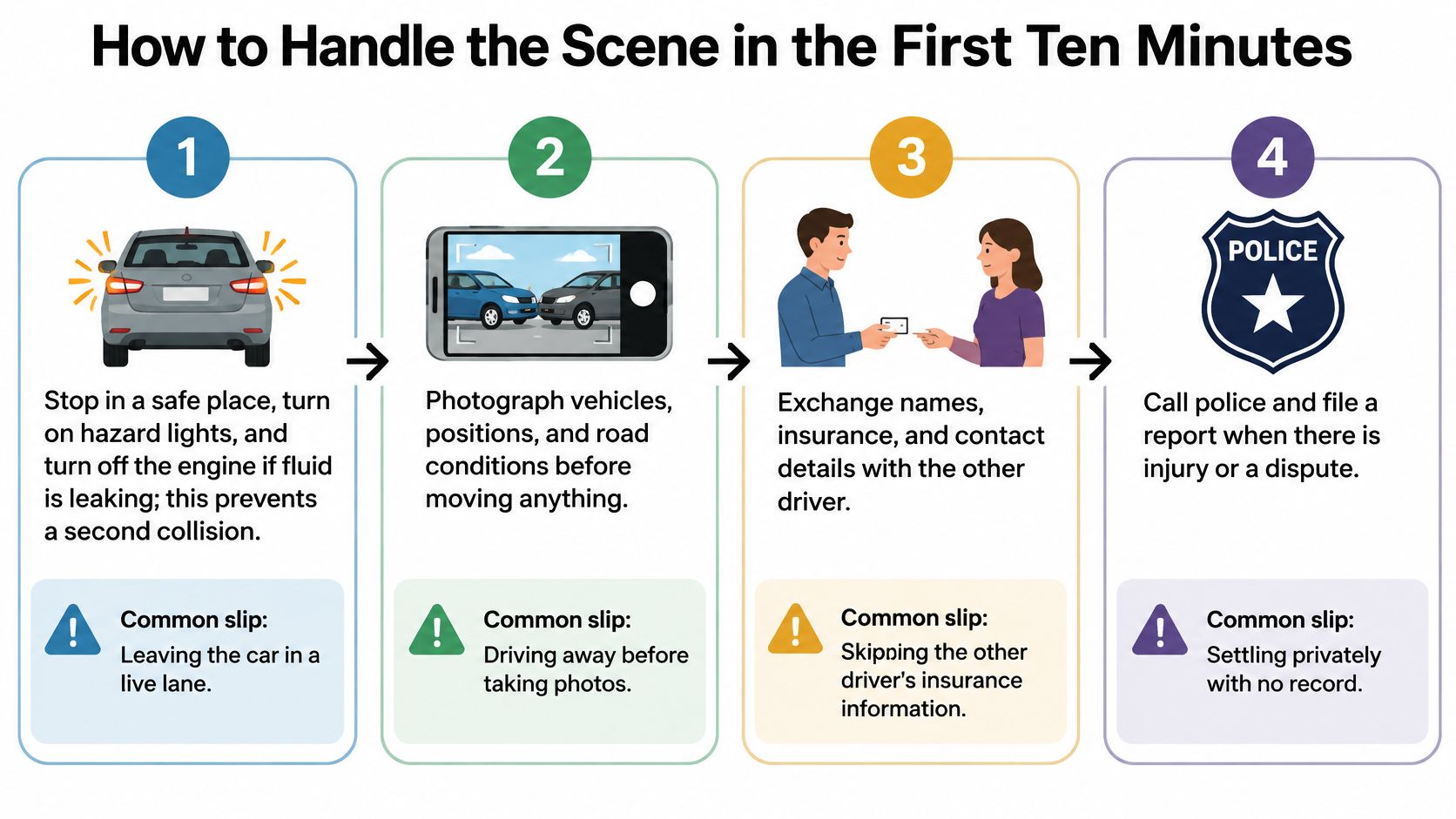
Stop safely and make yourself visible. Turn on your hazard lights, and turn off the engine if fluid is leaking. Don't stand between vehicles or remain in a live lane to inspect a scrape.
Check people before property. Ask passengers and the other driver whether they have pain, dizziness, trouble breathing, or difficulty moving. The common mistake is treating someone's ability to walk and talk as proof that they aren't injured.
Call emergency services when anyone may be hurt. Give the location, describe the collision plainly, and explain any immediate hazards. Don't wait for the other driver to agree that help is necessary.
Move vehicles only when it's safe. If you can photograph their resting positions without exposing yourself to traffic, do that first, then follow local requirements and police directions about moving them. Evidence matters, but it's never worth standing in danger to obtain it.
Exchange identifying and insurance details. Record names, phone numbers, insurers, policy numbers, license plates, and vehicle descriptions. Be courteous without guessing who caused the crash or offering an apology that could be interpreted as accepting responsibility.
Approach witnesses before they leave. Ask for their names and phone numbers, and whether they're willing to describe what they saw. Don't coach them or substitute your interpretation for their account.
Save a short factual account. Record your direction of travel, location, traffic controls, and the sequence you remember. Don't sign a roadside settlement or an inaccurate statement just to end an uncomfortable conversation.
Use this visual reminder only when you're safely away from traffic.
If the exchange breaks down
If the other driver leaves or refuses to share details, don't chase them or block their car. From a safe position, capture the plate and vehicle description, note where they went, and contact police. Use the non-emergency line when there's no immediate threat or medical emergency.
Bell Law's guidance on protecting your rights after a wreck provides additional context for handling the immediate aftermath without making premature commitments.
Before leaving, check that the information you collected is readable and saved. A blurry insurance card or an unsaved witness number is difficult to fix once everyone has gone.
Evidence to Collect and Why Each Item Matters
Witness contacts, vehicle identifiers, and surrounding conditions are easy to miss when everyone focuses on the dent. The California Department of Insurance accident guide recommends exchanging verified information, documenting the scene, and retaining claim-related records rather than relying on memory.
Use this checklist to capture both the collision and its context.
| Evidence item | What to capture | Why it matters |
|---|---|---|
| Vehicle positions | Wide shots of both cars at rest, from several safe angles | Documents final positions and their relationship to the roadway |
| Plates and VIN | Clear photos of plates and the dashboard vehicle-identification plate | Identifies the vehicles involved |
| Vehicle damage | Close and wide photos of both cars, including small scrapes | Records visible damage without assuming the full repair scope |
| Road and weather | Signs, signals, lane markings, lighting, surface, and weather | Helps explain visibility, traffic controls, and driving conditions |
| Other driver | Name, address, phone, driver-license number, insurer, and policy number | Provides information needed to identify the driver and handle the claim |
| Witnesses | Names and phone numbers of people who saw the collision | Makes independent accounts available |
| Visible injuries | Dated photos of marks, bruises, or cuts | Preserves how visible injuries appeared |
| Your account | Time, exact location, direction of travel, and event sequence | Separates your contemporaneous recollection from later interpretation |
Preserve originals, not just convenient copies
Keep original phone photographs rather than relying only on screenshots or compressed copies sent through messaging apps. Originals can preserve capture information and image detail that a screenshot doesn't retain. Don't crop or annotate your only copy; make a duplicate if you need to mark an impact point.
Check identification details against the documents the other driver shows you. If a policyholder's name differs from the driver's name, record both rather than assuming there's an error or that coverage is unavailable.
Write your account in observations: your lane, the signal you saw, the movement you noticed, and where contact occurred. Mark uncertainty clearly. A precise-looking guess is less useful than an accurate statement that you don't know.
Describe what a photograph shows. Don't assume a resting position, scrape, or bruise proves the entire sequence of events by itself.
Back up your files to cloud storage when you're somewhere safe. Keep receipts and estimates in the same case folder, but preserve an untouched copy of the original evidence separately.
Medical Checks for Delayed Symptoms
Get emergency evaluation for an escalating headache, repeated vomiting, slurred speech, weakness or numbness, unequal pupils, seizures, increasing confusion, or unusual difficulty staying awake. Breathing problems and chest or abdominal pain also deserve prompt medical attention. Don't drive yourself if your symptoms make driving unsafe.
Medical assessment should focus on how you feel and what happened, not how impressive the bumper damage looks.
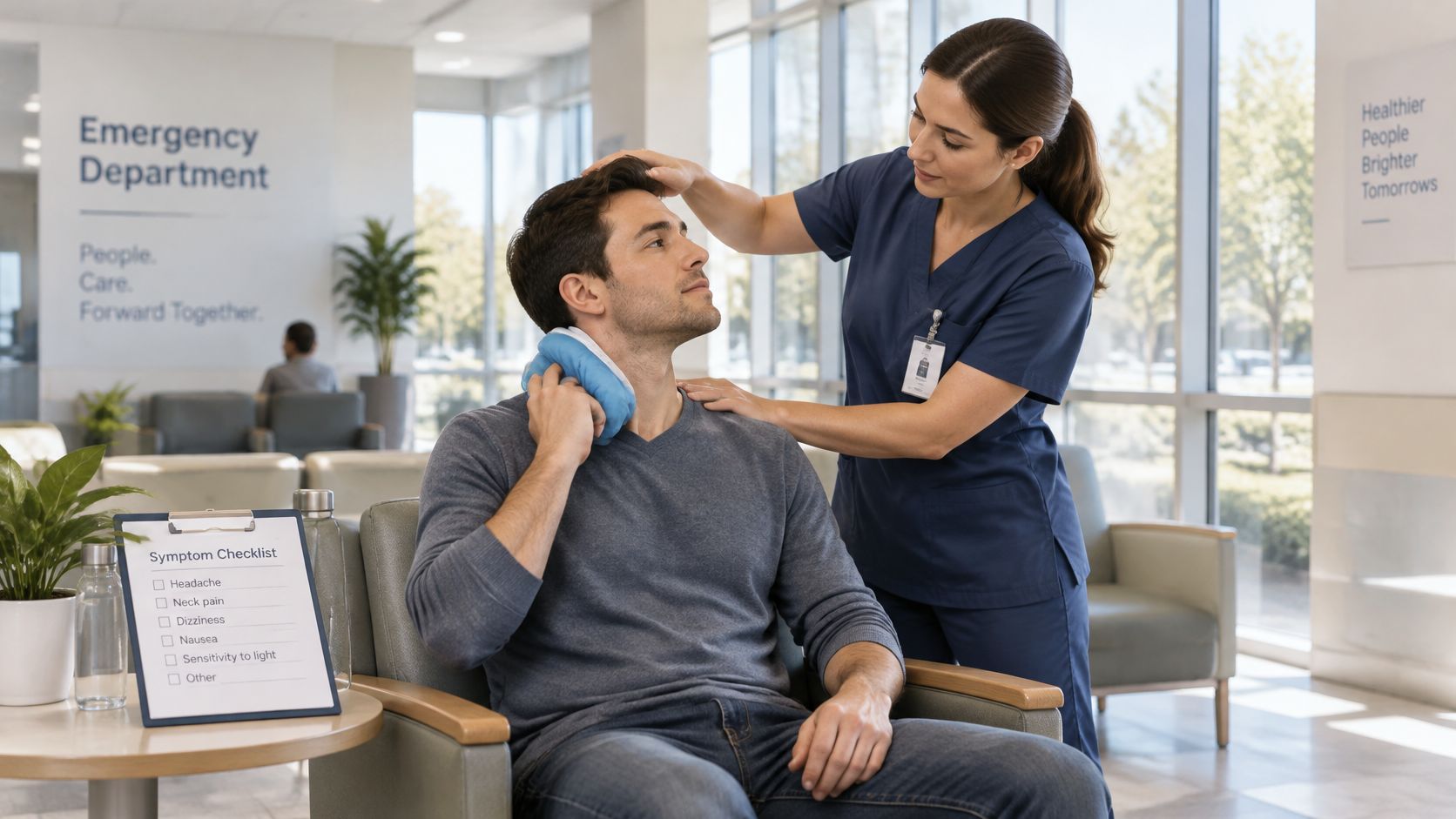
A nationally representative hospital survey, described by the Miami Herald, estimated approximately 3.8 million emergency-department visits per year for motor-vehicle-crash injuries during 2019–2020. That was a statistical national estimate, not a count of every crash, and it doesn't establish whether your particular collision caused an injury.
Monitor changes without diagnosing yourself
Neck stiffness, headaches, dizziness, and reduced movement can begin after the scene has cleared. Lawyers and Settlements' discussion of delayed accident injuries also describes later-emerging problems involving balance, sleep, concentration, and fatigue. A delay neither proves a serious injury nor rules one out.
Keep a simple log that a clinician can use:
- Onset and progression: Record when a symptom began and whether it improved, worsened, or returned.
- Daily limitations: Note concrete difficulties, such as turning your neck, concentrating at work, or sleeping.
- Medication and care: List what you took, appointments attended, and instructions received.
- Relevant history: Tell the clinician about pre-existing symptoms and explain what changed after the collision.
This video provides additional context while you organize your questions for a clinician.
Tell each treating clinician that the symptoms followed a collision, without insisting on your own diagnosis. Follow the care plan and seek reassessment when symptoms worsen or interfere with ordinary activities.
Our guide to delayed symptoms after a car accident can help you organize what to monitor. Avoid definitive assurances about having no injuries before you understand your condition; describe how you feel at that moment.
Police Reports, Insurer Notice and Deadlines
Police notification, a DMV filing, and an insurance claim are separate tasks. Completing one doesn't necessarily complete the others. Ask the responding agency what it will submit and what you must file yourself.
NHTSA's crash-data guidance recognizes collisions ranging from minor information exchanges to serious investigations and explains the value of consistent crash information. A collision doesn't need to be catastrophic to warrant a clear, usable record.
Report first, then confirm receipt
Check the rules for the place where the crash occurred, including injury and property-damage reporting triggers. Confirm current requirements directly with the relevant authority rather than relying on a remembered threshold or the other driver's advice.
Request the official police report once it becomes available, using the incident date, location, and case number. Our guide on how to obtain a police report explains how to identify the appropriate agency and request process.
Notify your insurer promptly through its designated channel. Provide the facts you have, identify information that's still pending, and save the submission confirmation. Ask what cooperation your policy requires, what documents are outstanding, and which deadlines apply.
Keep early statements narrow and accurate
Say a driver tells an adjuster that they feel fine and were probably responsible, then receives a settlement offer before a medical assessment. The problem isn't merely the recording. The driver has supplied conclusions before knowing the injuries, damage, or complete sequence.
For the other driver's insurer, explain that you're still gathering information and ask for requests in writing. With your own insurer, meet your policy obligations, but don't speculate about speed, diagnose yourself, or agree to an inaccurate summary.
- Before a release: Understand which claims it settles and whether further treatment or repair costs remain unresolved.
- For your records: Save dated reports, messages, estimates, bills, claim numbers, and notes identifying whom you spoke with.
- If a report is wrong: Ask the reporting agency about its correction procedure and send your insurer a factual written explanation with supporting evidence.
A police report is useful evidence, but you should still review it for omissions and errors.
Mistakes That Weaken a Minor Accident Claim
A minor-looking collision doesn't justify casual recordkeeping. The better approach is selective communication and careful preservation, not broadcasting everything or surrendering every record.
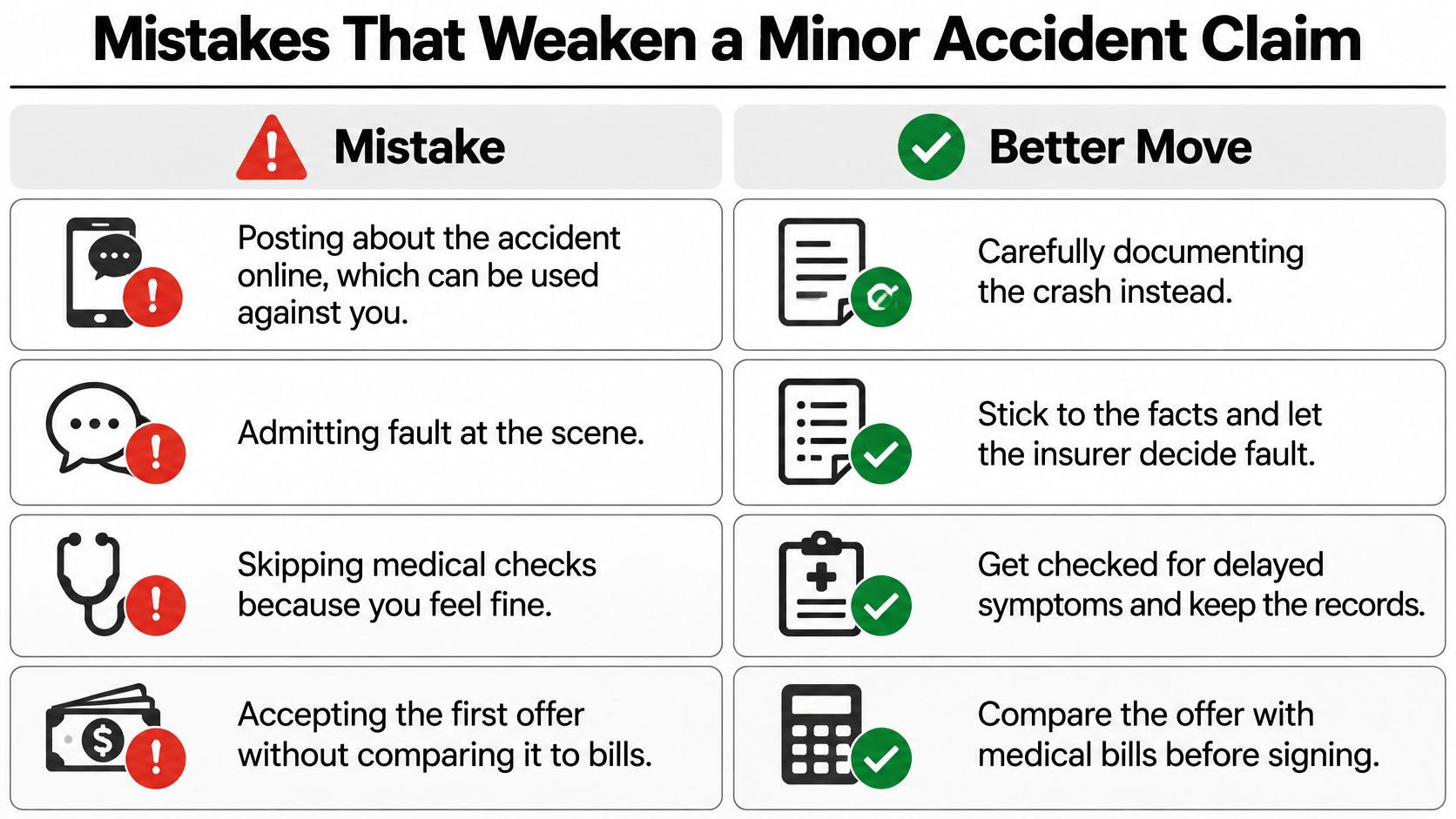
- Posting instead of documenting: Keep your account in a private claim file. Social posts can omit context and create apparent inconsistencies.
- Deleting or overwriting files: Preserve dashcam footage, phone photos, and crash-related app records. Check the camera's overwrite settings and export the original recording.
- Waiting while symptoms worsen: Seek appropriate medical advice rather than postponing care until the insurance conversation is settled.
- Skipping your written account: Record what you remember while you can distinguish observation from assumption.
- Signing broad data access: Ask what records are requested, for what purpose, covering which period, and who will receive them.
Preserve vehicle data without granting unlimited access
Connected vehicles may retain location, speed, braking, acceleration, or video information. In January 2025, the FTC announced action against General Motors and OnStar alleging collection and sharing of precise geolocation and driving-behavior data without adequate disclosure, as described in Drive With Care's connected-car evidence guide.
That makes preservation and permission different decisions. Keep available originals and ask the manufacturer or insurer what relevant records exist, but obtain jurisdiction-specific advice before granting broad access.
Before consenting: Request the scope in writing. Keeping evidence doesn't mean volunteering unrelated driving history.
Treat fault statements and settlement releases with the same discipline: verify the facts and scope before committing.
Decide Whether to Get a Free Case Review
Consider a legal review when symptoms persist, a doctor recommends further treatment, the insurer disputes injury or responsibility, or an offer doesn't appear to cover documented losses. You don't need to wait for every bill if someone is pressing you to settle before you can evaluate the consequences.
A lawyer may be unnecessary when symptoms resolve, the damage is straightforward, responsibility isn't disputed, and payment addresses the documented costs. Still, distinguish a simple repair payment from a release that also closes an injury claim.
Put the offer beside your records before deciding.
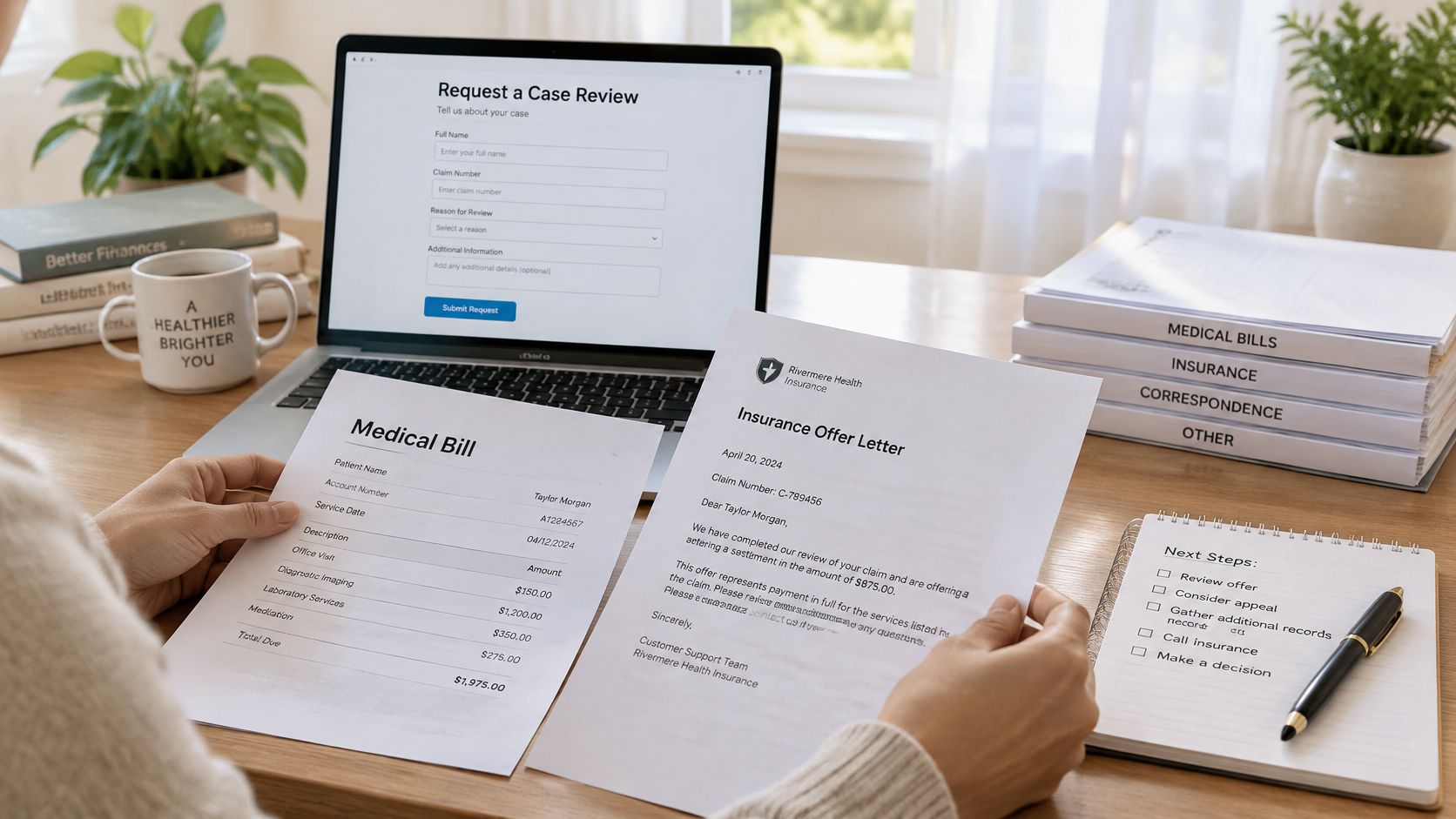
Bring the facts that affect the decision
- Collision evidence: Photos, witness details, and the police report or report number.
- Health information: Medical records, treatment recommendations, and your symptom timeline.
- Financial records: Repair estimates, bills, receipts, pay stubs, and missed-work documentation.
- Insurer communications: The offer, proposed release, coverage correspondence, and any explanation of a denial.
We offer a free Accident Claim Value Assessment, which reviews facts affecting how a claim is handled, with immediate guidance and no contact details required. Our free Police Report Lookup helps identify and request the official report; a report request requires contact and accident details.
If the dispute needs individual legal attention, consider a free car accident lawyer consultation. First complete the unfinished task that matters most right now, whether that's medical follow-up, insurer notice, or obtaining a missing document.
AskLegally offers straightforward accident guidance, free tools, and a free case review for people deciding whether they need legal help. Visit AskLegally to organize your next step after a minor collision and decide whether a lawyer review would help with an unresolved injury or insurance dispute.