
Bodily-injury claimants received about $2 in total settlement for every $1 of medical bills paid, before legal fees, in the Insurance Research Council's auto-injury analysis. That sounds like a settlement calculator. It isn't. It describes payments across a group of claims, not what an insurer owes someone with a particular injury.
The useful question isn't what the average personal injury settlement is. It's which claims produced that average, how closely they resemble yours, and how much of any payment you would keep.
Average Personal Injury Settlement Figures and Why They Mislead
Published average and median injury payment figures
| Source and measure | Figure | What it includes |
|---|---|---|
| Insurance Research Council, average bodily-injury payment, beginning and end of the study period | About $14,000 in 2017, rising to more than $20,000 in 2022, a 7.8% annualized increase | More than 7.4 million auto-injury claims closed with payment |
| Insurance Information Institute average paid bodily-injury liability claim, cited by Green Prophet's car-accident settlement analysis | $26,178 in 2023 | Paid bodily-injury liability claims from U.S. automobile accidents |
| Bureau of Justice Statistics federal tort-trial report, historical median awards | $136,000 for personal-injury plaintiff winners; $91,000 for motor-vehicle injury cases; $19,157 for automobile tort awards | Personal-injury plaintiff winners, motor-vehicle injury cases and automobile tort awards under the report's court-selection rules |
| Central Bank of Ireland settled-claims report, average total cost and distribution | €35,774 average total cost for an injury claim settled in the first half of 2025; 94% of claims across the period settled below €100,000 | Irish private motor-insurance injury claims, measured as total claim cost rather than a U.S. claimant's take-home settlement |
These figures are constructed from different populations and payment definitions. One series counts auto-injury claims that closed with payment. Another counts paid automobile liability claims. The BJS figures count selected court outcomes. The Central Bank series measures total claim cost in Irish motor insurance.
A mean is the total amount paid divided by the claims counted. A median is the middle result after outcomes are arranged in order. An average home price can combine studios and mansions. An injury-payment average can similarly combine brief treatment with permanent disability. A median reduces the influence of unusually high outcomes, but it still does not show how far results spread above and below the middle.
The denominator changes the answer
The phrase closed with payment matters. A dataset restricted to paid claims leaves out claims that close without compensation. It can describe payment size among recipients, but it cannot tell you the probability that a newly reported claim will produce a payment.
Ask what entered the calculation before treating the result as a benchmark. Was the unit an injured person, an insurance coverage, a lawsuit, or a successful plaintiff? Were unpaid claims included? Was the figure limited to bodily-injury liability, or did it combine other coverages?
Those distinctions determine which question the number can answer. A paid-claim average addresses payment size among compensated claims. A trial median addresses outcomes for plaintiffs whose cases reached a verdict. Neither identifies the probability or size of payment for a newly reported claim.
The distribution matters more than the headline
The Central Bank series is useful because it publishes a mean and a claim-value band together. The pair gives more context than an average alone by showing the overall cost level and the share of resolved claims below a stated threshold.
Request the spread, not just the average. A mean alone does not reveal how tightly outcomes cluster or how much unusually expensive claims influence the result. Claim-value bands and a median make the comparison more informative.
Trial awards introduce another filter. People whose disputes reach a verdict are selected by the disagreements that kept their cases from resolving earlier. Using their awards to price an ordinary claim skips the selection process that produced those awards.
Benchmark test: A published payment figure is useful only after you identify who was counted and what the payment measures.
Before relying on an online number, check:
- Population: Paid claims, all claims, trial winners, or another selected group.
- Time and place: The payment period and the jurisdiction covered.
- Measure: Mean payment, median award, total claim cost, or claimant compensation.
- Deductions: Gross payment or money remaining after obligations and expenses.
The same limit applies to workers' compensation figures. AskLegally notes that figures circulated online as average workers' comp settlements commonly mix states, injury types and years. They say nothing definitive about an individual claim.
Factors That Move a Claim Above or Below Average
Start with the injury's consequences, not its label. A fracture that heals without lasting restrictions presents a different valuation question from a spinal injury that limits work indefinitely. Prognosis and functional loss help explain the difference.
Claim value factors and the evidence to keep
| Factor | How it shifts value | Evidence to keep |
|---|---|---|
| Injury severity and prognosis | Surgery, lasting impairment, and prolonged recovery can support greater damages than a temporary injury | Imaging, specialist notes, treating doctor's prognosis |
| Medical bills and necessity | Bills establish an economic component, but treatment must be connected to the injury and medically supported | Itemized bills and treatment records |
| Lost income | Supported wage loss adds a concrete financial consequence | Pay stubs, employer letter, work restrictions |
| Liability and fault | Under applicable comparative-fault rules, an injured person's fault can reduce recovery | Police report, photographs, witness statements |
| Insurance limits | A coverage limit can constrain payment under that policy | Declarations pages and coverage correspondence |
| Jurisdiction | Rules governing fault, damages, and deadlines affect the claim | Applicable state statutes and local rules |
| Treatment gaps and pre-existing conditions | Missing care records or prior injuries can create causation disputes | Prior records, appointment history, explanations for gaps |
Match each argument to a document
For severity, collect more than a diagnosis. Ask your treating clinician to describe restrictions, expected recovery, and whether limitations may persist. An imaging report identifies findings; clinical notes help explain what those findings mean for your daily life.
For medical expenses, retain the underlying records alongside the invoices. An invoice shows a charge. A treatment note can explain why the service was necessary and how it relates to the collision.
Wage loss needs its own proof. Save records showing missed shifts, reduced hours, and the medical restrictions responsible for the change. Don't assume a medical bill establishes an employment loss.
Separate injury value from payment availability
Fault and coverage can alter the practical result even when the medical evidence is strong. Preserve scene photographs and witness details before those materials become difficult to obtain. Request the relevant coverage documents rather than assuming the other driver's policy will cover every loss.
Pre-existing conditions require a comparison, not concealment. Earlier records can help distinguish an existing problem from a new injury or aggravation.
For nonfinancial harm, use our pain and suffering calculation guide to organize the effects you need to describe. The table identifies valuation categories, not dollar ranges. No diagnosis alone supplies a reliable settlement price.
Medical Bills, Lost Income and Delayed Symptoms
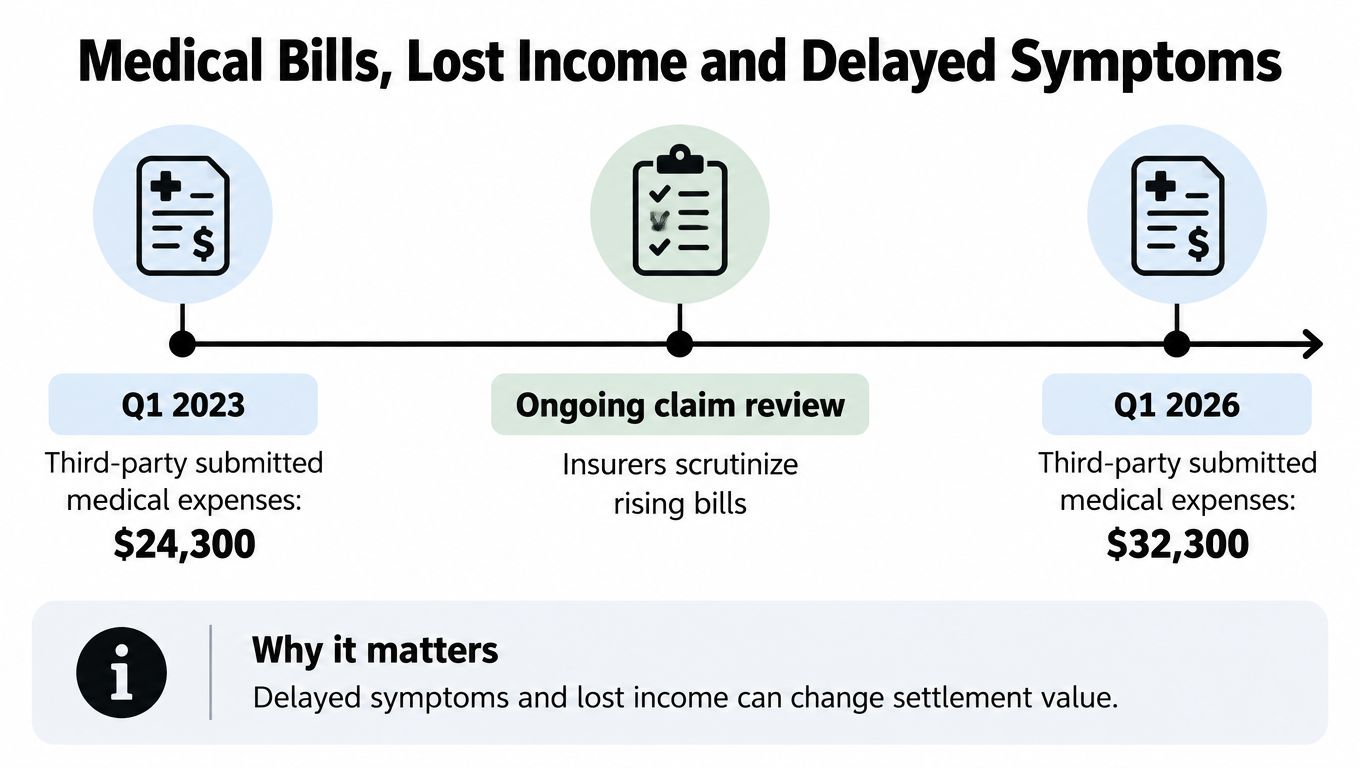
Third-party submitted medical expenses during claim evaluation rose from $24,300 in the first quarter of 2023 to $32,300 in the first quarter of 2026, according to CCC's claims analysis. These are submitted expenses, not promised payments or a schedule of injury values.
The timeline below illustrates that change in submitted expenses.
Say you leave a collision feeling shaken, then notice neck pain later. The documentation question is when the symptoms began, how they developed, and what a clinician found. A later bill alone won't establish that connection.
Build a medical and employment timeline
- Get an appropriate evaluation. Describe the collision and every symptom accurately. Let the clinician determine what care is needed.
- Keep a dated symptom log. Record pain, sleep disruption, and tasks you can't perform. Distinguish your observations from a medical diagnosis.
- Follow the treatment plan. Save referrals and appointment records. If cost, transportation, or scheduling interrupts care, document the reason.
- Obtain written work restrictions. Pair those restrictions with employer records showing the resulting missed work or reduced duties.
- Request a prognosis. Ask what has resolved, what remains uncertain, and which limitations may continue.
- Support future expenses. Obtain a treatment recommendation and a defensible cost estimate rather than guessing what future care might involve.
Our guide to delayed symptoms after a car accident helps you organize the questions raised when pain doesn't appear immediately. A gap before evaluation can give an insurer room to dispute the connection, so record the chronology.
For additional context on evaluating an injury claim, the video is below.
More treatment isn't automatically stronger evidence. The useful record explains why the treatment was needed.
Unnecessary escalation can create a dispute about medical necessity instead of strengthening the claim. Don't pursue a procedure to increase a settlement, and don't avoid recommended care merely to keep bills low. Future costs become meaningfully assessable when a treating clinician can identify a supported care plan and its likely duration.
Headline Payment Versus Net Recovery
A settlement announcement usually emphasizes the gross payment. Your financial decision requires the net recovery, the amount left after the obligations attached to that payment are resolved.
Use a written settlement worksheet:
Gross settlement − medical liens and outstanding bills − case costs − attorney fees = estimated net recovery.
Account for each obligation once. A provider's bill and a lien connected to that bill may overlap, so adding every notice together can overstate deductions.
Compare the outcome, not just the check
The Insurance Research Council's representation analysis reports the following comparison.
Gross and net recovery, unrepresented versus represented claimants
| Measure | Unrepresented claimants | Represented claimants |
|---|---|---|
| Net recovery per dollar of medical bills, after medical costs and legal fees | About $1.80 | About $1.40 |
| Median time to close a bodily-injury claim | Less than half the represented group's median | Nearly 440 days |
| Gross total settlement per dollar of medical bills, before fees | Representation-specific split not reported | Representation-specific split not reported |
This comparison doesn't prove that hiring a lawyer reduces recovery. Represented claims may involve more severe injuries, harder liability disputes, or other complications. These aren't matched versions of the same claim handled with and without counsel.
The timing comparison has the same limitation. It doesn't establish how long your particular case would take under either option. Nor does the overall gross-payment benchmark supply a missing representation-specific figure.
Put deductions and timing in writing
Waiting has practical consequences when you're missing income or carrying unpaid bills. But a quicker payment isn't necessarily better if it requires surrendering a supported claim for future losses.
Ask for a closing estimate, not merely a verbal description of the offer. It should identify known deductions, unresolved reimbursement claims, and any expenses that could still change.
Before treating a quoted net as usable money, ask:
- Medical obligations: Have liens and unpaid balances been accounted for?
- Fee calculation: Are attorney fees calculated before or after case expenses under the agreement?
- Payment timing: What must happen before funds can be distributed?
Those answers make competing options comparable. A larger gross offer and a larger usable recovery aren't interchangeable.
Three Illustrative Claims and Where They Land
These hypothetical claims show why similar accident descriptions can lead to different evaluations. They aren't settlement predictions, and none has a predetermined dollar range.
Each folder represents a different evidentiary problem.

Claim A has a clear endpoint
A driver is rear-ended, completes prescribed physical therapy, and returns to normal activities. The other driver acknowledges causing the collision. The treating clinician documents a full recovery.
The strongest presentation is a compact, consistent record: the collision evidence, treatment history, recovery date, and any verified missed work. Claiming permanent limitations would conflict with the prognosis. Available insurance still needs confirmation, but the central valuation question is the documented effect of a temporary injury.
Claim B has lasting work consequences
A warehouse employee suffers a herniated disc after a side-impact collision. The medical record includes imaging, injections, and a treating doctor's permanent lifting restriction. The employee returns to lighter duties.
Here, the employment evidence matters alongside the treatment record. Can the worker perform the former job? Has pay changed? Does the doctor connect the restriction to the collision?
Larger medical bills don't establish a proportional settlement. The insurer may dispute whether the injections were necessary or whether the imaging reflects an earlier condition. The claim becomes stronger when the records answer those questions directly.
Claim C has a liability problem
Both drivers say they had a green light. The injured driver has medical bills, but the insurer offers less than the claimed expenses because it disputes responsibility.
The next useful evidence may be intersection footage, an independent witness, or a vehicle recording, not another medical invoice. Clear proof of injury doesn't resolve who caused the crash. The practical evaluation must consider the strength of the liability evidence and the applicable fault rules.
Decision point: Identify the weakest essential part of your claim before assuming a low offer reflects an injury disagreement.
These claims could land on either side of a published average. What matters is whether the proposed payment fits the provable losses, disputed issues, and available coverage in that particular file.
How to Judge Whether an Offer Is Reasonable
Evaluate an offer as a proposal to resolve specific rights and obligations. Don't judge it solely by whether it exceeds an internet average or sounds substantial compared with your latest bill.
At AskLegally, our view is that reasonableness depends on the state's formulas, the medical record, and what the settlement closes out. Our guide to negotiating an insurance settlement can help you prepare a documented response rather than an unsupported counteroffer.
Use a written offer review
Total your documented economic losses. List medical expenses, supported wage loss, treatment-related travel, and other out-of-pocket costs for evaluation under the applicable rules. Attach receipts or records, and distinguish amounts billed from amounts already paid.
Identify what the offer covers. Ask the adjuster to explain which losses were accepted, reduced, or rejected. A payment that resembles your bill total may still leave wage loss or other supported damages unaddressed.
Check the medical endpoint. Read the treating clinician's prognosis rather than assuming discharge means every issue has resolved. If further care is recommended, identify whether the proposed amount accounts for it.
Assess the fault evidence. Separate facts you can prove from facts the parties merely assert. If the insurer assigns fault to you, request its explanation and check how the applicable state rules affect recovery.
Verify available coverage. Investigate the other driver's bodily-injury coverage and potentially relevant PIP, MedPay, uninsured, or underinsured motorist coverage. Don't assume these coverages have identical requirements or can be added together.
Request an estimated distribution. Apply the net-recovery worksheet to the actual offer and current obligations. Flag unresolved liens or expenses instead of treating uncertain deductions as settled.
Read the release itself. Identify which people, insurers, claims, and future consequences it covers. Don't rely on an adjuster's informal assurance that you can address additional medical needs later.
Respond to the unresolved issue
A useful counteroffer explains a disagreement. It might supply missing wage records, correct an inaccurate treatment timeline, or challenge a fault assumption with photographs. Merely demanding the national average doesn't answer the insurer's valuation position.
Don't sign a release before treatment is finished or your prognosis is clear. If a filing deadline may be approaching, obtain prompt legal advice rather than assuming that waiting for recovery preserves the claim. Medical uncertainty and procedural deadlines need separate attention.
Decide Whether to Get a Free Case Review
An offer can look adequate and still leave the question that matters unanswered: what does signing close out? Your decision is whether to accept, negotiate, or get a review before responding. A review earns its place when you cannot tell which of those three protects you.
The reasons to pause are specific and checkable:
- Disputed liability: The insurer rejects responsibility or assigns you fault you don't understand.
- Uncertain recovery: Treatment continues, restrictions remain, or future care hasn't been assessed.
- An unexplained offer: You can't reconcile the proposed payment with your records, or someone pressures you to sign quickly.
A review does not guarantee a higher number. What it does is locate the gap: missing wage records, an untested fault assumption, release language that reaches further than the payment suggests. It also tests the offer against the deductions that shrink a headline figure into a net recovery, so you judge the amount you would keep.
Prepare a file someone can evaluate
A reviewer can only work from what you bring. Write down the collision and symptom timeline. Gather medical records, itemized bills, work restrictions, wage documentation, and the insurer's written offer. Include the proposed release itself, since the payment amount alone hides what the money buys out.
AskLegally offers the free Accident Claim Value Assessment, which reviews the facts that can affect how an accident claim is handled. It provides immediate guidance and requires no contact details.
Organize your records this week and name the single question blocking a confident decision. If the prognosis or the release stays unclear, an average cannot answer it for you. The average is a starting point, not a verdict on your claim.
Visit AskLegally for free guidance on evaluating an accident claim and deciding what to do next. If you haven't retained an attorney, our free case review can help connect you with participating personal injury lawyers so you can assess the offer before signing.