
Low back pain is still reported by 30% of people 12 months after a motor-vehicle collision, according to a 2024 Oxford University Press clinical reference. That number reframes back pain after a car accident. It isn't a bruise that always fades by the weekend, and it also isn't proof, by itself, that the crash created a new spinal injury.
Pain, a scan, and fault are three different questions. Sort the symptoms first so you know whether this hour is an emergency. Then keep a dated record of what you can no longer sit through, lift, or finish at work.
What to Do About Back Pain Right Now
Match what you notice to one row below, then do that row's action before you guess at a diagnosis. Pain intensity is only one clue. A proper exam also checks strength, sensation, reflexes, gait, and bowel or bladder function, because a crash can strain muscle or ligament, irritate a disc or facet joint, or send pain from the neck or mid-back.
| What you notice | What it can mean | What to do |
|---|---|---|
| New bladder or bowel trouble, or groin numbness | Possible nerve or spinal cord emergency | Emergency care now |
| Leg weakness that is new or getting worse | Nerve compression that should not wait | Emergency or same-day urgent care |
| Severe midline pain after a high-energy crash, rollover, or ejection | Possible fracture or unstable injury | Emergency evaluation; CT if the mechanism or tenderness is high risk |
| Pain above 5.5/10, or neck pain plus headache | Higher chance of symptoms lasting six months or more | Same-day clinician visit and a written record |
| Pain or numbness traveling into an arm or leg | Disc, nerve, or referred spinal irritation | Same-day exam of strength, sensation, and reflexes |
| Cannot sit, walk, lift, or work, even if early films look normal | Functional injury the scan did not explain | Prompt care plus a daily limit log |
| Stiffness starting over the next few days, no nerve signs | Strain, guarding, or a slower soft-tissue course | Book an exam, do not treat delay as proof |
How the first exam changes the next six months
A systematic review and meta-analysis in the Journal of Orthopaedic & Sports Physical Therapy tied several intake findings to poorer outcomes at six months or later. Those markers included baseline pain above 5.5/10, initial neck pain, headache, a Neck Disability Index score above 14.5/50, pre-existing neck pain, and low-back pain already present at intake. Initial low-back pain carried an odds ratio of about 1.83. That is a weak marker, not a diagnosis and not a forecast for you personally.
Same-day care still matters when pain sits above that 5.5 line, when neck pain arrives with headache, or when pain or numbness runs into a limb. Mild new stiffness belongs on a chart too, so the first date is written down even if you can still walk.
When a scan belongs in the first visit
Routine imaging is generally discouraged for uncomplicated low-back pain without red flags. Trauma-related midline tenderness, focal nerve findings, or a high-risk mechanism can justify CT. New neurological deficits may need urgent MRI. Infection, cancer, and epidural hematoma are other reasons clinicians escalate, not reasons to self-diagnose from a symptom list.
Pick the row that matches you and act on it today. If two rows fit, use the faster one.
Injury Types That Follow a Collision
A crash can load the spine the way a sudden, unexpected lift does. Compression, flexion, and a twist can hit in the same second, often while a seat belt holds the pelvis still. Vehicle damage is a poor guide to which tissue got the load.
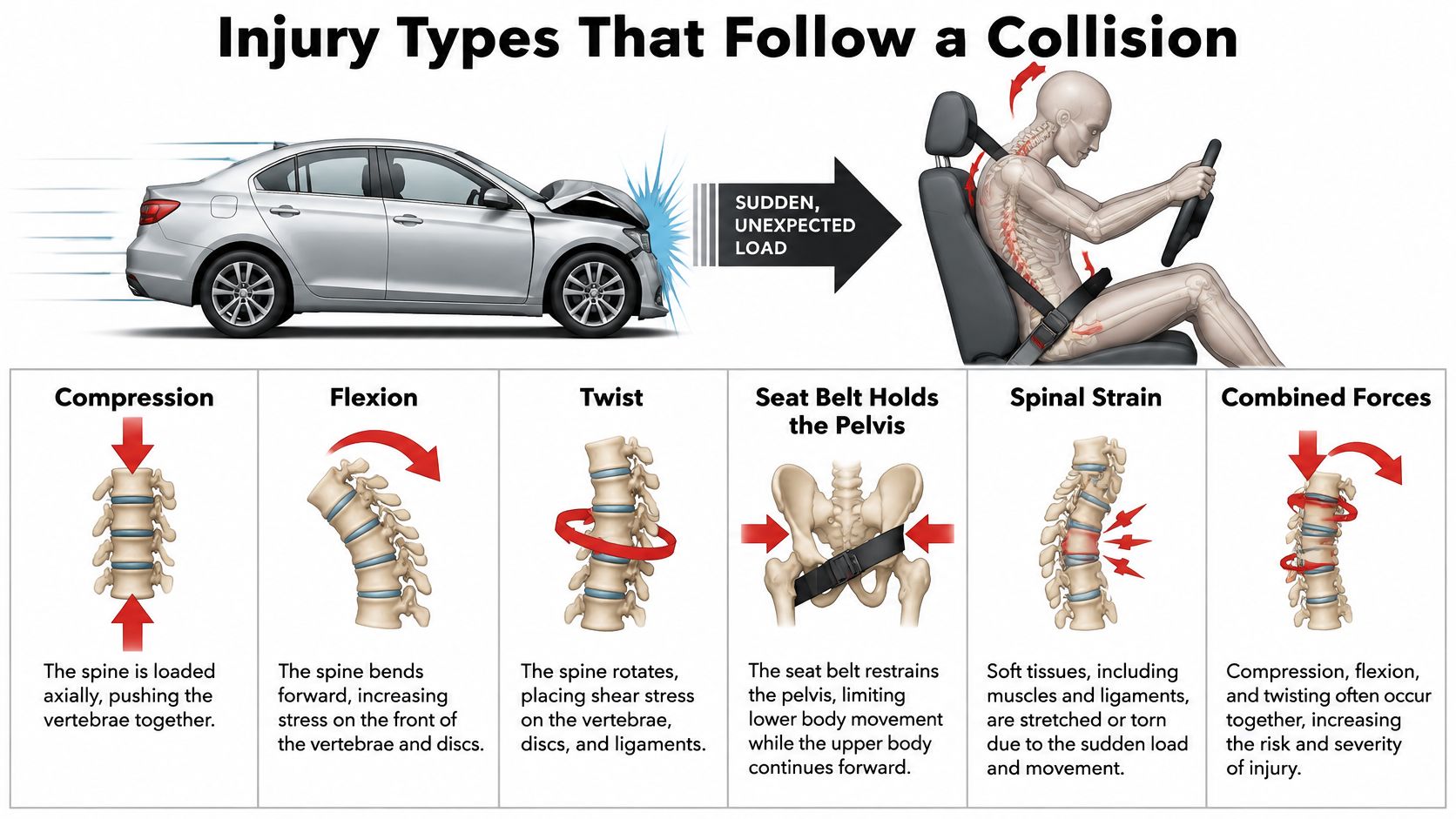
In a prospective study of 890 adults seen in emergency departments within 48 hours of a collision and then sent home, 827 people (93%) reported at least one crash-related pain complaint, and 66% had pain in three or more body regions, as reported in work published through PubMed Central. In a separate look at minor rear impacts, 22.5% of recorded diagnostic complaints involved the lumbar or sacral region, even though those crashes were classed as minor. Back pain can sit beside neck or shoulder pain. None of that proves every later complaint was caused by the crash.
Six patterns an exam tries to sort
These labels are clinical possibilities. Don't assign one to yourself from a forum post.
| Pattern | Typical feel | Crash clue | Exam focus |
|---|---|---|---|
| Muscle or ligament strain | Ache, spasm, stiffness | Any impact, often rear | Local tenderness, guarded motion, normal nerve tests |
| Disc irritation or herniation | Worse sitting; pain into buttock or leg | Flexion or compression load | Strength, reflexes, sensation, nerve tension |
| Facet joint irritation | Local pain worse with arching or twist | Extension moment | Pain on extension, focal joint tenderness |
| Sacroiliac irritation | One-sided low back or buttock | Lap belt or uneven load | Provocation tests, pelvic alignment screen |
| Fracture or unstable injury | Severe midline pain, hard to bear weight | High energy, rollover, fragile bone | Trauma imaging when tenderness or mechanism warrants it |
| Referred neck or thoracic pain | Back pain plus neck or shoulder pain | Whiplash-type motion | Cervical and thoracic exam, not lumbar only |
Why a minor-looking hit can still hurt
Say you're stopped, a car taps the rear bumper, and the belt locks across your hips while your trunk folds forward. Muscle and ligament often ache with spasm and guarded motion, and the nerve screen stays normal. A disc problem more often worsens in a chair and can send pain into the buttock or leg, so the exam checks strength, reflexes, sensation, and nerve tension. Facet irritation tends to stay local and bite when you arch or twist. Sacroiliac irritation is often one-sided into the buttock after an uneven belt load.
Practical rule: If the pain is severe in the midline after high energy, a rollover, ejection, or fragile bone, that pattern already belongs in emergency care, not in a self-sorted strain.
Referred pain from the neck or mid-back can show up as low-back pain next to a whiplash-type motion. The exam isn't only the lumbar spine. A minor-looking crash can still produce real back pain, and a dramatic dent can leave someone walking away sore for a day and then fine. The pattern table is a map for the clinician, not a verdict.
Pain That Starts Hours or Days Later
The line that "adrenaline masks pain" until day two is too simple, and it misleads people. Onset can lag for ordinary reasons: soft-tissue injury, muscle guarding, doing less, pain medicine taken for another bruise, stress, and a flare of a back problem that was already there. A rigid clock, such as inflammation always peaking in the first two or three days, or a disc tear that always worsens on day three, isn't settled by neutral clinical evidence. DK Law's discussion of back pain days after a crash is a useful reminder that delay is a timing problem, not a verdict.
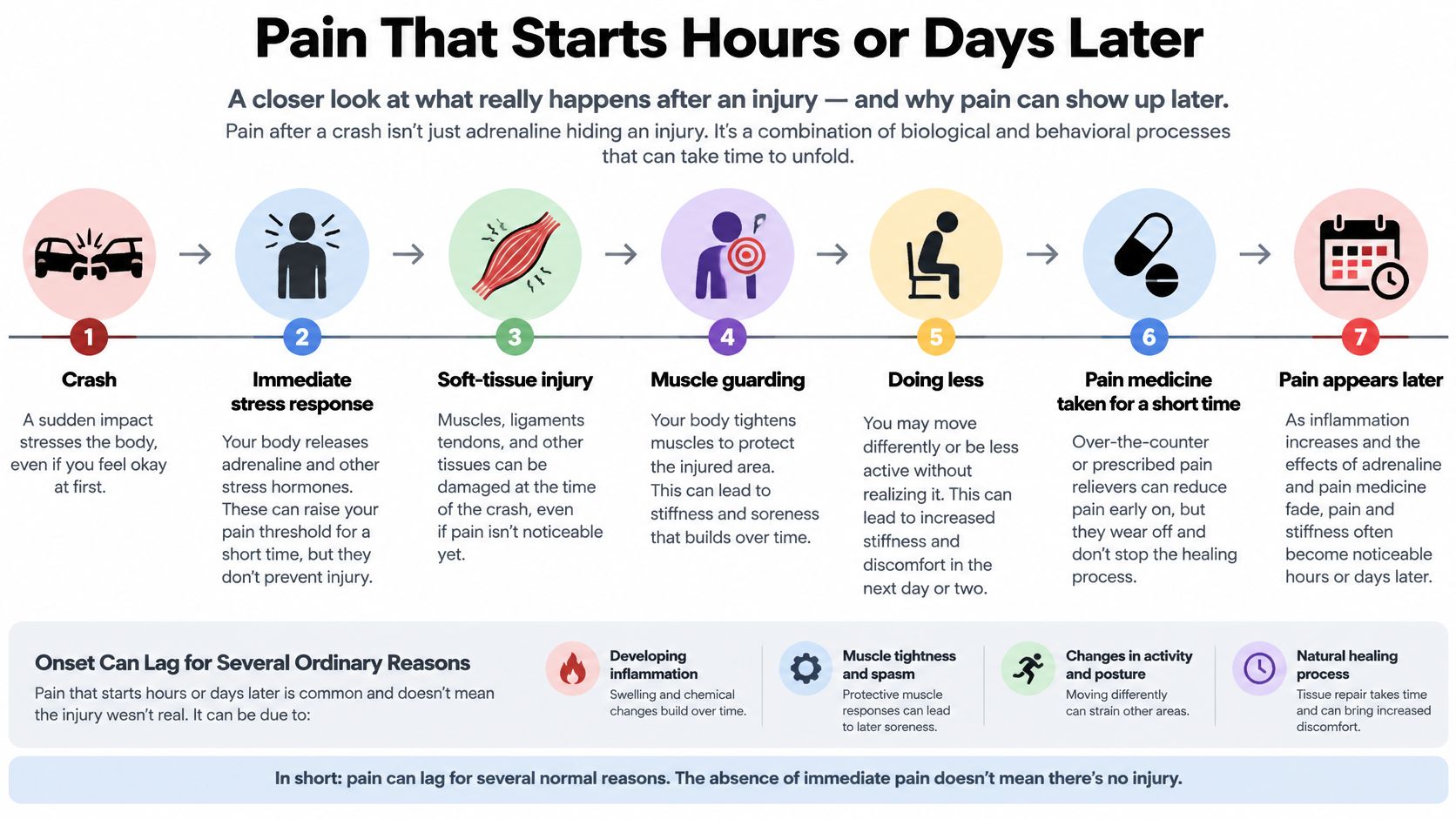
Two drivers, same kind of tap
Picture a rear-end driver who feels fine in the lot, stiff that night, and unable to sit through a meeting on day three. Picture a second person whose old back ache returns after the same kind of stop. Both need an exam and a dated note. Neither story, by itself, proves the crash created a new injury.
Delayed symptoms don't automatically defeat causation, and they don't automatically establish it. What belongs in one conversation is the timeline from the crash hour, the first exam, prior back history, work limits, and crash facts such as speed, direction, and vehicle damage. Next-day pain isn't automatically compensable. A gap with no note is also easy to misread.
If weakness, limb pain, numbness, or a bladder or bowel change shows up, go back to the first-hour table instead of waiting out a soreness story. Those signs can mean nerve or spinal-cord involvement and need urgent assessment. For the slower, non-emergency course, our guide on delayed symptoms after a car accident walks through how a later start still gets written down.
Until the visit, write three things each day.
- Start time: When the ache or stiffness showed up, including "fine at the scene, stiff by 9 p.m."
- What movement hurts: Sitting, bending, twisting, or getting out of the car.
- What activity stopped: The meeting you left, the shift you cut, the walk you couldn't finish.
A short video on why symptoms can surface after you leave the scene is worth watching once, then put the pen back on the log.
Exams Scans and Treatment Choices
Severe pain with a normal first image is common enough to plan for. So is an MRI that shows wear which might be years old. A scan is one clue beside the story, the hands-on exam, nerve findings, and what you can't do. A normal early film doesn't erase pain. An abnormal film can be age-related or preexisting, so the clinician has to ask whether that finding matches the new symptoms. Clear Life Scoliosis frames the same mismatch: imaging isn't binary proof of a crash injury, and soft tissue isn't magically settled by calling it invisible.
Name the limits out loud
Say the function in numbers a later reader can check.
- Sitting: Minutes before you have to stand.
- Walking: Distance before the ache forces a stop.
- Lifting: The pound level that hurts, including a grocery bag or a child.
- Sleep: How often pain wakes you.
- Medicines: What you took and any side effects.
- Work: Days or hours missed.
Evidence for particular conservative treatments after collision-related low-back pain is limited and mixed. There isn't one plan that fits every back.
Two paths, not a promise
Early care is usually activity as tolerated rather than days in bed, guidance on positions, and a short course of medicine if a clinician prescribes it. Physical therapy enters when pain lingers or movement stays limited. Injections or surgery are later, narrower options for specific nerve or structural problems, not the default for a strain.
Say one person has spasm, a normal nerve exam, and improves over a few weeks of guided movement. That course supports a soft-tissue story. It still doesn't prove the crash was the only cause. Say another person has leg pain plus a reflex change and gets referred on. That referral answers a nerve question. It still doesn't, by itself, assign fault or a dollar figure.
The useful question for the next visit is what changed in function, not whether a picture alone proves the crash.
Start with primary care or urgent care unless the exam already shows nerve signs, in which case a spine specialist is the right next clinician. Before you sign any release, check whether your auto policy's medical payments or PIP coverage can pay for care while a claim is open. Coverage rules differ by policy and state, so read the declarations page rather than assuming the other driver's insurer will fund every visit.
Records That Show the Injury and the Limits
A later reviewer sees the file, not the memory of the intersection. Population numbers aren't your chart. A 2020 systematic review and meta-analysis on PubMed screened 1,136 articles and kept three that met stricter quality criteria. Across those studies, people who sustained an acute injury in a collision had 2.7 times the risk of future low back pain compared with people who weren't exposed, with a 95% confidence interval of 1.9 to 3.8. The authors calculated an attributable risk of 63% among exposed, injured individuals, inside those study populations and assumptions. Persistent low back pain was present in at least 31% of exposed individuals one year after the crash. Low back pain is common in the general population anyway, so a claim needs individualized medical evidence.
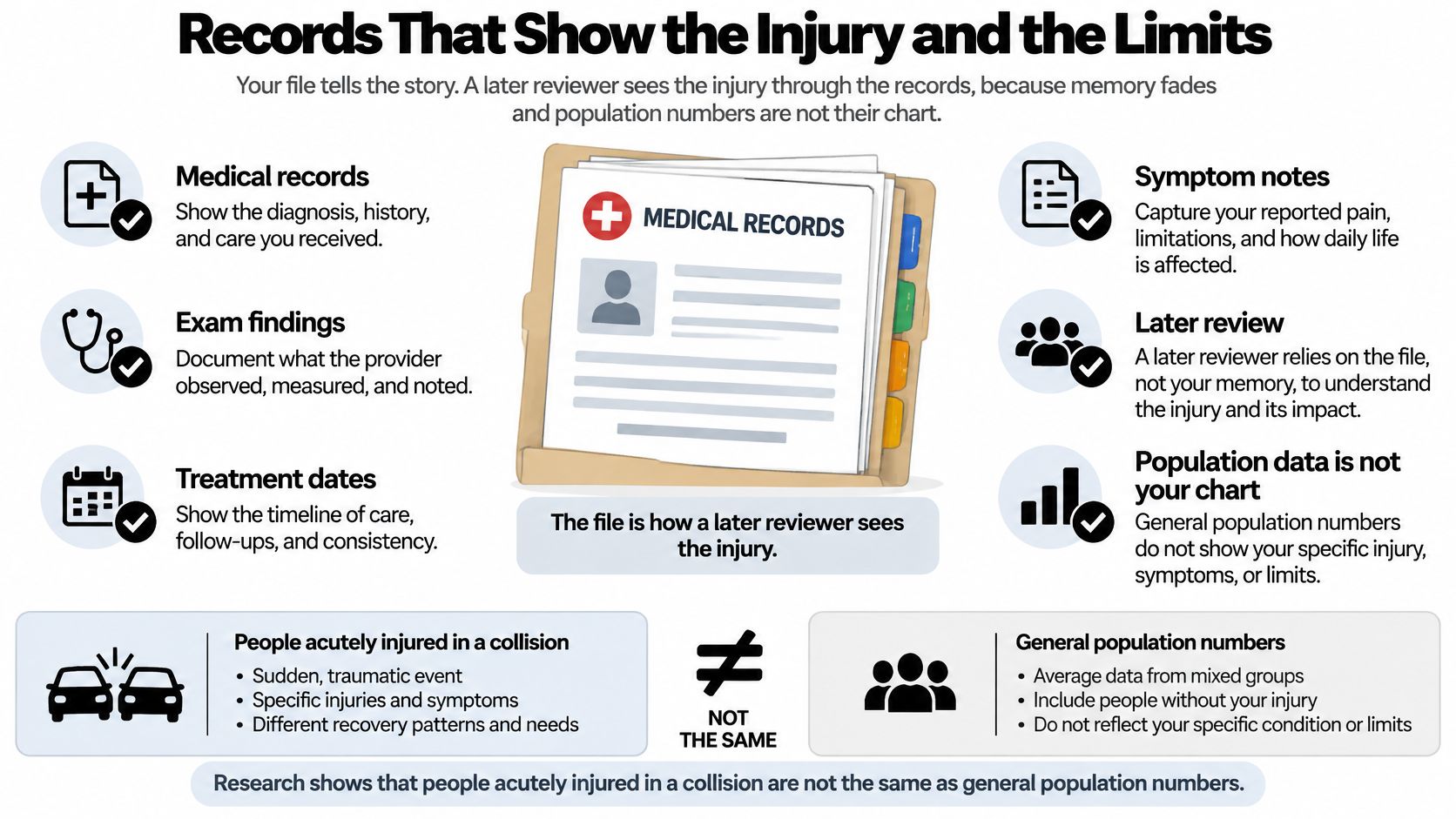
What good looks like
| Record | What to keep | What good looks like |
|---|---|---|
| Crash facts | Photos of vehicles and scene, other driver's details, police report number | Dated images and numbers recorded the same day |
| Body facts | Pain location, movement that triggers it, daily sitting, walking, lifting, sleep, missed work | One dated line per day |
| Medical facts | Visit dates, work or activity limits given, prescriptions, therapy attendance, provider bills | Each item tied to a date and provider name |
| Prior-back facts | Old flare-ups and how this episode differs | Stated plainly, never left out |
| Gap check | Skipped visits and long silences | Any gap explained in the notes |
| Out-of-pocket and wage facts | Receipts, mileage to care, employer notes of hours lost | Filed as they happen, not rebuilt later |
Get the police report number into that crash folder as soon as it exists. If you don't know how to request it, use the steps for how to obtain a police report.
Hiding an old flare is worse than explaining how this episode differs. Skipped visits and long silences are easy for an insurer to read as recovery, even when you were waiting on an appointment. File receipts, mileage to care when it matters, and employer notes of hours lost as they happen.
This packet answers what changed after the crash. It doesn't set a dollar value by itself.
How to Protect a Claim From the Start
You can do this sequence before you hire anyone, including while the other driver's insurer is already calling.
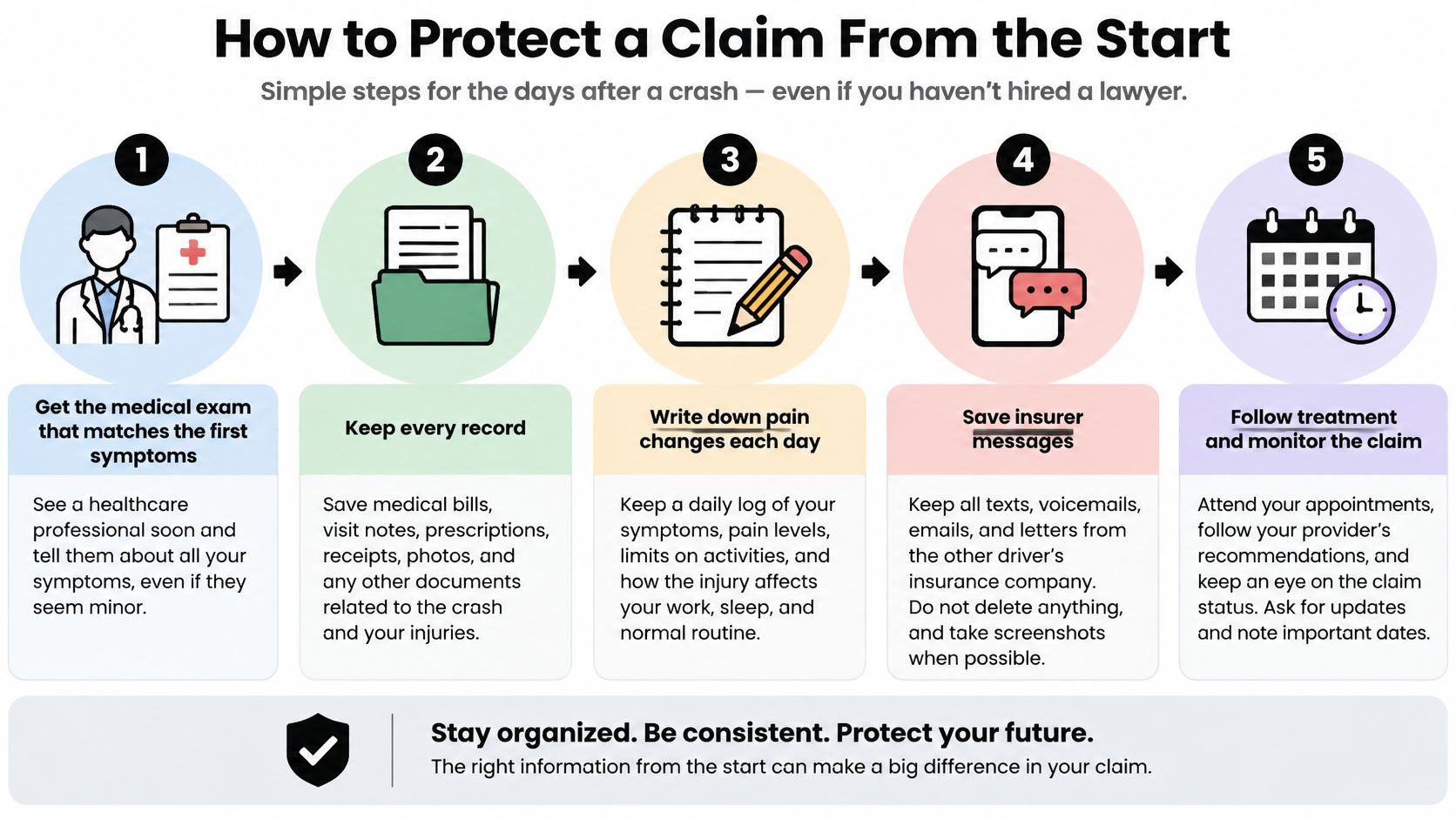
- Get the medical exam that matches the first-hour symptom row, and say the pain started with the crash, including a delayed start date if that's true.
- Report the collision as the policy requires, with facts only: place, time, vehicles, and visible injuries. Don't offer a guessed diagnosis or a promise that you feel fine.
- Request the police report and keep the number with your photos.
- Don't give a recorded statement or sign a broad medical release until you understand the scope. A wide release can pull years of unrelated records.
- Follow the limits you were given and keep appointments, so a gap isn't mistaken for recovery.
- Log lost hours and bills the day they happen, in the same packet as your photos, visit dates, and employer notes.
- Avoid posting activity clips that contradict the limits in the chart.
- Hold off on a quick release or a small check if treatment is still open. Some releases close future medical claims.
- Note repair damage and, if the car will be salvaged, save photos first.
What these steps don't do
They don't prove the other driver was at fault. They don't replace state deadlines, which differ and should be checked before a year slips by. If the insurer disputes the back, delays care, or pushes a number you can't judge, the decision in the next section is the one to make, not a rushed signature.
Decide Whether to Call a Lawyer
A lawyer is often unnecessary when care is approved, the back is steadily improving, little or no work was lost, and nobody is blaming an old condition or pushing a release. A review is worth it when the insurer says the crash didn't cause the back pain, especially if symptoms started the next day, when treatment is refused, when a settlement arrives before the course of care is clear, when lost wages are mounting, or when more than one party may share fault.
Delayed pain and a messy scan are reasons to get the facts reviewed, not proof of a payout. If the same crash also turns into a fight with your employer over restrictions or being pushed back to the job, you can contact employment dispute lawyers through The Lawyer Guide for that separate workplace problem. Our article on whether you need a lawyer after a car accident lays out that fork in more detail.
Before you hire anyone, two free tools can narrow the next step. The Accident Claim Value Assessment reviews facts that can affect how a claim is handled and gives guidance without asking for contact details. The Police Report Lookup helps you identify and request the official report, and that request does ask for contact and accident details. If you haven't retained a lawyer and the dispute is already real, a free case review can connect you with participating personal injury lawyers.
If a red-flag symptom is present, medical care comes before any form. Otherwise, finish the record list and use the assessment before you sign a release.
AskLegally publishes plain guides for the stretch after a crash, when you're sorting back pain, insurance calls, and medical bills and you haven't hired a lawyer yet. We also offer free tools and straightforward guidance for what to do next after an accident, a work injury, a landlord or rental problem, a nursing home concern, or sexual harassment. If that matches where you are, visit AskLegally and start with the record you already have.