
You felt shaken but reasonably okay after the crash. Now your neck won't turn comfortably, your back aches when you get out of bed, and you're wondering whether this is ordinary soreness or something that needs urgent attention.
Body aches after a car accident can develop gradually, but delayed pain isn't automatically harmless. What matters is where you hurt, whether symptoms are worsening, and what you can no longer do comfortably. Getting the right assessment, then keeping an accurate record of your symptoms and limitations, helps protect both your health and your ability to explain an insurance claim.
Common Causes of Body Aches After a Crash
| Cause | Typical location | Usually starts | Usual course |
|---|---|---|---|
| Whiplash-type neck strain | Neck, upper back, sometimes headache | Immediately or after a delay | May improve with appropriate care, but symptoms can persist |
| Seatbelt and airbag bruising | Chest, shoulder, hip, abdomen | At impact or as tenderness becomes noticeable | Superficial bruising should gradually improve; deeper pain needs assessment |
| Low back soft-tissue strain | Lower back, buttocks, hips | At impact or as stiffness develops | Follow improvement in walking, bending, and ordinary activity |
| Shoulder strain | Shoulder, upper arm, shoulder blade | Immediately or after initial soreness develops | Reassessment is needed if reaching and lifting remain difficult |
| Concussion | Head, balance, vision, sleep, concentration | Immediately or after a delay | Requires symptom-guided care and review if recovery stalls |
| Jaw joint injury | Jaw, face, chewing muscles | Can become noticeable after other injuries | Persistent chewing problems or restricted opening need review |
| Referred pain from a disc or nerve | Arm, hand, leg, or an area away from the impact | May be immediate or develop later | Needs clinical evaluation, particularly with altered sensation or weakness |
These are symptom patterns, not diagnoses. A sore shoulder could reflect bruising, a strained muscle, a joint injury, or pain originating in the neck. Matching a row doesn't tell you which structure is injured or whether home care is appropriate.
How a crash strains connected areas
Your body doesn't move as a single rigid unit during a collision. In a rear impact, the seat and restraint move and hold your torso while your head initially lags behind, creating rapid changes in neck movement and curvature, a mechanism described by NHTSA's biomechanics guidance.
That helps explain why pain may involve several connected areas rather than one obvious point of impact. Neck discomfort can occur alongside upper-back and shoulder symptoms, while the lower back can also be affected by the forces transmitted through the body.
Seatbelts and airbags protect you, but contact with them can leave tenderness or bruising. Don't assume pain beneath a visible mark is only a surface injury, especially when it's deep, severe, or worsening.
Look beyond the sorest muscle
Concussion can accompany body aches. Headache with dizziness, disrupted sleep, or difficulty concentrating deserves attention rather than being grouped together as general soreness.
Jaw symptoms are another easy-to-miss problem. You might notice discomfort while eating, clicking when you open your mouth, or facial pain only after the more distracting neck and back symptoms settle.
Pain traveling into a hand or leg also deserves a clear description. Tell the clinician whether it feels aching, burning, electric, numb, or weak, rather than saying your whole body hurts.
Before your appointment, note which patterns match your symptoms and which movements bring them on. Describe what you feel without trying to name the diagnosis yourself.
Why Aches Can Appear Hours or Days Later
You leave the scene able to walk and talk normally. Later, sitting on the sofa becomes uncomfortable, and getting up reveals stiffness you hadn't noticed before.
That experience can be unsettling, particularly when several areas start hurting together.

The collision applies force suddenly, but you don't necessarily perceive every consequence immediately. Irritated tissues can become more uncomfortable as inflammation develops, and protective muscle tightening can make ordinary movements feel increasingly restricted.
A bruise offers a useful analogy: the bump happens at one moment, while the tenderness and visible changes may become clearer afterward. The analogy explains delayed awareness, not injury severity. A symptom that appears later still needs to be judged on its own features.
What delayed whiplash symptoms tell us
A clinical review of whiplash evidence describes an acute-whiplash study in which patients who recovered within two years reported average delays of 10 hours for headache and 11 hours for neck pain, and a separate follow-up of 117 acute-whiplash cases found 24% remained symptomatic after one year.
Those observations support two practical conclusions. First, immediate pain isn't required for a crash-related injury to be plausible. Second, an early description of soreness doesn't guarantee a short or uncomplicated recovery.
The figures aren't a personal forecast. Different patients have different injuries, health histories, treatment needs, and functional demands, so your clinician should assess your actual progression rather than assign you a recovery deadline from a study.
A delay in symptoms doesn't, by itself, establish that an injury is unrelated to the collision. It also doesn't prove that every later symptom came from it.
This video provides an additional explanation of post-crash symptoms.
Use a practical assessment trigger
Ask yourself whether the ache is new since the crash, whether it affects an impacted or connected area, and whether it interferes with ordinary activities. These questions help you identify what to report, not establish medical causation.
- New symptoms: Record what changed from your usual baseline.
- Connected symptoms: Note whether turning your neck, reaching, bending, or sitting reproduces the discomfort.
- Lost function: Identify whether the problem interrupts sleep, prevents work tasks, or makes driving difficult.
Arrange an assessment when symptoms develop, worsen, or limit your activities. Don't use the fact that you felt relatively well initially as a reason to dismiss a developing injury.
Symptoms That Need Emergency Care Now
Seek emergency care immediately for any of these post-crash warning signs:
- Head or behavior changes: Severe or worsening headache, repeated vomiting, confusion, slurred speech, unusual drowsiness, or seizure.
- Neurological changes: New weakness, spreading numbness, or loss of coordination.
- Other serious signs: Fainting, difficulty breathing or swallowing, or severe pain directly over the middle of the spine.
Don't drive yourself if you're confused, faint, unusually sleepy, or unable to move safely. Call local emergency services and describe the collision and the symptoms you're experiencing.
The warning signs below are useful to keep accessible while you arrange help.
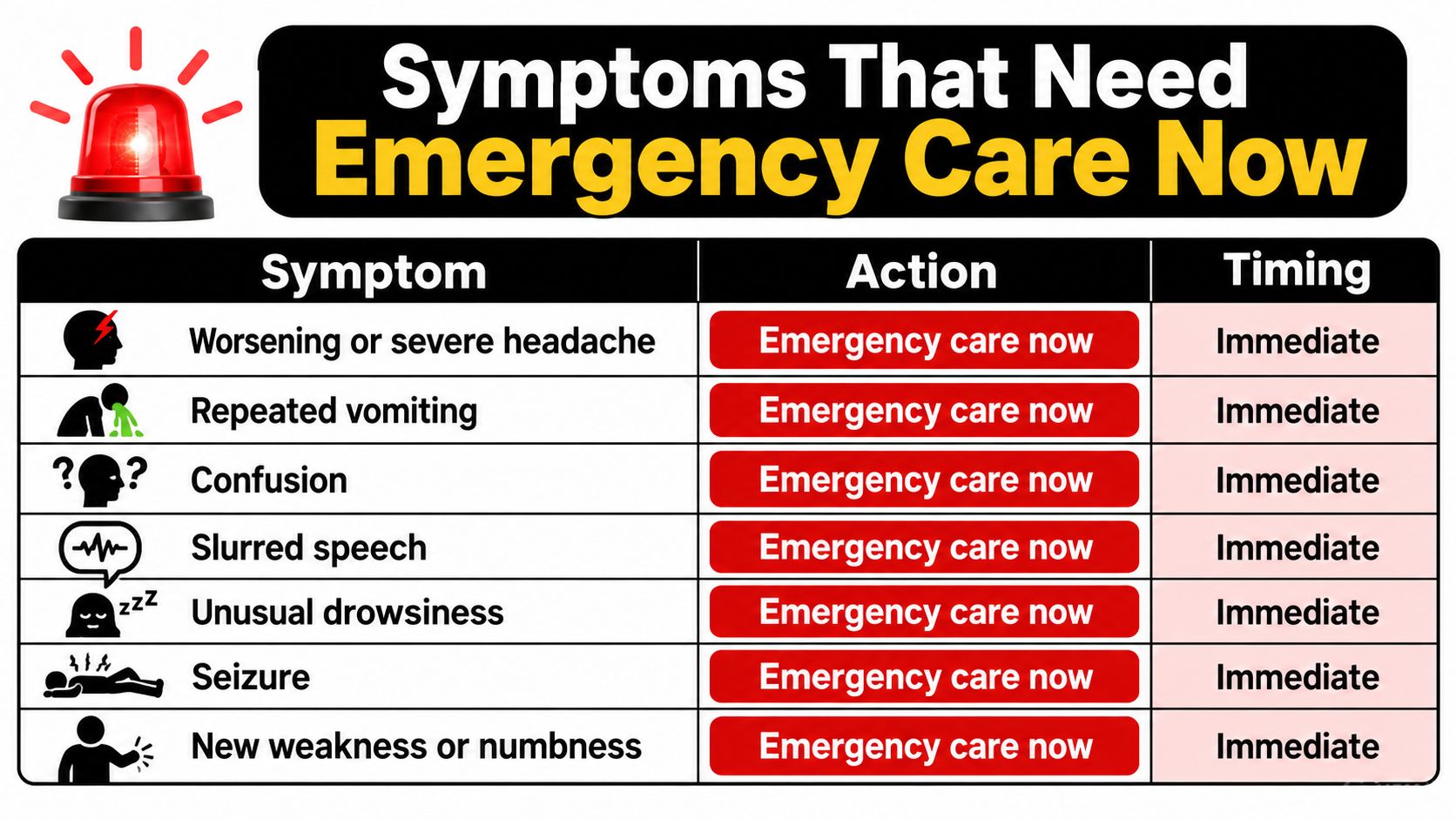
| Symptom | Action | Timing |
|---|---|---|
| Worsening or severe headache, repeated vomiting | Emergency care | Immediately |
| Confusion, slurred speech, unusual drowsiness, seizure | Call emergency services | Immediately |
| New weakness, spreading numbness, loss of coordination | Emergency care | Immediately |
| Fainting, difficulty breathing or swallowing | Emergency care | Immediately |
| Severe midline spinal pain | Emergency evaluation | Immediately |
| Widespread or rapidly spreading pain | Contact a clinician for urgent assessment | Same day |
| Persistent or worsening neck or back pain, dizziness, memory problems | Arrange medical assessment | Promptly; escalate if symptoms worsen |
| Jaw clicking, chewing difficulty, facial pain, limited mouth opening | Arrange medical or dental assessment | Promptly; seek urgent advice for locking or inability to eat or drink |
Delayed doesn't mean safe to ignore
According to the CDC's concussion symptom guidance, symptoms can appear immediately or hours or days later, and many people improve within a couple of weeks. That general recovery pattern isn't permission to wait through deterioration.
The important distinction is between a stable symptom you're arranging to have assessed and a new or escalating warning sign. Increasing confusion isn't tiredness, and new weakness isn't ordinary muscle soreness.
Our guide to concussion after a car accident explains the concern in more detail. If symptoms affect memory or concentration, ask someone you trust to help communicate changes to the clinician.
Less urgent symptoms still need a plan
Widespread or quickly spreading pain warrants same-day medical advice rather than an open-ended wait. Persistent dizziness, restricted movement, worsening neck or back discomfort, and sleep disruption also deserve prompt review.
Jaw problems can become noticeable after the initial aches have eased. Arrange a medical or dental assessment for chewing pain, facial discomfort, clicking accompanied by symptoms, or reduced mouth opening; don't assume these problems are unrelated merely because they weren't obvious at the scene.
Safety rule: Judge urgency by the symptom, its progression, and its effect on functioning, not by how long after the crash it began.
If you're unsure whether a warning sign is an emergency, call emergency services for guidance. Never wait for an insurer's approval before seeking necessary emergency care.
Treatment and Self-Care Options Compared
| Option | Best for | Timing | Watch for |
|---|---|---|---|
| Ice packs | Local swelling and sharp soreness | When appropriate for the assessed injury | Skin damage; use a cloth barrier |
| Heat packs | Stiffness and muscle tightness | When swelling isn't increasing and warmth feels helpful | Avoid any numb area |
| Over-the-counter pain relievers | General aches; some medicines also reduce inflammation | As labeled or as your clinician advises | Stomach upset, interactions, and bleeding risk |
| Gentle movement | Stiffness and reduced comfortable movement | Regularly, within clinical restrictions | Pain that rises sharply with movement |
| Physiotherapy | Ongoing neck, back, or shoulder limitations | After assessment or referral, with planned progress reviews | Exercises that repeatedly worsen function |
| Chiropractic or massage | Selected muscle-tension symptoms as an add-on | Only after medical clearance | Avoid forceful neck manipulation before evaluation |
| Dental or jaw specialist review | Jaw clicking with pain, chewing difficulty, facial pain, limited opening | Arrange when symptoms become apparent | Locking jaw or worsening chewing pain |
| Specialist review and imaging | Suspected nerve injury, persistent midline pain, or stalled recovery | When examination findings or referral criteria justify it | New or progressive neurological symptoms |
Home care is an addition to appropriate assessment, not a test of whether an injury is serious. Temporary relief from a pack or tablet doesn't establish the cause of the pain.
Start with safe, symptom-guided measures
If a clinician considers home care appropriate, use cold for uncomfortable local swelling and gentle warmth for muscle tightness when suitable. Put a cloth between the pack and your skin, follow the product instructions, and check your skin rather than falling asleep with a pack in place.
Don't apply heat where sensation is reduced. If either cold or warmth increases pain, stop and ask your clinician what's appropriate for that area.
For practical background, Vitals Healthcare Doctor On Call's guide to home remedies for muscle strain describes muscle-care measures. Its exercise-injury context doesn't replace a post-crash evaluation or establish that your symptoms are a simple strain.
Medication choice needs similar care. Follow the label or your clinician's instructions, avoid accidentally combining products with the same active ingredient, and check first if you take blood thinners or have a history that could make a medicine unsafe.
Match rehabilitation to the task you need back
Gentle activity should fit the injury and any restrictions you've received. A short, comfortable walk or a change of position may be more suitable than testing how far you can twist or stretch.
Physiotherapy can address specific problems, such as difficulty turning to check traffic or reaching into a cupboard. Ask what each exercise is intended to improve and what response should make you stop or call the therapist.
- Track benefit: Note whether you can move more easily afterward, not just whether pain briefly decreases.
- Track setbacks: Record which activity triggered a flare and what you couldn't do afterward.
- Request adjustment: Tell the treating clinician when the plan isn't producing functional progress.
The dental or jaw referral route is for temporomandibular symptoms, not an alternative treatment for neck strain. Likewise, imaging and specialist review should address a clinical question rather than add more treatment when the current plan isn't working.
Documenting Symptoms, Care and Insurance Claims
A useful record explains what happened, what changed, what care you received, and how daily life was affected. It doesn't need dramatic language or a conclusion about who caused every symptom.
Keep the health record and the financial record separate but organized together. That makes it easier to prepare for appointments and respond accurately to insurance questions.
Build a clear record
Write a dated timeline. Record the crash circumstances and when you first noticed each symptom. Distinguish the time a symptom began from the time you recognized it was affecting you.
Get evaluated and name every affected area, including symptoms that seem minor beside the main complaint. Mention relevant pre-existing problems and explain what's different now.
Keep a consistent symptom and function log. Include location, severity in your own words, altered sensation, interrupted sleep, and activities you couldn't complete. If you use a pain scale, apply it consistently rather than treating the number as the whole story.
Photograph visible bruising, swelling, or restraint marks, retaining the original files and dates. Photos supplement a clinical examination; they don't establish what's happening beneath the skin.
Separate costs from symptoms. Save medical records, prescriptions, receipts, appointment travel records, bills, and evidence of lost work. Mark whether an expense has been paid, submitted, or remains outstanding.
Report the injury to the relevant insurer in writing and retain the date and confirmation. Consult the applicable policy and local requirements rather than assuming all reporting rules are alike.
Keep correspondence and follow care instructions. Save insurer letters, work notes, restrictions, and appointment details. If you can't attend or access recommended care, record why and contact the provider about the next step.
Our workers' compensation guidance similarly emphasizes keeping injury reports, medical records, work notes, insurer letters, costs, timelines, and photos. It also identifies late reporting as a reason workers' compensation claims may be disputed, though a vehicle insurance claim follows its own rules.
Track function and overlooked jaw symptoms
Record concrete changes: whether you can sleep comfortably, complete your usual work duties, drive safely, walk normally, and concentrate on a conversation. Note improvements as carefully as setbacks.
A clinical review published by the Journal of the Canadian Dental Association describes jaw symptoms becoming noticeable three to four weeks after a crash, cites a prospective study in which 33% of whiplash sufferers developed such symptoms during the following year, and discusses a systematic review reporting persistent pain or disability in approximately half of people injured in motor-vehicle collisions.
That broader review also associated psychological distress and early pain with poorer recovery and found imaging unreliable for predicting outcome. Report anxiety, sleep disturbance, or concentration problems, without assuming they make physical symptoms less legitimate.
A normal scan doesn't tell you whether you can comfortably chew, sleep, work, or turn your head. Those limitations need their own record.
Understand imaging and insurance questions
Clinicians use examination findings and tools such as NEXUS and the Canadian C-Spine Rule to decide whether cervical imaging is warranted. The clinical overview in StatPearls explains that routine MRI or CT generally isn't recommended for uncomplicated low-grade whiplash, while objective nerve findings, progressive neurological changes, or persistent major midline pain despite a negative CT can justify further investigation.
Ask what the scan was intended to rule out and what follow-up is needed. Don't interpret either an imaging order or a decision against imaging as a verdict on an insurance claim.
When records need to move between providers, confirm the recipient and approved transmission method. SendItFax's guidance on how to securely fax lab results to specialists offers practical document-transfer context; verify privacy requirements with the treating offices.
Adjusters may examine consistency, treatment gaps, and how symptoms fit the crash account. For recorded statements, stick to known facts, say you don't know when you don't, and avoid predicting recovery. Our guide to filing an insurance claim explains the administrative steps.
Decide Whether to Speak With a Lawyer Now
Consider a legal review when the claim becomes difficult to understand or manage, not just because you have soreness. A consultation can help clarify rights and obligations without replacing your clinician's judgment about treatment.
Useful triggers include:
- An unclear recovery: Symptoms persist beyond the course your treating clinician expected, or the diagnosis and future care needs remain uncertain.
- A disputed claim: An insurer denies responsibility, questions the injury, or refuses expenses you believe should be covered.
- An early settlement: You're asked to settle before you understand your treatment needs and ongoing limitations.
- Unclear documents or fault: You don't understand a recorded-statement request, medical authorization, or another party's potential responsibility.
- Growing financial pressure: Medical bills and lost wages are becoming harder to manage.
Our guidance on whether to get a lawyer after a car accident can help you weigh those circumstances. A legal review doesn't guarantee compensation, and an assessment of claim factors isn't a promised settlement amount.
AskLegally offers a free case review for people who may have a personal injury claim and haven't retained an attorney, potentially connecting them with a participating lawyer. Our free Accident Claim Value Assessment reviews facts that can affect how an accident claim is handled, with immediate guidance and no contact details required; free guides also help explain what to do next after an accident.
Make today's decisions manageable
Write down your current symptoms and onset dates, confirm your next medical appointment, and gather the records and bills you already have. Don't sign an insurer's document until you understand what it authorizes or resolves.
Medical care comes first. You can make the legal decision as your health picture becomes clearer, while preserving records and getting advice about any time-sensitive obligations.
AskLegally offers free, straightforward guidance to help you document post-crash injuries, understand insurance questions, and decide whether legal help makes sense. Visit AskLegally to explore your next steps while you focus on getting appropriate medical care.