
You walked away from the crash, declined the ambulance, and told someone you felt fine. By the next afternoon, your head is pounding and you're rereading the same message without taking it in. Now you're wondering whether something was missed, especially if the emergency department already said your CT scan was normal.
Feeling well at the roadside and having a normal CT don't close the question of concussion. The next useful steps are medical assessment and a clear record of when symptoms began, what they prevent you from doing, and what restrictions a clinician recommends. You don't need to diagnose yourself or decide what an insurance claim is worth before getting care.
What a Crash Concussion Is and How It Is Diagnosed
A concussion is a mild traumatic brain injury, not a measure of how badly the car was damaged. Sudden acceleration, deceleration, or rotation can move the brain inside the skull and disturb how it functions. That can happen during a rear-end collision, a side impact, or contact with an airbag or window.
A direct blow to the head isn't necessary. Neither is losing consciousness. Someone who remembers getting out of the vehicle and speaking to the other driver can still need evaluation for a brain injury.
The illustration below shows the transition from the immediate aftermath to recovery, but the important changes aren't always visible.

Why a normal CT isn't the final answer
Clinicians evaluate concussion through the injury mechanism, symptom history, and neurological or cognitive assessment. The CDC's traumatic brain injury overview explains the distinction between evaluating brain function and using imaging to investigate a potentially serious structural injury.
A useful comparison is a computer whose hardware looks intact but whose processing fails under load. A picture may not reveal why it struggles when several tasks run together. Similarly, CT generally can't show the functional disturbance of an uncomplicated concussion.
Imaging still has an important role. A clinician may order a scan when bleeding inside the skull or another structural injury is suspected. Some patients need imaging urgently; others can be evaluated through their history and examination without a scan.
A normal scan is useful information. It isn't permission to disregard new confusion, dizziness, or difficulty thinking.
What the assessment should establish
The clinician needs more than a statement that your head hurts. Describe how the collision moved your body, whether you struck anything, what you remember, and what changed afterward.
An assessment may examine:
- Thinking skills: Memory, concentration, learning, and problem-solving.
- Neurological function: Balance, coordination, and speech.
- Emotional changes: Mood, behavior, and observations from someone who knows you.
- Practical safety: Whether symptoms affect work, driving, or ordinary activities.
Tell the clinician about uncertainties rather than filling them in. If you don't remember whether your head touched the window, say so.
The first emergency record may describe a normal examination because symptoms were subtle or hadn't appeared yet. A follow-up visit adds new clinical information; it isn't pointless repetition. Ask that the chart reflect your symptom history, examination findings, treatment plan, and any work or driving restrictions.
The symptom groups below can help you describe what you're noticing. They aren't a substitute for diagnosis.
Symptoms by Type and When They Start
Scan for the group that matches your experience, but treat the emergency row as a different action category, not just a more uncomfortable version of ordinary symptoms.
| Symptom group | Examples | When it often starts | Action |
|---|---|---|---|
| Thinking and memory | Confusion, slow thinking, poor concentration, trouble remembering the crash | At the scene or hours to days later | Prompt medical evaluation and a written note of onset |
| Physical | Headache, dizziness, nausea, balance trouble, light or noise sensitivity, blurred vision, fatigue | At the scene or hours to days later | Medical evaluation; reduce the activity that worsens it |
| Mood and behavior | Irritability, anxiety, sadness, behaving unlike yourself | May be delayed and noticed by family or at work | Tell a clinician; don't wait for a visible injury |
| Sleep | Sleeping much more or less, trouble falling asleep | May emerge after leaving the scene | Report it with other symptoms, not as ordinary stress alone |
| Emergency warning signs | Worsening headache, repeated vomiting, seizure, weakness or numbness, slurred speech, increasing confusion, unequal pupils, unusual behavior, cannot be awakened | Any time, including after an initially reassuring period | Emergency care immediately |
According to the CDC's concussion signs and symptoms guidance, symptoms may appear immediately or hours or days later; symptoms usually improve within a couple of weeks, but symptoms that don't resolve within 2–3 weeks, or that worsen during recovery, need healthcare-provider follow-up.
How delayed symptoms can become noticeable
You might feel comfortable while resting at home, then develop headache and nausea when you resume your routine. Someone else may first notice light sensitivity at a desk or irritability during a family conversation. These are examples of changes worth reporting, not proof that a particular injury caused them.
The distinction matters: delayed onset doesn't establish cause or severity on its own. A clinician needs the sequence of events and an examination, including consideration of other possible explanations.
For more detail on describing headache patterns, our guide to headache after a car accident can help you organize what to report. Don't assume every headache is a concussion, and don't dismiss it because you initially felt well.
Separate emotional descriptions from a diagnosis
People sometimes describe feeling detached, unreal, or disconnected after a frightening collision. If that language fits your experience, reVIBE Mental Health's resource on understanding why dissociation happens offers context for describing those experiences.
That resource isn't a concussion assessment. Tell your clinician about both emotional experiences and problems with memory or attention rather than choosing a diagnosis yourself.
Safety first: Seek emergency care for the warning signs in the table. Don't wait to complete a symptom diary or speak with an insurer.
For non-emergency symptoms, start with the crash date and the earliest moment you noticed each change. Include whether you noticed it yourself or someone else pointed it out. An honest approximate time is more useful than a precise time you've guessed.
A Gradual Return to Activity and Driving
Recovery requires adjusting activity, not proving you can push through it. Think of relative rest as turning down a volume knob: you reduce the load without unplugging ordinary life indefinitely.
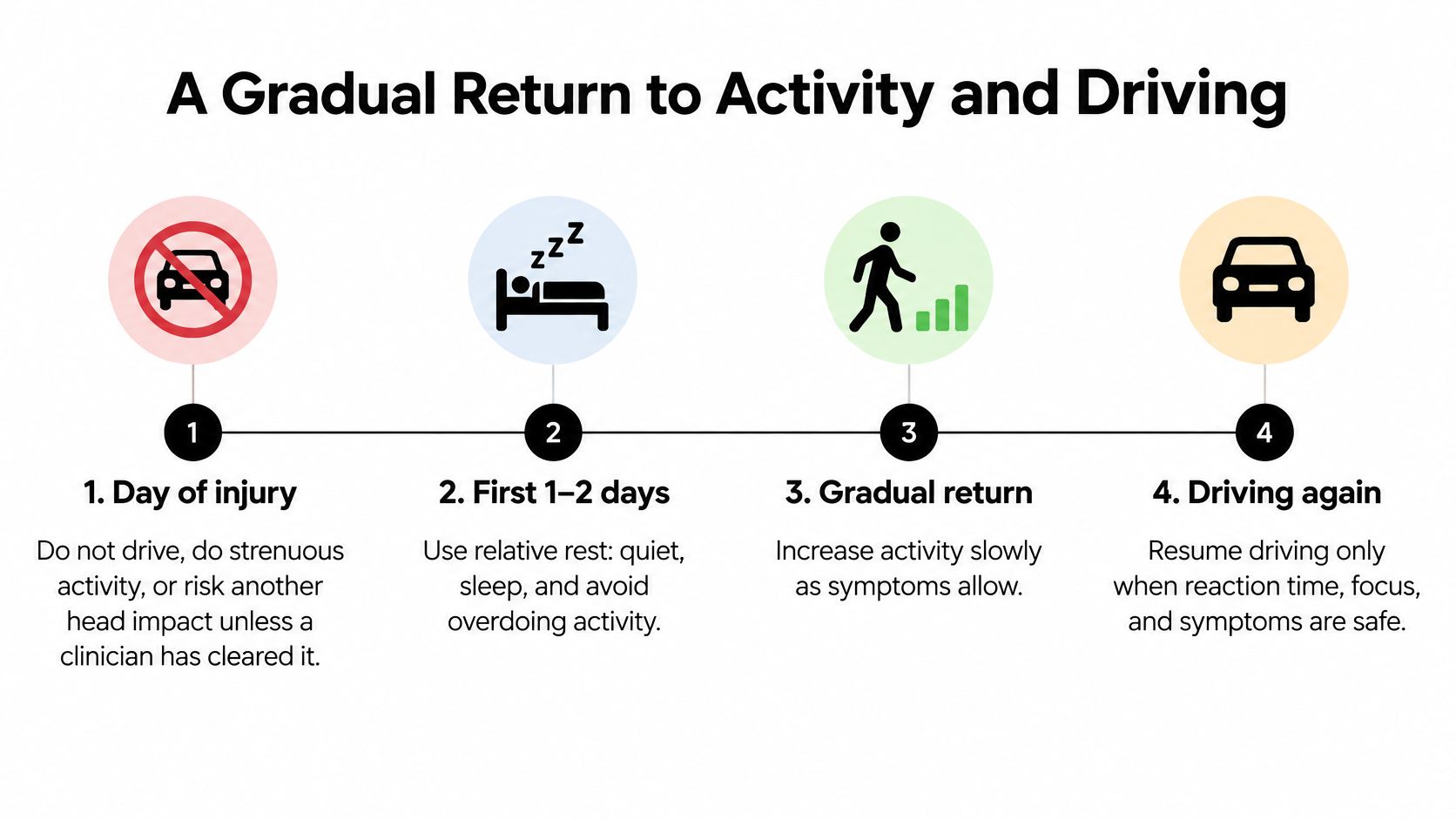
This timeline summarizes the progression, but your clinician should adapt it to your symptoms and responsibilities.
Rest first, then rebuild
The CDC's recovery guidance recommends rest during the first 1–2 days, followed by a gradual return to light physical and cognitive activity as symptoms allow.
- Protect yourself on the day of injury. Don't drive, undertake strenuous activity, or risk another head impact without medical guidance. Arrange transportation rather than treating the drive home as a test.
- Use relative rest initially. Prioritize sleep and a quieter routine. Reduce tasks that clearly intensify symptoms instead of forcing yourself through them.
- Reintroduce manageable activity. A gentle walk or a brief, uncomplicated task may be a starting point if your clinician agrees. Increase the load gradually rather than returning straight to a full schedule.
- Respond to symptom increases. If headache, dizziness, nausea, visual problems, or thinking difficulties intensify, reduce the activity or stop and retry later.
- Get an individualized return plan. Work, school, sport, and driving place different demands on you. Ask for written instructions that fit the activity.
| Phase | Timing | What to do | Stop or change if |
|---|---|---|---|
| Day of injury | Injury day | No driving, strenuous effort, or further head impact without medical guidance | Any emergency warning sign appears |
| Relative rest | Initial rest period | Quiet rest; avoid activities that clearly worsen symptoms | Symptoms spike with a task |
| Graded activity | After initial rest | Increase light physical and cognitive activity gradually | Headache, dizziness, nausea, vision, or thinking symptoms intensify |
| Return to work and driving | Clinician-set | Follow written restrictions and clearance | Limits are unclear or symptoms return |
| Not improving | Recovery isn't progressing | Contact a healthcare provider | Symptoms persist, worsen, or block daily function |
Driving isn't a self-test
Driving requires sustained attention, fast reactions, visual processing, and judgment at the same time. Feeling comfortable while sitting behind the wheel doesn't establish that you can respond safely to traffic.
Let a healthcare professional guide the return to driving. If restrictions are unclear, ask before resuming. Don't use a busy road, night journey, or motorway trip to find out whether you're ready.
Record triggers such as screens, busy stores, long meetings, or visual discomfort during travel. That information helps your clinician adjust the plan without relying on a general description of having a bad day.
The video below provides additional context for recovery conversations.
What to Record for Care and a Claim
Build one factual timeline that a clinician and a claims reviewer can both understand. You don't need persuasive language. You need a sequence showing symptom onset, care, restrictions, and expenses.
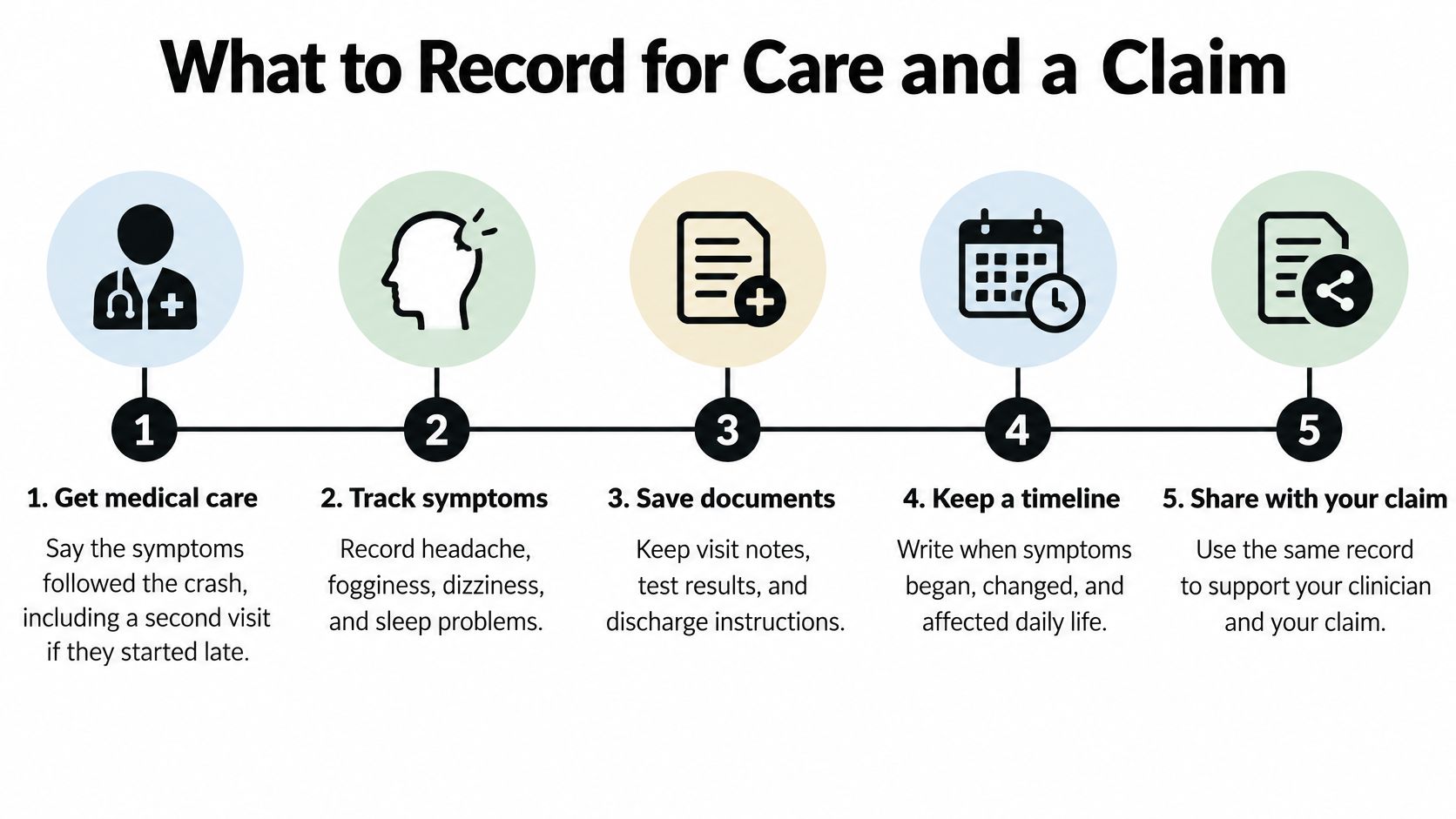
The checklist below shows the main parts of that record.
Build a usable file
- Get medical care and explain the sequence. Say that the symptoms followed a collision and describe when they appeared. If they began after your initial evaluation, arrange follow-up rather than assuming the earlier visit settled everything.
- Save the crash details. Record the date, location, vehicles involved, and witness contact information. Add the official crash report when it becomes available.
- Log symptoms in practical terms. Note onset, changes, triggers, and the task affected. Being unable to follow a meeting is more informative than writing that you felt off.
- Keep the clinical documents together. Save after-visit summaries, imaging reports, prescriptions, therapy notes, and written work or driving restrictions. Keep the original wording rather than rewriting a restriction from memory.
- Document financial effects. Preserve missed-shift records, reduced hours, receipts, and treatment-related out-of-pocket expenses. Separate amounts paid from bills still outstanding.
- Preserve photographs and observations. Photograph visible injuries and vehicle damage without treating either as a measure of brain-injury severity. Ask witnesses to describe what they observed.
- Keep an insurer communication log. Record who contacted you, what was requested, and what you said. Don't guess about speed, fault, or whether you've fully recovered.
Show the limitation, not just the symptom
A useful entry connects a symptom with an activity: headache increased during computer work, concentration failed during a meeting, or dizziness interrupted grocery shopping. Include what you did next and whether a clinician changed your restrictions.
Don't try to sort every problem into ordinary soreness or brain injury yourself. Describe local pain separately from difficulties with attention, balance, vision, or daily tasks so the clinician can assess both.
Write the file so someone unfamiliar with the crash can understand it without a long explanation from you.
For the administrative side, our guide to filing an insurance claim explains how to organize the process. Florida readers who need background on their policy can also consult Florida All Risk Insurance's guide to Florida PIP insurance coverage; use your actual policy and claim correspondence when checking what applies.
Follow the care plan you're given. If cost, transport, or scheduling prevents a visit, tell the provider and document the obstacle rather than leaving an unexplained gap.
When Symptoms Last Longer Than Weeks
Consider a hypothetical passenger who was rear-ended, evaluated at urgent care, and sent home. Well into recovery, grocery aisles still provoke dizziness, afternoon headaches interrupt work, and the passenger keeps leaving shifts early. The useful question isn't whether the person can endure more, but what follow-up and activity adjustments are needed.
Persistent symptoms deserve attention even when the initial assessment was reassuring. Bring examples of the tasks you can't sustain, along with your symptom timeline and any prior concussion history.
What longer-term evidence does and doesn't establish
A 2026 cohort study of adults injured in motor-vehicle crashes examined 907,984 adults requiring emergency medical care and found that a documented prior concussion was associated with a 15% higher risk of long-term disability after the crash.
That association makes concussion history relevant to a new evaluation. It doesn't mean the new collision will disable you, and it doesn't prove that a prior concussion caused a particular person's later limitations.
The same evidence summary describes a separate study of motor-vehicle occupants receiving care for persisting concussion symptoms. Those patients experienced multiple symptoms rather than a single isolated complaint. Because they were selected for ongoing problems, their experience shouldn't be treated as the expected outcome for everyone with a concussion.
Make follow-up about function
Ask your clinician to address the activities that remain difficult, not just whether a headache is present. Useful questions include:
- Work demands: Should duties, hours, or breaks change?
- Travel safety: Do dizziness or visual symptoms affect transport arrangements?
- Treatment needs: Does the current plan need reassessment or referral?
- Progress measures: What improvement should you track before the next appointment?
A prior injury belongs in that conversation even if it happened long ago. Explain what symptoms existed before the new crash and what changed afterward, without assuming every current problem has the same cause.
Non-resolving symptoms need reassessment, not an online severity score. Keep the focus on clinical findings, functional limitations, and a plan you can follow.
When a Personal Injury Lawyer Review Helps
A lawyer review becomes useful when medical needs and the claim stop lining up. That might mean another driver likely caused the collision, but the insurer disputes the injury because early imaging was normal. It can also mean treatment is being refused, restrictions are costing wages, or a settlement arrives before your recovery needs are clear.
You may not need a lawyer immediately when care is underway, there's no dispute, and the immediate task is keeping accurate records. Our guide to reasons to get a lawyer after a car accident can help you distinguish routine administration from a problem needing individual advice.
Pause when the request exceeds what you know
Recorded statements can preserve an incomplete account while symptoms are still unfolding. Broad medical releases may also involve records beyond what you expected. Ask what's being requested, keep a copy, and consider advice before agreeing if you don't understand the scope.
Avoid using an online average concussion settlement as your target. It can't account for your diagnosis, treatment needs, wage loss, available coverage, or disputes about responsibility.
Use help without committing to representation
We offer these free starting points:
- Accident Claim Value Assessment: Reviews facts that can affect how an accident claim is handled, with immediate guidance and no contact details required.
- Police Report Lookup: Helps identify and request the official report; a report request requires contact and accident details.
- Legal guides and case review: Our guides explain what to do after a crash, and a free case review can help connect people who haven't retained counsel with a participating personal injury lawyer.
Finish the medical evaluation and dated symptom log first. Use a legal review when the insurer, bills, or restrictions are already in conflict.
Frequent Questions After a Crash Concussion
Can symptoms appear weeks after the crash?
Symptoms can emerge after an initially reassuring period, but newly appearing symptoms much later shouldn't automatically be attributed to concussion. Record when they began and seek assessment so a clinician can consider the collision and other possible causes.
Does a normal CT mean there's no concussion?
No. CT investigates structural problems and doesn't rule out the functional disturbance of an uncomplicated concussion. Your clinician considers your history and examination rather than treating the scan as the entire assessment.
Is a concussion the same as a traumatic brain injury?
A concussion is a mild traumatic brain injury. Mild describes the injury category, not how easy the symptoms feel to live with. Suspected bleeding or another serious structural injury requires urgent evaluation.
Does a prior concussion change the picture?
It can affect the clinical assessment. Tell the clinician about earlier injuries, how you recovered, and any symptoms that existed before this crash. That helps distinguish your baseline from new changes.
Should I sign a settlement while symptoms are changing?
Get advice before signing if your treatment needs or restrictions remain uncertain. Read the release carefully because settling may end your ability to seek further payment for the same injury. A payment offer doesn't establish that recovery is complete.
Can I drive if I feel fine at the wheel?
Don't rely on that feeling alone. Ask your clinician for guidance that addresses your symptoms and driving demands. If you haven't been cleared or don't understand your restrictions, arrange another way to travel.
AskLegally offers free accident guidance, claim tools, and a case review for people who haven't hired a lawyer. After arranging medical care and starting your symptom timeline, visit AskLegally to organize your next claim steps and explore whether a participating personal injury lawyer's review would help.