
Chest injuries rank among the most serious harms a crash can cause, spanning a strained chest wall at one end and damage to the heart, lungs, or major vessels at the other. That range is why a sore seat-belt mark is hard to judge on your own.
Getting checked is not the same as needing a CT scan. The decision tonight is which level of care fits your symptoms, and which tests the mechanism and timing of the crash call for.
Chest Pain After a Car Accident
Choose the level of care before trying to name the injury. Breathing trouble, fainting, or an abnormal heartbeat belongs in emergency care. Stable soreness without those symptoms may be suitable for an urgent-care visit, but watching at home is safest only after a clinician has assessed the injury and given you return precautions.
Choose where to go tonight
The possibilities below aren't diagnoses. Different injuries can produce similar symptoms, and a visible bruise doesn't tell you what's happening underneath it.
Chest pain after a crash and how fast to get care
| What you notice | What it may be | Where to go |
|---|---|---|
| Pain worse with breathing and sore ribs | Rib fracture or lung bruise | Emergency department the same day |
| Shortness of breath or coughing blood | Lung contusion, laceration, or other chest trauma | Emergency services now |
| Fainting, sweating, racing or irregular heartbeat, sudden weakness | Blunt heart injury or major vessel injury | Emergency services now |
| Seat-belt bruise and muscle soreness with easy breathing | Possible chest-wall strain | Urgent care promptly if stable; emergency care if symptoms change |
| New or worse pain days later, especially with exertion | Delayed heart complication or worsening chest injury | Urgent reassessment, emergency department if faint or breathless |
| Older age or a side impact, even if pain feels mild | Higher concern for rib, sternal, or lung injury | Lower threshold for the emergency department |
If you're breathless, feel faint, or have a racing or irregular heartbeat, call emergency services rather than driving yourself. Don't spend time photographing bruises or calling an insurer first.
Urgent care is an option for someone who's breathing comfortably, has localized soreness, and has no concerning associated symptoms. Call ahead to explain that the pain followed a collision. A clinic may direct you to an emergency department if it can't provide the assessment you need.
Practical rule: Being able to walk away from the vehicle doesn't establish that your chest is uninjured.
What can hurt inside the chest
The chest wall includes the ribs, breastbone, muscles, and connecting tissues. Beneath it sit the lungs, heart, and major blood vessels. A collision can injure the outer structures, the organs underneath, or both.
A rib fracture can cause localized tenderness and pain with breathing. A pulmonary contusion, meaning a bruised lung, affects the lung rather than just the skin over it. Breastbone injury can make the center of the chest painful, while injury to the heart or major vessels may produce symptoms that aren't confined to one tender spot.
Seat belts and airbags protect occupants, but the forces involved in restraining the body can still injure the chest. A diagonal belt mark explains where force was applied. It doesn't prove that the damage stops at the skin, nor does a bruise by itself prove internal injury.
Age and impact direction change the decision
In NHTSA research on older occupants, the estimated incidence of at least moderate thoracic injury was 1.3% in frontal crashes among occupants aged 25–44, compared with 5.9% in frontal crashes and 8.5% in side crashes among occupants aged 75 and older.
Those are estimates for particular crash populations, not a calculator for your individual risk. Their practical message is that an older person with tolerable pain after a side impact deserves more caution than the word mild might suggest.
Tell the clinician which side of the vehicle was struck and where you were sitting. Don't use limited vehicle damage or the absence of dramatic pain as the deciding reason to stay home.
Self-Care in the First Days After a Crash
Home care is for an injury a clinician has assessed as suitable for home management. Follow your discharge instructions first, especially if you have a fracture, lung injury, or another condition that changes the plan.
- Reduce painful loading. Avoid heavy lifting, forceful pushing, and twisting that aggravate the chest. A supported, partly upright sleeping position may feel more comfortable.
- Hold a pillow gently against your chest when coughing or sneezing. Don't bind or tightly wrap your ribs, because restricting chest movement can interfere with breathing.
- Use cold carefully. Place a cloth between a cold pack and your skin, apply it briefly, and check the skin regularly. Don't sleep with the pack in place.
- Take comfortable, slow, full breaths while awake rather than deliberately breathing shallowly all day. If you can't breathe because of pain, contact your clinician; new breathing difficulty requires urgent care.
- Check medicines before adding them. Ask which pain reliever is appropriate after the trauma. Don't start aspirin or anti-inflammatory medicines without checking, and don't stop prescribed blood thinners on your own.
- Avoid driving while dizziness, medication effects, or pain interferes with steering, turning, or braking. Ask for written work or activity restrictions if needed.
- Keep a brief symptom note. Record changes in breathing, pain, activity tolerance, and medication use.
Home care should make an assessed injury easier to manage. It shouldn't become a reason to postpone reassessment when symptoms change.
Why Chest Pain Can Start Days After the Crash
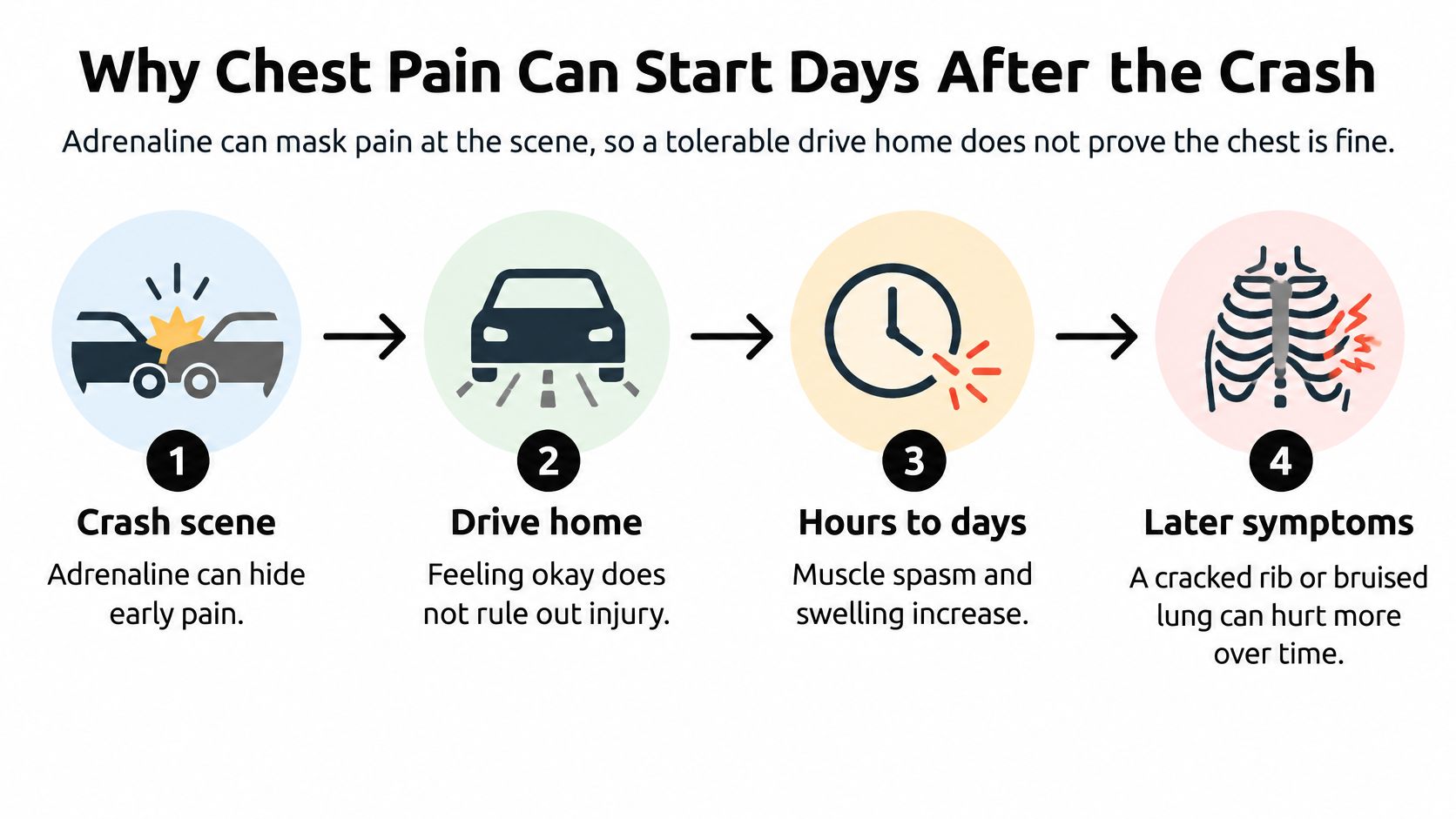
Adrenaline can turn down your awareness of pain at the scene. Later, as the immediate stress settles and injured tissues become sore, a chest injury may become more noticeable. A tolerable drive home isn't proof that everything inside the chest is fine.
The timing matters, but it doesn't diagnose the injury. Delayed pain isn't automatically a severe complication, and an initially reassuring examination isn't permanent clearance.
The timeline below illustrates why symptoms can become more apparent after you leave the scene.
Treat the change as useful information
A published report of delayed cardiac complications after a motor-vehicle collision describes intermittent mild pain before more serious symptoms and discusses the NEXUS Chest factors used when considering imaging, including age 60 or older, rapid deceleration, chest pain, intoxication, altered mental status, distracting injury, and chest-wall tenderness.
A case report demonstrates what can happen. It doesn't establish that everyone with delayed soreness has a heart injury. The useful question is whether the pain has changed in a way that calls for another examination.
Delayed chest symptoms by time since the crash
| Time since crash | What can surface | Action |
|---|---|---|
| At the scene and during the initial assessment | Pain may be less noticeable; early findings may be reassuring | Keep the visit results and discharge instructions |
| During the repeat-testing interval | Heart blood-test or electrical findings may change | Complete repeat testing if the trauma protocol calls for it |
| During early observation | Rhythm problems can become apparent | Accept monitoring when recommended; seek help for palpitations |
| In the following days | Chest-wall soreness or a delayed complication may become noticeable | Seek urgent reassessment for new, worsening, or exertional pain |
Describe the change precisely. For example, soreness when rolling over is a different history from new tightness while walking. Neither description lets you diagnose yourself, but each helps the clinician choose the next assessment.
Getting checked doesn't automatically mean getting a CT
A clinician may begin with an examination, oxygen measurement, and tests directed at your symptoms. A selected, well-appearing patient may need a chest X-ray rather than a CT scan. Someone with a more concerning mechanism or examination may need more detailed imaging.
More scanning isn't automatically better care. Clinicians balance the possibility of a missed injury against radiation exposure, cost, and findings unrelated to the crash. You can ask what the proposed test is intended to find and how its result would change treatment.
Our guide to delayed symptoms after a car accident can help you organize changes beyond chest pain. Don't wait to complete a symptom diary if pain becomes exertional or comes with shortness of breath, fainting, palpitations, or worsening weakness.
Tests to Expect and What a Normal ECG Misses
An electrocardiogram, or ECG, records the heart's electrical activity. It doesn't examine every structure in the chest, and a normal tracing alone doesn't settle every concern about a crash-related heart injury.
The clinical review of blunt cardiac injury hosted by the National Library of Medicine recommends an initial 12-lead ECG and cardiac troponin when blunt cardiac injury is suspected, notes that several protocols repeat them after approximately 4–6 hours, and explains that serious arrhythmias or cardiac failure most often become apparent during the first 24–48 hours.
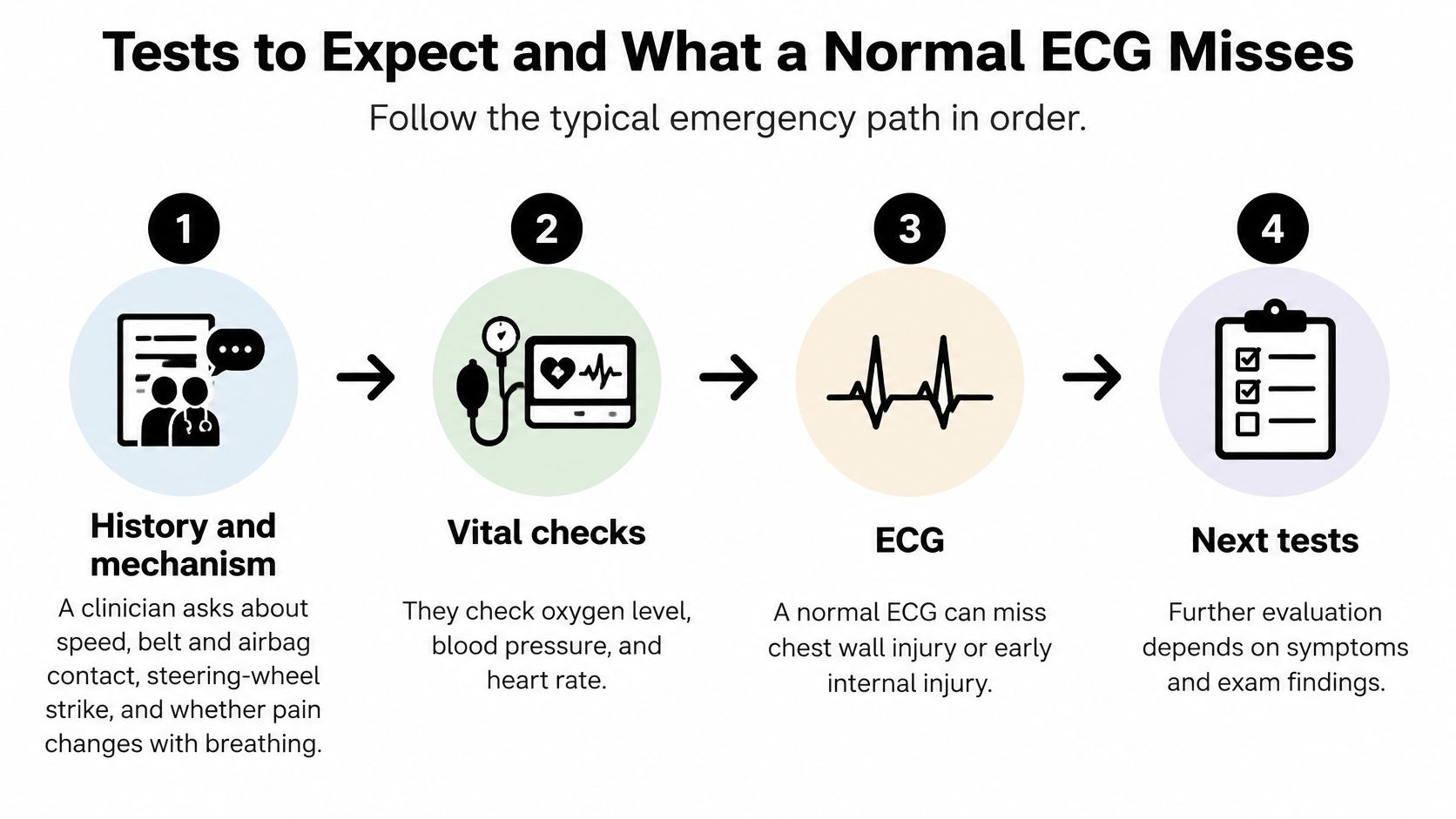
Follow the emergency assessment in order
- Explain the mechanism. Describe the impact, your seating position, restraint use, airbag deployment, and any steering-wheel contact. Say whether pain changes with breathing, movement, or effort.
- The team checks your oxygen level, blood pressure, heart rate, and chest wall. Tell them about dizziness or palpitations even if those symptoms have stopped.
- An ECG checks electrical patterns. When heart injury is possible, clinicians look for rhythm disturbances and other abnormalities rather than using pain intensity alone.
- Troponin checks for heart-muscle damage. The timing of the blood draw matters. A clinician may arrange another sample instead of treating an early normal result as the end of the assessment.
- Imaging is selected for the question being asked. An X-ray and CT don't provide identical information, and neither replaces the heart assessment when that's needed.
- Echocardiography examines heart function. Low blood pressure, heart failure, or a new arrhythmia can prompt this ultrasound examination.
- Abnormal findings may lead to continuous heart monitoring. Observation lets the team detect changes that weren't present on arrival.
This visual summarizes the sequence, not a promise that every patient needs every test.
Match each test to its question
Chest evaluation after a crash
| Test | When it is used | What it looks for |
|---|---|---|
| Exam and oxygen level | Initial assessment of post-crash chest pain | Breathing trouble, low oxygen, chest-wall tenderness |
| ECG | Possible heart injury, fast heart rate, fainting, or concerning chest symptoms | Rhythm problems and electrical injury patterns |
| Troponin, repeated when indicated | Suspected blunt cardiac injury | Evidence of heart-muscle damage |
| Chest X-ray | Selected patients after examination | Some fractures, lung abnormalities, or a collapsed lung; it can miss injuries |
| CT of the chest | Higher-risk mechanism or concerning examination | Injuries requiring more detailed imaging, potentially including vessel injury |
| Echocardiogram | Low blood pressure, heart failure, or a new arrhythmia | Pump, structural, or valve problems |
| Continuous heart monitor | Abnormal ECG or troponin findings | Rhythm changes during observation |
Blunt cardiac injury means physical injury to the heart from impact or rapid deceleration. Concern increases with direct chest impact, rib or breastbone fractures, a lung bruise, unexplained fast heartbeat, low blood pressure, or palpitations. Little pain doesn't reliably exclude it.
Before leaving, ask whether testing is complete or another blood draw is planned. Confirm which symptoms require an immediate return, who will handle follow-up, and how to obtain the ECG, laboratory results, and imaging reports.
Records That Support a Chest Injury Claim
Build a dated chain from the collision to the symptoms, treatment, and expenses. Accurate records are more useful than strong adjectives such as unbearable or devastating, especially when the diagnosis is still being clarified.
Keep the file factual
- Describe the connection accurately. Tell the clinician when the crash happened, where you sat, and whether a belt, airbag, or steering wheel contacted your chest. If pain began later, say that rather than changing the timing to make the connection sound stronger.
- Request the visit note, ECG, troponin results, imaging reports, discharge instructions, and written restrictions. Keep preliminary findings separate from the final diagnosis.
- Photograph visible evidence. Save images of the belt mark, vehicle damage, and any relevant interior contact point. Add the date and keep the original files.
- Keep a short daily account of pain, breathing limits, medication use, sleep disruption, and missed work. Record improvement as well as setbacks.
- Save financial proof. Retain medical bills, receipts, travel records for appointments, pay stubs, and employer confirmation of missed shifts.
- Identify the official police report and request a copy. Don't substitute your memory of a conversation at the scene for the report itself.
- Avoid premature conclusions in statements. Don't describe the injury as only a bruise while evaluation is ongoing. Before giving a recorded statement, understand who is requesting it and consider legal advice if you're unsure of your obligations.
For a practical filing system, the Ares guide to organizing medical records offers a useful starting point. Keep records grouped by provider and date, with bills stored separately from clinical reports.
Finish with a one-page timeline
| Event | What to record |
|---|---|
| Collision | Date, location, seating position, and impact description |
| First symptom | When it began and what you noticed |
| First visit | Facility, clinician, and presenting symptoms |
| Testing and follow-up | Results, repeat tests, referrals, and restrictions |
| Work and expenses | Missed shifts, supporting documents, and outstanding bills |
An insurer may question a delayed first visit or an unexplained follow-up gap. If transport, cost, or appointment availability caused a delay, record that truthfully and keep related messages.
Use our guide to filing an insurance claim to organize the reporting process. Documentation supports an explanation of your injury; it doesn't guarantee coverage or a particular settlement.
Crash Examples That Change the Next Move
These hypothetical situations show why the next action should follow the person's symptoms and crash circumstances, not the appearance of the bruise.
An older passenger seeking advice after a collision may look comfortable while still needing an in-person assessment.
A dull ache after a side impact
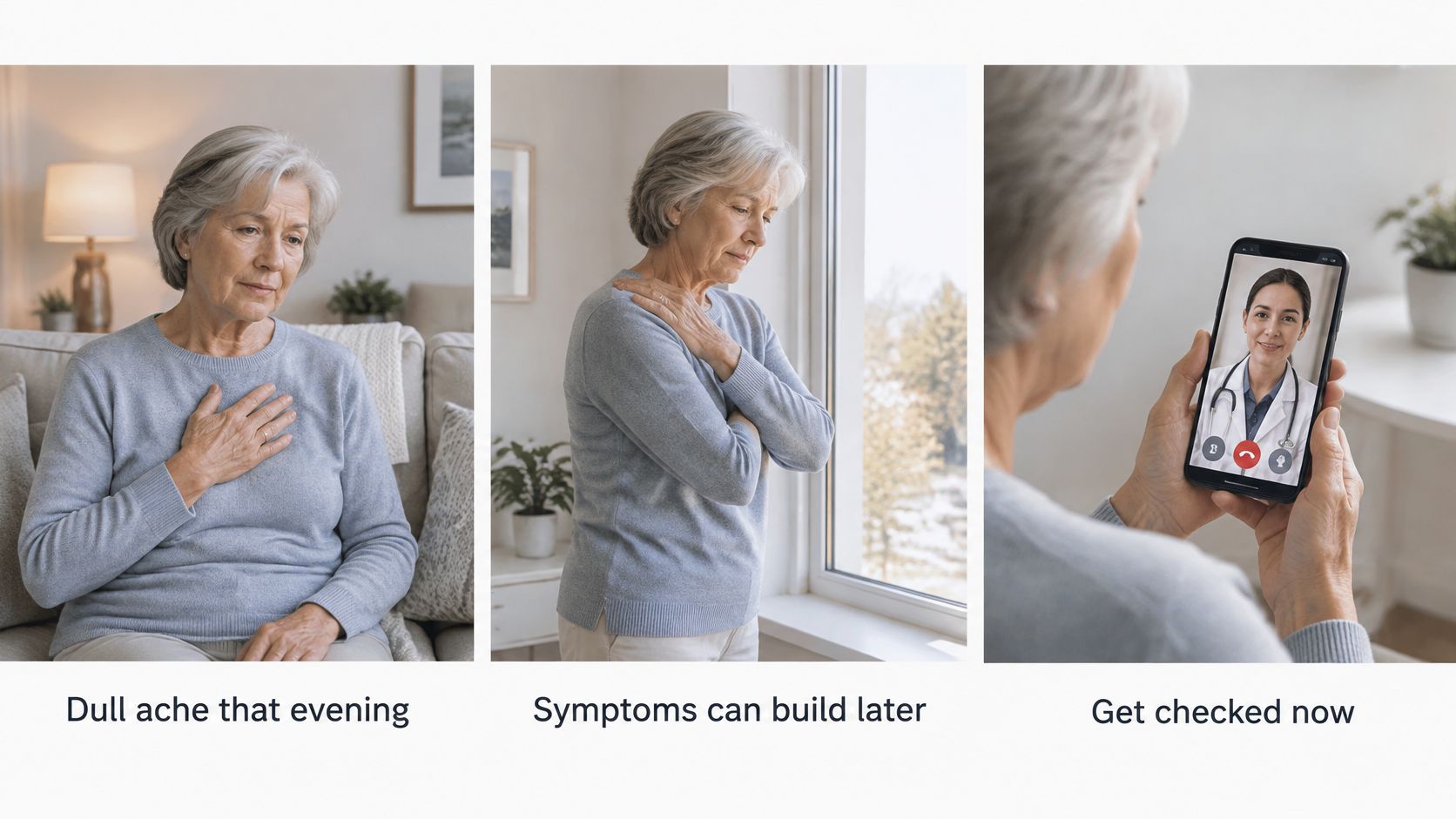
An older passenger feels a dull ache that evening after another vehicle strikes her side of the car. She can speak comfortably and doesn't describe the pain as severe, so her family wonders whether she can sleep it off.
Her age and the side-impact mechanism lower the threshold for emergency assessment. The next move is an emergency-department visit, not reassurance based only on her calm appearance.
A belt stripe with comfortable breathing
A younger driver has localized muscle soreness and a diagonal belt mark after a low-speed frontal collision. He breathes easily, isn't dizzy, and hasn't noticed palpitations or worsening symptoms.
A prompt urgent-care assessment is a reasonable starting point, provided the clinic can evaluate crash-related chest pain. The next move is to arrange that assessment, rather than decide from the photograph that the injury is minor.
New tightness after a reassuring visit
Another driver leaves an initial visit with a normal ECG. Days later, she notices chest tightness while walking and a fluttering pulse, although the discomfort still feels mild.
The next move is urgent emergency reassessment, where clinicians can decide whether repeat ECG, troponin, monitoring, or imaging is appropriate. The change doesn't prove a disaster, but it isn't a reason to stay home or immediately demand a CT.
For additional context, the video below accompanies these examples; it doesn't replace an assessment of your symptoms.
In each situation, write down what changed and bring any earlier medical records. Choose care first and organize the paperwork afterward.
When to Contact a Personal Injury Attorney
Medical danger and legal difficulty are separate problems. Emergency symptoms need medical care first, even if you're worried about the cost or haven't reported the claim yet.
A legal review becomes useful when the injury requires ongoing treatment and someone disputes the connection to the crash. It can also help when an insurer refuses payment, fault is contested, lost wages are substantial, or a settlement arrives before the medical picture is clear.
Recognize when the claim needs help
- The injury is disputed. The insurer says your chest pain is unrelated despite records explaining its onset.
- The offer is premature. You're asked to settle while follow-up tests, restrictions, or treatment remain unresolved.
- The financial consequences aren't addressed. Documented bills or missed work aren't reflected in the proposed resolution.
A straightforward claim may not require an attorney when responsibility is accepted, appropriate expenses are being addressed, and recovery is uncomplicated. Our guide to reasons to get a lawyer after a car accident can help you assess that decision.
If negotiations stall, Mediation & Negotiation Services (M&N) explains the benefits of mediating an injury claim. Ask an attorney whether a negotiated process fits your dispute rather than assuming a lawsuit is the only route.
Prepare for a concrete review
You don't need a perfect file before requesting help. Bring the collision date, reporting history, claim correspondence, available medical records, and wage documents.
We offer free car-accident guides and an Accident Claim Value Assessment with immediate guidance and no contact details required. Our free Police Report Lookup helps identify and request the official report; a report request requires contact and accident details. For people who haven't retained an attorney, a free case review may help connect them with a participating personal injury lawyer.
If you have an emergency warning sign, get medical care now rather than waiting for claim advice. Once you're medically safe, visit AskLegally for practical guidance on documenting chest injuries and handling insurance, or request a free case review if the insurer is pushing back.