
You felt shaken after the collision, but you were able to go home. Now your head hurts, your neck feels stiff, and looking at your phone makes the pain worse. You're wondering whether this is ordinary soreness, something that needs medical attention, or an injury you should tell the insurance company about.
A headache after a car accident deserves attention even if you didn't hit your head or notice pain at the scene. The safest approach is to assess the symptoms first, then keep an accurate record of what happened. Medical care and claim documentation can follow the same timeline, but a headache alone doesn't prove a particular injury or legal outcome.
Headache Types and When They Appear After a Crash
A headache can start at the scene, after neck stiffness develops, or after a symptom-free interval. The timing and pattern help a clinician assess what may be happening, but neither one identifies an injury on its own.
| Pattern | Typical onset | What it often indicates | When to act |
|---|---|---|---|
| Neck-related (cervicogenic) headache | As neck soreness develops after the collision | Pain referred from strained or irritated neck structures | Arrange assessment if it isn't easing; act sooner if it worsens |
| Muscle-tension headache | As stiffness and muscle guarding build | Tight muscles, bracing, or stress-related tension | Seek assessment if it persists or worsens despite rest |
| Concussion-related headache | Immediately, or hours to days afterward | A possible concussion symptom | Get prompt assessment; seek emergency care for warning signs |
| Post-traumatic headache | Begins within seven days of the injury | A headache associated with the injury, classified partly by its timing | Seek assessment and follow-up if it persists |
| Delayed headache | After an initially symptom-free period | A new symptom that needs assessment, not an automatic diagnosis | Arrange a provider visit for new pain; seek emergency care if it worsens |
These patterns can overlap. “Cervicogenic” describes a suspected source of pain, while “delayed” describes when the headache appeared. A clinician may consider both neck-related pain and concussion symptoms.
Timing helps, but it doesn't diagnose the injury
The CDC concussion recovery fact sheet explains that symptoms can appear hours or days after an injury and change during recovery. It advises contacting a healthcare provider if symptoms worsen or don't resolve within roughly two to three weeks. That follow-up guidance does not mean you should wait to get a new or concerning headache assessed.
An immediate headache does not establish a concussion, and a headache that appears later does not rule one out. The location of the pain, other symptoms, examination findings, and whether the headache is changing all help a clinician evaluate it.
For example, neck stiffness might begin the morning after a crash, followed several days later by stronger pain and nausea while reading. That change is worth reporting and assessing rather than assuming the neck stiffness explains every symptom.
Keep the timeline factual
Record when the headache began and how it changes. If symptoms appear later, guidance on delayed symptoms after a car accident can help you organize what you noticed after leaving the scene. Describe the timing without guessing at the cause.
Neck symptoms may be relevant to a clinician's assessment, but they do not confirm whiplash. Bryan Fagan whiplash injury guidance offers information about symptoms associated with whiplash.
Write down when the headache first appeared and whether it is easing, staying the same, or getting worse. That timeline can help connect changes in your symptoms with the care you seek and the records created along the way.
Red Flags That Need Emergency Care Now
Post-crash headache red flags and the action for each
| Red flag | Action |
|---|---|
| Worsening or sudden severe headache | Emergency care now |
| Repeated vomiting | Emergency care now |
| Confusion, drowsiness, or unusual behavior | Emergency care now |
| Seizure, slurred speech, weakness, or numbness | Emergency care now or call emergency services |
| Unequal pupils, vision changes, or impaired coordination | Emergency care now |
| Loss of consciousness | Emergency care now |
| Clear fluid or blood from the nose or ears | Emergency care now |
| Headache with none of the above, not improving | Book a provider visit promptly; contact them if it remains unresolved |
The CDC's traumatic brain injury signs and symptoms guidance identifies a worsening headache that won't go away and neurological changes as danger signs that can indicate a dangerous blood clot inside the skull. These symptoms require medical evaluation, not an insurance appointment.
Use this warning-sign checklist when describing symptoms to a clinician or someone helping you get care.

Why being awake doesn't rule out concussion
A collision can accelerate and stop your body abruptly, causing your brain to move within your skull. That movement can disrupt brain function even without a direct blow to the head. You can have a concussion without losing consciousness.
Headache may occur alongside dizziness, nausea, sensitivity to light or sound, fatigue, slowed thinking, or sleep changes. Those symptoms need assessment, but they don't all carry the same emergency urgency as a seizure, new weakness, or inability to wake.
Someone who seems fine at the roadside may develop concerning symptoms later. If a family member notices that you're unusually confused, speaking differently, or difficult to wake, their observation matters even if you don't feel especially worried.
What to do while arranging help
- Call emergency services when necessary. A seizure, inability to wake, significant weakness, or unsafe transportation makes calling preferable to trying to reach care yourself.
- Don't drive with impaired function. Dizziness, visual changes, slowed thinking, and poor coordination can make driving unsafe. Have someone help arrange transport.
- Describe the collision and the change. Tell the emergency team about the crash, when symptoms began, and what has become worse.
- Bring medication information if available. A medication list is useful, but don't delay departure to find paperwork.
For a headache without warning signs, arrange a prompt healthcare visit rather than treating yourself indefinitely. Contact the provider again if recovery stalls or new symptoms appear, and follow the return precautions they give you.
The absence of a red flag doesn't identify the cause of your headache. It changes the immediate level of care, not the need to take the symptom seriously. If you're unsure whether a post-crash symptom is an emergency, choose the emergency department.
How Doctors Evaluate and Treat Post-Crash Headaches
A doctor needs to answer separate questions: Is there an urgent injury? What is causing the headache? What treatment and activity plan will support recovery? The evaluation usually combines your account of the collision with an examination, rather than relying on the pain's location alone.
What the evaluation includes
A neurological examination. The clinician checks alertness, pupil response, speech, strength, coordination, and balance. Tell them about memory gaps or difficulty concentrating, even if those problems feel less important than the pain.
Your medication and health history comes next. Anticoagulants and antiplatelet medicines can affect bleeding risk and imaging decisions. Report prescription medicines, over-the-counter products, prior headaches, and any previous head or neck injuries.
An imaging decision based on clinical findings. The American College of Radiology head-trauma imaging criteria rate noncontrast head CT as usually appropriate for mild head trauma when a validated clinical decision rule indicates imaging, with post-traumatic headache and concerning features also relevant to assessment. Age, vomiting, amnesia, seizures, examination findings, and the force of the crash help inform that decision.
A follow-up plan. Once urgent concerns have been addressed, the provider assesses possible concussion, neck injury, and other headache causes. Persistent symptoms may require referral or a more focused examination.
CT helps detect acute bleeding, skull fracture, or pressure from an abnormal collection or swelling. A normal scan doesn't exclude concussion or another functional brain injury. Equally, not receiving a scan doesn't mean the clinician ignored the headache; imaging should answer a specific medical question.
Treatment should match the findings
Early care may include reducing activities that provoke symptoms, maintaining regular sleep, and using pain relief exactly as directed. Ask which medicine is appropriate before adding an over-the-counter product, especially if you take medicines that affect bleeding.
Frequent use of headache medicines can contribute to medication-overuse, sometimes called rebound headache. Tell the clinician what you take and how often rather than repeatedly increasing the dose on your own.
Physical therapy may help an assessed neck-related problem, while vestibular rehabilitation may be appropriate for persistent dizziness or balance difficulties. The provider should guide the choice and timing.
At the appointment: Ask the clinician to record symptom onset, headache severity, associated symptoms, and specific functional limitations. An accurate chart supports treatment decisions and preserves the medical chronology.
Any deterioration or emergency warning sign takes priority over a scheduled follow-up visit.
Tracking the Pattern and Impact of Persistent Headaches
2025 Canadian post-traumatic headache cohort (n=405 adults)
| Measure | Result |
|---|---|
| Headache on at least 26 days per month | 72.1% |
| Continuous headache | 28.1% |
| Attacks lasting hours to days | 53.1% |
| Median time from injury to neurological assessment | 37 days |
In a 2025 Canadian outpatient study of 405 adults with post-traumatic headache, 72.1% reported headache on at least 26 days per month, 28.1% had continuous headache, and 53.1% experienced attacks lasting hours to days; median time since injury at neurological assessment was 37 days. The same clinical discussion describes post-traumatic headache as beginning within seven days of concussion and chronic headache as persisting beyond three months.
A calendar can make a recurring pattern easier to discuss at an appointment.

These findings show that people receiving outpatient care for post-traumatic headache can experience frequent, prolonged symptoms. Describing a brain injury as mild doesn't necessarily mean the resulting discomfort is occasional or easy to manage.
Record the pattern and the practical impact
- Frequency and duration. Note daily versus intermittent pain and whether you have pain-free periods.
- Associated features. Describe light or sound sensitivity, nausea, neck pain, or discomfort with head movement.
- Medication use. Record the product, dose taken as directed, and how often you use it.
- Sleep and concentration. Note interrupted sleep, trouble reading, or difficulty following conversations.
- Work and driving. Describe tasks you couldn't safely complete, breaks you needed, and restrictions your provider gave you.
For example, a note that you stopped preparing a report because reading worsened the headache tells a clinician more than a pain rating alone. Record what happened without trying to interpret it as proof of injury severity.
Use video information to prepare questions, not to substitute for an individualized assessment.
Don't minimize disabling symptoms because someone called the crash minor. But don't assume persistent headache establishes brain injury, fault, or claim value either. Tracking function and following medical advice is more useful than relying only on headache frequency.
Documenting Symptoms and Protecting Your Claim
Documentation helps a clinician understand your recovery and helps an insurer evaluate your account. A symptom diary is useful supporting evidence, but it doesn't establish legal causation by itself. Medical findings, prior health history, collision evidence, and the applicable claim rules also matter.
You don't need a complicated app. A dated notebook, phone note, or spreadsheet can work if you keep entries clear and preserve the original record. If you're starting after symptoms have already developed, distinguish what you're recording today from what you remember about earlier events.
This checklist can help you organize the medical and claim records together.
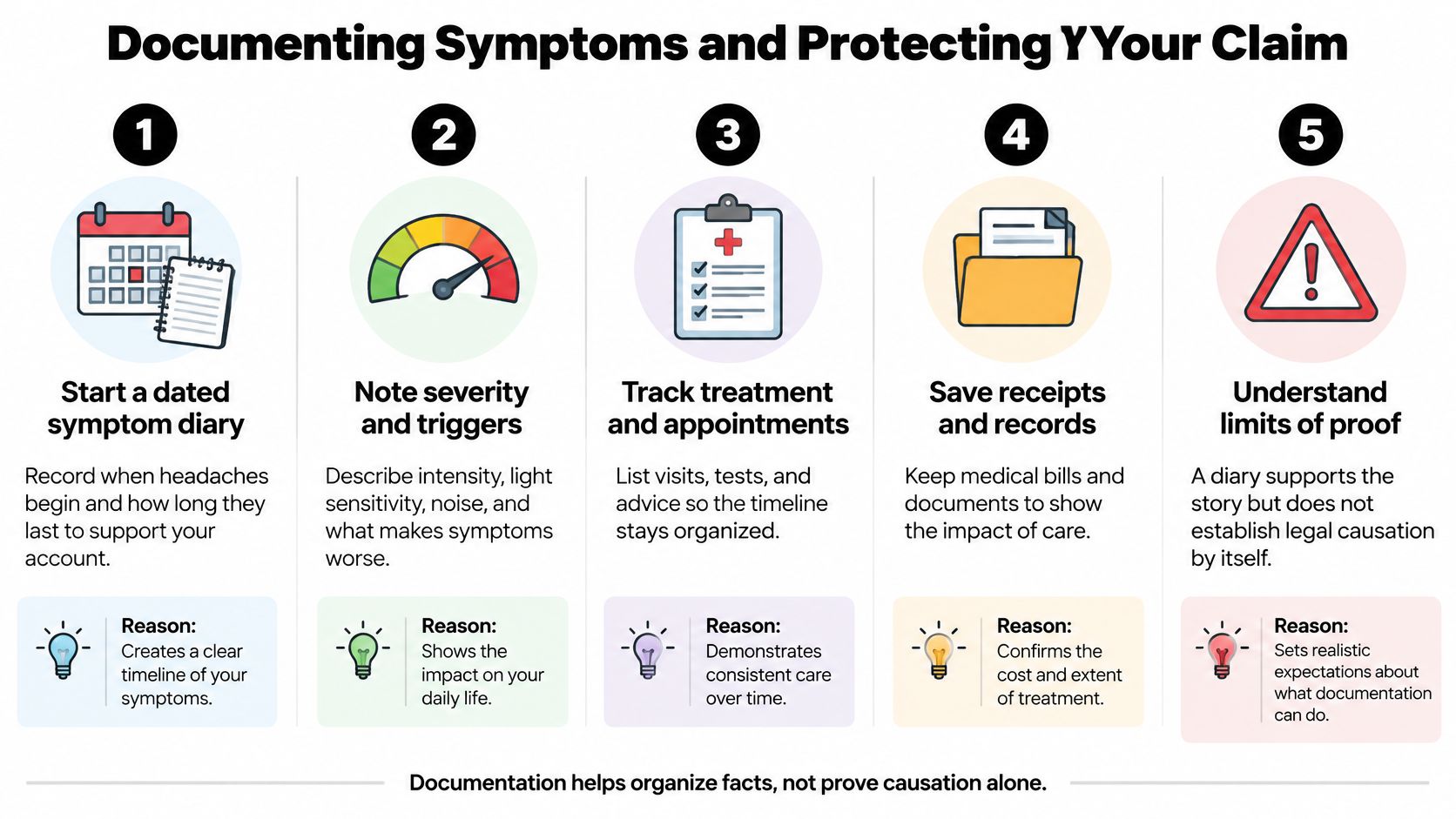
Build a usable record
Start a dated symptom log. Record the crash date, first headache onset, location, intensity, duration, triggers, and medicines taken. Early entries help anchor the timeline; if you don't remember an exact time, say so rather than inventing precision.
Keep each medical visit and instruction. Save the provider's name, visit date, discharge instructions, referrals, and work or driving restrictions. Contemporaneous clinical records give an independent account of what you reported and what the clinician found.
Save itemized costs. Keep medical bills, pharmacy receipts, appointment travel records, and other injury-related expenses. These records help identify potential financial losses, although whether a cost is recoverable depends on the claim and applicable law.
Document income changes. Preserve pay stubs and request an employer letter confirming missed work, shortened shifts, or reduced duties. That separates a documented earnings loss from a general statement that the headache affected your job.
Preserve collision and insurer records. Save vehicle and scene photos, the police report number, claim correspondence, and any witness contact information you already have. These materials can become harder to obtain later.
Create a chronological summary. Put symptom changes, appointments, treatment, and activity restrictions in date order. A clear sequence makes it easier for someone reviewing the file to understand what happened without searching through scattered messages.
Suppose your log says that completing a computer-based shift worsened your headache. At the next appointment, your provider recommends shorter periods of screen use and records a temporary work restriction. Keep both entries: your observation describes the difficulty, while the medical note records the clinician's response.
Neither entry should be rewritten to sound more dramatic. If symptoms improve, record that too. An accurate recovery record includes setbacks, improvement, and uncertainty.
Protect the record during everyday recovery
Attend follow-up appointments and follow the activity restrictions you're given. If you can't attend because of cost, transportation, or scheduling, contact the provider and document the problem. An unexplained treatment gap can create uncertainty about both your recovery and the continuing need for care.
Tell clinicians about previous migraines or neck problems rather than leaving them out because you're worried about the claim. They need that history to distinguish new symptoms from a preexisting pattern or an aggravation. Accuracy is more useful than presenting an artificially simple story.
A useful claim file records what happened, what you experienced, and what clinicians advised. It doesn't turn every symptom into a legal conclusion.
When speaking with an insurer, describe symptoms and dates plainly. Don't guess about vehicle speed, medical diagnoses, or fault if you don't know. Ask for important requests and decisions in writing, and note the date, participants, and substance of phone calls.
Read medical release forms before signing, including which records they authorize and who can receive them. If the scope is unclear, request clarification or legal advice. Keep copies of anything you submit and don't alter original documents.
Our guide to filing an insurance claim explains how to organize the claim process. Keep claim administration separate from medical urgency: an adjuster's request doesn't decide when you need treatment.
Your recovery plan and claim file should develop together. The same dated facts can help your clinician adjust care and help a reviewer understand the injury's impact, without promising that the records will produce a particular settlement.
When to Get a Lawyer for a Headache Injury Claim
Consider a consultation when the headache persists, a clinician identifies a brain or neck injury, or medical bills and lost income become difficult to manage. Legal advice may also help when an insurer disputes the injury's connection to the crash, requests a broad release, or proposes a settlement while your treatment needs remain uncertain.
Responsibility for the collision matters, but apparent fault alone doesn't tell you whether a lawyer is necessary. The practical question is whether someone needs to investigate disputed facts, protect your rights, or evaluate an agreement you can't confidently assess.
Match legal help to the problem
- A disputed injury. An insurer says the headache isn't accident-related despite your medical account.
- Continuing losses. Symptoms still interfere with work or safe driving, and the financial impact is growing.
- Settlement pressure. You're asked to resolve the claim before you understand the likely course of treatment.
- Unclear paperwork. You don't understand what rights a release or settlement agreement would end.
Many claims resolve without a lawyer when the insurer accepts the injury and payments proceed without dispute. A consultation becomes more useful when the medical picture, responsibility, or proposed resolution is contested. Our guide to whether you need a lawyer after a car accident helps frame that decision.
We offer a free Accident Claim Value Assessment that reviews facts affecting how an accident claim is handled, with immediate guidance and no contact details required. For people who haven't hired an attorney, we also offer a free case review and help connect them with participating personal injury lawyers. Neither option replaces medical assessment or guarantees a legal outcome.
Choose the next action in order
- Get emergency care if you have a warning sign.
- Arrange medical follow-up if the headache persists or disrupts daily activities.
- Start your symptom log today and gather the records you already have.
- Evaluate legal help using the documented medical picture, expenses, and insurer's response.
If you already have a lawyer, bring your updated symptom log, medical instructions, bills, and insurer correspondence to your next meeting. Don't delay necessary care while deciding who will handle the claim.
AskLegally offers free tools and straightforward guidance to help you decide what to do after an accident. Visit AskLegally to organize your next claim steps and explore whether a case review would help with a persistent headache injury claim.