
You're rear-ended at a stoplight and feel shaken but basically fine. The next morning, bending to put on your shoes sends a sharp ache across your lower back. It's natural to wonder whether the pain could really be connected to the crash, especially if you had occasional back stiffness before it happened.
Lower back pain after a car accident can come from several different structures, and symptoms may become noticeable after you've left the scene. A prompt medical evaluation and a clear, dated record of what changed can help your care team understand the problem and help distinguish new symptoms from your previous baseline. Neither delayed pain nor a scan alone settles what caused an individual injury.
Common Causes of Lower Back Pain After a Crash
A collision can load the spine suddenly through impact, twisting, compression, or bracing. More than one structure may be affected, much as a single force can irritate both a door's hinge and the frame around it. The location and pattern of pain can offer clues, but a clinical examination is needed to assess the cause.
Muscles and ligaments can be strained when they're stretched or loaded abruptly. This often feels like a localized ache or stiffness that worsens with bending, lifting, or changing position. Facet joints, the small joints that guide movement between vertebrae, may become irritated too. Pain from a facet joint can be one-sided and more noticeable when leaning back or twisting.
An intervertebral disc works like a cushion between the bones of the spine. A crash may irritate or injure a disc, sometimes causing back pain that worsens with sitting. If a nearby nerve root is affected, pain, tingling, numbness, or weakness may travel into a leg. Vertebral fractures are a different concern: severe pain or tenderness directly over the middle of the spine after an impact needs prompt assessment. Pain around one side of the lower back or buttock may also involve the sacroiliac joint, which connects the spine and pelvis.
A systematic review and meta-analysis published in 2020 found that at least 31% of injured people still reported low back pain one year after a crash. Its pooled analysis found that collision-injured people had 2.7 times the risk of future low back pain compared with people not exposed to a collision, with a 95% confidence interval of 1.9 to 3.8. Those group-level findings don't predict one person's recovery or prove what caused their symptoms.
Likely causes of lower back pain after a crash
| Possible cause | Typical signs | How it's usually confirmed |
|---|---|---|
| Muscle or ligament strain | Localized ache and stiffness, worse with bending or lifting | Clinical exam; imaging usually isn't needed |
| Facet joint irritation | One-sided pain, worse when leaning back or twisting | Physical exam and response to targeted treatment |
| Disc injury | Pain worse with sitting, possible leg symptoms | Neurologic exam; MRI if symptoms persist or nerve signs appear |
| Vertebral fracture | Midline tenderness and severe pain after impact | X-ray or CT; urgent assessment if suspected |
| Nerve root compression | Pain radiating into a leg, numbness, or weakness | Neurologic exam and MRI |
| Sacroiliac joint irritation | One-sided buttock pain, worse after standing from sitting | Exam and history; specialist evaluation if unclear |
| Aggravated pre-existing degeneration | Long-standing pain that flared after the crash | Comparison of prior records with current history |
When you describe your symptoms, note whether the pain is localized, one-sided, or traveling into a leg. That detail helps the clinician decide what to assess.
Pre-Existing Back Problems and Aggravation
A history of back pain doesn't mean a crash couldn't make things worse. Many people have some combination of age-related disc changes, facet joint arthritis, old strains, or previous episodes treated by a doctor, physical therapist, or chiropractor. The important clinical question is often whether your condition changed after the collision, not whether your spine was perfectly free of wear before it.
To assess that change, a clinician can compare your symptoms before and after the crash. Were you having occasional stiffness that stayed stable, or did the pain become more frequent, spread into a leg, or interfere with daily activities? The exam may also reveal new findings, such as a change in sensation or strength. The history and examination matter together because an image can show a structural change without explaining when it began or whether it's causing today's symptoms.
For example, suppose you sometimes felt stiff after a long day but kept working and managed normal chores. After a crash, you miss work, can't lift a laundry basket, and begin to feel pain or tingling down one leg. Those changes in symptom pattern and function give your clinician specific information to compare with your prior baseline.
Earlier medical notes, pharmacy records, and older imaging may help show what your back was like before the collision. A gap in care doesn't mean the earlier pain wasn't real, but it can make the baseline harder to document. Tell each provider about prior symptoms and treatment at the first visit, rather than waiting until an old scan or record brings it up.
Be accurate about your history. An existing degenerative finding doesn't, by itself, mean the collision caused nothing. An aggravation of a pre-existing condition can still be a real injury, but your clinicians need an honest account of what was happening before and what changed afterward.
Red Flags That Need Emergency Care
A car crash can cause injuries that need more than routine back-pain care. Severe or worsening symptoms deserve prompt attention, particularly when they involve the spine or nerves. If you're unsure whether a symptom is urgent, tell a clinician you were in a motor-vehicle collision. That context can affect how they assess your symptoms.
Emergency now
Go to an emergency department for new loss of bladder or bowel control, difficulty controlling urination, numbness around the groin or inner thighs, or rapidly worsening weakness in a leg. These symptoms, along with symptoms affecting both legs, can signal a serious problem involving the nerves. Don't wait to see whether they resolve on their own.
Severe pain with tenderness directly over the middle of the spine after impact also needs urgent assessment, especially if you can't move or walk normally. An imaging guideline for low back pain identifies significant trauma, midline spinal tenderness, neurologic findings, suspected fracture, and severe or progressive weakness as reasons clinicians may consider imaging. The appropriate study depends on what they suspect: X-rays or CT are more useful for evaluating bone, while MRI is generally preferred for suspected nerve, disc, spinal-cord, or cauda-equina problems.
See a doctor this week
Arrange a medical visit if pain is spreading or getting worse, you have numbness or tingling in one leg, or you notice weakness that isn't rapidly progressing. Fever with back pain also warrants medical assessment. Seek care if pain isn't improving after a few weeks or is interfering with sleep, work, or basic activities.
Pain intensity alone doesn't determine whether you need imaging. For uncomplicated acute back pain without red flags, routine imaging often doesn't improve care; a clinician considers the collision, examination findings, and possible nerve or bone involvement. If you're uncertain which level of care fits, choose urgent care or the emergency department and clearly describe the crash and your symptoms.
How Delayed Back Pain Unfolds Over Weeks and Months
Feeling fine at the scene doesn't prove you escaped injury, just as pain that appears later doesn't, by itself, establish that the crash caused it. Symptoms can emerge hours or days afterward, and a consistent timeline gives your clinician useful context. A 2024 clinical review of collision-related low back pain explains that delayed onset doesn't prove or disprove causation. It also reports that most collision-related low back pain is localized rather than nerve-root pain, and that symptoms may persist for some people.
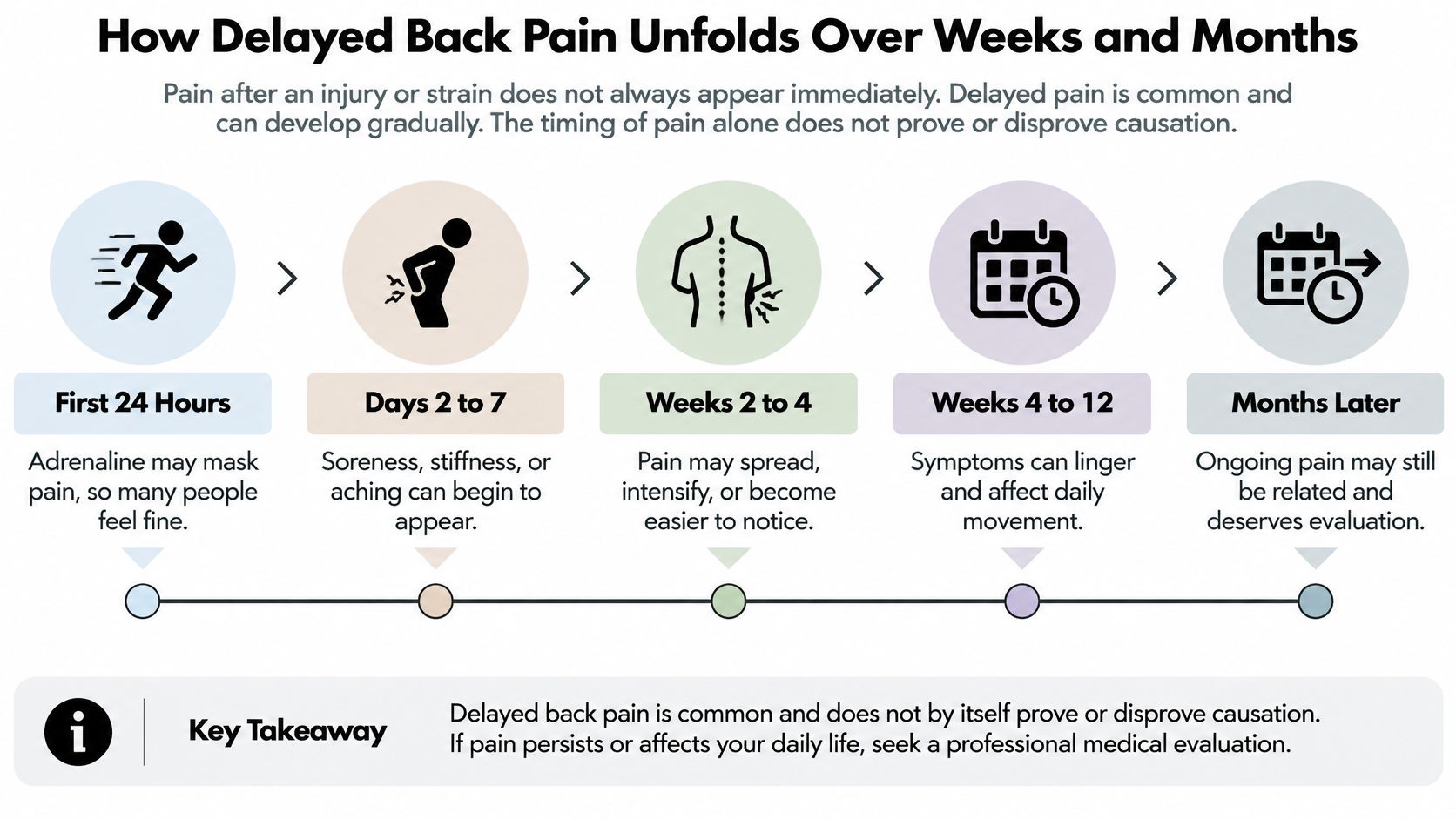
Consider someone who walks away from a rear-end collision feeling shaken but notices no back pain. During the first day, adrenaline and the demands of handling the crash can mask subtle discomfort. Over the next few days, stiffness, aching, or spasms may surface during ordinary activities like getting out of bed or backing out of a parking spot. These changes are worth recording even if they're manageable.
Over the following weeks, that person may find the pain is clearest when sitting, bending, or getting out of a car. In a multicenter emergency-department cohort, 37% of participants reported moderate or severe low back pain six weeks after a collision, and low back pain overlapped with neck pain in only 23% of participants. Back symptoms deserve their own assessment rather than being folded into neck complaints. The same clinical review reports that most patients recover within 4 to 10 weeks, while about 30% reported pain at 12 months and 20% at seven years. Those are group findings, not a prediction for any individual.
Keep a timeline, not a guess
Write down the date pain first appeared and note what movements make it worse. Include sleep disruption, missed work, medication use, and any numbness, tingling, or weakness. If symptoms change, add the date and describe how your function changed, such as driving less, avoiding lifting, or needing help with chores.
A dated record does two jobs at once. It shows your doctor how the problem evolved, which helps distinguish a new crash injury from wear that predates it. It also shows an adjuster that you reported symptoms consistently from the start rather than months later.
Pain that lingers for weeks after a crash is common across crash-injury research, and that persistence can involve body areas well beyond the lower back. Slow improvement doesn't mean your claim is weak. What weakens a claim is a gap between the crash and the first documented symptom that nobody can explain.
For more on the timing of symptoms, see this guide to how long after a car accident injuries can appear.
The video below offers another overview of delayed symptoms and back pain after a collision.
Medical Evaluation and Treatment Options Compared
The usual starting point is an examination, not an automatic scan. Depending on your symptoms, you might see a primary care clinician, urgent care, or an emergency department. They'll ask when the pain began, what the collision was like, what makes symptoms better or worse, and whether you have numbness or weakness. They may check movement, sensation, strength, and reflexes.
For uncomplicated pain, clinicians often start with conservative care and follow how symptoms and function change. This can include modifying activities temporarily without staying in bed for long periods, using heat or ice for comfort, medication as directed, and physical therapy with gradual strengthening. If leg symptoms persist, a clinician may consider a specialist referral or injection; progressive neurologic deficits may require urgent specialist assessment.
Imaging is selected to answer a clinical question, not to produce proof. The Healthline overview of low back pain after a car accident explains that specialized tests aren't routinely recommended for uncomplicated, low-grade presentations. A normal scan doesn't mean your pain isn't real, and an abnormal scan doesn't automatically show that the crash caused the finding. The useful interpretation combines your history, examination, daily limitations, treatment course, and imaging when it's clinically appropriate.
Treatment and evaluation options by situation
| Option | When it usually fits | What to expect |
|---|---|---|
| Primary care or urgent care exam | New post-crash back pain without red flags | History, neurologic check, and a plan within days |
| Emergency department evaluation | Bladder changes, saddle numbness, or rapidly worsening weakness | Immediate neurologic exam and urgent imaging when indicated |
| X-ray or CT | Suspected fracture or bony injury after significant impact | Assessment of bone, with limited detail of discs and nerves |
| MRI | Suspected disc, nerve, or spinal-cord problem, or persistent pain beyond about six weeks | Detailed soft-tissue view; findings may be unrelated to the crash |
| Conservative care with physical therapy | Localized strain or facet irritation | Gradual recovery; most localized pain resolves within 4 to 10 weeks |
| Injection or specialist referral | Radiating pain that persists despite conservative care | A specialist decides whether targeted treatment fits |
| Surgical consultation | Progressive weakness or severe nerve compression | Assessment of whether surgery is needed; not a first step for most people |
At an appointment, ask what diagnosis the clinician is considering, whether the exam shows objective nerve changes, and whether imaging would change the treatment plan. If hands-on care is part of your recovery discussion, this overview of understanding hands-on osteopathic care can help explain the approach and its role in movement and function.
Documenting Your Back Injury and Protecting Your Claim
A collision on Tuesday. Back pain that arrives Thursday. In between, an insurance adjuster asking why nothing was reported at the scene. A dated record kept from day one is what closes that gap: it helps your care team follow how symptoms developed and gives an adjuster a continuous account of the injury, which matters most when the pain was delayed. Keep every entry factual, dated, and consistent with what you tell medical providers. Start with these steps:
- Write a dated crash account. Record the time, location, direction and speed as you remember them, what was hit, and whether you were braced, while your recollection is still fresh.
- Describe your first symptoms. Note the exact location, pain intensity on a 0 to 10 scale, and whether pain travels into your buttock or leg. Specific descriptions are more useful than “my back hurt.”
- Track nerve symptoms. Record numbness, tingling, or weakness, including the date each first appeared, so a clinician can follow the sequence.
- Describe prior back problems accurately. Separate old symptoms from new or worsened ones. A fair comparison is more credible than claiming you had no history if that isn't true, and it gives doctors a baseline for judging what the crash changed.
- Save treatment and expense records. Keep visit summaries, prescriptions, medical bills, and receipts for out-of-pocket costs.
- Record work effects. Save notes about restrictions and missed shifts, along with pay stubs, so you can show how symptoms affected your work.
- Log changes in daily function. Every few days, note limits with lifting, sleeping, driving, or household tasks. Concrete examples show what the pain means in practice.
- Photograph visible evidence. Take clear pictures of bruising or other visible injuries and vehicle damage. Keep the original files where possible.
- Keep report and driver details. Save the police report number and the other driver's information so you can retrieve the official record and identify the parties involved.
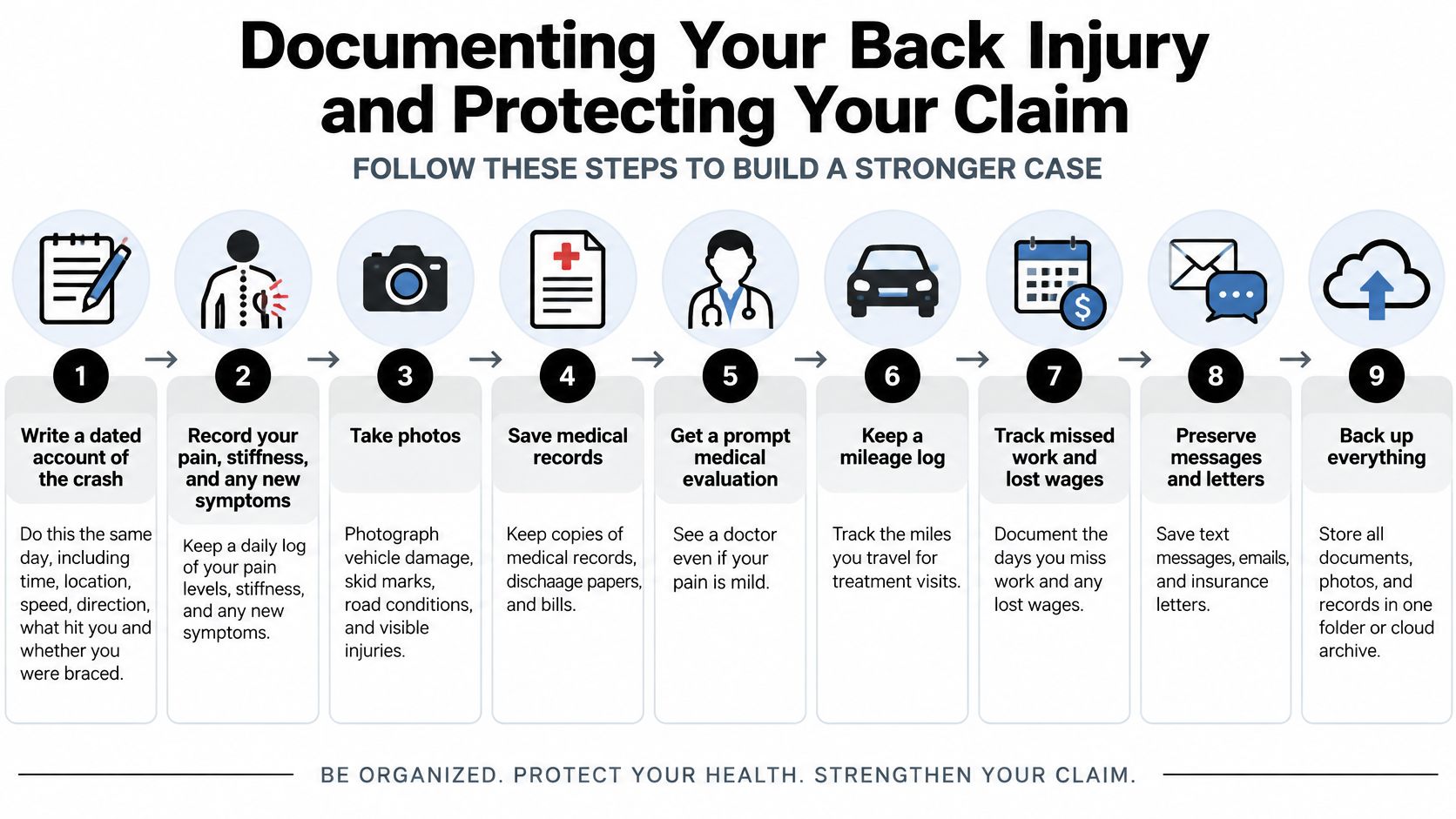
Your notes should match the history you give your providers. If a symptom appears later, add it with its actual date rather than making the timeline seem earlier or more dramatic. Emergency-department follow-up after collisions shows that back and neck pain are often reported together, yet back pain also frequently appears on its own, which is why back symptoms deserve their own dated entries with their own locations instead of being folded into general soreness. That separation also helps clinicians tell a new crash injury apart from pre-existing degeneration, since the two look similar on a chart but have different timelines in your notes. For guidance on the claims process itself, this guide to filing an accident claim covers general next steps.
How insurers may read your records
An adjuster may compare your description of the crash with what appears in medical notes, look at when you first sought care, and review any gaps in treatment. They may also compare the symptom timeline against documented restrictions and daily limitations. A gap does not automatically invalidate a claim, but an unexplained one makes it harder to show what happened and when. If you missed an appointment, a short dated note about why, such as waiting on a referral or a schedule change, gives that gap an explanation instead of leaving it open.
Coverage depends on your state and policy. The at-fault driver's liability coverage, your own medical payments coverage, or personal injury protection may apply in some circumstances, so check your policy's declarations page to see which applies to you. Be cautious about giving a recorded statement before you understand what you're being asked and how the statement may be used. Don't sign a release until you understand which claims or records it covers.
No checklist or document guarantees a claim outcome. The point is to keep a coherent record of the crash, symptoms, care, and effects on daily life.
Decide Whether to Talk to an Attorney Now
Consider speaking with a personal injury attorney soon if your pain continues beyond several weeks, a clinician recommends injections or surgery, or an insurer disputes your injury, denies coverage, or presses you to settle quickly. Legal advice may also help if fault is contested, medical bills or lost wages are significant, or you're unsure whether a settlement would cover future care.
You may not need a lawyer right away if you recovered quickly, your bills are covered, and the insurer accepts the claim. Many minor strains improve with treatment and don't require a legal dispute. Whichever path you take, keep your medical and symptom records organized, and don't agree to a settlement you don't understand.
Claim deadlines vary by state and can arrive sooner than people expect. Note the crash date, and speak with an attorney promptly if you think a deadline may be approaching. For help weighing the decision, read this guide on whether you need a lawyer after a car accident.
AskLegally offers a free Accident Claim Value Assessment that reviews facts that can affect how an accident claim is handled and provides immediate guidance without requiring contact details. We also offer free guides to help people figure out what to do next after an accident and choose the category that best fits their situation.
If back pain began after a collision, keep your symptom timeline and care records together, then use AskLegally to explore practical next steps. Its free tools and straightforward guidance can help you assess what may matter as you deal with treatment and an insurance claim.