
“Rest until your neck stops hurting” sounds sensible after a crash, but it isn't a complete recovery plan. Neither is assuming you're uninjured because you felt fine at the scene. Neck pain after a car accident needs a timeline, a safety check, and a record of what you can actually do, not just a decision to wait.
Start with your symptoms and daily function. The same notes that help a clinician judge recovery can help explain an insurance claim, without turning every sore morning into a legal issue.
Neck Pain Timeline After a Car Accident
The timeline is a useful starting point for judging whether neck pain is following an improving course. It isn't a diagnostic test: worsening symptoms matter more than which week you're in.
A StatPearls clinical summary of cervical acceleration-deceleration injury describes recovery as fastest during the first three months, with substantially less improvement afterward; persistent symptoms warrant reassessment around one week, three weeks, six weeks, and three months. Those are checkpoints for reviewing progress, not deadlines by which everyone must recover.
Use this visual as an overview, rather than a promise about your recovery.
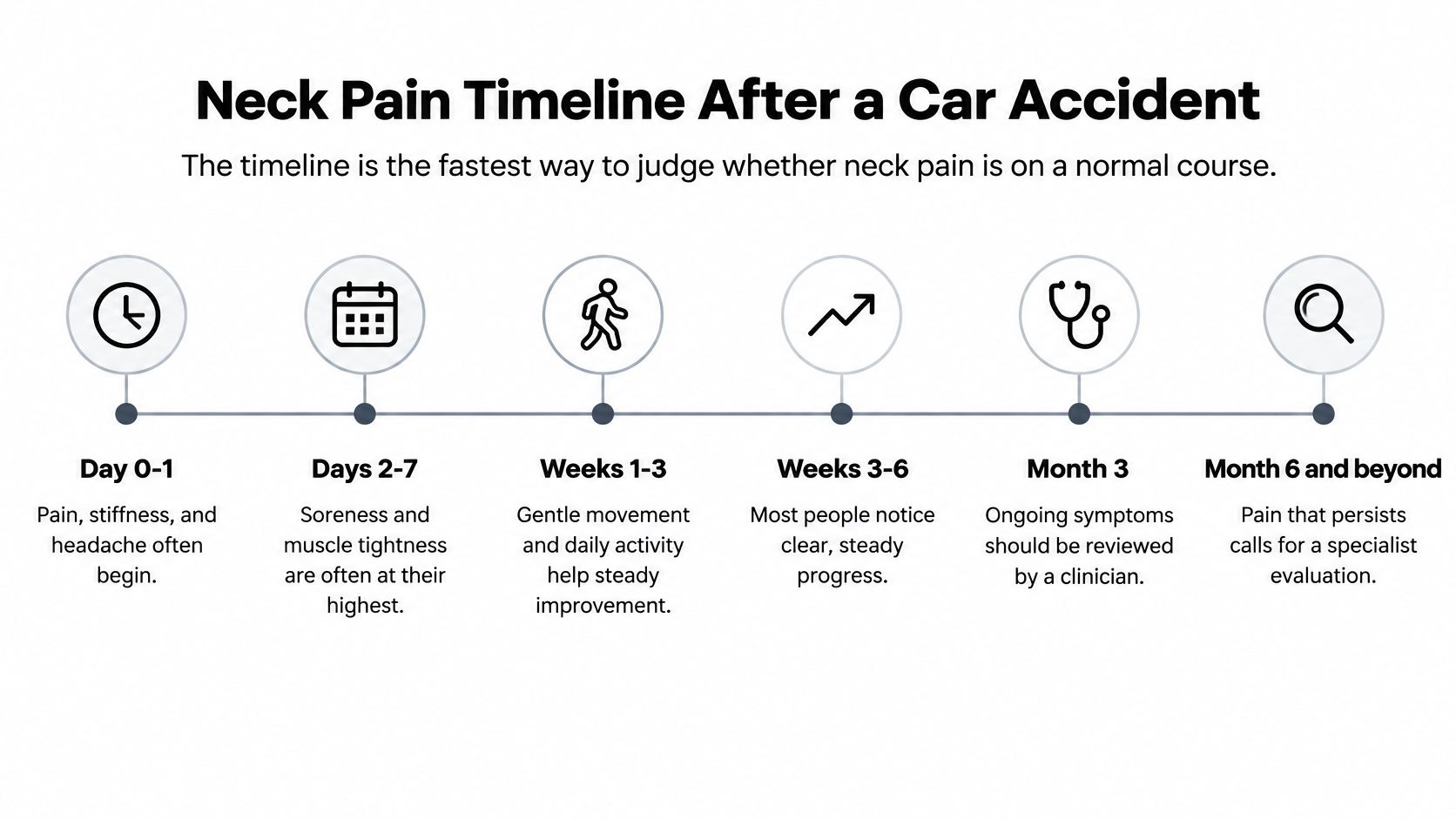
Check progress rather than counting days
| Window | Typical pattern | What to track or do |
|---|---|---|
| Day 0-1 | Pain may be absent or noticeable; stiffness can develop later | Record your starting symptoms and comfortable neck-turning ability |
| Days 2-7 | Soreness and protective muscle tightness may become more noticeable | Seek evaluation for substantial or worsening pain; follow advice about movement |
| Weeks 1-3 | Look for an improving trend, not necessarily complete relief | Review sleep, driving tolerance, and missed work at follow-up |
| Weeks 3-6 | Continuing symptoms need another assessment | Compare comfortable movement and daily tasks with your earlier baseline |
| Month 3 | Improvement may slow; unchanged symptoms deserve a revised plan | Discuss whether specialist assessment is appropriate |
| Months 6-12 | Some people continue to experience pain or disability | Keep documenting function and seek further evaluation rather than simply waiting |
Don't treat increased early soreness as proof that everything is normal. A clinician should assess substantial pain, especially if it limits ordinary activities or continues to worsen.
Likewise, an uncomfortable day after an otherwise improving week doesn't automatically mean treatment has failed. Look for whether you're gradually sleeping better, moving more comfortably, and doing more without a prolonged flare.
Establish a useful baseline
Begin a simple daily log with a pain rating, comfortable neck movement, sleep, and any arm symptoms. You can use a zero-to-ten scale consistently without treating the number as a diagnosis. Describe movement in practical terms, such as whether you can comfortably look toward a blind spot, rather than forcing your neck to measure it.
Use the table as a checkpoint list, not permission to delay care. Emergency warning signs require a different response from routine follow-up.
Why Neck Pain Can Start Days After the Crash
Say Dana is rear-ended while stopped at a red light. She notices a tight shoulder but doesn't think she's injured. The next morning, turning left hurts enough that she can't safely check traffic, so she arranges an examination.
Her clinician checks her movement and other symptoms before diagnosing whiplash-associated disorder. This hypothetical scenario illustrates an important distinction: the time you first notice pain isn't necessarily the time the injury occurred.

What whiplash means
Whiplash-associated disorder, often shortened to WAD, describes symptoms after rapid acceleration and deceleration of the head and neck. That movement can load the muscles, ligaments, discs, and small spinal joints. It doesn't mean every affected structure is damaged, or that everyone has the same injury.
Inflammatory irritation and protective muscle tightening can develop after the impact. As those responses develop, a person may notice stiffness or pain that wasn't obvious at the roadside.
A peer-reviewed review of whiplash-associated disorder reports an estimated annual incidence of approximately 328–677 cases per 100,000 people, with more than 80% occurring in motor-vehicle collisions. These are population estimates, not a way to calculate the likelihood or severity of your own injury.
Practical rule: Report when symptoms actually started. Don't change the timeline to make the injury sound more immediate.
Why vehicle photographs don't settle the question
A bumper photograph records the vehicle, not your neck movement, examination findings, or ability to work. Minor visible damage doesn't establish that you're uninjured, just as dramatic damage doesn't establish a particular diagnosis.
A flexible branch can look unchanged after bending, but that analogy has limits. Delayed pain doesn't mean something is about to snap. It means your symptoms deserve assessment rather than assumptions based on appearances.
If you're trying to make sense of the gap between the collision and your symptoms, our guide to how long after a car accident injuries can appear explains that timing problem. Record the sequence plainly, including any symptom-free period.
Red Flags That Need Urgent Care Now
Get urgent medical assessment the same day if a warning sign below appears. For sudden or severe symptoms, call your local emergency number rather than driving yourself.
Keep this checklist accessible while you're monitoring symptoms.
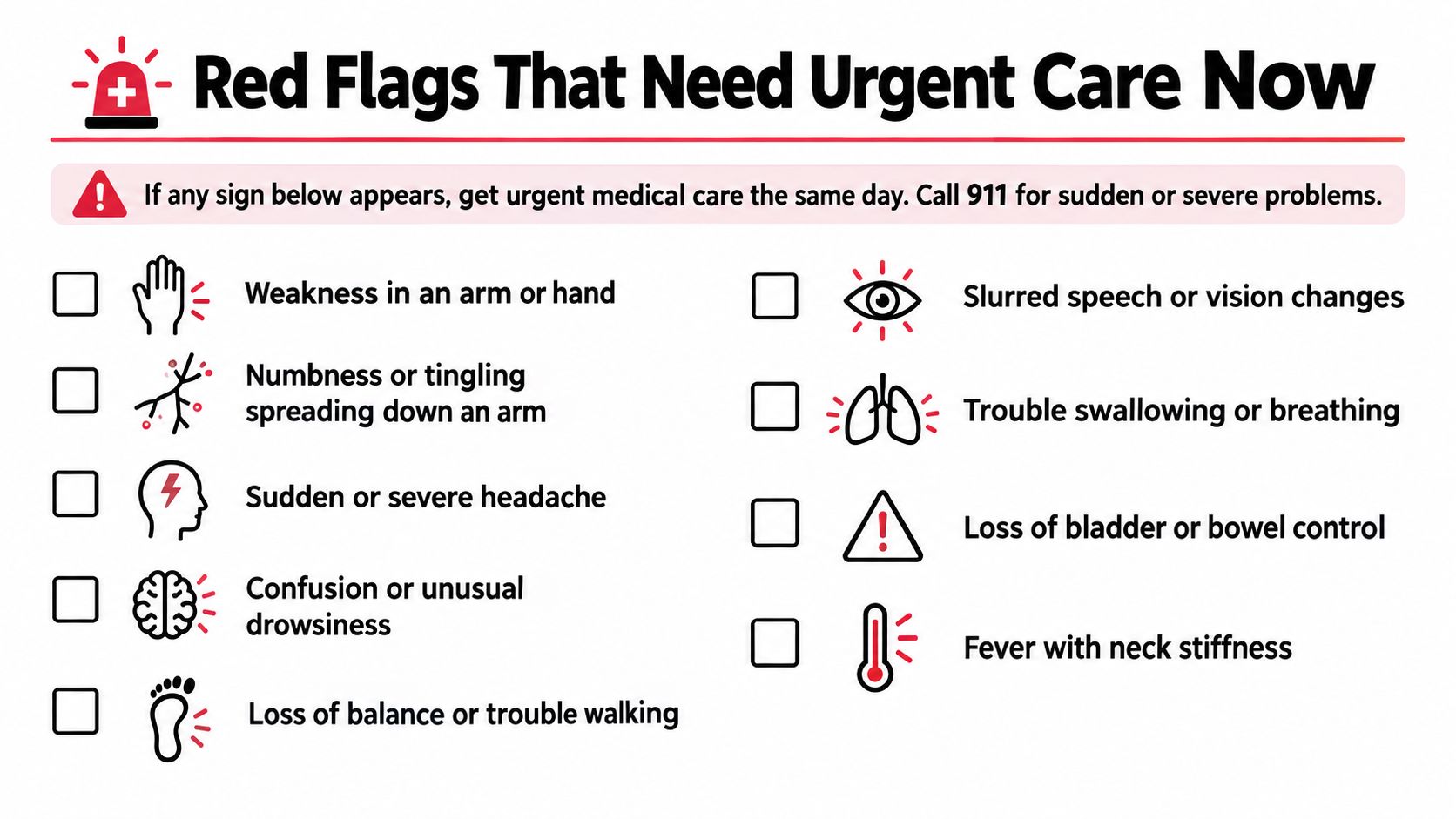
- Weakness: An arm or hand feels newly weak, or you're unexpectedly dropping objects.
- Changing sensation: Numbness or tingling spreads into an arm or hand.
- Radiating pain: Pain travels down the arm, especially alongside weakness or sensory changes.
- Severe headache: A new, intense headache develops or feels unlike your usual headaches.
- Changed consciousness: You experience confusion, unusual drowsiness, fainting, or difficulty staying alert.
- Poor coordination: Walking, balance, or ordinary hand movements become difficult.
- Speech or swallowing problems: You develop new difficulty speaking or swallowing.
- Rapid deterioration: Pain quickly worsens or remains severe despite stopping the activity that aggravated it.
Why these symptoms change the plan
These signs can indicate a problem that needs prompt screening, such as a fracture, nerve compression, or another serious injury. You can't reliably distinguish those conditions from uncomplicated neck pain at home.
Don't test weakness by lifting heavier objects, force your neck through a painful movement, or ask someone to manipulate it. If you're unsure whether a change is significant, describe it to an urgent-care service and ask where you should be assessed.
The absence of these signs doesn't mean there's no injury. It means you still need an appropriate examination and follow-up based on pain, movement, and daily limitations, rather than assuming emergency treatment is required.
Prepare for the visit without delaying it
Bring your symptom log if it's readily available. Tell the clinician what changed, when it changed, and whether symptoms affect one side or both.
Don't postpone urgent care to collect photographs, insurance information, or a complete medical file. Someone else can help gather those later.
If you watch the accompanying video, treat it as supplementary information, not a substitute for an examination.
Who Stays in Pain Longer and Why
In a prospective study of patients with neck pain after a collision, 128 of the 480 people completing follow-up, or 27%, reported neck pain at every assessment through 12 months; the study initially enrolled 765 patients who reported neck pain within 24 hours. The distinction matters: the percentage describes follow-up participants, not everyone involved in a crash.
The strongest predictors included initial neck disability, whiplash-related symptoms, widespread pain before the collision, and psychological distress. These findings explain why a useful examination considers the person's starting health and daily limitations, not just the collision description.
Factors to discuss at an assessment
| Factor | What it signals | Action to take |
|---|---|---|
| High initial pain | A heavier early symptom burden | Record baseline pain and whether it changes |
| High Neck Disability Index score | Greater difficulty with daily activities | Ask the clinician to record the questionnaire result |
| Reduced neck range of motion | A movement limitation worth following | Describe difficulties checking mirrors or looking over a shoulder |
| Cold hyperalgesia | Unusually painful responses to cold | Ask whether clinical sensitivity testing is appropriate |
| Widespread pain before the collision | A relevant recovery factor | Give an accurate account of prior pain |
| Psychological distress and poor sleep | Recovery needs that deserve attention | Discuss anxiety, mood, and disrupted sleep without minimizing them |
| Medium or high perceived collision severity | One part of the risk picture | Describe the collision accurately without treating severity as destiny |
| Grade III injury | Neurological findings requiring clinical interpretation | Ask the clinician to explain and document the injury grade |
The Neck Disability Index is a questionnaire about how neck symptoms affect ordinary life. It complements a pain rating by asking about function. A person might report less pain while still struggling to read, concentrate, lift, or drive.
Cold hyperalgesia is different from merely disliking cold weather. Don't try to diagnose it with ice at home; let a clinician decide whether testing would help.
Psychological distress is a recovery factor, not evidence that pain is imaginary.
Risk is not a verdict
A low-speed collision can be followed by persistent symptoms, while someone in a more dramatic collision may recover well. Collision details matter, but they don't replace the examination or the person's recovery pattern.
Give your clinician an honest history of previous pain, treatment, and limitations. Distinguishing old symptoms from new or worsened symptoms makes the record more useful, not less credible.
Several concerning factors together justify discussing closer follow-up or earlier specialist assessment. The practical question is: How can I tell whether delayed pain is following an improving recovery pattern or needs a new evaluation?
Treatment Options and What Each One Is For
Arrange a medical evaluation promptly rather than spending weeks trying to diagnose yourself. Describe the accident and symptom onset accurately, and ask the clinician to document their assessment of any connection between them.
For uncomplicated whiplash, a clinical review of whiplash-associated disorder supports appropriate activity and supervised exercise rather than prolonged immobilization, and explains that routine early imaging findings don't consistently predict recovery. Imaging is generally reserved for suspected fracture, instability, neurological compromise, or another serious condition.
Match the option to its purpose
| Option | Best used for | Caution |
|---|---|---|
| Primary care or urgent care examination | Initial assessment and red-flag screening | Bring the accident details and symptom history |
| Imaging, such as X-ray or MRI | Suspected fracture, instability, or neurological involvement | Not routine for uncomplicated neck pain |
| Normal daily activity | Maintaining function after serious injury is excluded | Pace tasks and don't push through sharp pain |
| Supervised exercise or physiotherapy | Persistent stiffness and movement limitations | Request written home exercises and clear limits |
| Over-the-counter pain relief, heat, or ice | Short-term comfort | Confirm suitability with your clinician or pharmacist |
| Soft collar | Brief use when specifically advised | Don't extend use without clinical guidance |
| Bed rest | Not a routine treatment for uncomplicated neck pain | Prolonged inactivity can impede functional recovery |
A scan answers particular structural questions. It doesn't measure every source of pain or every limitation, so not ordering an MRI doesn't automatically mean the clinician has dismissed your symptoms.
Activity advice also needs interpretation. “Stay active” doesn't mean resume heavy lifting or drive when you can't check traffic safely. Ask what you can do now and what would justify reducing an activity.
Make the plan specific to your work
For a warehouse worker, a plan might include comfortable walks, temporary lifting restrictions, and neck exercises taught by a physiotherapist. The useful details are the permitted movements, work modifications, and signs that should prompt another assessment.
If you're considering complementary care, Arizona Valley Acupuncture on neck pain provides context about an integrative approach to neck complaints. Its discussion of tech-related pain isn't crash-specific evidence or a substitute for post-collision screening; discuss suitability with your treating clinician.
Before leaving an appointment, ask:
- Diagnosis: What am I being treated for, and what remains uncertain?
- Activity: Which movements and work tasks are safe for me now?
- Review: When will you reassess me, and what changes should bring me back sooner?
How to Document Neck Pain for Your Claim
Keep one factual record that serves both recovery and the claim. Clinicians need to understand symptom changes; insurers may need records explaining treatment, expenses, and lost function.
A study examining sensorimotor function after whiplash found measurable movement-control deficits one to three months after injury, reinforcing why a pain score alone may miss meaningful disability. Describe what you struggle to do, not just how much it hurts.
Use the graphic as a reminder, then keep the supporting documents together.
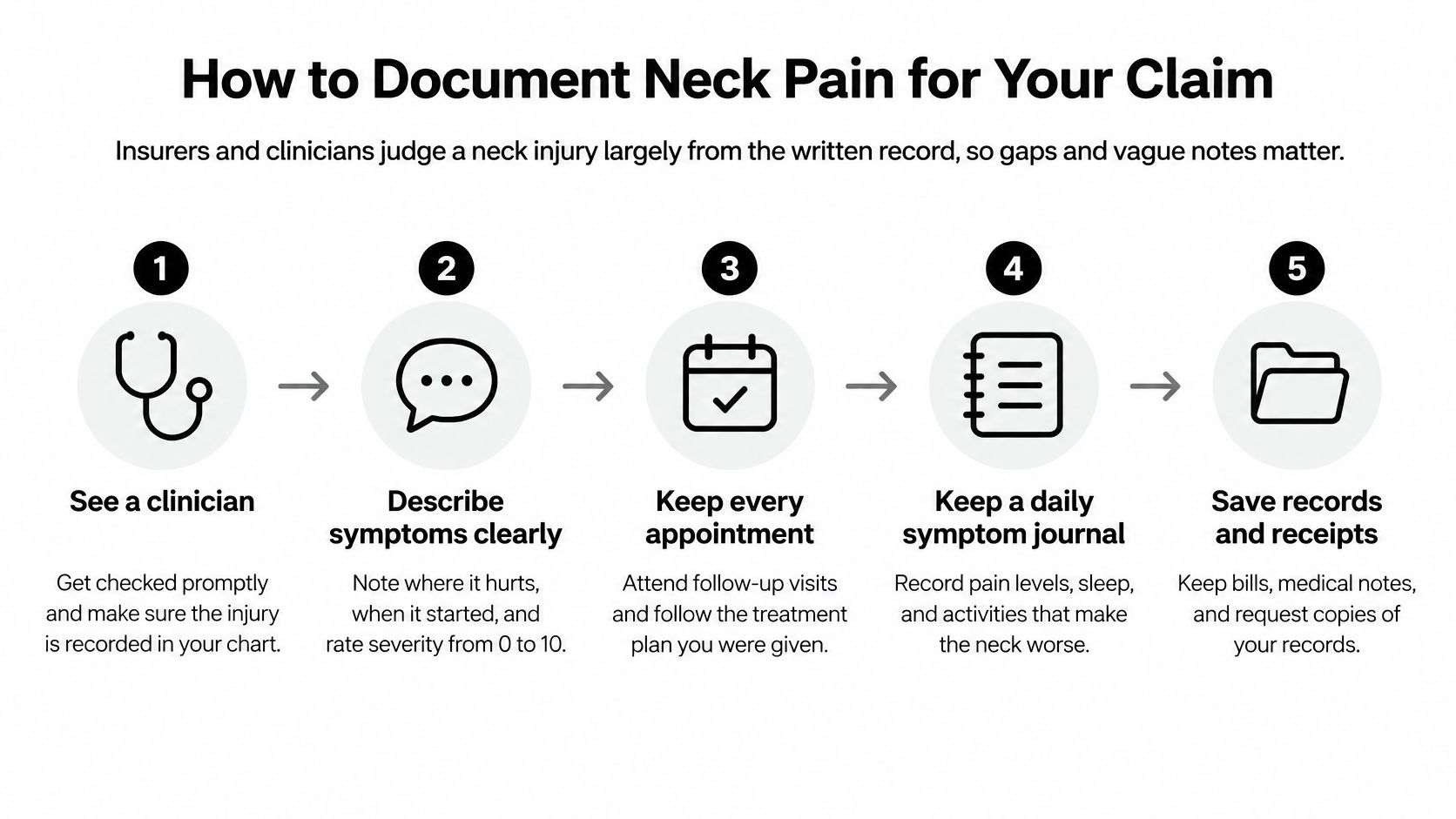
Build a clear, dated record
Get the medical history right. Ask that the accident date, symptom onset, and your reported limitations appear accurately in the chart. Request correction of factual errors without asking the clinician to change their medical opinion.
Keep a daily symptom entry. Use a consistent pain scale and note comfortable movement, sleep, and arm symptoms. Include improvements as well as difficult days.
Describe lost function. Record tasks you couldn't complete or had to modify, such as driving, carrying a child, or working overhead. Explain whether you needed help, took breaks, or stopped altogether.
Save expenses. Keep receipts for co-payments, prescriptions, and transport to appointments. Maintain a dated mileage record where relevant, without assuming every expense will be reimbursed.
Preserve collision records. Save existing photographs of the scene and vehicle damage, and request the official police report from the investigating agency. Don't return to an unsafe location to collect evidence.
Keep wage-loss evidence. Save pay stubs, medical work restrictions, and an employer letter documenting missed work or modified duties. Distinguish unpaid time from leave you used.
Retain insurer communications. Save letters, emails, claim documents, and dated notes of calls. After an important conversation, consider sending a factual written summary.
Record the reason, not just the result
A hypothetical entry might read:
Day 9: pain 6/10 when turning left. Stopped driving after 15 minutes because checking traffic hurt. Slept about 4 hours. No new arm symptoms.
Those are example observations, not treatment thresholds. Your entries should reflect your experience, including good days.
Keep appointments or document why you couldn't attend, such as transport problems or difficulty obtaining an appointment. An unexplained gap leaves uncertainty about whether you improved or couldn't access care.
Our guide to filing an insurance claim can help you organize the administrative steps. A thorough record supports a clear account, but it doesn't guarantee coverage or a particular settlement.
Decide Whether to Call a Personal Injury Lawyer
You don't automatically need a lawyer because your neck hurts after a crash. If treatment is progressing, the insurer accepts the claim, and your losses are straightforward, you may be comfortable handling the process yourself.
A conversation becomes more useful when there's a dispute or a decision you can't confidently evaluate. The purpose is to understand your options, not to commit to hiring someone.
Signs a legal review may help
- The cause is disputed: The insurer argues that your symptoms didn't come from the collision.
- Settlement pressure appears: An adjuster wants you to settle before your recovery outlook is clear.
- Recovery becomes complicated: Symptoms persist, a specialist becomes involved, or lasting restrictions are discussed.
- Work losses grow: You miss substantial work or can't resume your usual duties.
- Bills become difficult to manage: You're unsure who may be responsible for outstanding costs.
- Fault or coverage is unclear: The other driver is uninsured, or responsibility for the crash is disputed.
- The offer is hard to judge: You don't understand what a settlement covers or what signing would give up.
Our guide to whether you need a lawyer after a car accident helps separate those concerns from situations you may be able to manage independently. Don't assume that speaking with an attorney obligates you to hire them.
Prepare without waiting for a perfect file
We offer a free case review for people who may have a personal injury claim and haven't hired a lawyer, and help connect them with participating personal injury lawyers. Helpful details include the injury date, how it was reported, claim paperwork, medical records, and pay stubs, but you don't need everything ready before requesting a review.
Ask any lawyer how fees are calculated, how case expenses are handled, and what you could owe under the proposed agreement. Request an explanation you understand before signing.
For this week, take these practical steps:
- Arrange any due reassessment and bring your symptom-and-function record.
- Assemble your documents and write down the particular dispute or decision worrying you.
- Seek a legal conversation if needed, bringing questions about fees, settlement consequences, and next steps.
AskLegally offers free tools and straightforward guidance to help you work out what to do after an accident. If neck pain has left you uncertain about documentation, insurance, or whether to speak with a lawyer, visit AskLegally to explore your next step.