
Road crashes cause 20–50 million nonfatal injuries worldwide each year, and many injured people develop disabilities, according to the World Health Organization. Pain after a car accident isn't always a single sore spot or an immediate warning. You may notice several painful areas, develop symptoms after going home, or struggle with ordinary activities despite reassuring initial test results.
The safest approach is to separate symptoms needing emergency care from those needing prompt follow-up, then keep an accurate record. A symptom diary can't diagnose an injury or establish legal fault. It can help your clinician understand what's changing and help you explain the impact without guessing.
When Pain Appears After a Crash
In a peer-reviewed study of adults evaluated in emergency departments within 48 hours of a collision, 827 of 890 participants, or 93%, reported collision-related pain, and 589, or 66%, reported pain in three or more body regions. Those findings describe an emergency-department sample, not every person involved in a crash. They nevertheless make an important point: recording only neck pain can leave out much of the picture.
Timing is a checkpoint, not a diagnosis. Symptoms can overlap, and a complaint appearing later shouldn't automatically be attributed to ordinary soreness.
Typical pain timeline after a car accident
The windows below organize what to watch for. They aren't fixed onset periods or deadlines for getting help.
| Window | Common Pain or Symptoms | What to Do |
|---|---|---|
| Immediately through the first day | Neck, head, upper and lower back, shoulders | Get checked promptly, preferably the same day, even if pain feels mild |
| Following days | Neck soreness, stiffness, headache | Note the onset and any change, then follow up with the provider |
| Early recovery | Dizziness, fatigue, concentration problems | Report to a doctor and watch for red flags |
| Later recovery | Jaw pain, chewing difficulty, ear or facial pain | Ask a doctor or dentist about a jaw assessment |
| Weeks to months | Ongoing neck, back or shoulder pain | Keep follow-up appointments and keep records |
At the scene, describe every painful area rather than choosing the worst one. Once you're home, add new symptoms with their actual onset dates. If you aren't sure when something started, write that uncertainty instead of creating a precise timeline.
A changing symptom pattern matters more than whether you match a particular schedule. For example, improving shoulder soreness doesn't cancel out newly developing dizziness, and being able to walk doesn't establish that you're ready to drive.
Include more than soreness
Sleep disruption, fear of riding in a car, and distress deserve attention alongside physical complaints. Refresh Psychiatry & Therapy's resource on understanding trauma after a car accident offers context for discussing the emotional aftermath without assuming that physical pain is psychological.
Practical rule: Record what you notice, when you notice it, and what it prevents you from doing. Don't wait until you can explain the cause.
No point on a timeline makes a symptom safe to ignore. Delayed symptoms call for assessment, not accusations of exaggeration or an automatic conclusion that the crash caused a particular diagnosis.
Where Pain Hides and Why It Lingers
A bruised knee can feel acceptable at rest and protest on the stairs. Pain at rest and pain under load are different tests. After a collision, describe both rather than using a comfortable moment on the sofa as proof that everything has healed.
Neck and upper-back discomfort can involve several neighboring structures.

Different tissues can produce overlapping complaints
Muscles and ligaments can be injured during sudden movement, while irritated spinal joints can make turning or bending uncomfortable. Nerve involvement may produce burning, tingling, or pain traveling into an arm or leg. These descriptions help a clinician choose an examination, but none confirms the injured structure by itself.
Headache, dizziness, and light sensitivity can accompany neck complaints without necessarily having the same cause. Tell the clinician about the whole combination rather than deciding that every symptom comes from a tight muscle.
Pain can also affect both sides. In a 2025 clinical study published in Pain involving 122 people with whiplash, 49% reported bilateral symptoms, so record left and right separately instead of writing only shoulder pain.
Don't overlook the jaw
Jaw symptoms can become noticeable as other pain subsides, which makes them easy to miss during the first stretch of recovery. Jaw pain, chewing difficulty, facial discomfort, or ear symptoms deserve their own entry and a medical or dental assessment.
Evidence across jaw diagnosis, treatment, and prognosis is uneven. A late symptom isn't proof of a specific jaw injury, and clicking alone shouldn't become a self-diagnosis.
This video offers an additional visual resource on post-crash concerns.
If discomfort keeps lingering, Bayside Osteopathic Health's guide to making sense of persistent back pain can help you describe the pattern before a visit. Track where pain sits, whether it spreads, and which movements trigger it. Location guides assessment; it doesn't establish the diagnosis.
Red Flags and Why Normal Scans Fall Short
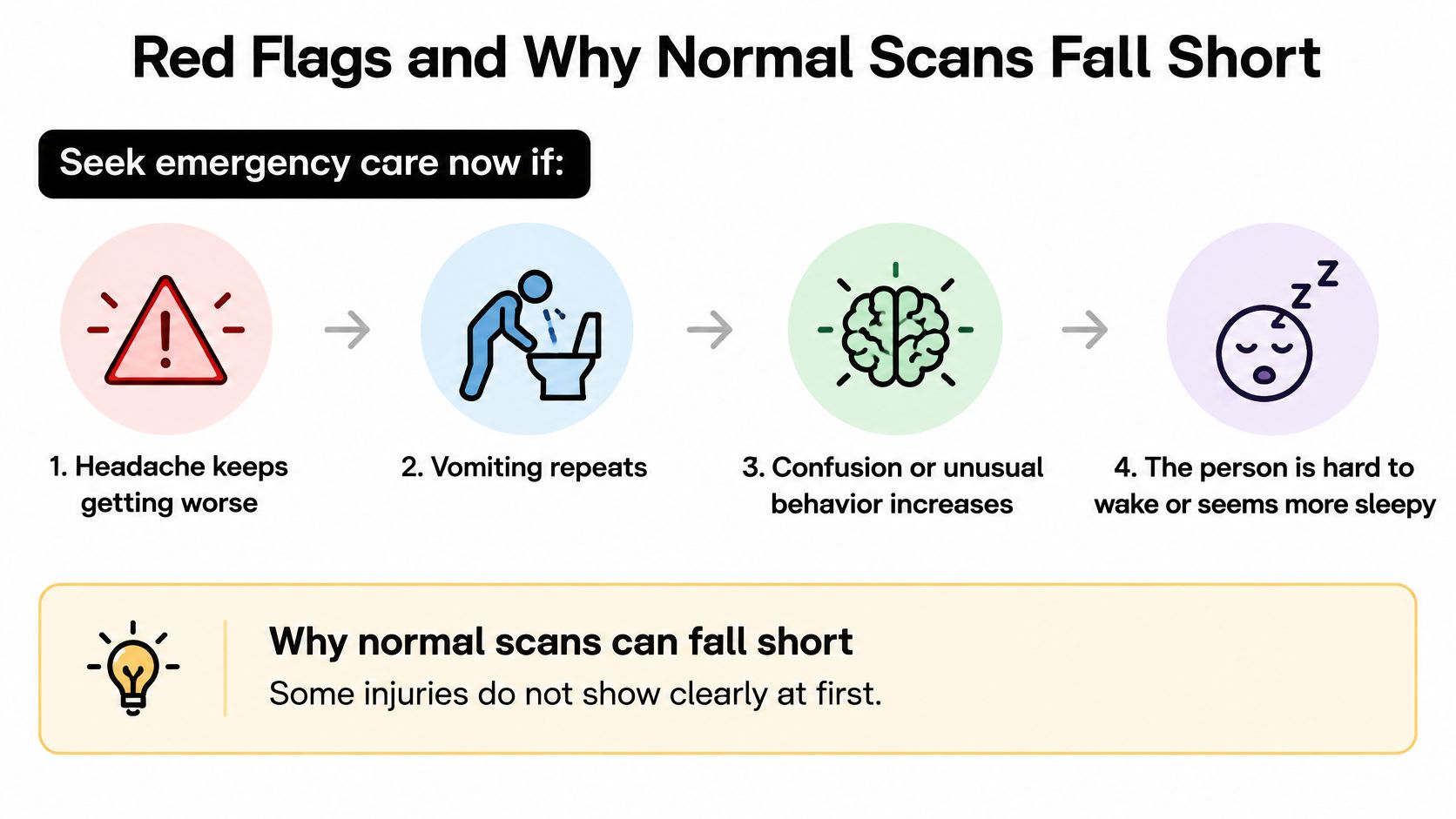
Seek emergency care now for any of these warning signs after a crash. The CDC's concussion danger-sign guidance identifies them as possible signs of a dangerous complication, including a rare intracranial blood clot:
- Worsening headache: The headache keeps getting worse or won't go away.
- Repeated vomiting: Vomiting happens repeatedly.
- Increasing confusion: The person becomes unusually confused, agitated, or behaves differently.
- Difficulty waking or seizure: The person can't be awakened, becomes markedly drowsy, or has a seizure.
- Neurological changes: Speech becomes slurred, or new weakness, numbness, or reduced coordination appears.
- Unequal pupils: One pupil looks larger than the other.
Don't drive yourself if you're confused, dizzy, unusually sleepy, or otherwise impaired. Call emergency services or have someone obtain help.
What a reassuring scan can and can't tell you
Emergency-department discharge isn't the same as complete recovery. A normal scan may be reassuring about what that test was designed to detect, but it doesn't rule out every reason for pain or cognitive symptoms.
The CDC's report on mild traumatic brain injury explains that acceleration and deceleration forces can cause brain injury involving altered awareness, confusion, or memory problems. Concussion assessment depends on the history and clinical examination, not only on whether an image shows damage. Routine X-rays also do not provide a complete assessment of muscles, ligaments, joints, or nerves.
Concussion symptoms can emerge after the initial evaluation. Persistent headache, dizziness, sleep changes, unusual fatigue, light sensitivity, or difficulty concentrating deserve follow-up even when you were sent home without a concussion diagnosis. Our guide to concussion after a car accident explains the practical questions to raise during that appointment.
What to do when symptoms change
Pain noticed several days later still needs reporting. Give the provider the onset date, location, and effect on your activities rather than waiting for your next routine visit if symptoms are worsening.
Don't exercise through symptoms that get worse. Ask for individualized activity instructions, particularly when balance, concentration, or head-injury symptoms are involved.
Feeling better briefly isn't a clearance test. If symptoms return with work or activity, document the trigger and contact the treating clinician.
Any emergency warning sign overrides a planned appointment. For persistent mild symptoms, arrange prompt follow-up rather than waiting for them to become severe.
Get Checked and Keep a Dated Record
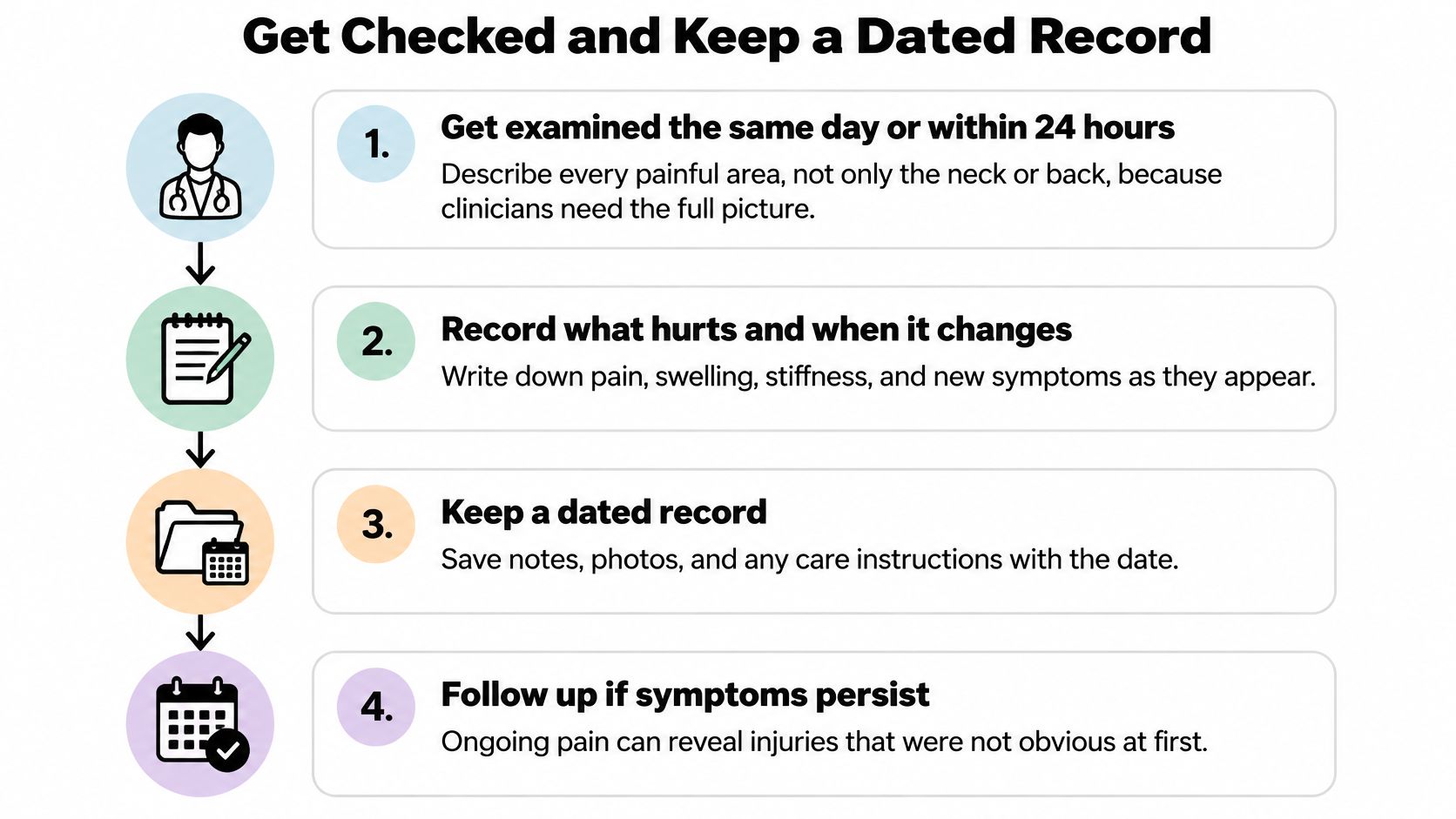
A useful record starts with medical care, not paperwork. Use a phone note, notebook, or spreadsheet you can update consistently, and keep the original wording when adding later corrections.
Take these steps in order
Arrange a prompt examination. If you're newly injured and haven't been assessed, seek a same-day evaluation when possible because a clinician needs to establish what requires treatment. Describe every painful area, including symptoms that seem unrelated.
Explain the crash and symptom sequence. Say how the collision occurred, whether you struck your head, what you noticed immediately, and what appeared later. Include preexisting symptoms and explain what changed, because an accurate comparison is more useful than an incomplete history.
Keep follow-up appointments. Ask who should assess persistent jaw, ear, balance, or neurological complaints. If cost, transport, or scheduling prevents attendance, tell the provider and record the reason rather than leaving an unexplained gap.
Get restrictions in writing. Ask about lifting, driving, screen work, and hazardous tasks so you and your employer understand the limits. Your clinician's individualized instructions take priority over a general recovery checklist.
Record treatment and response. Follow the prescribed self-care plan, including any recommended activity changes, ice or heat, and medication directions. Report side effects, new symptoms, or treatment that repeatedly worsens your condition.
Sample symptom log entries
These are hypothetical entries, not a recovery schedule or treatment recommendation. Use actual calendar dates in your own record and a consistent personal severity scale.
| Date | Pain Location | Severity (0-10) | Activities Limited | Treatment or Medication |
|---|---|---|---|---|
| Day 1 | Neck, upper back | 6 | Turning head, lifting bag | Doctor visit; pain relief as directed |
| Day 3 | Neck, shoulder, headache | 7 | Driving, sleep | Follow-up with provider; rest |
| Day 10 | Neck, headache | 4 | Long screen time | Physical therapy referral noted |
| Week 4 | Jaw, ear | 5 | Chewing hard food | Dentist assessment booked |
The first and last entries describe different locations and limitations. They don't establish a diagnosis or prove that the crash caused the later jaw complaint. They give the clinician a specific change to investigate.
Write observable facts: woke because of pain, couldn't turn comfortably to check traffic, or stopped chewing a hard food. Avoid conclusions about permanent injury, fault, or what an insurer should pay.
Build a separate claim folder
Save discharge papers, medical records, bills, treatment instructions, insurer letters, and medication receipts. Add pay stubs, missed-work records, scene and vehicle photographs, and the police report number.
Our guide to the personal injury claim process from filing to settlement can help organize those documents. You don't need every detail ready before requesting a review, but helpful information includes the injury date, how it was reported, claim paperwork, medical records, and pay stubs.
Review the folder each Sunday, add missing documents, and bring your symptom log to appointments. Keep copies as records arrive rather than trying to reconstruct everything later.
When Pain Lasts for Months
Ongoing pain deserves a fresh clinical review, not a demand that you tolerate it. The question becomes more specific: What is limiting recovery, and what should change in the treatment plan?
A report describing a 2025 systematic review and meta-analysis published in Pain notes that researchers analyzed 61 studies comparing chronic whiplash-associated disorders with chronic nontraumatic neck pain. Persistent post-crash neck pain is a subject of clinical study, but that doesn't identify the cause or best treatment for an individual.
Signs that your plan needs reassessment
Ask your treating clinician about further evaluation when:
- Progress has stalled: Pain isn't steadily improving despite following the plan.
- The pattern changes: Discomfort spreads or a new area becomes painful.
- Function remains limited: Sleep, work, driving, or basic household tasks remain difficult.
- Treatment isn't tolerable: Exercises or medication repeatedly cause problems that haven't been addressed.
New neurological warning signs require urgent assessment rather than waiting for a routine specialist referral.
Measure function as well as pain
Depending on examination findings, a doctor may consider physical therapy, revised activity limits, or referral to a pain or spine specialist. Ask what each referral is intended to clarify and what improvement would look like.
For example, record whether you can finish a grocery trip, sit through a work meeting, or sleep without repeatedly changing position. Note tasks you avoided as well as tasks you attempted, since a low-pain day spent doing very little may not represent restored function.
A useful treatment question: What should I be able to do more comfortably, and when should we reconsider the plan if that isn't happening?
Treatment can aim to improve mobility, sleep, tolerance for activity, and participation in daily life. There isn't a guaranteed timetable, but specific functional goals make progress easier to recognize and discuss.
Pain After a Car Accident FAQs
Is it normal to feel fine at the scene and hurt days later?
Yes, symptoms can become noticeable after you leave the scene. Feeling fine initially isn't a medical all-clear, so report new complaints with their actual onset date and don't assume a delayed symptom is harmless.
If several symptoms appear at different times, list them separately. That gives your clinician a clearer account than saying everything started immediately.
Does a gap in treatment hurt a claim?
It can make the record harder to interpret, particularly if there's no explanation for missed appointments or a long interval without reassessment. A gap doesn't by itself establish that you recovered or that your symptoms aren't genuine.
If you can't attend, notify the provider, ask about rescheduling, and record the barrier. Keep messages about transportation problems, appointment availability, or costs alongside the treatment record.
Can I take pain relievers while waiting?
Follow your clinician's instructions or the medicine's label, and ask a clinician or pharmacist if you're unsure. Mention a possible head injury, blood thinners, other medicines, allergies, and existing health conditions before choosing a product.
Don't combine products without checking their ingredients. Record what you took and whether it helped, and don't use temporary pain relief as a reason to ignore worsening symptoms.
Should I post about the crash on social media?
The cautious choice is to avoid discussing the crash, injuries, activities, or fault publicly while a claim is unresolved. Posts can be taken out of context, and privacy settings aren't a guarantee that material will remain private.
Don't delete existing material to conceal it. Ask a lawyer how to preserve relevant posts and respond to any requests for information.
Keep the symptom log as your central factual record. It should describe your experience for care and documentation, not serve as a public argument about the claim.
Decide Whether to Call a Lawyer Now
| Situation | Next Step |
|---|---|
| Pain fading within weeks, care steady | Keep the log and follow up with your provider |
| Insurer asks for a recorded statement | Answer facts only and ask for time to prepare |
| Other driver disputes fault or injury | Consult a personal injury lawyer |
| Treatment denied, delayed or ended early | Get a lawyer review |
| Medical bills or lost wages mounting | Book a lawyer consultation |
| Settlement offered before treatment finishes | Get advice before signing |
You don't have to treat every painful day as a legal emergency. A consultation becomes more useful when someone disputes the injury, money problems interfere with care, or you're asked to make a decision you can't confidently evaluate.
Separate medical uncertainty from claim decisions
A clinician evaluates symptoms and treatment needs. A lawyer can explain obligations, insurance issues, deadlines, and the consequences of proposed documents under the law that applies to your case. Neither role should replace the other.
For a recorded statement, clarify who is requesting it and why. Don't guess about speed, fault, diagnosis, or recovery, and get advice about any policy obligations before refusing or agreeing.
A settlement may require releasing claims, making later requests for additional payment difficult or unavailable depending on its terms. Before signing, understand which parties and claims the release covers, what bills remain, and whether future care has been considered.
Choose advice that fits the problem
Our guide to whether you need a lawyer after a car accident provides decision-making context. For another explanation of the role counsel can play, The Law Offices of Attorney Angel Lugo discusses legal representation after an accident.
AskLegally offers a free Accident Claim Value Assessment that reviews facts that can affect how an accident claim is handled. It isn't a medical diagnosis or a promise of compensation.
Start the log today, arrange the medical check you need, and preserve any document you're being asked to sign. Those concrete steps help you make a more informed decision about a lawyer consultation.
AskLegally provides straightforward accident guidance and a free Accident Claim Value Assessment with immediate guidance and no contact details required. If post-crash pain has left you uncertain about insurance paperwork or whether to seek legal help, visit AskLegally to review your next steps while keeping medical care your priority.