
The car behind you stopped later than you did. You felt the jolt, heard the crunch, and spent twenty minutes on the shoulder swapping insurance cards with someone who kept apologizing. Then you drove home, slept fine, and told your family you were okay.
By Thursday your neck aches when you check your blind spot, and you're not sure whether to see someone or wait it out. Waiting is the wrong default. So is rushing into the first clinic that answers the phone.
What happens between the crash and your first appointment decides two things at once: how fast your neck recovers, and what the record of your injury looks like when an adjuster reads it six months from now. Both come from the same visits and the same notes, which is why the paperwork matters as much as the exercises.
When to Start Physical Therapy and Red Flags That Need Urgent Care
The first decision isn't which therapist to call. It's how quickly you need to be seen by anyone at all. Place yourself in the timing below before you book anything.
| When | Situation | Best first step |
|---|---|---|
| Same day | Pain with dizziness, weakness, numbness, severe headache or suspected fracture | Emergency or urgent medical evaluation first |
| Within 1 to 3 days | Neck, back or shoulder pain without red flags | Primary care or PT evaluation |
| Within 1 to 2 weeks | Pain or stiffness limits driving, sleep or work | PT evaluation with measured baseline |
| After 2 to 4 weeks | Symptoms delayed or worsening | Clinician reassessment, then PT if indicated |
| After 6 weeks or more | Ongoing limits despite self-care | Structured PT plan with scheduled reassessment |
A calm first day tells you very little. Adrenaline after a collision masks pain, and the inflammation and muscle guarding that follow build over the next day or two. A stiff neck on day three is common even after a low-speed hit, and a clean self-check at the roadside proves nothing about soft tissue.
Hard rule: any red flag pauses routine exercise progression until a clinician reassesses you. Red flags aren't something to stretch through at home.
The red flags that stop everything
Go to an emergency department for a sudden severe headache, loss of balance, changes in vision or speech, trouble swallowing, chest pain, shortness of breath, or fever with neck stiffness. Those symptoms point at structures and systems that need imaging and a physician, not a rehab plan.
Get seen the same day for progressive arm or leg weakness or numbness, pain that spreads or worsens over several days, night pain that no position relieves, or a suspected fracture. Report new or worsening sleep problems too. A 2024 cohort study of 97 people with whiplash-associated disorder after a motor-vehicle collision, published through Nova Southeastern University, found sleep disturbance predicted persistent disability with an odds ratio of 5.4, so broken sleep after a crash is a clinical finding, not a nuisance.
What the first visit should measure
Ask for numbers, not impressions. A baseline you can compare against in three weeks is the single most useful thing produced by appointment one.
- Pain score at rest and with movement, on the same scale every time.
- Cervical range of motion in degrees for rotation, flexion and side bend.
- A neurological screen covering strength, sensation and reflexes in both arms.
- Driving and lifting tolerance, described concretely, such as whether you can shoulder-check or carry a grocery bag.
- Daily function, meaning how long you can sit, work or sleep before symptoms stop you.
If you noticed nothing on the day of the crash and the pain arrived later, delayed symptoms after a car accident explains why that pattern is so common and why it changes how you should describe the timeline to an insurer. Book the evaluation this week either way.
Referrals, Insurance and Getting Care Without Delay
Three separate questions decide whether you can start treatment, and injured people tend to merge them into one worry that stalls them for a month. Can a therapist evaluate you without a physician referral? Will your health plan pay? Will the auto insurer treat the visits as accident-related? Work through them in order, because each answer changes what you ask next.
- Confirm direct access where you live. In a 2025 APTA consumer perceptions survey, only 41% of respondents knew that physical therapists may treat patients without a physician referral, and only 13% had self-initiated PT services. Direct access rules vary by state and often carry limits on visits or conditions, so a two-minute call to the clinic's front desk settles it before you book.
- Ask your health plan about network and authorization before the first visit, and write down the reference number you are given. That number, plus the name of whoever confirmed coverage, goes in the same file as your medical records.
- Call the auto insurer early to confirm whether medical payments coverage or PIP applies in your state, and ask for that confirmation in writing rather than accepting a verbal answer.
- Bring the crash facts to the evaluation: the accident date, the date symptoms started, your medication list, and any emergency department paperwork. These details do double duty. They shape the treatment plan, and they anchor the record that connects your symptoms to the collision.
| Situation | Referral usually needed? | What to check first |
|---|---|---|
| Health insurance, state allows direct access | Often not | Plan network and authorization rules |
| Health insurance, plan requires referral | Yes | Physician referral before the first visit |
| Auto insurance medical payments or PIP | Depends on policy and state | Whether the policy pays for PT and what proof it requires |
| Third-party liability claim | Not a referral question | Whether the insurer accepts the treatment as accident-related |
| Self-pay or uninsured | Usually not | Cash price per session and payment options |
Timing evidence is suggestive but narrower than most advice admits. An analysis of 83,846 acute work-related musculoskeletal cases found a median case duration of 14 days when physical therapy began within 0 to 2 days, against 17, 21 and 28 days when it started later. Those cases were work injuries rather than crash injuries, so they support early assessment without proving that every crash victim needs intensive treatment on day one.
Access shapes adherence as much as motivation does. The same review cites a 2025 digital-PT study in which 58.2% of 6,090 people using a musculoskeletal digital therapeutic also received a conventional PT prescription, while 36.3% used digital and in-person therapy at the same time. Hybrid care, meaning a supervised in-person assessment plus a home or app-based program, helps people juggling transport, childcare or shift work. It still requires an initial examination to screen for red flags, and an app log alone does not establish what caused your symptoms.
Cost planning deserves the same attention as scheduling. If you are paying out of pocket while a claim is pending, ask the clinic for its cash rate and ask the insurer which payment options it recognizes, then look at how you route that money. Some patients pay through a health savings account, and the triple-tax advantage of an HSA is worth understanding before you put sessions on a standard credit card. Keep every receipt either way, because out-of-pocket treatment costs become part of what a claim may reimburse.
Typical Treatments and What Each One Targets
For acute neck pain with mobility deficits after a collision, the clinical practice guideline linked to the American Physical Therapy Association recommends a combined active program rather than passive care alone. That means cervical range-of-motion work, scapulothoracic and upper-extremity strengthening, and thoracic manipulation only where it's clinically appropriate. Each piece does a different job.
| Treatment | Targets | When it is used |
|---|---|---|
| Cervical range-of-motion exercises | Neck stiffness and lost rotation | Early, within comfortable range |
| Scapulothoracic and upper-limb strengthening | Shoulder and upper-back weakness | Once acute irritability settles |
| Thoracic manipulation | Upper-back stiffness | Only when clinically appropriate |
| Supervised session with follow-up | Technique, progression and adherence | Preferred over handouts alone |
| Education and return to normal activity | Fear of movement and deconditioning | Throughout recovery |
| Intensive exercise or work-hardening | Work capacity | Not in the early acute or subacute phase |
The guideline favors at least one supervised session plus one follow-up over verbal instructions or a pamphlet alone, and the reason is mechanical rather than ceremonial. A therapist watches how you move, corrects the substitution patterns you can't feel, and decides when load increases safely. A handout can't tell you that your shoulder is doing the work your neck should be doing.
Thoracic manipulation is the piece patients ask about most and understand least. It's an option when the upper back is stiff enough to be driving the neck symptoms, not a default add-on for everyone with a sore neck. Ask whether your presentation calls for it.
Two cautions carry real weight. The guideline advises against intensive exercise or work-hardening during the early acute or subacute phase, when tissue irritability should set the loading. And persistent or worsening neurologic symptoms, progressive weakness or severe headache mean medical reassessment, not a harder workout.
Education and an early return to normal, non-painful activity are associated with better recovery in collision-related neck pain. Resting in bed for a fortnight because your neck hurts tends to make the stiffness worse.
Ask at the first visit: which one treatment in this plan targets my biggest limitation this month, and how will we know in three weeks whether it worked?
How Much Exercise Is Enough and How Progress Is Measured
A supervised session usually starts with gentle, guided motion before any loading is added.

Exercise helps, and the size of that help is measurable. A systematic review and meta-analysis of exercise for neck pain found exercise beat control by 15.32 mm on a 100-mm pain scale and improved the Neck Disability Index by 3.64 points. Both are real gains, and neither is a cure.
The same analysis found that weekly exercise minutes and total treatment weeks did not predict how much benefit a patient got. There is no magic session count, which is why a clinic that promises a fixed twelve-visit package is guessing.
Dosing that follows your symptoms
- Begin with active motion that stays tolerable during the movement itself.
- Add low-load strengthening once range holds.
- Check how you feel the next morning, not in the moment.
- Increase repetitions, resistance or activity only when symptoms stay stable or improve.
The warning sign is a pain level that sits higher the next morning, or soreness that lingers for days. That's a dose problem, not a character problem, and it's solved by backing off rather than pushing through.
Candor helps here. A separate evidence review of 21 randomized controlled trials covering 2,126 participants across 9 countries found the evidence for physiotherapy was limited and of inconsistent quality, though pooled short-term results suggested a modest pain benefit for active treatment. Exercise is still the best first-line tool. It just isn't magic.
What gets recorded, and why it matters twice
Your therapist should capture pain score, Neck Disability Index, cervical range of motion and activity tolerance at baseline and at every review. Say you can sit for twenty minutes now and forty minutes in four weeks. That's measurable progress even if your pain score hasn't budged, and it's also the sentence that answers an adjuster asking whether you're improving.
Ask for the baseline numbers in writing, and ask for a re-test date before you leave.
Recovery Timelines and What Good Progress Looks Like
A flooded highway gets repaired in stages. The crew makes the washed-out section safe to cross, fixes the surface, then restores full traffic. Recovery after a crash follows the same sequence, and skipping a stage does not get you there faster.
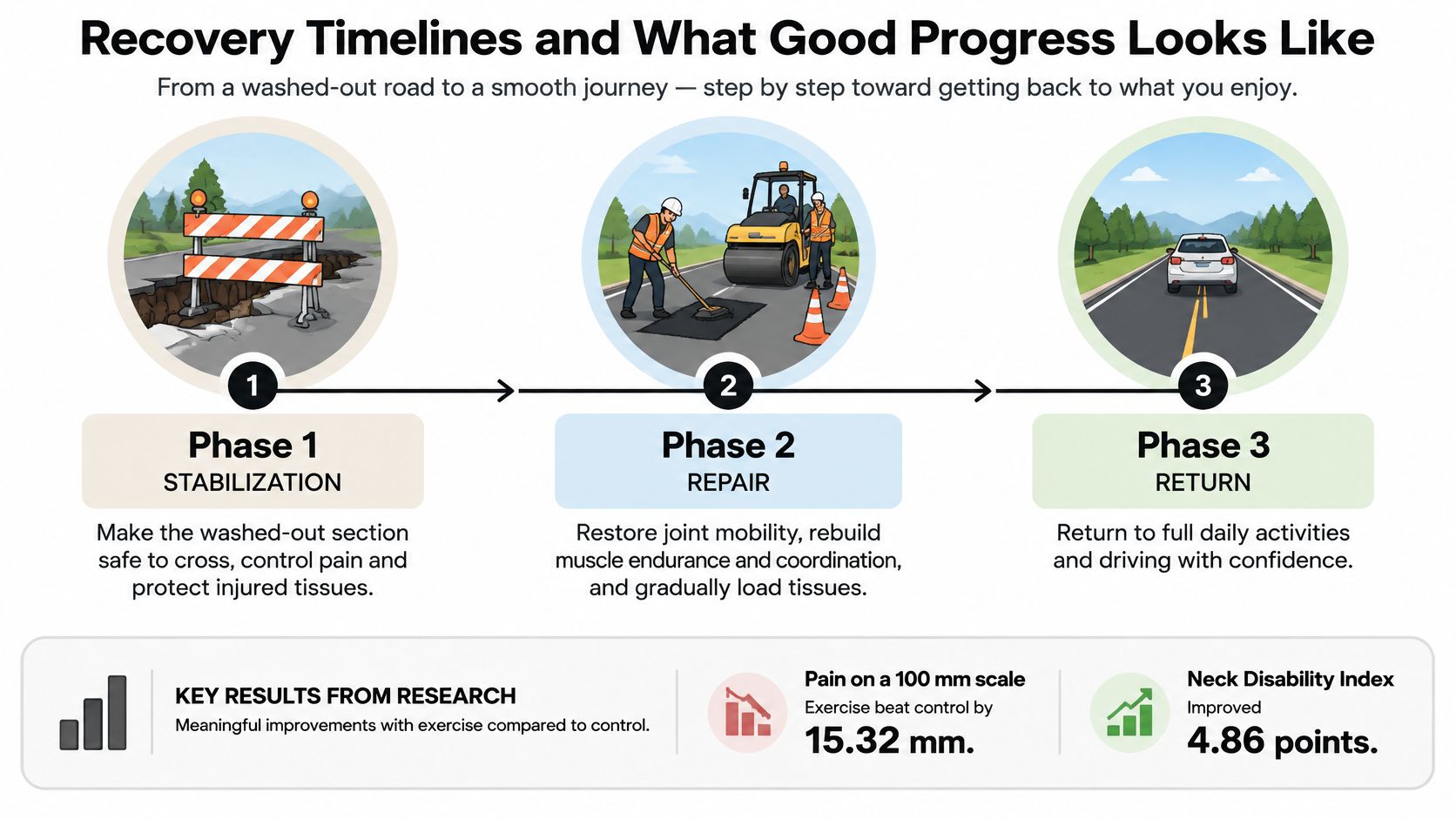
| Phase | Typical window | Main goal | Typical focus |
|---|---|---|---|
| Acute | First 6 weeks | Protect the injury and restore pain-free motion | Gentle range of motion, education, return to normal activity |
| Subacute | Weeks 6 to 12 | Rebuild strength and endurance | Progressive strengthening, work and driving tolerance |
| Persistent | Beyond 12 weeks | Manage ongoing pain and disability | Individualized plan, reassessment, possible specialist referral |
Set expectations with care, because the hard moment usually arrives around week eight, when early gains level off and patience runs thin. Even with steady treatment, some people still feel pain or limitations a year after the crash. Recovery is likely. Recovery on a fixed date is not.
Read the phases as windows, not deadlines. Two people with the same diagnosis can move through them at different speeds depending on the injuries involved and how the body responds to treatment. What matters is direction: are you doing more this month than last? The third row deserves a closer look, too. Reaching the persistent window does not mean treatment failed. It means the plan shifts from chasing a cure date to rebuilding function while symptoms are managed, and a specialist referral at this stage is a normal next step.
Three markers you can check at home
Progress after a crash is never one number. Take a driver three weeks in who can turn her head far enough to check mirrors but still wakes twice a night when she rolls over. That is partial progress, and both halves belong in the record.
- Mobility: can you turn further than last week, and does it hurt less at the end range?
- Endurance: can you sit, stand or drive longer before symptoms start?
- Sleep: are you waking less often, even if the ache is unchanged?
Your therapist tracks these same areas at each reassessment, so every visit produces one set of notes doing two jobs. The numbers that tell you that you are improving are also the numbers an insurer later reads as proof the injury was real and the treatment was needed.
A short walkthrough of what supervised rehabilitation looks like before you commit to a schedule:
Anxiety about driving again is common enough to plan for. If fear is slowing your return to the road, say so at your next session. Graded driving practice can be built into your plan, and services that focus on the fear itself, such as trauma counselling in Kelowna, exist alongside physiotherapy for exactly this stage.
The stall rule: if progress stops for two to three weeks, ask for a reassessment and a revised plan. Plateaus are information, not failure.
Keeping Records That Protect Your Claim and Your Budget
Every note your therapist writes serves two purposes at once. Range-of-motion readings and functional scores track your recovery clinically, and they are also the evidence an insurer reads when deciding whether the injury was real and the treatment justified. One dated folder, paper or digital, holds it all. Add each item the day it arrives.
Keep these nine records:
- The crash date and the symptom onset date, kept separate, because they often differ.
- A symptom journal noting pain, sleep and what you couldn't do that day.
- Diagnoses and the written treatment plan from each provider.
- An attendance log of every session, plus any missed visit and the reason.
- Progress measures from each review, including range of motion and functional scores.
- Bills, receipts and explanation-of-benefit statements, filed as received.
- Letters from insurers, unedited.
- Missed-work records and an employer letter stating the days and hours lost.
- Photos of visible injuries or the scene, taken early rather than reconstructed later.
Gaps get read as evidence, fairly or not. A three-week hole between the crash and your first appointment, or a run of missed sessions, makes it harder to show that ongoing symptoms were still being treated. Consistent attendance is the plainest proof you have that the injury needed care.
Budget tracking belongs in the same folder. The Health Care Cost Institute figure reported by KFF Health News put a typical privately insured physical-therapy session at an average of $192 in 2025. Two sessions a week runs about $384 weekly before insurance pays anything, so checking your out-of-pocket total each month matters as much as following your treatment plan.
The journal is the piece that gets skipped first, so keep it short. Date every entry, then write one line on pain, one on sleep, and one on any activity you couldn't do that day. A minute a night is enough, and brief entries stay useful months later. For the mechanics of keeping short daily entries readable over time, entry-writing advice from Life Calendar explains a workable format.
When the bills arrive faster than the insurer responds, the guide on how to file an insurance claim walks through the sequence. If you want a read on where things stand while the file builds, AskLegally's free Accident Claim Value Assessment reviews the facts that can affect how an accident claim is handled and gives immediate guidance with no contact details required. Start the folder this week and save every letter the day it lands.
Decide Whether to Call a Lawyer This Week
Many people with minor injuries that resolve in a few weeks never need a lawyer. That's the honest answer, and it saves a lot of people a lot of anxiety.
A review is worth arranging when the insurer disputes that your injury came from the crash, when a claim is delayed, denied or closed, or when a settlement is offered before your treatment ends. It's also worth a call if you're asked for a recorded statement you don't fully understand, if treatment gaps were caused by an insurer's decisions, if medical bills or lost wages are being argued over, or if another driver was clearly at fault and your injury is significant.
Do not sign a release before treatment ends. A release closes the claim, and it's very difficult to reopen.
Four steps fit into this week.
- Get a medical evaluation if any red flag applies, before anything else.
- Start the dated folder and drop in every document you already have.
- Request the official police report, which needs your contact and accident details. AskLegally's free Police Report Lookup tool helps you identify and request the right report.
- Check where your situation stands. Our guide on whether you need a lawyer after a car accident lays out how to weigh a case review against your claim before you call anyone.
Some decisions are medical, some are financial, and some are legal. Keeping them separate stops a slow insurer response from delaying your neck treatment.
Physical therapy after car accident claims go smoother when one set of records does two jobs, and AskLegally is built for exactly that moment between injury and hiring anyone. Their free tools and straightforward guidance help you figure out what to do next, including a free Accident Claim Value Assessment that reviews the facts affecting how your claim is handled without asking for contact details. Visit AskLegally to see where your situation stands before the next letter arrives.