
If you lined up everyone treated after a road-traffic crash in China, roughly one in four would meet the criteria for post-traumatic stress disorder. A 2025 systematic review of 21 studies put pooled PTSD prevalence among road-traffic-accident patients in China at 27% (2025 systematic review of 21 studies). That's the part of a crash injury nobody photographs. No cast, no bruise, nothing on the X-ray. Just a nervous system that learned the road is dangerous and won't unlearn it on command.
This guide walks through what PTSD looks like after a collision, why symptoms so often arrive weeks after the crash rather than the same day, and which treatments hold up in guidelines. It also covers the practical side most health writing skips: how to keep one dated record that serves your doctor and, if you need it, your claim.
You don't have to decide today whether you have PTSD or whether you need a lawyer. You do need to know what to watch for, and when to stop waiting.
How Common PTSD Is After a Car Accident
PTSD is a common consequence of surviving a road-traffic crash, not a rare one. It's a stress response that keeps running after the danger has passed: the brain replays the collision, or stays braced for a repeat of it, long after the metal is straightened out.
The clearest number comes from a 2025 systematic review and meta-analysis covering 82 studies, which found an overall PTSD prevalence of 20.3% among road-traffic-accident survivors, with a 95% confidence interval of 18.1% to 22.8% (the 2025 meta-analysis of 82 studies). One in five survivors.
How you ask the question changes the answer. Clinician-administered assessments identified PTSD in 18.7% of survivors, while self-report questionnaires produced a higher estimate of 22.8%, the same review found. Earlier research summarized in a BMJ Open systematic review reported rates of approximately 20% to 40% after motor-vehicle crashes.
The number to hold onto: about one in five crash survivors meets PTSD criteria in the months after the collision. That's an estimate for a population, not a verdict on you.
Three things move the figure around: when survivors are assessed, how severely they were injured, and which population was studied. Timing alone shifts it dramatically. Prevalence was 29.4% during the first month after the accident and fell to 18.8% at three months, a statistically significant reduction. No single percentage applies to every crash victim.
Here's where readers get confused. No visible injury does not mean no psychological injury. Whiplash that settles in a fortnight and a nervous system that won't let you merge onto a highway are two different injuries with two different recovery tracks.

If the next section describes your last few weeks, the right next step is a professional assessment rather than a guess. A clinician trained in trauma therapy for adults can separate ordinary acute stress from PTSD, and that distinction decides what treatment you're offered.
PTSD Symptom Timeline From One Month to Three Years
Prevalence isn't one number. It's a curve, and the curve falls steeply at first and then flattens.
Reported PTSD rates after a car accident by time since the crash
| Time after crash | Reported PTSD rate | Study type |
|---|---|---|
| 1 month | 29.4% (review) to 34.4% (cohort) | Systematic review; prospective study of 122 victims |
| 2 months | 22.4% | Prospective study of 1,074 road-trauma survivors |
| 3 months | 18.8% (review) to 25.2% (cohort) | Systematic review; prospective study of 122 victims |
| 6 months | 17.9% to 18.2% | Prospective studies of 1,074 and 122 victims |
| 9 months | 17.6% | Prospective study of 122 victims |
| 12 months | 16.2% to 16.5% | Prospective studies of 1,074 survivors and 967 emergency-clinic patients |
| 3 years | 11% still met DSM-IV criteria | Three-year follow-up study |
Read each row as the share of survivors in a particular study who met PTSD criteria at that point. It is not a forecast for any individual. Some people in these cohorts had no symptoms from week one; others got worse while the average improved.
What the early numbers show
The sharpest contrast appears in the first weeks. In a prospective study of 122 motor-vehicle-accident victims and 42 comparison participants, 34.4% of crash victims met diagnostic criteria for PTSD one month after the accident, against 2.4% of the comparison group (prospective study in the American Journal of Psychiatry). A separate study of 967 emergency-clinic patients found a prevalence of 23.1% at three months, easing to 16.5% by one year.
The long tail is real. A three-year follow-up found that 11% of participants still met DSM-IV criteria for PTSD, which makes lasting effects a minority experience rather than an anomaly.
Averages also hide four different trajectories. A 2026 trajectory study sorted survivors into distinct groups: 80.4% had consistently low symptoms, 16.7% experienced chronic severe symptoms, and 2.9% showed delayed recovery (2026 trajectory study of PTSD patterns). If you're in that last small group, you may feel fine at six weeks and awful at six months.
Practical rule: if symptoms are still present at the three-month mark, or they're getting worse instead of better, book a clinical assessment. Write down the date the symptoms started and how long they've lasted, because that sentence is the beginning of your record.
Symptoms That Signal PTSD and When Delayed Signs Appear
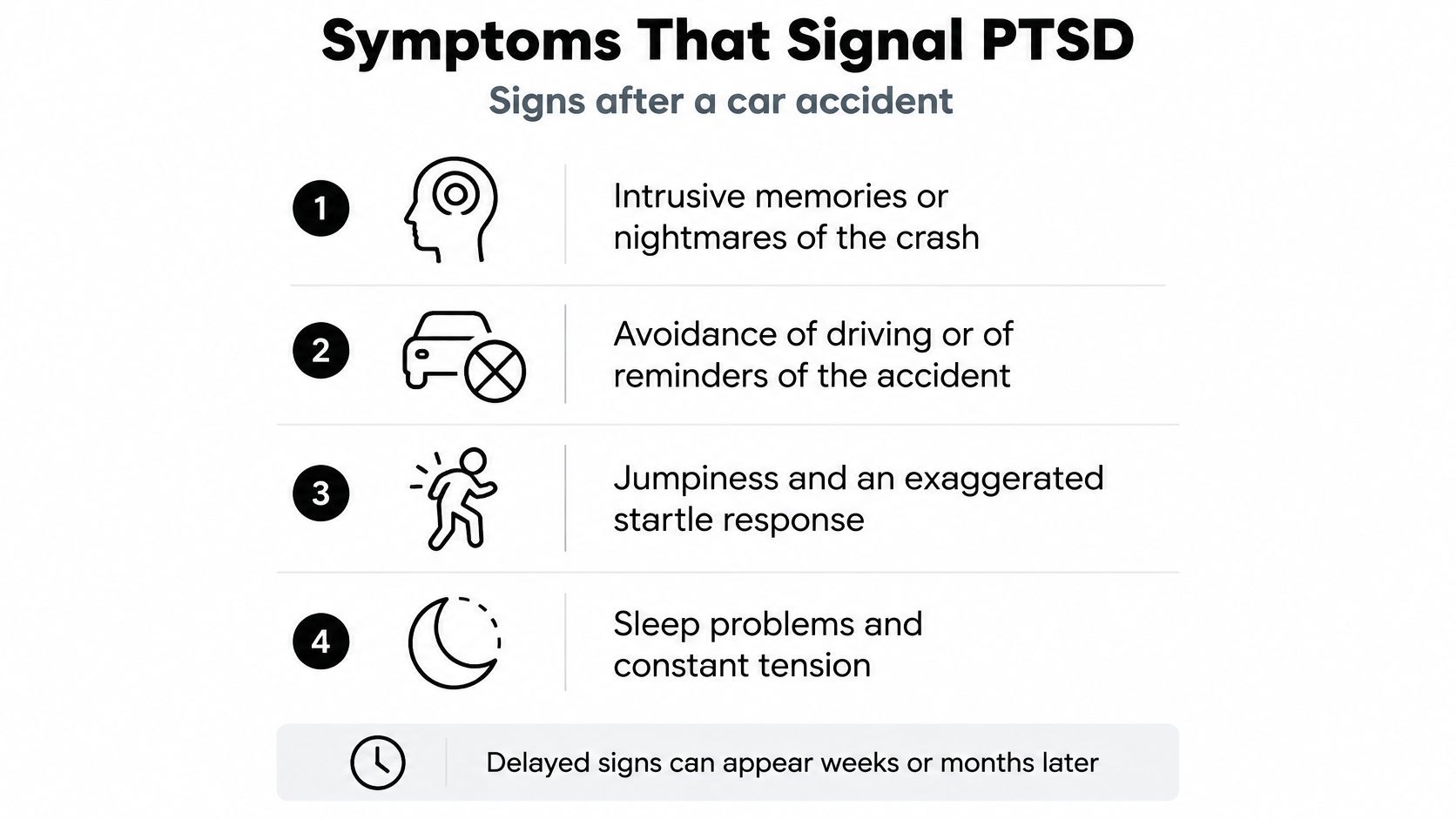
Clinicians look for symptoms in four families: reliving the crash, avoiding reminders of it, staying on guard, and going emotionally flat. In everyday terms, the checklist looks like this.
- Intrusive memories or nightmares of the collision, sometimes triggered by a song, a junction, or the smell of the car.
- Avoidance, which shows up most often as not driving, not riding as a passenger, or routing around the intersection where it happened.
- Jumpiness and an exaggerated startle response, where a horn behind you produces a reaction out of proportion to the event.
- Poor sleep, whether falling asleep, staying asleep, or waking at 3 a.m. with the crash replaying.
- Trouble concentrating, especially on tasks that require sustained attention like work spreadsheets or motorway driving.
- Irritability, snapping at people over small things and feeling it afterward.
- Emotional numbness, feeling detached from family or unable to feel pleasure in things you normally enjoy.
Why the delay trips people up
The first weeks after a crash are consumed by practicalities: X-rays, repair estimates, insurance calls, explaining the absence to an employer. Adrenaline helps you handle all of it. Emotional symptoms often surface once that surge settles.
A 2025 prospective study of 1,074 road-trauma survivors followed symptoms across a full year and found that improvement slowed substantially after the sixth month (2025 prospective study of 1,074 road-trauma survivors). Some survivors developed driving fear, nightmares, irritability, avoidance or concentration problems weeks after the collision, once the physical injuries stopped dominating their attention.
Delayed recognition doesn't make symptoms less real. It means the first responder, the emergency doctor and even you were looking at the wrong thing first. Our guide to delayed symptoms after a car accident explains how late-appearing crash injuries are assessed and documented.
One complication worth naming: PTSD can coexist with concussion, chronic pain, depression or anxiety. A headache after a crash might be post-concussion syndrome, sleep deprivation, or tension from hyperarousal. A medical assessment sorts out which condition is producing which symptom instead of treating everything as purely psychological. If you want to understand what's happening in your body before you speak to anyone, reading about counselling support for trauma reactions is a low-pressure place to start.
Symptoms that continue past a few weeks, or that start disrupting sleep, work, relationships or driving, are your signal to book a clinical assessment.
Who Faces Higher Risk After a Crash
Risk isn't distributed evenly across crash victims. Two factors move it the most: how the injury is defined, and how severe it was.
PTSD rates by diagnostic definition and injury type
| Group | Reported PTSD rate | Context |
|---|---|---|
| Survivors assessed with DSM-5 criteria | about 20% within six weeks | Narrower definition |
| Survivors assessed with ICD-10 criteria | more than 45% in some studies | Broader definition |
| Survivors with traumatic brain or spinal-cord injury | 29.4% pooled | 2025 systematic review |
Start with the definition, because it changes the answer more than many expect. A review of PTSD after road-traffic accidents reports roughly 20% of survivors meeting DSM-5 criteria within six weeks, against more than 45% in some studies using the broader ICD-10 definition, and puts PTSD in about 31% of hospitalized road-accident patients at one to six months versus about 20% among emergency-department cases.
Injury type pushes the rate higher still. A 2025 systematic review found a pooled PTSD prevalence of 29.4% among road-traffic-accident survivors with traumatic brain or spinal-cord injuries (2025 systematic review on brain and spinal injury survivors). Head and spinal injuries are a clear marker of increased risk, and they deserve a mental-health conversation as part of rehabilitation rather than as an afterthought.
A lower-risk group still develops symptoms. Being discharged from the emergency department without admission, or walking away from a low-speed collision, lowers your odds. It doesn't rule anything out.
If you were hospitalized or had a head or spinal injury, raise mental-health screening at your first follow-up visit and again a few weeks later. A single check during the acute phase catches the people who are struggling on day three and misses the ones who crash in week six.
When you do speak to a clinician, bring three things: what happened in the crash, what injuries you sustained, and the date your symptoms started.
First Medical and Legal Steps in the Days After a Crash
The first week is mostly about creating an accurate record while the details are still fresh. Sequence matters more than speed on any single item.
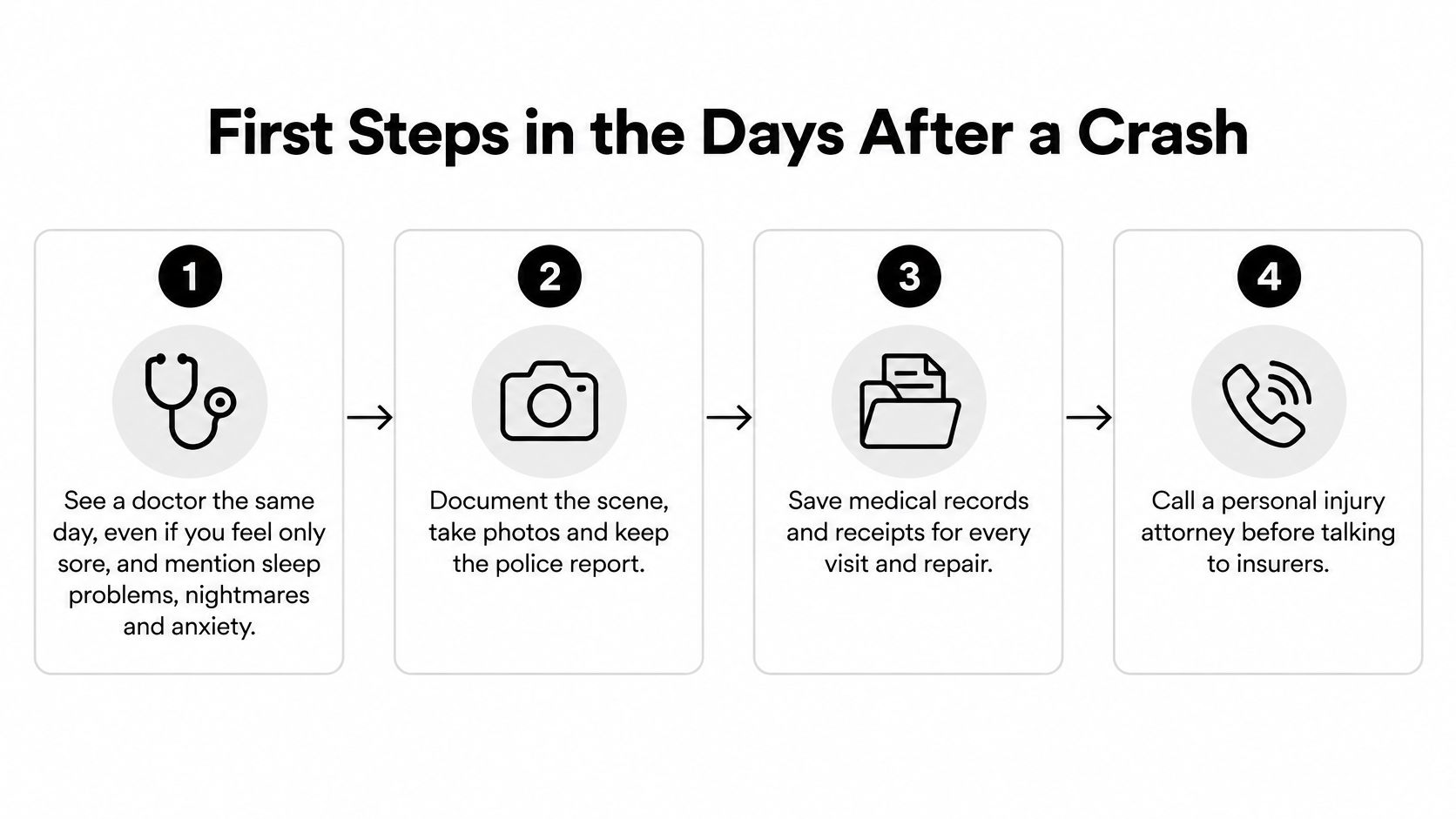
- See a doctor or urgent care the same day, even if you feel only sore. Tell them about sleep problems, nightmares and anxiety in the same visit as the neck pain, so the psychological symptoms are recorded from the start instead of appearing months later as a surprise.
- Report the accident to your own insurer promptly, sticking to facts. Describe what happened and what hurts. Skip guesses about fault and skip predictions about whether you'll be fine.
- Request the official police report from the investigating agency so the crash details are documented by someone other than the drivers involved.
- Pause before giving a recorded statement to the other driver's insurer, and before signing any medical release or settlement form. Early statements get quoted back later, and a general release can hand over records you'd rather control.
- Confirm the deadline for filing a claim. Limitation periods vary by state and some are short, so check early rather than assuming you have years.
The order reflects a simple logic: medical care first because your health drives everything else, then the record, then the paperwork, then any conversation with an adjuster.
If you'd rather watch than read, this walkthrough covers the same ground in a few minutes.
Everything from here feeds the file described in the next section. Receipts, notes and letters kept in one folder from day one are worth far more than a detailed reconstruction assembled six months later.
How to Document Psychological Injuries for a Claim
A symptom you can't describe in dates and frequency is hard for anyone to act on, whether that's a clinician deciding on treatment or an adjuster evaluating a claim. The fix is unglamorous: one file, started early, kept consistent.
Build the record from day one
- Start a dated symptom log on the day you can write it. Note each symptom, how often it occurs, and how strong it feels on a 0 to 10 scale. "Nightmares, 4 nights this week, 7 out of 10" beats "sleep is bad."
- Record the functional effects, because function is what distinguishes a bad week from an injury. Which drives do you avoid? How many hours do you sleep? Which work tasks can't you finish, and who covered them?
- Keep every treatment visit, referral and prescription, with dates and the clinician's name. Save the after-visit summary the portal generates. Those records create a timeline you could never reconstruct from memory.
- Ask your clinician to write functional limits into the notes, not only a diagnosis. "Cannot drive on highways" or "unable to work more than four hours without a break" tells a far clearer story than a code on a billing sheet.
- Save missed-work records, pay stubs and employer letters, each with a date. Lost income is the easiest part of a claim to prove and the easiest to lose through sloppy paperwork.
- Keep every insurer letter and your reply, and log each phone call with the date, the name of the person you spoke to and any reference number.
If paperwork isn't your strength, our walkthrough on how to file an insurance claim sets out the sequence and what to keep at each stage. For the medical side, it helps to know what to log before your evaluation so the first appointment produces usable notes rather than a vague recollection.
Two cautions worth writing down
A symptom log you write yourself supports a claim. It does not prove a diagnosis. Only a qualified clinician can do that, and an adjuster will weigh clinical records far more heavily than a personal journal.
Treatment should be pursued for your health, not to build a file. Care that exists to strengthen a claim tends to produce gaps, inconsistencies and appointments that stop the moment a settlement lands, and that pattern damages credibility.
Consistency matters more than volume. Twenty dated entries across three months showing a clear pattern will do more for you than a single impassioned page written the night before a deposition. If your symptoms change, record the change rather than smoothing it over. Recovery with setbacks is the normal shape of this injury, and a record that shows it reads as honest.
Treatment Options and How to Start Care
Good treatment exists, and the guidelines are unusually specific about which approaches work.
PTSD treatment options and when each fits
| Option | Best suited for |
|---|---|
| Trauma-focused CBT | Adults presenting within three months of the crash; typically eight to twelve sessions, with around five possibly sufficient when treatment starts in the first month |
| EMDR | Adults with clinically important symptoms or PTSD one to three months after a non-combat crash, especially when the patient prefers it |
| Generic supportive counselling | Support alongside care; less effective than trauma-focused CBT for PTSD |
| Primary-care screening and referral | Readers unsure whether symptoms need specialist care, or who cannot yet reach a clinic |
What the guidelines actually recommend
The NICE guideline on post-traumatic stress disorder recommends trauma-focused psychological treatment, either trauma-focused cognitive behavioural therapy or eye movement desensitization and reprocessing, for adults with PTSD regardless of how much time has passed since the trauma. That last clause matters. You are not too late at eight months, and nobody should tell you to wait and see how you feel at the anniversary.
For adults presenting within three months, trauma-focused CBT is the recommended route. Typical courses run about eight to twelve sessions, though around five sessions may be enough when treatment begins during the first month. EMDR may be considered for adults with clinically important symptoms or PTSD one to three months after a non-combat-related crash, particularly when the patient prefers it.
These are not interchangeable with generic supportive counselling. Guideline evidence indicates trauma-focused CBT performs better than supportive or non-directive therapy, which suggests the structured processing of trauma memories and avoidance is doing the therapeutic work. When you call a clinic, ask directly whether they provide trauma-focused CBT or EMDR for PTSD. "Counselling" is not the same answer.

When access is the problem
Plenty of people with real post-crash distress never get treated. Cost, stigma, the difficulty of driving to a clinic when driving is the thing that terrifies you, and simple exhaustion all get in the way.
Start with primary care. A GP or family doctor can screen, rule out other causes, and write a referral that carries more weight with insurers and employers than a self-referral. Ask whether the practice offers telehealth appointments for therapy, since trauma-focused CBT delivered by video removes the driving barrier entirely.
While you wait for an appointment, protect the basics. Keep daily routines anchored to fixed wake and sleep times. Stay in contact with one or two trusted people even when you'd rather withdraw. Avoid alcohol and recreational drugs as sleep aids, because they fragment sleep and worsen hyperarousal over weeks.
Request a clinical assessment when symptoms affect your sleep, your work, your relationships or your driving. That threshold arrives earlier than often admitted.
Frequently Asked Questions About PTSD After a Car Accident
1. Can PTSD start weeks after a crash? Yes. Delayed onset is common, and feeling calm in the first fortnight doesn't rule out symptoms later. The clinical picture often shifts once the physical injuries settle.
2. Do I need a formal diagnosis to make an injury claim? A clinician's diagnosis and their clinical notes carry real weight. A symptom log you write yourself supports a claim but doesn't prove a diagnosis, so pair it with records from a qualified professional.
3. Can I have PTSD without any visible physical injury? Yes. The absence of broken bones or a hospital stay doesn't rule out a psychological injury, and plenty of survivors with clean scans develop intrusive memories and driving fear.
4. Does PTSD always go away on its own? Not always. Rates fall over time, but a minority of survivors still meet criteria years later, which is why symptoms should be reassessed at the three-month mark rather than assumed to be resolving.
5. Is talk therapy enough? Ask specifically for trauma-focused CBT or EMDR. Generic supportive counselling is less effective for PTSD, and the difference is worth switching providers for.
6. How soon should I get help? Book an assessment if symptoms last beyond a few weeks or begin affecting sleep, work, relationships or driving. Don't wait for a fixed deadline that nobody set.
7. What should I tell my doctor about the crash? Give the mechanics of the collision, the injuries you sustained, and the date your symptoms started. Mention sleep, driving and concentration specifically, since those are the effects most often left out.
Decide Whether to Speak With a Personal Injury Lawyer
Most crash victims don't need a lawyer on day one. Some clearly do, and the difference is usually visible in how the claim is being handled rather than in the size of the impact.
Consider a review when any of these is true.
- The insurer disputes the injury or the fault. If PTSD is being framed as unrelated to the crash, the argument needs clinical records and a legal strategy behind it.
- Symptoms need ongoing treatment. A claim closed before you've finished therapy usually undervalues the injury, and reopening it is harder than waiting.
- Medical bills or lost wages are mounting faster than the insurer is responding.
- A settlement is offered before your treatment costs are known. Early offers feel generous precisely because nobody has priced the year ahead.
- Someone asks you to sign documents you don't understand, whether that's a medical release, a general release or a recorded statement summary.
You may not need one yet if the injury is minor, you expect a full recovery, you missed little or no work, and the claim has been accepted and is being paid without argument. Filing deadlines and claim rules vary by state, so confirm yours early even if you handle everything yourself.
Gathering documents speeds up any review, and you don't need a complete file to start one. Helpful items are the injury date, how the crash was reported, claim paperwork, medical records and pay stubs (how AskLegally's review process works). If you don't yet have the official report, our free Police Report Lookup tool helps you identify and request it.
There's no pressure in either direction. A short conversation tells you whether the claim is straightforward or whether the insurer's conduct suggests you'd benefit from representation.
PTSD after a car accident is one of the injuries that gets priced badly, because the symptoms arrive on their own schedule and the paperwork rarely captures them. AskLegally helps you close that gap: our free case review asks about the crash, your injuries, your treatment and the ways your daily life has changed, then helps you decide whether connecting with a participating personal injury lawyer makes sense for your situation. If you're still working out whether the psychological side of your crash belongs in a claim, start with AskLegally and keep the dated record you've already begun.