
You felt stiff at the crash scene, but you could still move your arm. The next morning, lifting a coffee cup hurts, pulling on a shirt feels awkward, and you're wondering whether the problem is your shoulder, your neck, or both.
Shoulder pain after a car accident needs an examination, not a diagnosis based on timing alone. The useful questions are where the pain starts, what movements change it, whether strength or sensation has changed, and which activities you can no longer manage. Those details help a clinician choose the right care and create a clearer record for an insurance claim.
Common Shoulder Injuries After a Crash
A collision can load the shoulder through the seat belt, a direct impact, or an arm braced against the steering wheel. It can also injure nearby structures that produce pain around the shoulder without damaging the shoulder joint itself.
Shoulder symptoms often belong to a broader neck-and-trunk pain pattern. In a population-based study of 6,481 Saskatchewan residents treated or filing an insurance claim after traffic injury, 95% reported posterior-trunk pain, a region that included the posterior neck, shoulders, back, and buttocks, according to the peer-reviewed pain-localization article. That isn't a shoulder-injury percentage, but it helps explain why a sore shoulder may accompany neck stiffness or upper-back pain.
Post-crash shoulder problems and the first step
These patterns help you describe symptoms. They aren't a way to confirm an injury at home, and more than one can occur together.
| Problem | How the crash loads it | Hallmark signs | First step |
|---|---|---|---|
| AC joint separation | Shoulder driven down while the torso moves forward | Bump at the collarbone junction; pain reaching across the body | Same-day exam if deformed or very swollen |
| Clavicle fracture | Seat belt, dashboard, or direct blow | Point tenderness, grinding, or a visible bend along the bone | Emergency or same-day assessment and x-ray |
| Dislocation or labral injury | Arm braced on the wheel or outstretched | Locked motion, squared-off shoulder, possible numbness; a labral injury may cause catching | Emergency care for suspected dislocation; assessment for persistent catching |
| Rotator-cuff strain or tear | Sudden deceleration while reaching or bracing | Weakness lifting or rotating; night pain | Prompt exam, urgently if the arm drops or won't lift |
| Contusion or bursitis | Door, belt, or seat impact | Bruising, swelling, pain lying on that side | Cloth-wrapped ice and an exam if swelling or movement worsens |
| Referred neck pain | Rapid neck motion during whiplash | Pain changes with head turning; tingling into the arm | Examination that includes the neck and nerves |
Similar names can mean different injuries
A separated shoulder involves the acromioclavicular, or AC, joint where the collarbone meets the top of the shoulder blade. A dislocated shoulder involves the ball coming out of its socket. They aren't interchangeable diagnoses, and their treatment differs.
The rotator cuff is the muscle-and-tendon system that helps lift and rotate the arm. The labrum is the cartilage rim around the socket. Painful lifting doesn't automatically identify either structure, because bruising, bone injury, and neck-related pain can also limit movement.
Tell the clinician whether you were driving, sitting in the front passenger seat, or struck from the side, and whether your shoulder contacted the door or belt. Use that information to describe the force, not to select a diagnosis from the table.
Practical rule: A visible deformity, a dropped arm, or new numbness deserves urgent assessment. Less dramatic pain still warrants a prompt appointment if it interferes with ordinary movement.
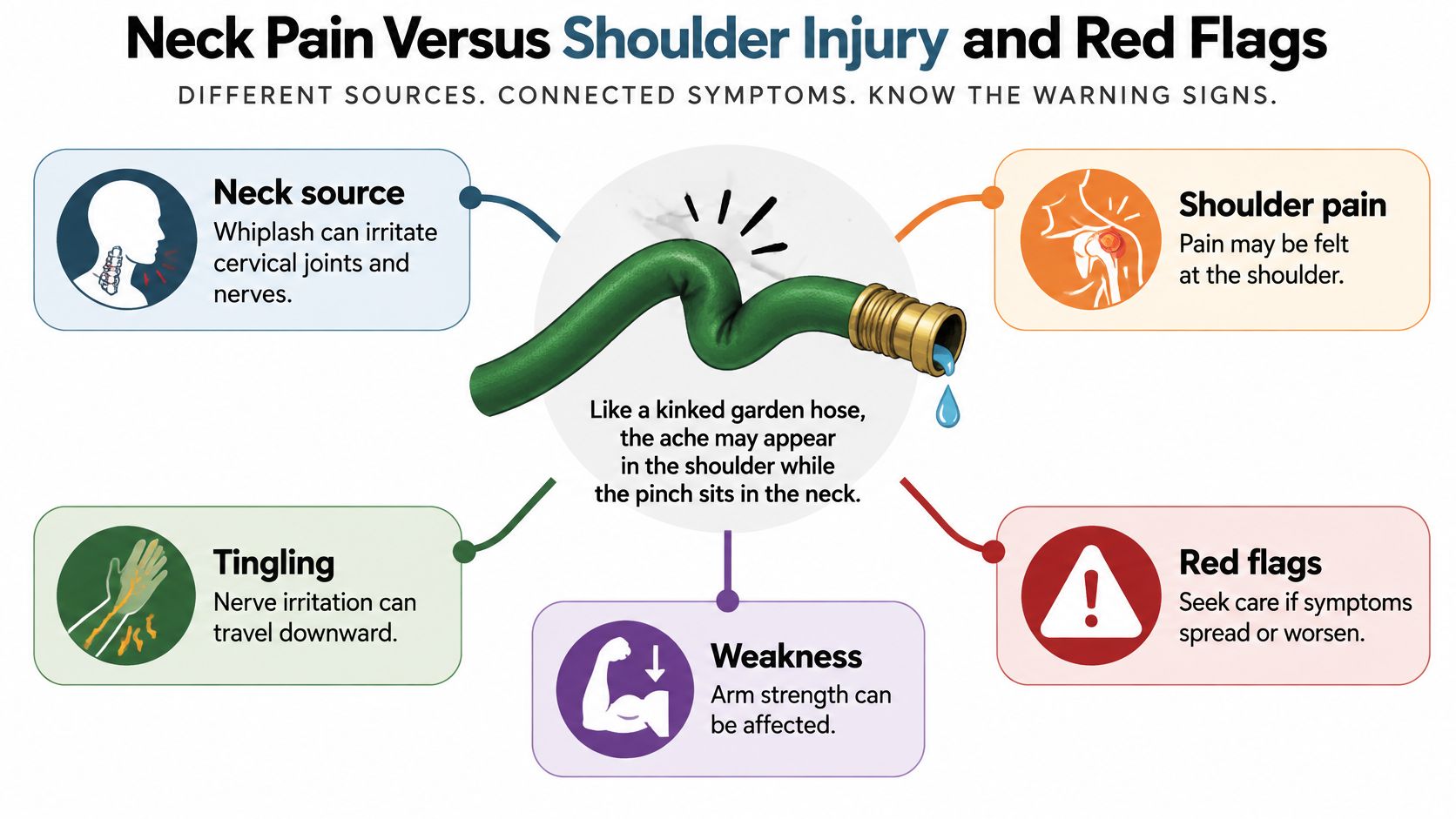
Neck Pain Versus Shoulder Injury and Red Flags
A kinked garden hose offers a useful analogy: the problem may sit upstream from where you notice its effect. With neck-related pain, irritation around the cervical spine can produce symptoms at the shoulder or farther down the arm.
That doesn't mean every sore shoulder is whiplash. It means the clinician should examine both areas when the symptom pattern suggests it.
The illustration below shows why the location of pain doesn't always identify its source.
Describe the pattern without testing through pain
Pain directly over the collarbone junction or deep inside the shoulder, especially during arm movement, can suggest a local shoulder problem. Pain that changes when you turn your head, travels below the elbow, or comes with tingling may call for a closer neck and nerve examination.
Neither pattern is conclusive. Don't repeatedly provoke symptoms or force your arm overhead to see whether something is torn.
Bring the clinician these observations:
- Neck movement: Does turning or tilting your head change the shoulder pain?
- Travel: Does discomfort remain near the shoulder, or extend into the forearm or hand?
- Sensation and strength: Have you noticed numb fingers, weaker grip, or difficulty holding objects?
- Onset: When did you first notice each symptom, and what were you doing?
Delayed onset isn't a diagnosis. The Hutzler Law discussion of delayed crash symptoms acknowledges that shoulder symptoms can originate in the neck and that symptom timing doesn't establish the injured structure. Record what happened without turning “pain began later” into “a tendon must have torn.”
Our guide to neck pain after a car accident can help you organize overlapping complaints. For additional general context, Thermo Recovery Wear explains whiplash recovery, though recovery information shouldn't replace an examination or determine whether a wearable is appropriate for your injury.
Signs that need urgent care
Seek emergency assessment for a suspected dislocation, impaired circulation, or chest-related symptoms. Other substantial or worsening changes also need urgent medical attention:
- Changed shape: The shoulder looks deformed or squared off.
- Loss of movement: You can't move the arm, or it keeps dropping.
- Uncontrolled pain: Supporting the arm and basic pain relief aren't enough.
- Rapid swelling: Bruising or swelling is increasing quickly.
- Neurological changes: Numbness, tingling, or weakness is spreading.
- Circulation changes: The hand becomes pale, cold, or blue.
- Chest-related symptoms: Shoulder pain accompanies chest pain, shortness of breath, or fainting.
Don't wait for a scheduled appointment if these develop. Chest symptoms, fainting, or a cold or discolored hand warrant emergency help.
While arranging care, support the arm comfortably and use cloth-wrapped ice briefly if it helps. A sling may ease discomfort temporarily, but prolonged use should follow clinical advice. Avoid forced reaching, aggressive stretching, and attempts to pop the shoulder back into place.
For additional visual context, the video below accompanies the discussion of post-crash symptoms.
How Doctors Choose Shoulder Imaging
Pain after a crash can involve the shoulder, neck, or both. A clinician starts by checking where it hurts, how the shoulder looks and moves, and whether strength, sensation, and circulation are affected. They may also examine the neck and compare arm movement with the arm supported. The examination guides which scan, if any, is likely to help.
Which shoulder test fits which question
| Test | Best question it answers | Main limit | Typical timing |
|---|---|---|---|
| X-ray | Is there a fracture or obvious dislocation? | Misses many tendon injuries and subtle AC shifts | First study when bone or joint injury is possible |
| Zanca and comparison views | Is the collarbone-shoulder joint displaced? | Still a plain film, not a detailed soft-tissue test | When the examination and standard films disagree |
| CT | Is there a hidden fracture that would change care? | Not the usual test for cuff or labral injury | After negative x-rays with high fracture suspicion |
| Ultrasound | Is a tendon torn, or moving abnormally? | Operator-dependent; doesn't establish when an abnormality developed | When examination suggests a suitable soft-tissue question |
| MRI | Is there cuff, labral, or other structural damage? | Some abnormalities may predate the collision | Persistent unexplained dysfunction, or earlier when major injury is suspected |
Standard front and side x-rays can miss subtle displacement of the acromioclavicular (AC) joint. The NCBI Bookshelf clinical reference on AC joint injury describes a Zanca view, with the beam angled 10–15 degrees toward the head, and comparison views as options when standard films don't fit the examination. A normal first x-ray does not necessarily explain focal tenderness.
CT can help clarify a suspected fracture that isn't visible on x-ray when finding it would affect care. Ultrasound can show selected tendons in motion. MRI provides a broader view of soft tissues and other structures, but a finding on a scan does not, by itself, show when it developed or prove the crash caused it.
Reassessment matters more than a rigid scan schedule
Significant cuff weakness or a dropped arm that has not improved by 72 hours calls for further evaluation. Pain that remains despite conservative care after about 4–6 weeks, with nondiagnostic radiographs, may warrant ultrasound or MRI under the shoulder-treatment guidance. These thresholds address different situations, and severe symptoms may need earlier care.
A clinician may arrange advanced imaging sooner when traumatic weakness is substantial. If pain is improving and strength is preserved, immediate MRI may not be needed.
Clicking, weakness, or restricted movement can come from different structures. A report mentioning a tear or arthritis needs to be considered alongside the examination and history. If symptoms persist despite an unrevealing early test, follow-up still matters.
Before leaving, ask what diagnosis the clinician is considering, which changes should prompt earlier review, and what happens if function does not improve. The answers can clarify the plan beyond the scan result.
Treatment Paths and Recovery Time
A bruise, an unstable joint, and a torn tendon don't follow the same recovery path. Treatment should match the injured structure, degree of instability, and loss of function, not a product advertised for shoulder pain.
A clinician should rule out fracture and dislocation before prescribing an exercise routine. Trying to stretch through an unrecognized structural injury can be unsafe.
Match treatment to the injury
For contusions, mild strains, and some neck-related symptoms, care may include relative rest, symptom relief, and a gradual return to movement. Relative rest means avoiding the activities that sharply aggravate symptoms, not keeping the entire arm motionless indefinitely.
- Stable AC sprains: Lower-grade injuries often receive nonsurgical care, with support followed by progressive movement.
- Fractures and unstable injuries: Displaced collarbone fractures, higher-grade separations, and recurrent dislocation need orthopedic assessment to determine whether surgery is appropriate.
- Rotator-cuff injuries: Partial tears may begin with rehabilitation. A traumatic full-thickness tear with major weakness can warrant an earlier surgical discussion.
- Rehabilitation: Physical therapy commonly progresses from comfortable movement to strength and task-specific activity, within the restrictions set for the injury.
Pain medication also needs to fit your health history and other medicines. Ask a clinician or pharmacist before combining products, particularly if you take blood thinners or have kidney, stomach, or liver problems.
Use function to judge progress
Recovery isn't just a lower pain score. Useful milestones include getting dressed without assistance, reaching a shelf, sleeping comfortably, and controlling the steering wheel safely.
| Activity | Useful progress marker |
|---|---|
| Dressing | Less help needed with sleeves and fastenings |
| Sleeping | Fewer awakenings and less positional pain |
| Reaching | Better controlled movement without compensating |
| Working | Ability to complete approved duties within restrictions |
Long-term symptoms are documented, but they aren't inevitable. In a 20-year comparison, 72.0% of former acute-whiplash patients reported shoulder stiffness, compared with 45.9% of controls, as described in the long-term whiplash follow-up discussion.
That comparison isn't your personal prognosis. It concerns a particular whiplash population, not every person with a post-crash shoulder injury, and stiffness isn't the same as permanent disability.
Use persistent limitations as a reason to reassess the plan, rather than assume recovery has stopped. Tell the treating team if exercises consistently worsen symptoms, work demands exceed your restrictions, or sleep remains disrupted. If transportation, cost, or authorization prevents follow-up, document the barrier and ask about workable alternatives instead of dropping out of care.
What to Record for an Insurance Claim
Start a dated log, not a folder full of unexplained photos. A useful record connects the collision, your symptom timeline, clinical findings, and the activities you couldn't perform.
The Hillguard guide to injuries appearing after a collision describes pain, swelling, and restricted movement as reasons for evaluation. For claim documentation, the important addition is your baseline: what you could do before the crash compared with what changed afterward.
Use the visual checklist to organize the earliest details, without delaying medical care.
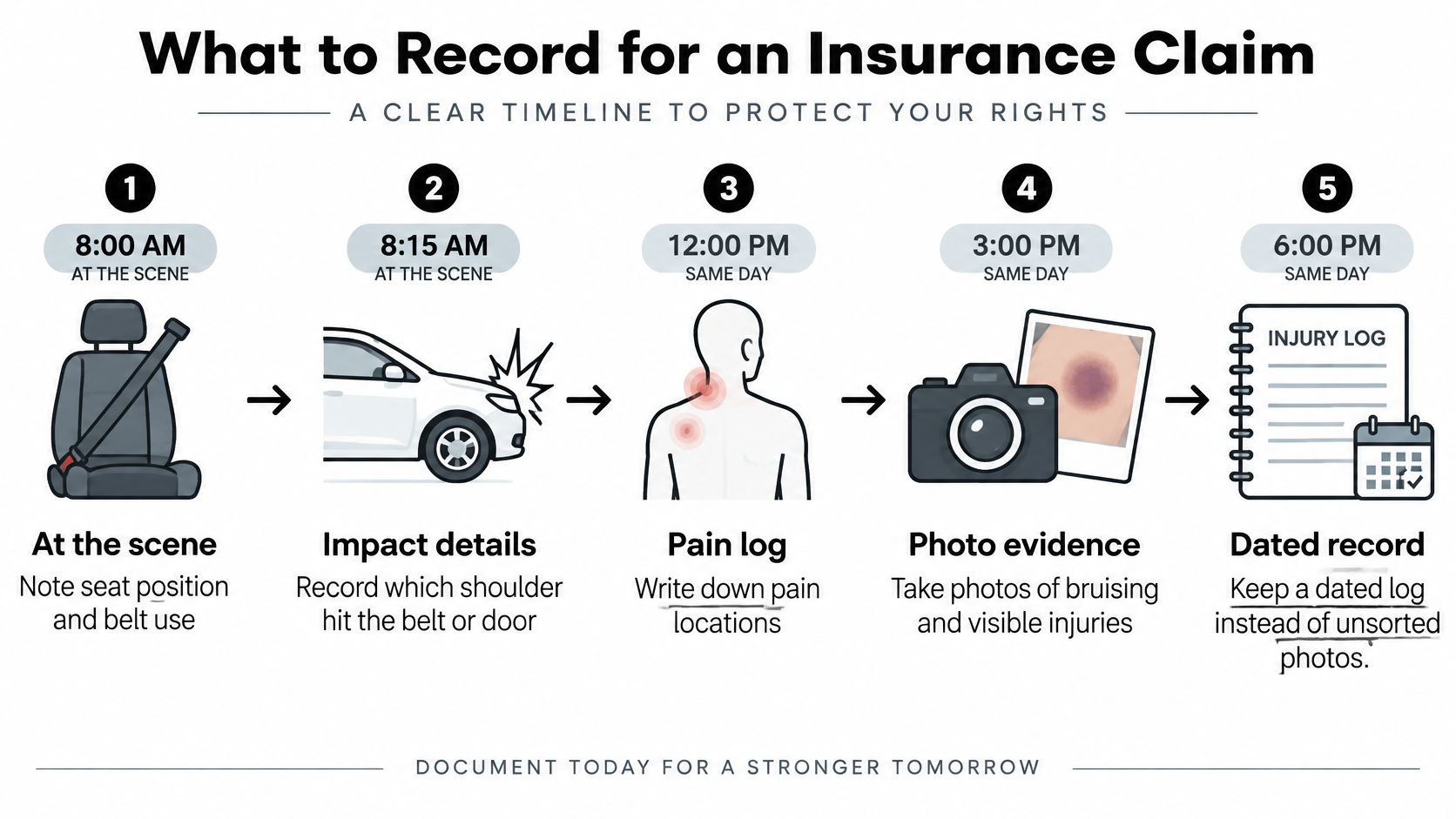
Build the record outward from the collision
The timing below is an organizational framework, not a claim deadline or medical waiting period.
| Phase | What to record | Concrete example |
|---|---|---|
| At the scene, when safe | Seat position, belt use, impact direction, pain locations, visible injuries, vehicle damage | Front passenger; left shoulder pressed against belt |
| As symptoms develop | Onset time, new weakness, numbness, swelling, sleep disruption | Needed help putting on a shirt after waking |
| During ordinary activity | Movement that triggers symptoms and whether neck motion changes them | Turning to check traffic brings tingling into the forearm |
| At appointments | Findings, restrictions, referrals, treatment plan, unanswered questions | Clinician advised avoiding overhead lifting |
| Throughout the claim | Records, bills, receipts, work notes, insurer correspondence, missed work | Saved therapy receipt and employer's modified-duty note |
If a police report was made, save the report number and request the official report when available. Keep original photographs and label copies with the date and what they show.
Record observations rather than conclusions
Say a passenger photographs a belt-line bruise and later receives an AC-joint diagnosis. The photos may help document the impact location, but the diagnosis still comes from the clinical assessment.
Now consider a driver whose log consistently records arm tingling when turning the head. That detail helps prevent an inaccurate history that labels every complaint as a rotator-cuff problem.
Useful chart language: Describe the task, the symptom, and the change from your usual ability. “Could carry groceries before the crash; now lifting the bag causes shoulder pain” is more informative than “shoulder bad.”
Disclose earlier neck or shoulder problems, including prior treatment and symptoms that had resolved. Accuracy is more useful than an unrealistically perfect history, particularly when imaging shows older changes.
Keep appointments when possible, and explain cancellations or access barriers. An insurer may question an unexplained treatment gap, but a gap alone doesn't establish recovery. Save messages showing attempts to reschedule or obtain authorization.
Bring your log and prior-history summary to the first visit. Our guide to filing an insurance claim can help you organize the administrative steps while your clinician handles diagnosis and treatment.
When to Contact a Personal Injury Attorney
The decision to seek legal help should turn on what's being disputed and what you're being asked to agree to, not whether your shoulder still hurts.
A review can be useful before you sign a settlement or broad medical release. You don't need to finish treatment or collect every document before asking about your options.
Reasons to request a review
- Causation is disputed: The insurer says your shoulder condition predates the collision or isn't related.
- Care is challenged: Necessary treatment or therapy is being refused or questioned.
- Settlement pressure is building: You're asked to settle before the likely treatment needs and work effects are clear.
- Financial losses are growing: Medical bills and missed earnings are becoming difficult to manage.
- Fault or information requests are complicated: Responsibility is contested, or you're unsure how to respond to a recorded-statement request or broad release.
You may not need representation yet if care is proceeding, losses are limited, and you're steadily regaining function without a dispute. Claims can progress while treatment continues, but that doesn't mean you should sign a final release before understanding its consequences.
Our guide to whether you need a lawyer after a car accident offers additional decision criteria.
Bring what you have
Gather the accident date, how it was reported, claim correspondence, available medical records, and pay stubs showing lost earnings. Missing paperwork shouldn't stop you from requesting a free case review if a significant dispute has already developed.
For people deciding what to do next, we offer the free Accident Claim Value Assessment, which reviews facts that can affect claim handling and provides immediate guidance without contact details. Our free Police Report Lookup helps identify and request the official report; a report request requires contact and accident details.
Legal help can address a claim dispute, but it can't replace medical assessment. If you have a deformed shoulder, new weakness, circulation changes, or chest-related symptoms, seek urgent care rather than waiting for a case review.
We offer free tools, straightforward accident guides, and a free case review for people who haven't hired an attorney. Visit AskLegally to organize your next steps for a shoulder-injury claim and explore appropriate legal assistance while you continue getting medical care.