
You're stopped at a light when the car behind you doesn't stop. The jolt arrives before the thought does. Both drivers get out, the damage looks modest, insurance cards get exchanged, and you drive home. An hour later your neck feels tight and there's a dull ache between your shoulder blades. Nothing is bleeding. Nothing looks broken. So the question is small and urgent at once: emergency room, urgent care clinic, or a night on the couch?
That question usually gets answered badly. Most car accident advice tells you to get checked out and leaves you to guess where. The decision isn't a feeling. It's a set of criteria: which symptoms you have, what kind of impact you were in, and whether anything is getting worse. A person who walks away from a wreck can still have a bleeding brain or a fractured vertebra. A person who feels awful at the scene often has nothing worse than a strain.
Here's the routing logic a triage nurse would apply to you, in the order they'd apply it. Where to go first, then how to get through the visit, then how to keep records that hold up weeks later. If you want the short version of urgent care after car accident decisions, it fits in one line: symptoms and mechanism set the destination, not how you feel.
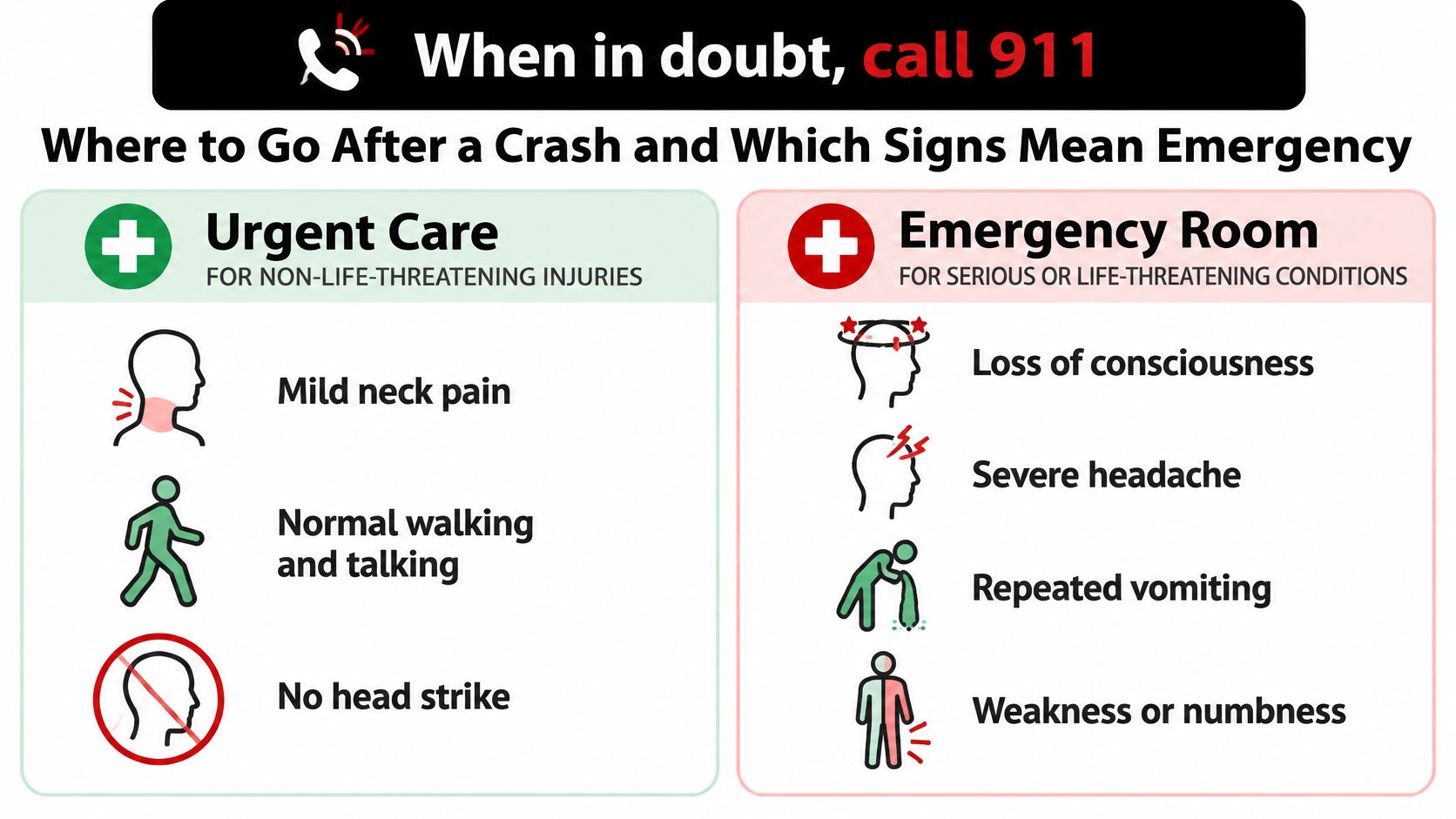
Where to Go After a Crash and Which Signs Mean Emergency
Say the crash was a rear-end hit at a suburban intersection and an hour later your neck is stiff and your lower back aches. You can walk, talk, and hold a conversation, and you want to know whether a clinic is enough. For that picture, it usually is, provided nothing on the emergency list is happening. What decides it isn't how sore you feel. It's your symptoms, the mechanism of the impact, and whether anything is changing.
Read the row that matches you, then read the row below it, because the second row is often the one that matters.
| Situation | Where to Go | Why |
|---|---|---|
| Walking and talking normally, mild neck or back soreness, no head strike | Urgent care | Exam, X-ray if needed, pain plan |
| Bruises, cuts that may need stitches, sprain or strain | Urgent care | Wound care, splinting, X-ray |
| Worsening headache, confusion or drowsiness after a head strike | ER now | CT scan may be needed |
| Neck pain with arm or leg numbness or weakness | ER or call 911 | Spinal assessment and imaging |
| Chest pain, shortness of breath, abdominal swelling or faintness | ER or call 911 | Possible chest or internal injury |
| Ejection, rollover, or a trapped occupant | Call 911 | Trauma care needed |
| Mild symptoms that appear days later | Urgent care or primary care | Document and reassess |
What Urgent Care Can Actually Do
A clinic handles the middle of the severity range well: sprains and strains, whiplash without neurologic symptoms, bruises, a cut that may need a few sutures, a possible minor fracture without deformity. Most sites can take an X-ray, clean and close a wound, fit a splint or a walking boot, and prescribe pain relief or a muscle relaxant. They can also hand you work restrictions in writing the same day, which matters more than people expect.
What they generally can't do is CT imaging, trauma resuscitation, or same-hour specialist review. Capabilities vary enormously by location, so if a head strike is part of your crash, call ahead and ask whether there's a CT scanner on site. A no answers the urgent care versus ER question for you.
Why Walking Away From the Car Proves Nothing
The most expensive mistake is treating mobility as evidence. Being able to get out, swap insurance details, and drive home tells you your legs work. It doesn't tell you your brain and spine are fine. Epidural bleeding and evolving brain injury can look normal in the first hour. So can a slowly filling abdomen.
Crash outcomes are serious at population scale. The National Highway Traffic Safety Administration counted an estimated 40,901 deaths from traffic crashes in the United States in 2023, according to its 2023 crash data overview. Somebody is the person who felt fine at the scene. The point isn't fear. It's knowing which symptoms mean you don't get to wait and see.
Head Injury Signs That Override Everything Else
After any head strike, loss of consciousness, or gap in memory around the impact, these signs send you to an emergency department. Don't drive yourself.
- Repeated vomiting, not one wave of nausea.
- A severe or worsening headache that builds over the first hours.
- Confusion, unusual drowsiness, or trouble staying awake.
- Weakness or numbness in a face, arm, or leg.
- A seizure, slurred speech, or unequal pupils.
The American College of Emergency Physicians recommends the Canadian CT Head Rule for adults with minor traumatic brain injury and a Glasgow Coma Scale score of 14 to 15, with CT indicated or considered for repeated vomiting, severe or worsening headache, focal neurologic deficit, seizure, abnormal mental status, suspected skull-base fracture, significant coagulopathy, older age, or a dangerous mechanism such as vehicle ejection, per ACEP's clinical policy on mild traumatic brain injury. A normal appearance at the scene doesn't exclude intracranial bleeding.
Neck and Spine Signs That Change the Plan
Don't drive yourself if neck pain comes with arm or leg weakness, numbness, tingling, severe midline tenderness, an inability to turn your head normally, altered consciousness, or a high-risk mechanism such as ejection. Until you're evaluated, keep the neck neutral and decline anyone's offer to stretch or crack it.
Four groups carry extra risk and get a lower threshold for the ER: passengers who never saw the impact coming, older adults, children, and anyone taking anticoagulant or antiplatelet medication. Blood thinners change the imaging decision and the observation plan, so say it at the front desk, not at the end of the visit.
Even a low-speed collision deserves a checkup once symptoms appear, and a guide to injury checks after a minor Texas crash is a useful reminder that the record you make that day is the one everyone else works from later. Symptoms that surface days afterward follow their own pattern, covered in this walkthrough of delayed symptoms after a car accident.
The rule that covers every gap in the table: when you're unsure, or when you can't get yourself there safely, choose the ER or call emergency services. Uncertainty is a reason to escalate, not a reason to wait. Write down each symptom and the time it appeared, starting now.
How to Get Through an Urgent Care Visit After a Crash
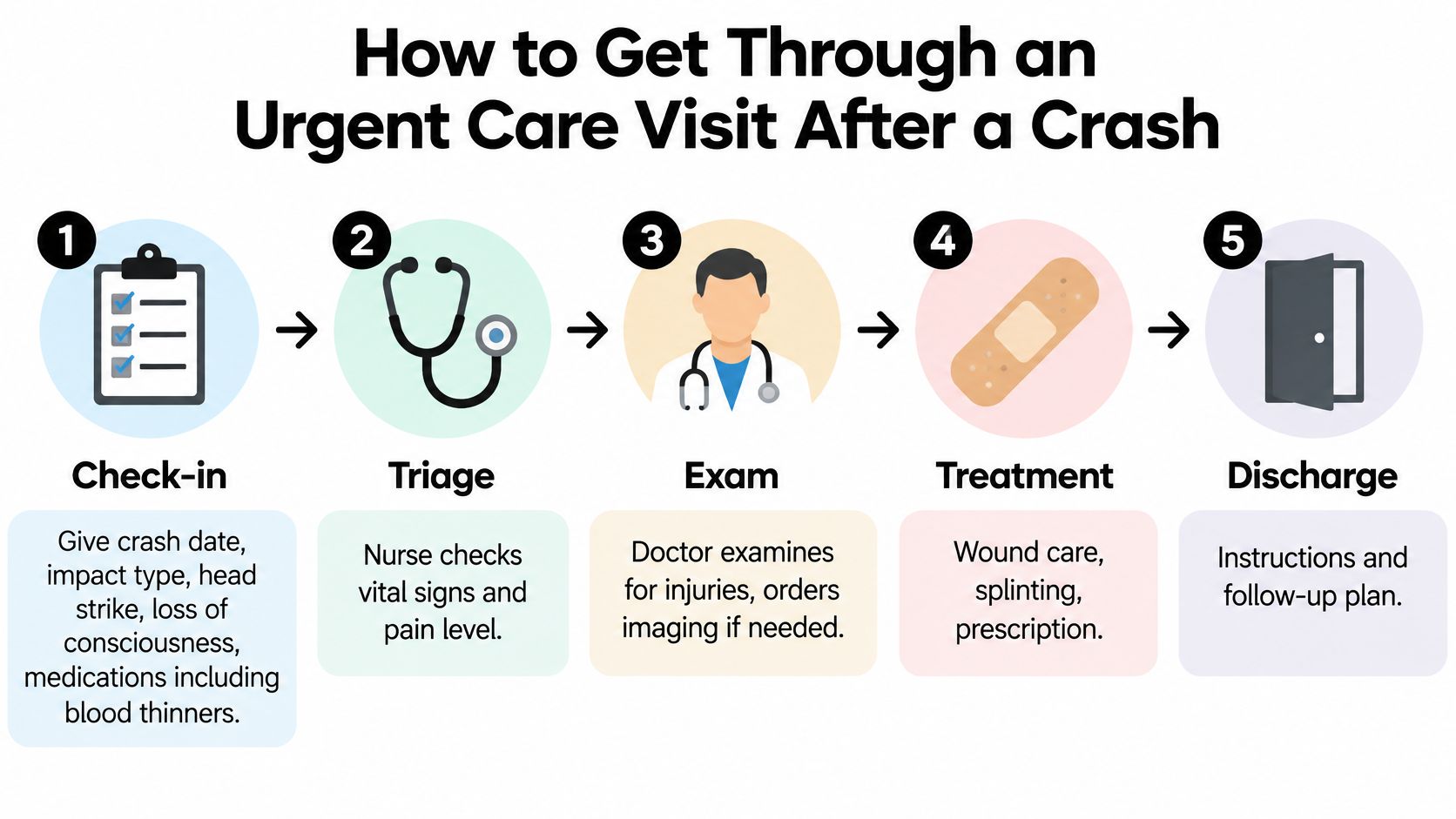
You walked in under your own power, which is exactly why the first questions matter. Standing in the parking lot proves you could stand in that moment; it does not clear the neck, head, or abdomen. The visit works like a funnel: mechanism and symptoms narrow the possibilities, the exam confirms them or sends you onward, and discharge turns the findings into instructions.
The Six Steps in Order
1. Check-in and history. Give the crash date and time, the type of impact, whether your head struck anything, whether you lost consciousness or cannot recall the moments afterward, and every medication you take. Blood thinners belong in the first sentence. That history drives whether imaging happens today.
2. Triage. A nurse records blood pressure, heart rate, oxygen, pain level, and how you are walking. A high reading after a crash can reflect pain and adrenaline, or a problem that needs escalation. Repeat readings during the visit help separate the two.
3. The physical exam. The clinician documents the mechanism, midline neck tenderness, neurologic symptoms, range of motion, and any distracting injuries before deciding on imaging. Screening tools such as the Canadian C-spine Rule and NEXUS criteria help identify low-risk adults who can sometimes skip neck X-rays. Limited neck rotation is a measured finding for the record, and so are weakness, numbness, or tenderness over the spine.
4. Imaging and tests. X-rays look for suspected fractures; some visits add lab work. Ask before you arrive whether the site has CT, because a clinic without it will send you onward anyway.
5. Treatment. Pain relief, a splint or soft collar, wound care, a prescription, and a referral if something needs a specialist.
6. Discharge. Leave with written work restrictions, activity limits, warning signs, and a follow-up date. Ask for copies of the visit note and any imaging report before you walk out.
Symptoms that change after the visit call for reassessment. The emergency signs from earlier still apply that night and the next day; if a new one appears, go to the ER.
Documenting Your Injuries for Insurance and Claims
Insurers and attorneys rebuild your injury from paper and dates. A gap in the file, or a note that says "some soreness", gives them room to argue the crash wasn't the cause. Building the record takes about fifteen minutes a day.
1. Record the crash facts the same day. Date, time, location, the other driver's name and insurer, witnesses, and the police report number. Memory drifts within a week, and the report number provides access to the official version.
2. Keep a daily symptom log. Date, body region, pain level from 1 to 10, and the specific activities you couldn't do. "Couldn't lift the toddler into the car seat" proves more than "back hurts".
3. Save every medical paper. Visit notes, imaging reports, prescriptions, work notes, and bills go in one place. A full checklist for preserving rights after a collision, such as this car accident checklist for Wisconsin drivers, helps you avoid missing a document you'll be asked for months later.
4. Photograph damage and visible injuries, then photograph them again. Bruises change color and fade, so a second set of photos a few days apart documents progression.
5. Keep one dated list of losses. Missed work, mileage to appointments, parking, prescriptions, and any out-of-pocket cost. Each entry is a number someone can verify.
6. Write down what each provider told you, and who said it. Name and date. This is the habit that resolves most later disagreements about restrictions and referrals. Keeping the medical record accurate, following the restrictions you're given, and documenting what you were told and by whom is what helps in every state.
You don't need every detail in hand before asking for a review of your situation. What helps is the injury date, how it was reported, your claim paperwork, medical records, and pay stubs. If you're building toward a filing, this playbook for faster claim approvals covers the paperwork order.
Billing, Timing and Why Early Care Matters for Your Claim
Scale explains why prompt evaluation matters. The National Highway Traffic Safety Administration estimated 6,138,359 police-reported traffic crashes in the United States in 2023, injuring approximately 2,442,581 people, about 6,692 injured people per day, per NHTSA's 2023 crash statistics. With that many people cycling through clinics and emergency departments, the visit that happens first is the one that anchors the file.
| Timing | What to Do | Why It Matters |
|---|---|---|
| Day of the crash | Get evaluated and report every symptom | Creates the earliest medical record |
| First 24 to 48 hours | Watch for delayed symptoms and start a pain log | Delayed pain is common and must be recorded |
| First week | Attend every follow-up and keep receipts | Gaps in care are used to argue the injury was not from the crash |
| Ongoing treatment | Follow the prescribed plan and note work limits | Shows severity and duration over time |
| Before any settlement | Get a claim review before signing | A signed release usually closes the claim for good |
Where the Bills Actually Go
Payment rarely comes from one place. Health insurance often covers the visit first, then may seek reimbursement from the auto insurer later. Medical payments coverage on your own auto policy can pay regardless of fault, up to the limit you bought. The at-fault driver's liability insurer typically enters the picture at settlement rather than at the front desk. Which one applies depends on your policy language and the facts of the crash, and a plain explanation of how medical bills get paid after a car accident is worth reading before the first statement arrives.
Ask every provider for an itemized statement rather than a summary balance, keep each explanation of benefits, and tell the billing office a claim is open so they can hold the account while it resolves. Never let a bill slide into collections because you assumed someone else was paying.
Insurers do argue that a late first visit or a long gap in treatment means the injury came from something else. That's why the first-week row of the table matters more than the size of the bill. Filing deadlines vary by state and some are short, so confirm yours early rather than after treatment ends. Add each bill and each deadline to the same timeline you're already keeping.
Questions to Ask at Urgent Care and Follow-Up
Bring this list to the visit, or use it on the phone afterward. The answers become entries in your timeline, with the date and the name of whoever gave them.
Clinical questions:
- Do I need imaging, and what finding would change that? It tells you which symptom would justify a return visit.
- Which symptoms mean I should go to the ER tonight? You want the specific list for your injury, not a general warning.
- When should this start improving, and what if it doesn't? A expected recovery window makes a plateau visible.
Work and activity questions:
- Are there work restrictions, and for how long? Ask for them in writing on the day, since retroactive notes are harder to obtain.
- What should I avoid while I heal? Lifting limits and driving limits are the two people most often forget to ask about.
Records and follow-up questions:
- Who is my follow-up provider, and when should I book? A named clinician and a date prevent the gap that insurers question.
- Can I get copies of my visit note, imaging report, and prescriptions today? Same-day copies are simpler than a records request two months later.
- Do I need a specialist referral, and how long is the wait? A long wait is a reason to book now, not later.
Billing questions:
- Will this be billed to my health insurance, and can I have an itemized statement? It keeps the paper trail clean from the first visit.
Write each answer down as you receive it. A record of who said what, and when, settles most later disputes without argument.
Confirm Your Follow-Up and Decide on a Lawyer Review
Book the follow-up before you leave the building, then keep it. If a symptom has changed since the last visit, say so at the start of the appointment rather than at the end, because it may change the exam and the imaging decision.
Most claims don't need a lawyer on day one. Some do, and the triggers are specific rather than dramatic.
- The insurer disputes causation, arguing your injury came from something other than the crash.
- A quick settlement is offered before your treatment is finished, which makes the offer impossible to value.
- Your injuries need ongoing care or may leave lasting limits on work or movement.
- Bills and lost wages are climbing faster than any payment you've been offered.
- A third party may share fault, such as a employer or a vehicle owner, which complicates who pays.
A review at that point helps you judge what the claim is worth and what signing a release would give up. Our free Accident Claim Value Assessment reviews the facts that can affect how an accident claim is handled and gives you immediate guidance, with no contact details required. If you're still deciding whether representation fits, this explanation of whether to get a lawyer after a car accident lays out the tradeoffs.
The decision in front of you is narrow: keep the follow-up schedule, keep the timeline current, and decide whether a review matches where your claim stands today.
If you're still sorting out where to go and what to keep, AskLegally can help you work through the next step without pressure. Our free Accident Claim Value Assessment reviews the details that shape how a car accident claim gets handled, from the date of injury to the treatment record, and gives you immediate guidance with no contact details required. Visit AskLegally when you're ready to see how your situation looks on paper.