
You're home after a crash, trying to decide whether the soreness in your neck can wait. Perhaps you walked away feeling fine, but now you have a headache, a stiff shoulder, or a strange tingling in your hand. Calling an orthopedist might seem sensible, but it's hard to know whether you need a specialist, urgent care, or an emergency department.
Choosing what kind of doctor to see after an accident starts with urgency, not the sore body part. First, get evaluated at the level of care that can safely address the most serious possible injury. Then use the diagnosis and referral plan to choose follow-up care.
Which Doctor Treats Each Accident Injury
If a serious injury is possible, an emergency physician should assess you first. For minor, stable symptoms after emergency warning signs have been ruled out, primary care or urgent care is usually an appropriate starting point. A specialist may follow when the examination identifies a particular injury or symptoms persist.
The location of pain doesn't tell the whole story. A painful shoulder could involve a bone, joint, muscle, or nerve. Dizziness after a head impact shouldn't automatically be treated as an ear problem.
Reporting on hidden injuries and delayed symptoms in The Murray Sentinel underscores why symptoms that appear later still deserve attention. Feeling well at the scene isn't a diagnosis.
First and follow-up provider by accident injury
| Injury or symptom | First provider | Follow-up specialist if it persists |
|---|---|---|
| Head impact with headache, dizziness or memory problems | Emergency department if any danger sign; otherwise prompt primary care | Neurologist or concussion specialist |
| Neck or back pain after a major crash | Emergency department for screening | Orthopedist, spine specialist or physiatrist |
| Neck or back pain, stable, no nerve symptoms | Primary care or urgent care after emergency signs are ruled out | Spine specialist or physical therapist |
| Suspected broken bone or joint injury | Emergency department, or urgent care with X-ray capability for a minor, stable injury | Orthopedist |
| Numbness, tingling or limb weakness | Emergency department | Neurologist or spine specialist |
| Eye pain, blurred vision or eye trauma | Emergency department for sudden vision loss; otherwise prompt eye exam | Ophthalmologist |
| Teeth, jaw or facial injury | Dentist for dental injury; emergency department for suspected facial fracture | Dentist or oral surgeon |
| Ear, nose or throat injury, hearing or balance change | Emergency department for severe bleeding or breathing trouble; otherwise primary care | Ear, nose and throat (ENT) specialist |
| Soft-tissue strain, muscle pain, no red flags | Primary care or urgent care | Physical therapist; discuss chiropractic care with the treating physician |
| Anxiety, flashbacks, poor sleep after the crash | Primary care | Mental-health professional |
Choose the level of care before the specialist
For head and spinal symptoms, the immediate question is whether an injury threatens the brain, spinal cord, or nerves. For bone and joint injuries, clinicians assess whether the injury needs emergency treatment or can be managed through outpatient care.
Eye, facial, and dental injuries need a different distinction: a routine specialist appointment isn't a substitute for emergency assessment when vision, breathing, or major bleeding is involved. Stable muscle pain and emotional symptoms usually follow an outpatient pathway.
Some urgent-care centers can X-ray a suspected uncomplicated fracture, but they aren't substitutes for emergency departments when head-injury danger signs are present. Find the row matching your most serious symptom, not just your most painful one. Bring a written symptom list and your accident report number if available, but never delay treatment to collect paperwork.
Emergency Warning Signs That Cannot Wait
Call your local emergency number or go to an emergency department whenever a serious injury is possible. The assumption that you can wait because you walked away from the crash can be dangerous. The World Health Organization emphasizes that delays of only minutes in post-crash care can affect survival.
You don't need to know whether you have internal bleeding, a fracture, or a brain injury before asking for help. Describe what happened and what you're experiencing. Emergency clinicians make that distinction.
Keep this emergency checklist accessible if you're helping someone after a collision.
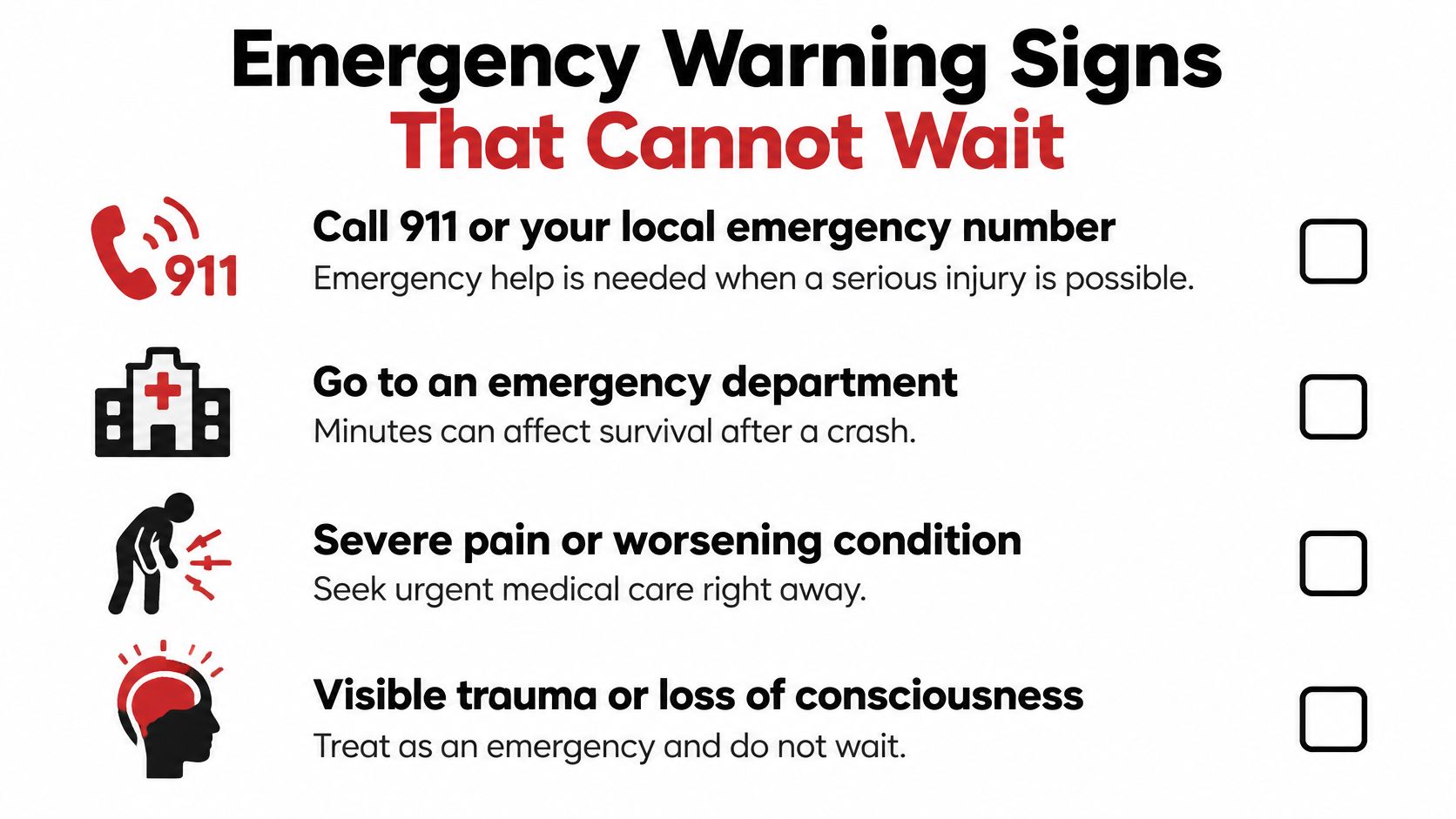
Symptoms that need emergency assessment
- Head and brain: Loss of consciousness, confusion, repeated vomiting, a severe or worsening headache, seizures, or unequal pupils can indicate a serious head injury.
- Spine and nerves: Neck or back pain after a major crash, limb weakness or numbness, loss of coordination, or inability to walk can indicate spinal or nerve injury.
- Breathing and bleeding: Difficulty breathing, chest or abdominal pain, uncontrolled bleeding, or blood in urine, stool, or vomit needs immediate evaluation.
- Bones and visible trauma: A deformed limb, suspected fracture, or substantial visible injury may require emergency stabilization and imaging.
Don't drive yourself if significant spinal injury is possible. Call emergency services and follow the dispatcher's instructions rather than testing whether you can walk or move normally.
What an emergency physician can assess
Emergency teams can rapidly evaluate breathing problems, internal bleeding, brain injury, spinal damage, and fractures. They can monitor changes, select appropriate tests, begin treatment, and arrange transfer to a trauma center when severe injuries require it.
An outpatient clinic may be equipped to examine a stable strain or minor wound. It may not have the staff, monitoring, imaging, or surgical support required for a rapidly deteriorating patient. That difference matters more than whether a clinic advertises accident treatment.
Practical rule: If you're unsure whether a post-crash symptom is serious, describe it to an emergency dispatcher or triage clinician rather than deciding on your own that it can wait.
Tell them about the collision itself, including a rollover, ejection, or major impact, and mention every symptom. Don't focus only on the injury that hurts most. Our guide to hidden injuries after an accident can help you understand why an injury may not be obvious, but reading about symptoms must never postpone emergency care.
Neck and Back Pain After a Crash
Say a driver is rear-ended at a stoplight. She walks away, wakes with a stiff neck, and books a chiropractor because she assumes walking means her spine is fine. If the impact was substantial or she has neurological symptoms, that order of care is risky.
Being able to move doesn't rule out a spinal fracture. Pain, shock, intoxication, or another injury can also make neurological changes harder to recognize.
NICE guidance on spinal injury assessment and initial management supports spinal protection and structured trauma assessment when findings suggest spinal injury. Emergency clinicians assess sensation, strength, and other neurological signs, repeat examinations when needed, and select imaging, including CT when indicated.
Emergency screening comes before manipulation
High-speed collisions, rollovers, and ejection raise concern even when someone initially appears alert. Spinal-cord compromise can worsen with movement, so a suspected serious spinal injury isn't something to stretch, manipulate, or exercise away.
Call emergency services for neck or back pain after a major crash, particularly with weakness, numbness, coordination problems, or difficulty walking. Don't self-transport when significant spinal injury is possible.
Follow-up after dangerous injury is excluded
The outpatient pathway should follow your findings rather than a fixed sequence everyone must complete:
- Start with primary care. Ask for a working diagnosis, activity restrictions, and a written referral plan. Bring your emergency discharge instructions and imaging reports if available.
- Use prescribed rehabilitation. For a diagnosed strain or sprain, the plan may include physical therapy or clinician-directed home exercises. Ask which movements are appropriate and which symptoms mean you should stop.
- Escalate persistent spinal pain. An orthopedist or spine specialist may be appropriate when pain continues, worsens, or suggests a structural problem.
- Consider function-focused care. A physiatrist, a physician specializing in physical medicine and rehabilitation, can coordinate recovery when pain limits mobility, work, or daily activities.
- Reassess neurological changes promptly. New numbness, tingling, or weakness isn't a reason to book a distant neurology appointment. Seek urgent reassessment, with emergency evaluation for acute or worsening deficits.
Chiropractic treatment shouldn't be the first assessment for a possible traumatic spinal injury. If you're considering it for soft-tissue pain, discuss suitability with your treating physician after fracture and nerve injury have been excluded.
Our guide to back pain after a car accident addresses the practical issues that can accompany ongoing symptoms. At your next visit, ask which spinal problems were ruled out, what remains uncertain, and when you should be rechecked. Request that information in your visit summary.
Head Impacts and Delayed Brain Symptoms
You may feel reasonably normal on the crash day, then notice a headache, mental fog, or irritability afterward. That change can be unsettling, especially if your first examination was reassuring. Delayed symptoms aren't automatically minor, and an earlier assessment doesn't make later deterioration safe to ignore.
The emotional strain of a crash can also make it harder to decide what to do next.

The CDC's guidance on traumatic brain injury signs and symptoms distinguishes symptoms needing medical attention from danger signs requiring emergency care. A person can deteriorate after initially seeming well, including when bleeding inside the skull increases pressure on brain tissue.
Follow the symptom-based pathway
- Use emergency care for any danger sign. Don't wait for an outpatient referral or a scheduled follow-up if a concerning change appears.
- Arrange prompt primary-care assessment for persistent, uncomplicated symptoms. Headache, dizziness, memory difficulty, nausea, visual symptoms, neck pain, or unusual fatigue deserve clinical attention after a crash.
- Ask about targeted referral when recovery isn't progressing. Neurology, concussion medicine, or rehabilitation may be appropriate when symptoms persist or interfere with daily function.
Your primary-care clinician can assess symptoms, review your earlier care, and coordinate referrals. A neurologist or concussion clinician can provide a more focused neurological assessment and decide whether additional testing or rehabilitation is appropriate. Imaging and cognitive testing aren't automatic for every patient.
Don't return to driving or hazardous work until you've been medically assessed. Ask for specific instructions about work duties and activities rather than assuming that feeling somewhat better means you're ready.
This video offers additional context while you prepare questions for your clinician.
Record changes in a usable way
Keep a symptom diary with date, time, severity, triggers, and functional effects. For example, record that reading brought on a headache or that you couldn't follow a familiar work task. That's more informative than writing only that you felt bad.
Record how the collision happened, when symptoms began, how they changed, and where you were evaluated. Our guide to concussion after a car accident provides related guidance for this follow-up period.
A useful follow-up plan names the working diagnosis, explains the next referral, and tells you when to return sooner.
Before leaving, make sure you have written instructions and a scheduled recheck or clear directions for arranging one.
Specialists Compared by Role and Referral Need
A specialist's value comes from the problem they're equipped to assess, not from how specialized their title sounds. A collision can affect the brain, spine, bones, muscles, and emotional health together, so coordinated care may involve several providers.
The WHO manual on prehospital trauma care systems treats rehabilitation as part of the care pathway after emergency and hospital treatment. The first examination is a starting point, not necessarily the end of care.
Post-accident specialists compared
Referral requirements are administrative rules, not measures of medical urgency. Confirm your insurance plan's requirements before booking routine care, but don't delay emergency treatment while seeking a referral.
| Provider | Typical role after an accident | Referral usually needed? | Use when |
|---|---|---|---|
| Emergency physician | Initial trauma assessment and imaging | No | Any serious or uncertain injury |
| Urgent-care clinician | X-rays, minor wounds and stable pain | Usually no | Minor, stable symptoms after emergency signs are ruled out |
| Primary-care physician | Symptom monitoring, referrals and a shared record | Often no; confirm plan rules | Stable injuries and ongoing follow-up |
| Orthopedist | Fractures, joint and ligament injuries | Often yes | Bone, joint or persistent musculoskeletal pain |
| Spine specialist | Disc, nerve and persistent spinal pain | Usually yes | Spinal pain that lasts or involves nerves |
| Neurologist | Concussion, nerve and brain symptoms | Usually yes | Persistent headache, cognitive change or nerve symptoms |
| Physiatrist | Rehabilitation, function and pain | Usually yes | Recovery of mobility, strength and daily activities |
| Physical therapist | Strength, balance and movement retraining | Check local direct-access and plan rules | Strains, sprains and return to activity |
| Chiropractor | Manual treatment of spinal and joint pain | Check plan rules | Selected soft-tissue pain after physician assessment excludes fracture or nerve injury |
| Ophthalmologist | Eye injuries and vision changes | Often yes | Blurred vision, eye pain or eye trauma |
| Dentist or oral surgeon | Teeth, jaw and facial injuries | Direct dental access or specialist referral | Dental, jaw or facial trauma |
| Ear, nose and throat (ENT) specialist | Ear, nose and throat injuries | Often yes | Ear or nose trauma, hearing change or balance problems |
Choose someone who can coordinate recovery
An orthopedist focuses on musculoskeletal injury. A neurologist evaluates brain and nerve symptoms. A physiatrist emphasizes how you move and function, while a physical therapist carries out movement-based rehabilitation.
Occupational therapy, pain management, and psychological care may also belong in your plan. The WHO rehabilitation fact sheet emphasizes rehabilitation across levels of care, including primary care, rather than as an isolated service.
Ask these questions at your first specialist visit:
- Care ownership: Who coordinates the plan and receives reports from other providers?
- Reassessment: When will you review progress or change treatment?
- Functional goals: Are we measuring walking ability, sleep, concentration, or return to work?
- Access: How can we address transport, language, disability access, insurance, or out-of-pocket costs?
The best fit may be the clinician who can organize a workable continuing care plan, not merely the most specialized doctor available.
Records and Timing That Protect Your Claim
Treatment gaps and vague descriptions can make the history of an injury harder to understand. An insurer may question whether symptoms relate to the crash, while your next clinician needs an accurate account of what changed and when. Good records support continuity of care and help explain your claim, but they don't guarantee an insurance outcome.
Use the timeline below as an organizational aid, not a universal medical schedule or legal deadline. Your symptoms and discharge instructions determine when you need care.
Documentation timeline after a crash
| When | Medical step | Record to keep |
|---|---|---|
| Day of crash | Emergency evaluation for red flags; appropriate assessment for other injuries | Accident report number and safely obtained photos |
| Promptly after initial assessment | Arrange primary-care follow-up as advised; report symptoms that emerge | Dated symptom notes and the first medical record |
| As referrals and tests are ordered | Schedule them according to clinical urgency | Appointment dates, instructions and receipts |
| During ongoing recovery | Continue prescribed care and report new or worsening symptoms | Symptom diary, work notes and missed-work log |
| After recovery or a plateau | Ask whether further care or reevaluation is needed | Updated records and a summary of ongoing limits |
Keep the record-keeping process simple enough to maintain while you're recovering.
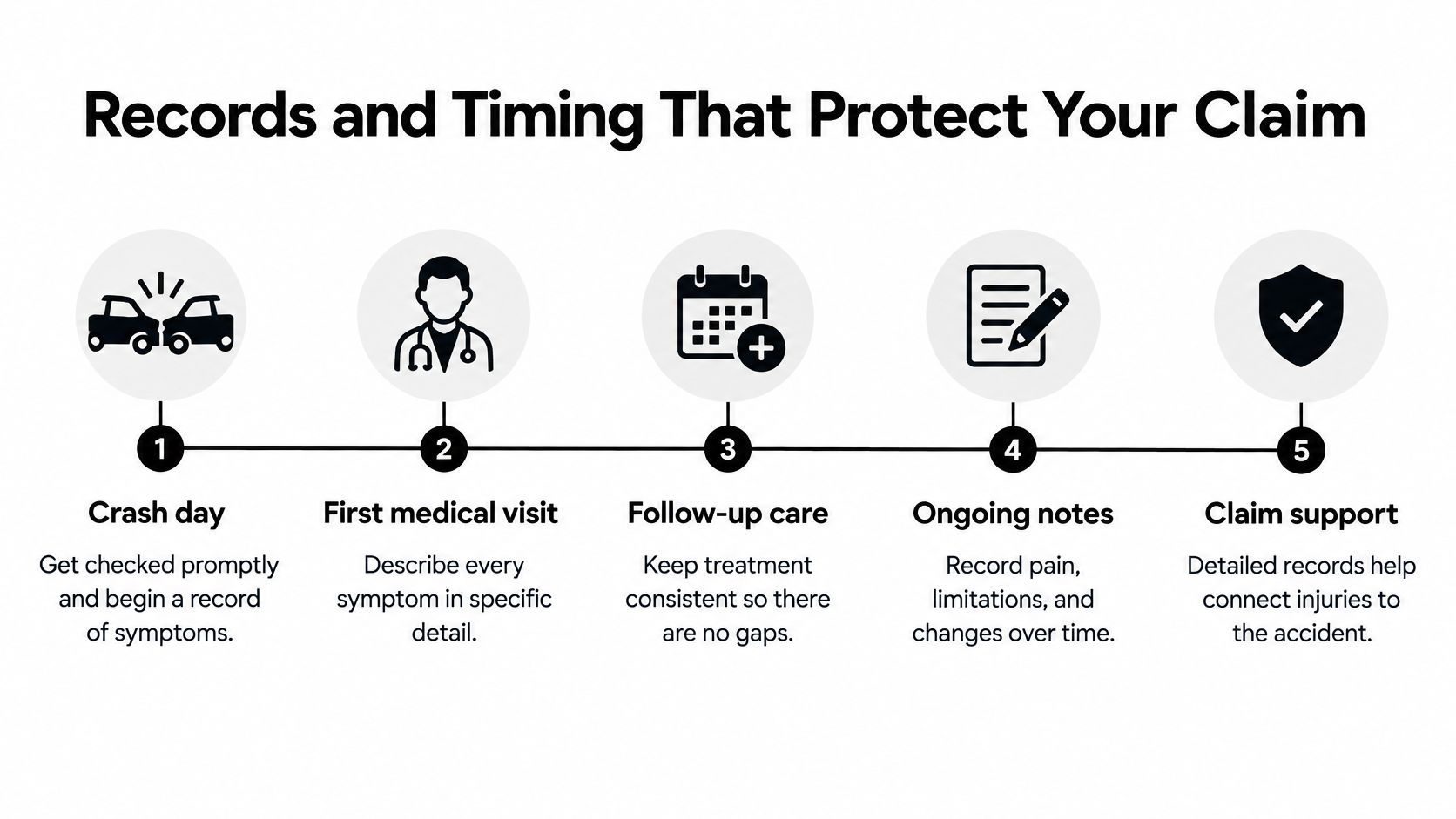
Keep accurate notes, not stronger-sounding notes
Our record-keeping guidance is to retain the injury report, medical records, work notes, insurer letters, out-of-pocket costs, a dated timeline, and photographs of the scene or injuries. Describe symptoms accurately, follow the restrictions you're given, and document what you were told, by whom, and when.
Don't minimize symptoms, but don't exaggerate them either. Tell the clinician that turning left causes neck pain if that's what happens, rather than saying you're fine out of habit. Distinguish a new symptom from a preexisting problem that became worse.
Record the reason for a gap. A missed appointment doesn't explain whether you improved, couldn't get transport, or couldn't leave work.
For example, a passenger might start physical therapy, then miss appointments because of work. Without a note, someone reviewing the file won't know why treatment stopped. Tell the treating office about the barrier and ask how to continue care safely.
Store everything in one folder, whether digital or paper. Update your timeline after each appointment with the provider's name, instructions, medication changes, restrictions, and next step. Don't seek unnecessary treatment just to create a record, and don't delay necessary treatment while organizing documents.
Confirm Your Next Step and When to Call a Lawyer
Arrange the first or follow-up appointment that matches your symptoms, and keep your documentation folder current. You don't need to settle the insurance questions before getting appropriate care. A lawyer can help with a claim dispute, but medical professionals need to make diagnosis and treatment decisions.
Legal advice becomes more useful when the consequences are serious or the claim stops being straightforward. A consultation can help you understand what information is missing and what decisions deserve closer review.
Situations that justify a consultation
- Serious injury or hospital admission: You may need help evaluating ongoing medical needs, work limitations, and an insurer's proposal.
- Disputed injury: The insurer questions whether you were injured or whether the crash caused the condition.
- An unclear settlement: You've received an offer but can't tell what it covers or what rights you'd give up.
- Bills or lost-income disagreements: You're facing unresolved questions about medical expenses or time away from work.
- Another responsible party: Someone beyond the immediately involved driver may have contributed to what happened.
- Treatment obstacles: An insurer refuses authorization where authorization is required, or coverage disputes interfere with your care.
A consultation doesn't mean you must hire a lawyer. It can be a way to understand your options before accepting an offer or responding to a disputed claim.
When you may not need a lawyer yet
A minor injury that resolves fully, an accepted claim, and treatment approved without argument may not require immediate legal representation. Keep your records anyway, particularly until you understand the bills and whether symptoms have resolved.
Our free Accident Claim Value Assessment reviews facts that can affect how an accident claim is handled and provides immediate guidance, with no contact details required. Choose the accident category when you start so the information matches your situation.
Treat that guidance as a starting point, not a medical assessment or a promise about compensation. If you're unsure what an insurer's letter means, keep the letter and note the specific question you want answered.
The decision path is practical: get the right medical care, gather your records, use the free assessment, and decide whether a personal injury lawyer could help with the remaining uncertainty. If you have emergency symptoms, medical care comes before every other step.
AskLegally offers straightforward accident guidance and a free Accident Claim Value Assessment to help you understand the claim questions that can follow medical treatment. Once your immediate care is arranged, visit AskLegally to review your situation and decide whether to speak with a personal injury lawyer.