
The car behind you braked late. You felt the jolt, heard the crunch, and now you're standing on the shoulder of a Texas road with a scuffed bumper, a phone that won't stop buzzing, and a neck that's starting to stiffen. The other driver is polite. He says it's minor, suggests you exchange info and get out of the heat. Maybe you do. It's a common reaction in the moment.
That calm, reasonable decision is where a small crash turns into a paperwork problem three weeks later, when the body shop's estimate lands well above the number you assumed, or when the tingling in your left hand is something a doctor wants to image. Texas rules don't care that the crash looked minor at the roadside. They key off injury, death and a damage threshold most drivers never think about.
What follows is the sequence that holds up when a claim gets contested: what to do in the first half hour, what to file if no officer shows up, how to build a medical record that survives an adjuster's scrutiny, and where the deadlines fall.
The First 30 Minutes at the Scene
The worst-handled crash scenes in Texas share a look: a drivable car, two calm drivers, nobody bleeding. Nothing feels urgent, and that calm is exactly when the details a claim depends on start slipping away.
Work the scene in this order. Skipping a step is easy on the shoulder and expensive three weeks later.
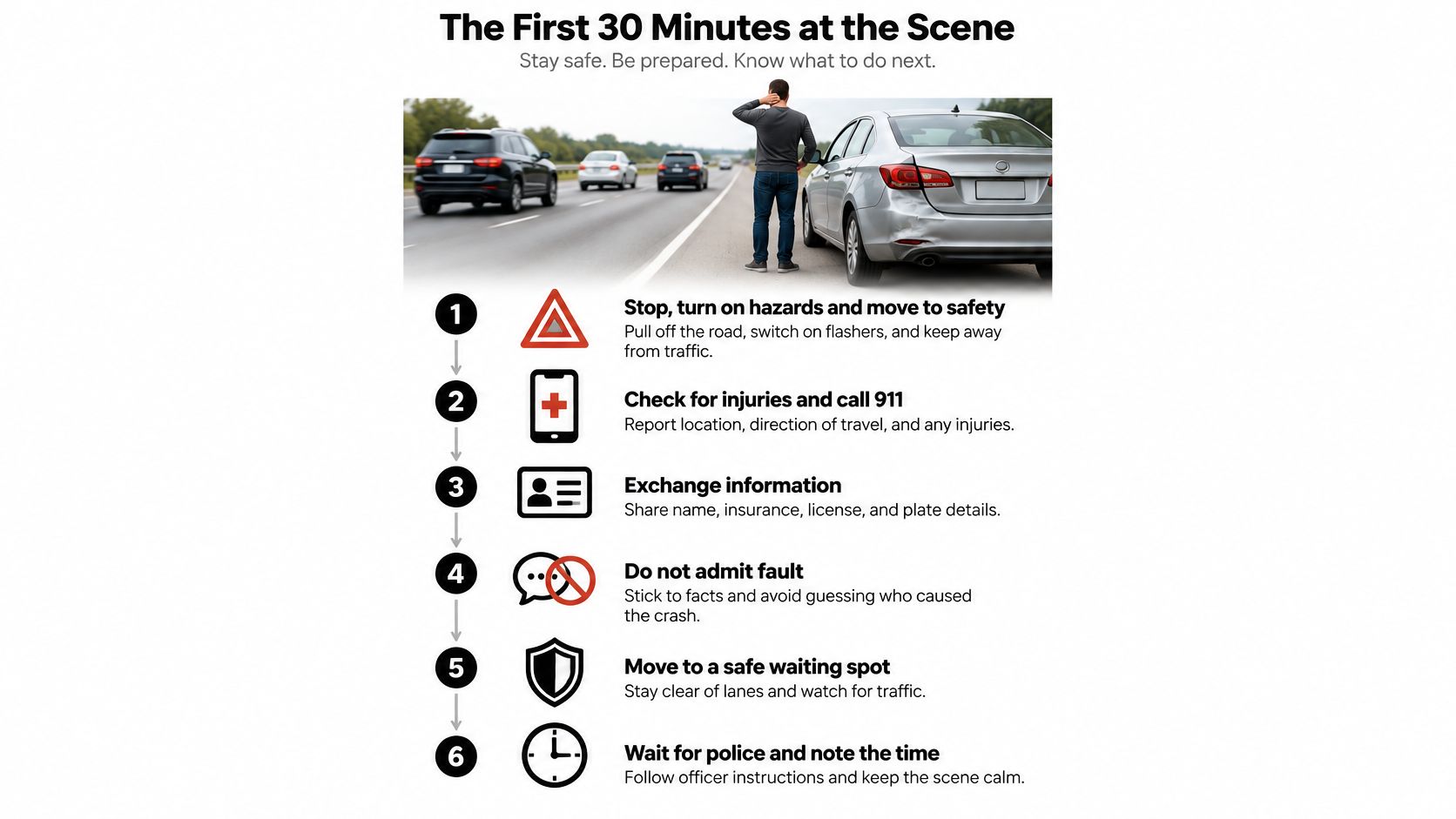
- Stop and get clear of the lanes. Pull as far onto the shoulder as the car will roll, switch on the hazards, and stand behind a barrier if there is one. A stopped vehicle in a live lane is how a dented bumper becomes a hospital stay.
- Check people before sheet metal. Ask every driver and passenger whether they are hurt, and call 911 the moment someone says yes, a car is blocking traffic, or the scene feels unsafe. Adrenaline masks plenty in ten minutes, so treat "I think I'm fine" as a first impression rather than a diagnosis.
- Move the cars only when it's safe and nobody is hurt. Clearing a minor collision out of travel lanes protects everyone, because the second impact is usually worse than the first. If a wheel is jammed or someone is injured, leave the vehicle where it sits and wait for the officer or the tow.
- Exchange the whole set of details. Full legal names, phone numbers, driver license numbers, plate numbers, insurance company names and policy numbers, plus the registered owner's name if the driver doesn't own the car. A first name and a phone number that turns out to be disconnected is the most common dead end in this process.
- Photograph before anything moves. Four corners of each vehicle, close-ups of the damage, the plates, the cars' positions relative to lane lines, skid marks, signs and signals. Take one wide shot that shows the whole intersection, then a slow video walk-around with your own commentary.
- Collect witnesses while they're still stopped. Names, numbers, and one sentence about what they saw. People leave fast, and a neutral witness who noticed the light color often splits a paid claim from a denied one.
- Report what you saw, and only that. Tell the officer what you were doing and what you saw. Skip speed estimates, skip fault theories, and skip apologies for a crash nobody has reconstructed yet. "I'm not sure how fast either of us was going" is a complete answer.
Why the $1,000 damage line decides more than it should
Texas ties official reporting to a damage figure. Under Texas Transportation Code §550.062, an investigating officer must file a written crash report with the Texas Department of Transportation within 10 days when a crash involves injury, death, or at least $1,000 in apparent property damage. That threshold was written for an era of bolt-on bumpers. A rear hit on a modern sedan can bury radar and parking sensors behind a cover that looks untouched, and the estimate climbs once recalibration appears on the invoice. The test is apparent damage at the roadside, so a crash that looks under the line at noon can cross it in the body shop.
The injury side is just as deceptive. Texas recorded 18,218 suspected serious injuries and 103,434 suspected minor injuries in 2024, according to TxDOT's crash reports and records data. Plenty of drivable cars carried hurt people away from the scene. The headache or back soreness that shows up the next morning still belongs in your medical record, so get checked even when the car looks fine.
Save this to your phone: stop, get clear, check everyone, call 911 if anyone is hurt. Then document everything before the cars move.
When and How to File the Texas Crash Report
The version of this that goes wrong most often doesn't involve a highway or an ambulance. It's a parking lot tap, two drivers who agree to handle it themselves, and no officer on scene because nobody was bleeding and both cars drove away.
That's the gap most post-crash checklists skip. When an officer investigates, the officer carries the paperwork. When nobody investigates, the duty moves onto the driver. Texas law requires the operator to submit a written crash report to TxDOT within 10 days when the crash was not investigated by law enforcement and involved bodily injury, death, or apparent property damage of at least $1,000, per the Texas Transportation Code provision on written crash reports. That's the SR-1, and it's a separate obligation from stopping at the scene and swapping insurance cards.
"We exchanged information and left" is not the end of the process. It's the point where you become the only person responsible for creating a record.
| Situation | Who files | Deadline | Getting a copy |
|---|---|---|---|
| Officer investigates, injury, death, or apparent damage of $1,000 or more | Investigating officer | 10 days after the crash | Involved party or person with proper interest requests it |
| No officer investigates, injury, death, or apparent damage of $1,000 or more | Driver files the SR-1 | 10 days after the crash | Request through TxDOT crash records |
| Driver physically unable to file | Confirm with TxDOT who may file on the driver's behalf | 10 days after the crash | Request through TxDOT crash records |
What the SR-1 actually asks for
The form wants the date, time and location, every driver's name, address, license number and insurance details, the damage to each vehicle, who was injured, and a short sketch or description of how the crash happened. Fill it out from your notes and photos, not from memory three nights later.
File it even if the other driver swears he'll "take care of it" without involving anyone. A crash report records facts. It does not assign fault, and filing one doesn't hand the other side a victory.
DPS, TxDOT and the report that isn't where you think it is
A week of phone calls usually starts with the wrong agency. DPS handles driver licensing. Crash reports live with TxDOT. If your report exists, a person directly involved or with a proper interest can request it under §550.065, subject to the required form and fee. If you'd rather not guess at agencies, you can start a traffic collision report request online and work from the crash date and county.
Three questions answer most of the confusion today: was an officer there, was anyone hurt, and could the damage reach $1,000 once the bumper comes off?
Documenting the Scene and Your Medical Care
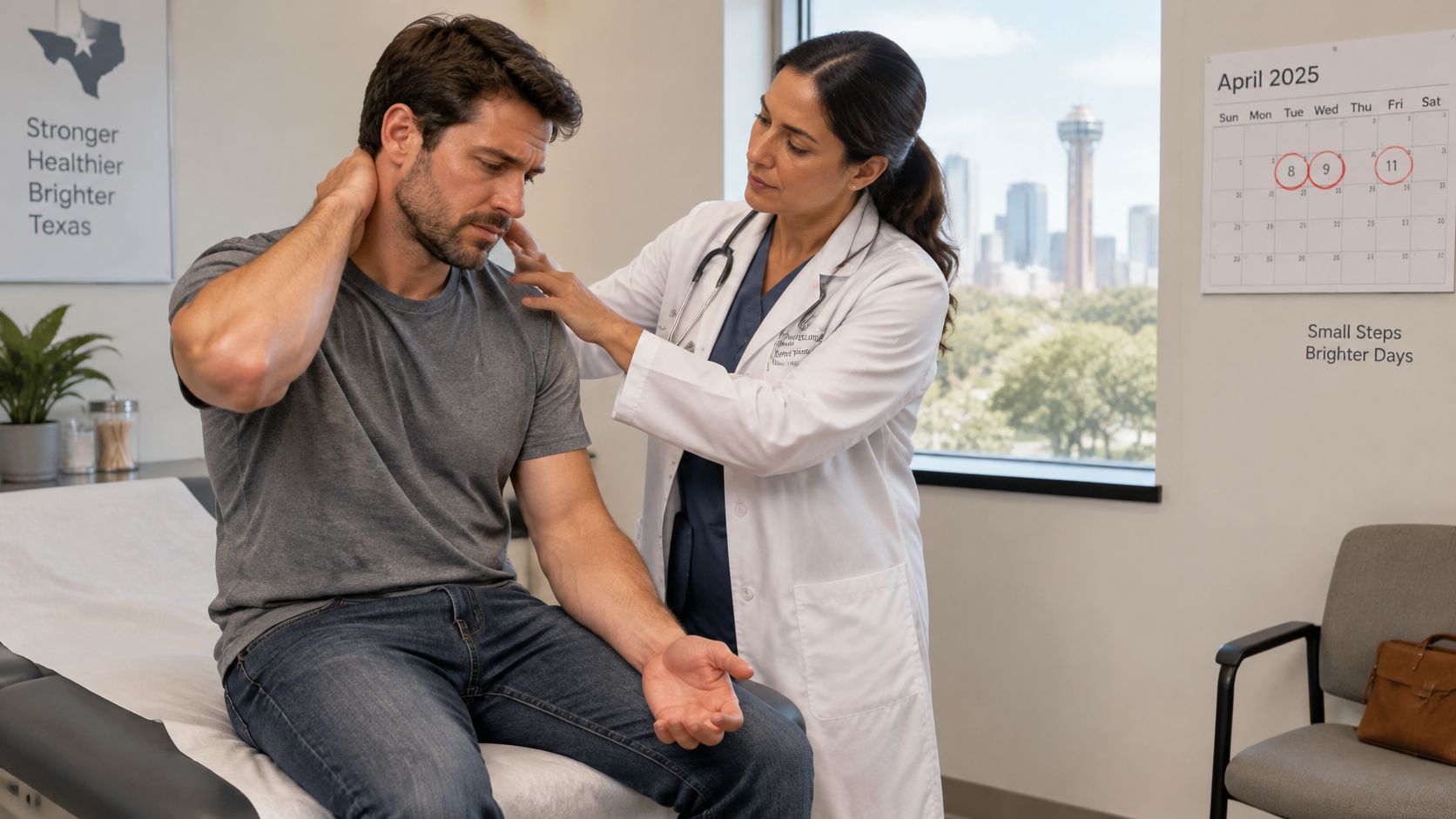
Delayed symptoms are where a minor-looking crash turns into a disputed claim. Someone walks away from a rear-end hit on Tuesday feeling fine, sleeps badly, wakes Wednesday with a stiff neck, and by Friday has numbness running into one hand. By then the other driver's insurer has already taken a recorded statement and noted that no injury was reported at the scene.
A same-week medical visit closes that gap. It catches what adrenaline masked, and it creates a record that ties the symptoms to the crash date rather than leaving an adjuster free to argue something else caused them.
What to tell the provider
Be specific and boring. Where you were hit, which direction your body moved, what you felt in the first hour, and every symptom since: dizziness, headaches, ringing ears, tingling, trouble sleeping. Say plainly that the symptoms started after the crash.
That last sentence matters more than people expect. Treatment records are what connect an injury to the crash itself, and they document expenses, work limits and recovery over time. A record made days after the crash is far harder to argue against than one made months later, once the adjuster is already hunting for another explanation.
The evidence folder to build this week
One folder, paper or digital, with a dated index on top. Everything goes in it, unsorted thoughts included.
- Photos taken days later, not just at the scene. Bruises, swelling, a wrist brace, the ice pack on the couch.
- A written timeline of the crash, the calls, the appointments and who said what.
- Every medical bill, receipt and discharge paper, plus mileage to appointments.
- A work log of hours missed, with pay stubs to back it up.
- Repair estimates, tow receipts and rental car charges, all originals.
- Every letter and email from any insurer, opened, dated and kept.
A rule of thumb that works: write a two-line symptom note each evening for the first two weeks. Memory blurs, and adjusters ask for specifics months later.
The habit that protects the claim is accuracy, not drama. Describe a bad night clearly and skip the language that exaggerates it. An adjuster who catches one inflated detail will discount everything else in the file.
You already have the scene photos and witness details from the roadside. What you're building now is the part nobody can reconstruct for you later.
Handling Insurers Without Hurting Your Claim
The call comes about two days after the crash, usually before you've seen a doctor. A friendly adjuster for the other driver wants a recorded statement, then a signature on a medical authorization. The instinct is to be helpful and answer everything quickly so the claim moves along.
That instinct costs people money. You are not obligated to give the other driver's insurer a recorded statement, and a broad medical authorization can release your entire history rather than the records tied to this crash.
Say this, hold that
- Say your name, the crash date and location, the facts you personally saw, and who insures your vehicle.
- Avoid guessing speed or distance, and avoid "I'm fine" as a phrase. You don't know that yet.
- Hold the medical authorization until a provider or lawyer can scope it to this crash.
- Hold any early offer until treatment ends and you know what future care looks like.
The wrinkle most guides skip is that you may be dealing with two different claims at once. The other driver's liability policy answers for his fault. Your own policy may carry uninsured or underinsured motorist coverage, which Texas Department of Insurance materials describe as coverage that can pay medical bills and vehicle repairs when the other driver has no insurance or insufficient limits, and which can also apply in a hit-and-run, as the Texas Department of Insurance consumer guide sets out. Those are separate claims with separate proof requirements, so preserve evidence of the other driver's fault and his coverage status from day one.
An insurer's request for information doesn't pause your medical care. Treatment continues on schedule regardless of what an adjuster asked for.
| Insurer step | Texas timing | What to do if it slips |
|---|---|---|
| Acknowledge notice of claim | Within 15 days | Ask in writing for confirmation and the claim number |
| Decide the claim | Within 15 business days after receiving necessary information | Ask for the missing items list and any written extension |
| Pay after agreeing to pay | Within 5 business days | Request the payment date in writing and keep the agreement |
Those are insurer deadlines under Texas claim-handling rules, not guaranteed payment dates. Extensions and written explanations are allowed, which is why every delay should be answered in writing rather than over the phone.
There's also a quieter loss to watch. A repair can be complete and paid in full while the crash history still sits on the vehicle, which is where a claim for car value loss after accident repairs comes in. If you're planning to push back on a low number, this guide to how to negotiate with an insurance adjuster covers the order of the conversation.
Assemble the paper trail before you argue: your declarations page, any denial letter, your notes from the recorded call, medical bills and wage-loss proof. Hit-and-run cases need one more item, evidence that the other vehicle and driver couldn't be identified.
Texas Deadlines and Fault Rules You Cannot Miss
Two clocks run at the same time after a Texas crash, and drivers mix them up constantly. The insurer's claim-handling timeline is one clock. The courthouse is the other, and it does not pause while an adjuster reviews the file. That gap matters most in the crash that looked minor at the roadside: a sore neck that becomes a diagnosis in month three sits inside the same limitations period as a fracture diagnosed on day one.
| Rule | Texas time limit or threshold | Practical effect |
|---|---|---|
| Personal injury lawsuit | 2 years from the crash under Civil Practice and Remedies Code §16.003 | Missing it usually bars the claim |
| Property damage lawsuit | 2 years under the same statute | Keep repair estimates and receipts within the same window |
| Claim against a city, county or state entity | Written notice within 6 months under the Texas Tort Claims Act notice provision, and many city charters set shorter windows | Notice rules differ from insurer deadlines |
| Modified comparative fault | Recovery barred at 51% or more of the fault under Civil Practice and Remedies Code §33.001 | Damages reduce by your percentage of fault |
The government notice rule catches drivers who assume a claim against a public entity works like an insurance claim. Six months is the outside number in the state statute, but that same statute preserves city charter provisions that demand notice sooner, sometimes much sooner. If a city vehicle, a county truck or a road defect is anywhere in the picture, find that entity's own deadline early rather than treating six months as safe.
The two-year clock does not wait for a diagnosis either. It runs from the crash date in most cases, which is exactly how the low-speed collision with delayed symptoms turns into a deadline problem. By the time the injury gets taken seriously, a real share of the window is already gone.
How comparative fault shrinks a number
Texas uses modified comparative fault, and the arithmetic is unforgiving. Say a jury values the case at $100,000 and finds you 30 percent responsible. You recover $70,000. Cross to 51 percent and the recovery drops to zero.
Fault gets decided case by case, from the report, the witness statements, the photographs and what each driver said early. That is the practical reason roadside documentation matters so much. A statement made in the first ten minutes can become a permanent percentage.
Fault isn't a moral verdict. It's a number two adjusters or a jury assign after reading the file you built.
A five-minute calendar exercise
Open your calendar today and add three entries: the crash date, the second anniversary of the crash date, and, if any government vehicle or road condition could be involved, a "written notice" reminder set well inside six months to leave room for a shorter local charter deadline. Then put a reminder 60 days before each one.
If a deadline is close, or you cannot tell whether a government party exists, that is the moment to have a lawyer read the facts, before the date passes rather than after.
Deciding Whether to Call a Personal Injury Attorney
Here's the test. Call an attorney soon if any of these is true: your injuries are ongoing or may need future care, the other driver disputes fault, the other driver is uninsured or underinsured, a government vehicle or road defect played a part, an insurer offers money before treatment ends, or the injury is keeping you off work.
A lawyer is less urgent when the injuries resolve quickly, liability is clear and accepted, and no wages were lost. Plenty of straightforward claims settle without representation, and paying a share of a small, clean claim can be worse than handling it yourself.
What a consultation actually covers
Expect questions, not a sales pitch. How the crash happened, where you treated, what the insurer has said, whether a report exists, and what records you already hold. Bring the folder. The conversation moves faster when the timeline is written down.
Ask directly about the fee structure, who pays for experts, and what the attorney thinks the deadlines look like in your case.
What to do this week
- Request the official crash report. It's the independent record of vehicles, parties, injuries and road conditions.
- Run a free claim value assessment to see which facts will shape how a claim is handled.
- Request a free consultation if the criteria above fit your situation.
AskLegally offers both free tools. The Accident Claim Value Assessment gives immediate guidance and needs no contact details, while the Police Report Lookup helps you identify and request the official report and does require your contact and accident details. If you'd rather read the longer version of this decision first, this explanation of whether you need a lawyer after a car accident walks through the same trade-offs.
Everything here is general information about Texas rules. A lawyer can apply those rules to the specific facts of your crash, and the difference between a good outcome and a denied claim often comes down to how well the first week was documented.
AskLegally is built for the stretch between the crash and the decision about hiring anyone, and the free tools exist to make that stretch less confusing. Start with the Accident Claim Value Assessment, which needs no contact details and shows you which facts will shape how your claim is handled, or use the Police Report Lookup when you're ready to identify and request the official report with your contact and accident details. If the criteria above fit your situation, you can request a free consultation at AskLegally and have your answers routed to an attorney who handles Texas car accident claims.