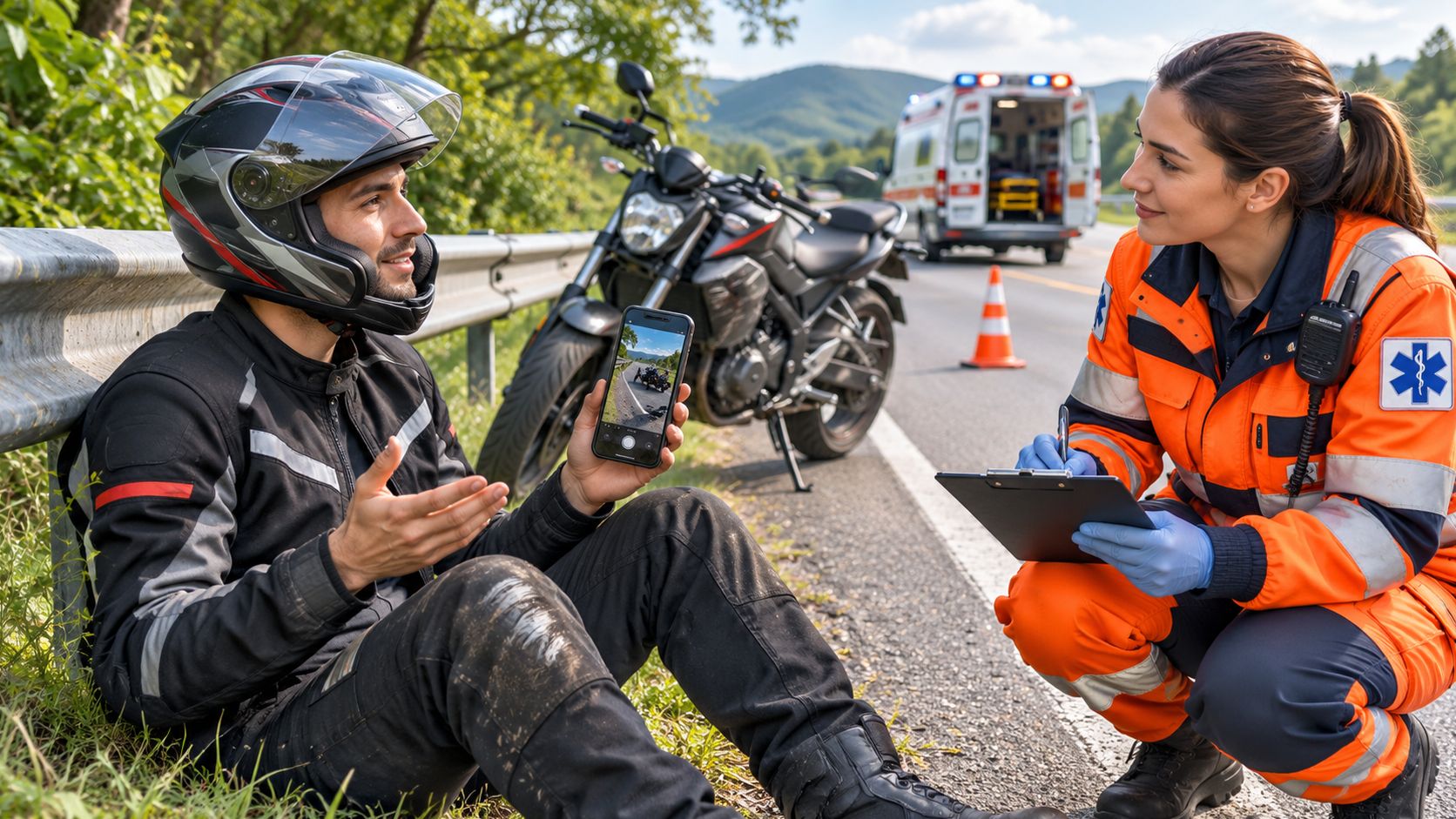
Ask anyone what to do after a motorcycle accident and you'll get the same script: stand the bike up, get it off the road, swap insurance cards, and call your carrier in the morning if anything starts to hurt. That script rests on two assumptions that fail constantly. The first is that a rider who can stand up and lift a fallen bike is uninjured. The second is that a tidy scene, a polite driver and a report number mean the record takes care of itself.
Neither holds. Trauma teams move faster than paperwork, and the effects of a head strike or a torn shoulder can surface days after you've agreed a repair estimate and gone back to work. Here is the order I'd give a friend standing on the shoulder with a scraped fairing and a ringing head: safety first, then evidence, then the medical trail that both a clinician and an adjuster will read months from now.
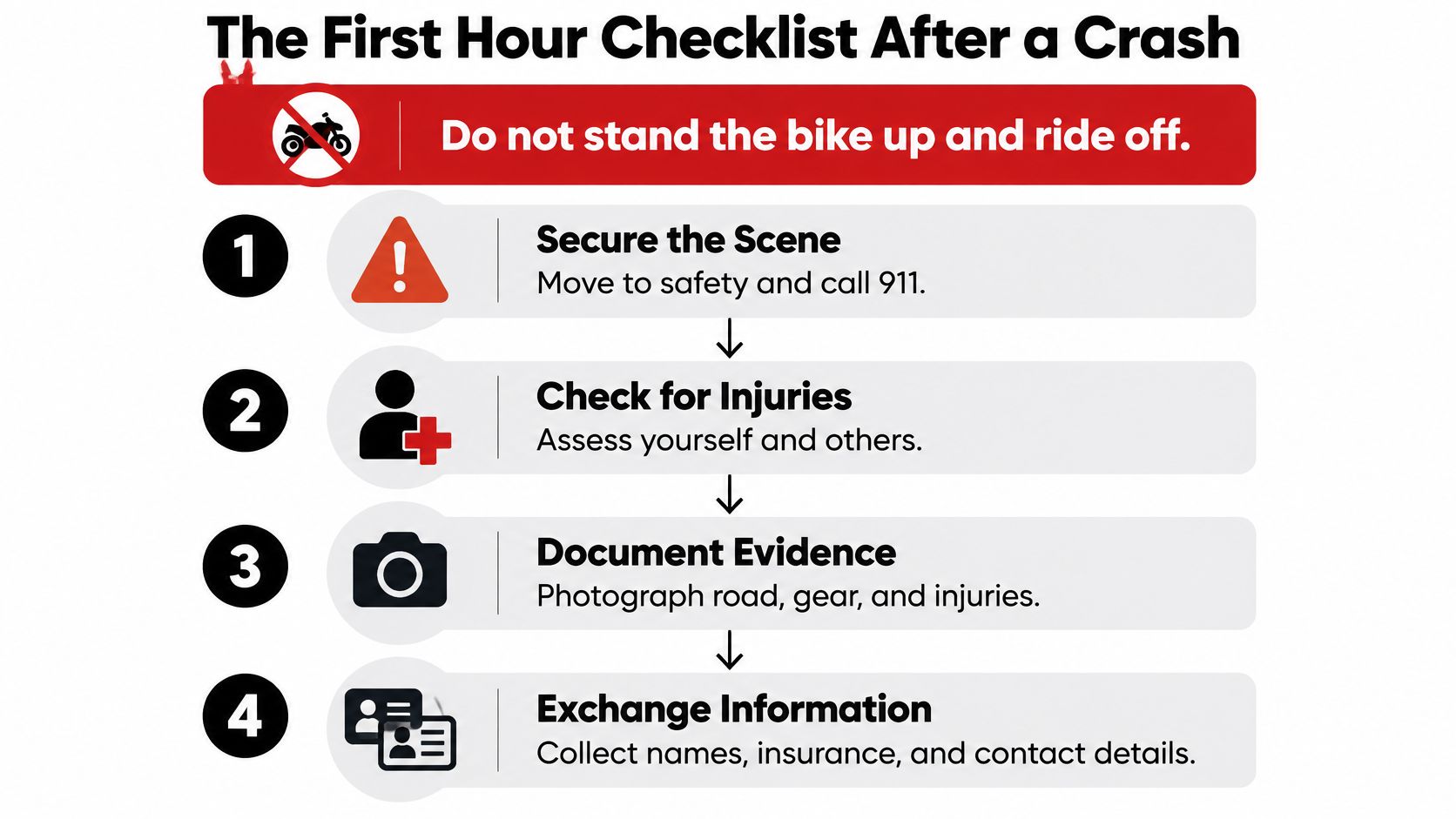
The First Hour Checklist After a Crash
You can stand up. That single fact is the most overrated piece of evidence available in the first ten minutes after a crash, and the riders who lean on it hardest are usually the ones with the most to lose. A rider with a fractured wrist, a bruised spleen or bleeding inside the skull can often walk to the barrier and lift a 200 kg machine. What that rider cannot do is feel the damage yet.
Energy is the reason. CDC field-triage guidance keeps a motorcycle crash at roughly 20 mph or above in the high-energy mechanism category, because a rider has no passenger-cell structure and absorbs the impact directly. Standing up doesn't change the physics. It only changes your opinion of what happened.
Run the first hour in this order:
- Get out of the traffic lane, and nothing more. If you can move without making your neck, back or a badly bent limb worse, get behind a barrier. If movement could worsen a spinal injury, stay still and let the people who stop keep you visible.
- Call the emergency number and ask for both police and medical response. Ask for both on the same call. The police response secures the lane and starts the official record; the medical response starts the clinical one.
- Leave the helmet on. Do not pull a helmet off an unconscious or seriously hurt rider unless trained responders have to open an airway. Cut straps only if a responder asks you to.
- Give the medics the mechanics. Estimated speed, direction of impact, whether you were thrown, helmet damage, any blackout, medicines you take, and every symptom, including the ones you're inclined to dismiss.
- Photograph the scene before it moves, if it's safe. Positions of the bike and the other vehicle, lane markings, signs, skid marks, debris, and your own damaged gear.
- Collect names without arguing fault. The officer's name, agency and incident number, the other driver's licence and insurance details, and witness phone numbers.
- Follow the ambulance and start a written timeline the same day. Times, places, names, symptoms and what you were told by whom.
The mistake that costs riders most isn't a missed photograph. It's leaving before anyone evaluates them, then learning three days later that the twinge in the neck is a fracture, with nothing written down that ties it to the crash. A blank contemporaneous record is hard to rebuild and easy to attack.
| Window | Do this | Do not |
|---|---|---|
| Right after impact | Move clear of traffic only if it won't worsen a spine or major injury; otherwise stay still | Stand the bike up or ride off to "check yourself" |
| Call for help | Call the local emergency number and request police and medical response | Remove a helmet from an unconscious or seriously injured rider |
| While waiting for EMS | Report speed, impact direction, ejection, helmet damage, loss of consciousness, medicines and symptoms | Self-transport if you're confused, in severe pain or unstable |
| Before the scene changes | Photograph road layout, controls, skids, debris, vehicle positions, plates, damage and torn gear if it's safe | Clean, repair or bin the helmet or riding gear |
| Before you leave | Get the agency, officer ID, report number, other driver's licence and insurance, and witness names and numbers | Argue fault or guess what happened |
| Same day | Follow EMS on the destination, keep the discharge papers, write a timed account while it's fresh | Treat the absence of pain as proof you're unhurt |
| Within 24 hours | Notify your own insurer with accurate facts and start a symptom and activity log | Give a recorded statement or a broad medical authorisation yet |
The helmet deserves its own line here. The NHTSA Countermeasures That Work guide credits compliant helmets with a 22% to 42% reduction in rider fatalities and 41% to 69% in brain injuries. That benchmark is also why the helmet that came off your head isn't trash: a cracked shell, a stretched strap or a gouged face shield is a physical record of where the force went, so keep it exactly as it came off.
If you want a second walkthrough of the claim side once you're home, handling motorcycle accident insurance claims from LA Law Group, APLC, covers the notice and documentation sequence in plain language.
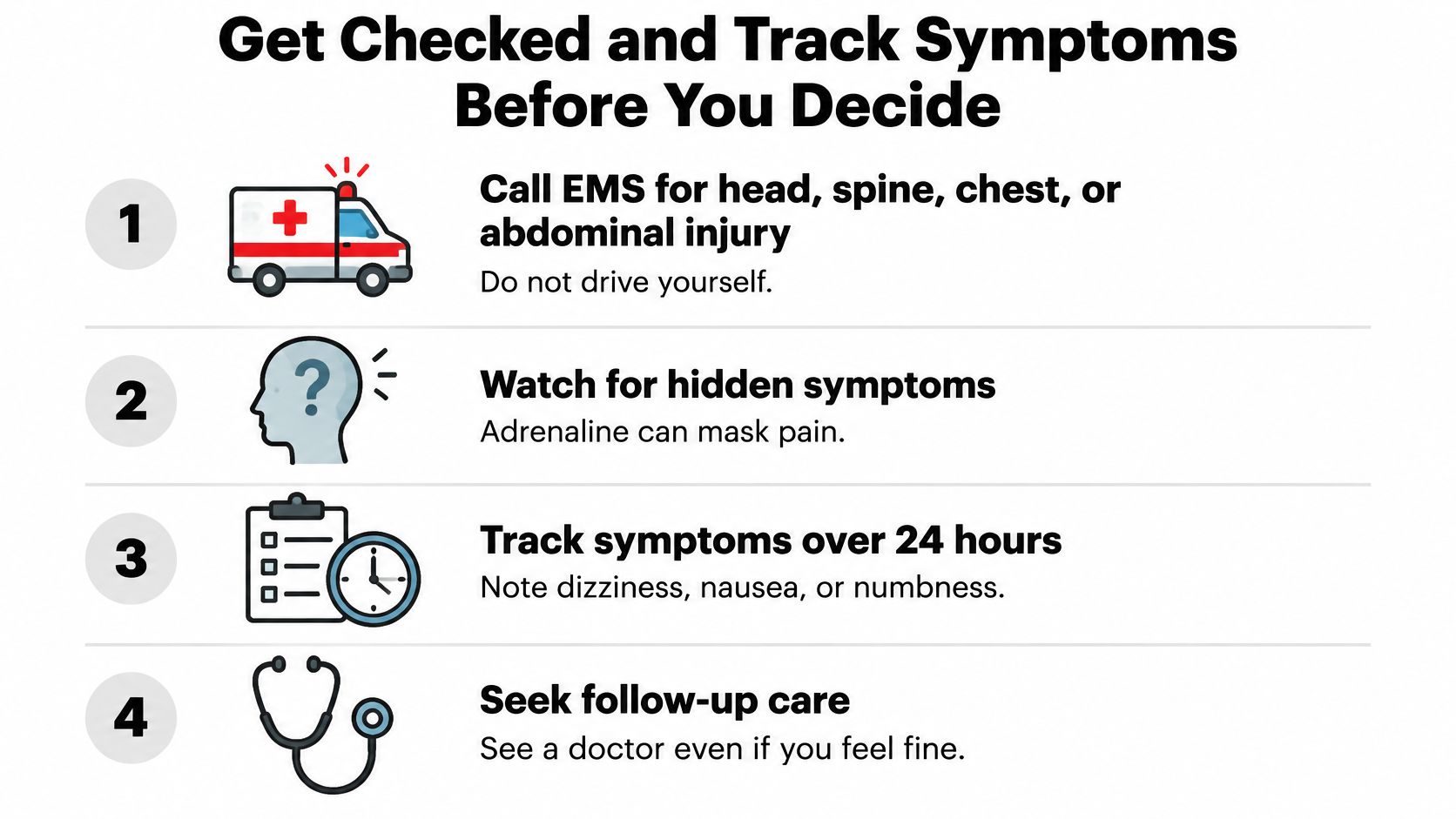
Get Checked and Track Symptoms Before You Decide
The medical decision after a crash isn't a verdict on how tough you are. It's a decision about what can safely be ruled out at the roadside, and the honest answer is almost nothing.
The exposure behind that rule is stark. In 2024, motorcyclists were nearly 27 times more likely than passenger-car occupants to die in a crash and nearly five times more likely to be injured per vehicle mile traveled, according to NHTSA's motorcycle safety data. That is what twenty years of experience is up against.
Call for transport, not a lift home
Call emergency services for a suspected head, spine, chest, abdominal or severely deformed limb injury. Call them for a rider who is confused, drowsy, vomiting, in severe pain or unable to bear weight, and for anyone who has been drinking or using anything, because judgment is the first thing impairment takes.
Never drive yourself, and don't hand the keys to a shaken friend. A rider who blacks out behind the wheel on the way to hospital turns one injury into two crashes and muddies the record of both. If you're the one who can walk, you're the one making the call, not the one driving.
Most crashes don't kill. They injure. In 2024, Great Britain recorded 340 motorcyclist deaths against 5,370 serious injuries and 10,250 slight injuries, per the UK Department for Transport motorcyclist factsheet. The serious-injury column is where most walking, talking, apparently fine riders end up, and it is populated by people who needed imaging.
The transfer decision that changes the odds
Where you're taken matters as much as how fast. A 2025 MOTOR Trial ancillary study, summarised in the 2025 National Motorcycle Safety Resource Guide, found that motorcycle-crash patients transferred from a lower-level to a higher-level trauma center more than one hour after the referral decision were four times more likely to die than patients transferred within an hour.
So ask out loud in the ambulance or at the first hospital: where am I being taken, and has anyone assessed whether I need a higher-level trauma center? Companions should ask it if you can't. Then keep every transfer and discharge document, because those pages explain why care moved and when, which matters to a clinician later and to an adjuster reading a gap in treatment.
What the receiving team needs from you
Tell the triage nurse it was a motorcycle crash and give the estimated speed. That sentence changes the pathway you're put on. Add the impact point, whether the helmet took a direct strike, any loss of consciousness, and the full medication list, including blood thinners, which change how a head injury gets handled.
Keep the helmet with you rather than in the vehicle being towed. The shell tells the receiving team where the force landed.
Log the week after discharge
Discharge is a checkpoint, not an ending. Say a rider low-sides at an intersection, gets cleared with a mild concussion and feels sharp that night. On day three the laptop screen won't come into focus and the shopping list keeps slipping. That is the moment to call the treating clinician, not the moment to wait for a follow-up appointment six weeks out.
The numbers support the caution. A 2026 emergency-department study reports that 16% to 25% of patients discharged after mild traumatic brain injury have post-concussive symptoms for up to three months, and it recommends follow-up when symptoms persist (2026 emergency-department study on post-concussive symptoms).
Keep the log simple enough that you'll fill it in. One line a day:
- Head: headache severity out of ten, dizziness, nausea.
- Thinking: concentration, memory, word-finding, screen tolerance.
- Mood and sleep: hours slept, irritability, anxiety.
- Body: pain location and score, balance, numbness or weakness.
- Function: hours worked, riding or driving avoided, medicines taken, next appointment.
Late symptoms follow a pattern that's well documented, and our guide to delayed symptoms after a car accident walks through the same sequence riders hit.
Red flags that outrank any log
A log is for tracking. Some symptoms are for calling, not writing down. A headache that keeps worsening, repeated vomiting, new confusion, weakness or numbness on one side, trouble breathing, vision changes, or pain that climbs instead of settling all go to urgent care or back to the emergency department the same day.
The rule I'd tape to the discharge sheet: the scan that was normal on the day of the crash says nothing about the week after it.
Don't ride or drive while impaired by symptoms or medication. Don't exaggerate what you feel either, and don't shrink it because nobody wrote it down at the scene. A clinician's note made the day a symptom appears is what connects later treatment to the collision.
Photos Witnesses and Gear Worth Keeping
A crash scene has a shelf life measured in minutes. The tow operator wants the lane clear, rain is already softening the scrape marks, and the driver who hit you has somewhere to be.

Shoot in this order, wide to close, so you aren't standing there deciding what matters:
- Roadway and lane markings. The approach to the impact, the lane split, any merge or turn lane.
- Controls and signs. Signals, stop and yield signs, and the speed limit sign nearest the impact.
- Light and weather. Sun angle, wet surface, fog, or a streetlight that isn't working.
- Skid and scrape marks. Yours and theirs, with something in frame for scale.
- Fluid and debris. Coolant, gravel, and the parts of your bike that travelled further than you did.
- Final positions. Where the bike stopped, where the other vehicle stopped, and the distance between them.
- Damage and plates. Close-ups of the fairing, forks and bars, plus both number plates.
- Your gear, as worn. The scuff on the jacket shoulder, the torn knee panel, the glove seam that split.
Get a witness card written before people drift away. A name, a phone number and one sentence is enough.
Witness card: name, phone, and one line on what they saw. "I was behind the white van and the silver car pulled out" is worth more in six months than any version you think you'll remember.
For the other driver, copy the licence, plate, insurer and policy number. Don't debate who drifted. Nobody's mind changes at a roadside, and the argument only adds to the record.
If you want to see how a scene gets documented under time pressure, this walkthrough is useful:
Now the gear. The helmet doesn't get cleaned, repaired, re-stickered or thrown out. In 2023, observed DOT-compliant helmet use in the United States was 73.8% (NHTSA helmet use data), so the odds are good that the shell on your head was a compliant model, which is exactly what makes its post-crash condition readable to an inspector. The same holds for a jacket with a ground-through shoulder or a boot with a crushed toe box.
Apply that logic to the bike too. Don't let a shop start repairs, don't sell it to a salvage buyer, and don't strip the aftermarket parts before it has been photographed and, if the claim warrants it, inspected. A passenger is a separate injured person: photograph their gear and injuries separately, keep their receipts separately, and don't fold their notes into the rider's. Everything goes into one folder with the time each file was created.
How to Report to Police and Insurers
Two things get confused after a crash: the official collision report and the insurance notice. The report is a public record written by an officer. The notice is a contractual obligation you owe your own carrier. You need both, and they run on different clocks.
Read the report before you trust it
Request the finished report through the agency's own process, then read it line by line: vehicle descriptions, direction of travel, citations issued, witness names, road and light conditions. Errors are common and they get copied forward. Say the report records your motorcycle as eastbound when you were westbound, or describes a pickup as a sedan. At an intersection claim, a direction error can move the point of impact, and every adjuster who reads the file afterwards inherits it.
Correct factual errors in writing through the agency's process, quoting the report number. A phone call to a records clerk doesn't change a field. Our guide to obtaining a police report sets out the request route, and the free Police Report Lookup tool identifies the right agency and report before you file.
Reporting thresholds differ by state, so confirm whether this crash had to be reported at all, even if everyone at the scene waved it off and drove home. A crash that should have been reported and wasn't leaves a gap an adjuster will notice.
Keep the first insurer call narrow
Call your own carrier promptly, because policies set notice windows and late notice is a common reason a claim gets disputed. Keep the first call to facts you know.
"I was in a motorcycle collision on [date] at [place]. The police report number is [number] if I have it. I'm getting medical care and don't yet know the full extent of the injury or the repair cost. Please send me, in writing, what you need from me."
That script timestamps your notice, commits the adjuster to a written list rather than a phone conversation, and avoids the two sentences that hurt riders most: "I'm fine" and "I'm sorry."
If the other driver's insurer calls, the answer is shorter.
"I'll confirm my name and that a crash happened. I'm not giving a recorded statement or signing medical releases today. Please email your questions."
Refuse to estimate a speed you didn't measure. Refuse to guess what the other driver was doing before you saw them. If you were a passenger, file your own notice rather than assuming the rider's call covers you, because your injury claim is separate and may sit against a different policy.
Write the claim number, the adjuster's name and the date of every call into the same folder as the photographs.
Records Adjusters and Filing Deadlines
Nobody settles an injury claim on a story. They settle on a file, and the file has to exist before the first settlement conversation, not after it. Have these in place before you discuss numbers:
- Medical records: emergency department notes, admission and discharge summaries, transfer records, imaging reports and the radiologist's read, prescriptions.
- Work evidence: work notes and restrictions, pay stubs from before the crash, hours missed, and proof of lost commission or contract work.
- Property and gear: repair estimates, the tow invoice, helmet and jacket receipts, replacement quotes.
- Daily log: symptom and activity entries, each with a date.
- Contact log: every adjuster call, the date, and what was said.
Three clocks start at the crash, and only one of them is medical. Here is the short version of what to confirm where you live.
| Clock | What to confirm locally | Why it matters |
|---|---|---|
| Emergency care and transfer papers | Destination hospital and whether a higher-level trauma center was considered | Delays and missing records weaken both treatment and later proof |
| Police report | How to request it and how to correct direction, vehicles, citations, witnesses and road conditions | Errors get repeated in insurance files |
| Your own policy notice | The notice window and whether it must be in writing | Late notice is a common reason carriers dispute a claim |
| Other driver's insurer | Claim number and what they asked you to sign or record | Early releases and broad medical authorisations can cut off the claim |
| Medical follow-up | Return visits if pain, cognition, sleep or function worsen | Delayed symptoms need a clinician's note to link them to the crash |
| Lawsuit filing deadline | The injury statute of limitations in the crash state, which is not one national number | A missed filing date can end the right to sue |
| Damaged helmet, gear and bike | Hold them until photographed or inspected | Repairing or discarding them removes evidence of impact |
Adjusters aren't villains for working the file. They're paid to close it, and three moves show up again and again.
- The fast small check. A payment that looks helpful while you're missing work, attached to a release that ends the claim.
- The broad medical authorisation. A form that reaches your entire history rather than the treatment related to this crash.
- The recorded statement. Taken before the diagnosis is stable, when your own description of your symptoms is at its vaguest.
The response is the same each time. Ask for the release in writing and read what it waives. Limit any authorisation to treatment connected to this crash, in writing. Postpone a recorded statement until your timeline and records are organised, and say so plainly rather than dodging the call.
Property damage moves faster than injury, which is why a totaled-bike offer sometimes lands while you're still in a brace. Take the bike money if the number is fair, but don't let your signature on it close the injury side.
If a form says "full and final," stop. Read every benefit it waives, including future care, and don't sign it on the phone.
Coverage When the Other Driver Pays Little
Most rider deaths happen in crashes that involve someone else. In 2024, 35% of U.S. motorcyclist deaths occurred in single-vehicle crashes and 65% in multiple-vehicle crashes, according to the IIHS motorcycle fatality statistics. That 65% is the part that matters when the other driver's policy is thin, lapsed or disputed.
Put three questions to your own carrier in writing, the same day you report the crash:
- Which coverages apply here? Uninsured motorist, underinsured motorist, medical payments, collision, and any coverage that stacks from other vehicles on the policy.
- What notice does each one require, and by when? Some require notice within days, and a medical payments claim can carry its own filing window.
- Is a medical payments claim paid regardless of fault? On many policies it is, which keeps hospital bills moving while fault is still being argued.
Read the declarations page yourself. The coverage names and limits are printed there, and a phone summary isn't the policy.
Passengers get their own route. A passenger can often claim under the rider's policy, the other driver's policy, or their own auto policy, so file your own notice and keep your injuries, wage loss and gear receipts in your own file rather than merging them with the rider's.
Don't claim a benefit you haven't verified. Ask the adjuster to name each coverage in writing, with the limit, before you rely on it. Coverage types and notice rules vary by state and by policy, so check the declarations page and the local rules first.
Decide Whether You Need a Lawyer Now
Telling every rider to hire a lawyer is as unhelpful as telling every rider to go it alone. The useful question is narrower: is someone about to ask you to sign something you can't evaluate?
Get a review now when:
- Fault is disputed. The other insurer is blaming your speed or your line through the corner.
- A release or recorded statement is being pushed, especially in the first weeks.
- Head, spine or still-evolving injuries are involved, where the final picture isn't clear yet.
- Money is stacking up. Wage loss, out-of-pocket care, a bike that's a total loss.
- Someone else shares the story. A passenger, a second vehicle, a work trip, a rideshare.
- A settlement number arrives before treatment is stable.
Waiting is reasonable when:
- Injuries are minor and confirmed, with a clear recovery expected.
- Your own coverage is paying and care is being authorised without argument.
- Nobody is asking you to sign anything.
- You've confirmed the notice deadlines and the filing deadline in the state where the crash happened.
If you're sitting between those two lists, our guide on whether you need a lawyer after a car accident applies the same test to the decisions riders face.
Comparative fault rules and filing deadlines are set by the crash state, not by any national standard, so a review sorts dates and facts. It doesn't conjure a dollar figure before a diagnosis exists.
Finish the scene folder and the symptom log, confirm the local filing deadline, and have the file read by someone before you sign anything that says the claim is finished.
The gap between a crash and a fair outcome usually comes down to organisation, not luck. AskLegally offers free tools and plain guidance for that stretch, from identifying and requesting the official police report to a free case review when you want someone to read the facts before you sign. Start at AskLegally and keep the next decision in your own hands.