
The crosswalk signal said walk. The car turned anyway. Now you're on the sidewalk with a torn jacket, a phone that survived the fall, and a driver asking whether you're all right before you've worked out the answer yourself.
Most pedestrians in that spot do the same three things: apologize, decline the ambulance, and go home. Three days later the swelling hasn't gone down, the driver's number goes to voicemail, and nobody photographed the intersection while the light was still in your favor.
That gap between what happened at the curb and what you can prove three weeks later is where pedestrian claims are won and lost. What follows is the sequence that holds up under scrutiny: safety first, then evidence, then medical follow-up, then the insurance and deadline work that decides what the claim is worth.
Why the First Hour Shapes Everything After
Consider a man in his fifties crossing a four-lane road at dusk. A sedan clips his hip, he goes down, he gets up, and he waves off the ambulance because he's already late for dinner. No photo, no plate, no insurer name. By morning his hip has stiffened, he can't remember the color of the car, and the only record of the collision is a dispatcher's note that says the pedestrian refused transport.
The event is more common than many assume. In 2024, 7,080 pedestrians were killed and more than 71,000 were injured in traffic crashes in the United States, according to the National Highway Traffic Safety Administration.
The order of priorities is simple enough to memorize. Safety and medical care first, then evidence, then insurance and legal steps. Reverse that order and you spend months trying to reconstruct what ninety seconds of photography would have captured.
Feeling able to walk away doesn't settle whether you were hurt, and the choices made in the first hour create the records everything afterward depends on. A pedestrian claim isn't built in an attorney's office. It's built by the ambulance report, the first set of photographs, the name of the witness who saw it, and the clinic note written that same night.
What the first hour is really for: producing a record that matches what happened. Everything later is an argument about that record.
The path through it runs in a fixed sequence: the scene, the evidence that vanishes first, symptoms that arrive late, the case where the driver leaves, the mistakes that cost money, and the deadlines that decide whether a claim survives at all.
Immediate Steps at the Scene and If the Driver Leaves
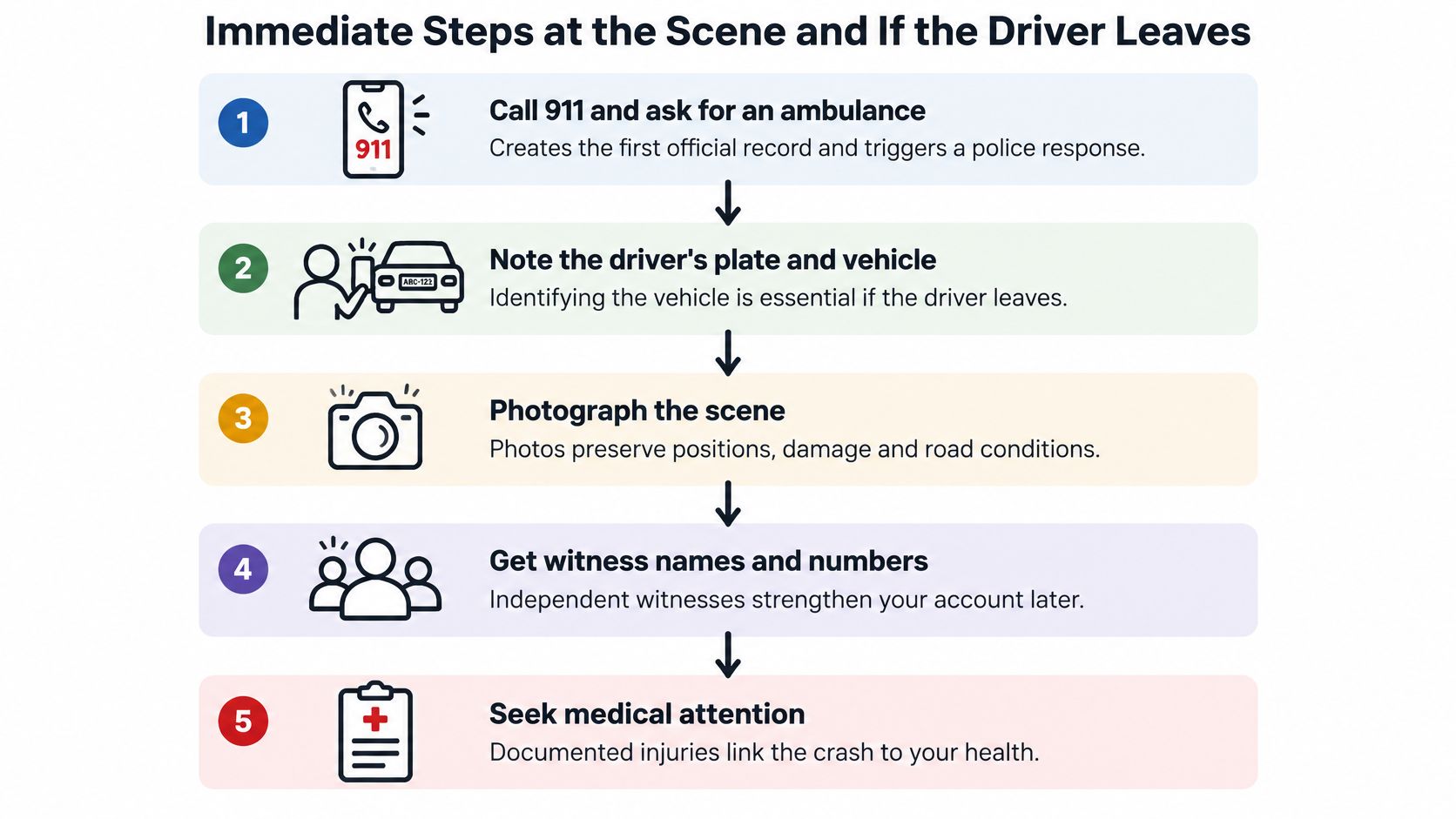
The first fifteen minutes decide what evidence exists afterward. Work through these in order, and don't skip a step because you feel fine.
- Call 911 and ask for an ambulance even if nothing hurts yet. The call creates the first official record of the collision and puts a clinician in front of you before you talk yourself out of it. A logged refusal of care is a gift to an adjuster.
- Stay put unless the lane is still live. Guidance is consistent on this: don't move an injured person unless remaining at the scene creates an immediate danger, as the NHTSA pedestrian traffic safety fact sheet sets out. If you must move, go only as far as the shoulder or curb.
- Make yourself visible. Hazards on, phone flashlight on, someone standing well up the road with a light. Darkness is the norm, not the exception: 76.5% of U.S. pedestrian fatalities with known lighting conditions in 2024 occurred after dark, regardless of artificial lighting, per the GHSA state fatality analysis.
- Check for the four injuries people misjudge. A head impact (did you hit glass, hood, or road), neck pain that takes minutes to register, bleeding hidden under dark clothing, and hip or knee pain you're attributing to the fall.
- Write down the driver's details before you discuss anything else. Name, phone, plate, make, model, color, insurer, policy number, and the direction of travel. Even a partial plate is worth keeping.
- Ask for an officer and note the agency plus the report number. Not every collision gets a police response; when one does, that number gives access to every other record.
- Collect witnesses before they scatter. A first name, a phone number, one line about what each person saw and where they were standing. Then text them so they have your number too.
If the Driver Leaves Before You Get the Plate
Nearly one in four U.S. pedestrian deaths involved a hit-and-run in 2024: 1,669 people were killed after drivers fled the scene, according to the Governors Highway Safety Association. That case needs its own protocol, and it starts in the first minute.
- Call emergency services and describe the vehicle while the image is fresh. Make, body style, color, visible damage, partial plate, direction of travel. Use the words hit-and-run, because it changes how the report is classified.
- Request a formal police report and record the agency name. Ask how the report will be numbered and how you request a copy.
- Photograph the scene and your clothing before conditions change. Scuffed shoes, torn fabric, and paint transfer on a sleeve are physical evidence, so bag the items unwashed rather than tossing them in the laundry.
- Map the cameras. Note the businesses, doorbells, traffic signals, and dashcam-equipped vehicles that could have caught the impact, and get the business names and addresses written down.
If no driver is ever identified, the claim isn't automatically dead. Depending on where you live, the options can include uninsured or underinsured motorist coverage on your own or a household policy, or a government victim-compensation program. Eligibility, notice deadlines, and dollar limits differ enormously between states and countries, so no guide can promise coverage, and I wouldn't trust one that does. Get local advice early if you were hospitalized or lost income.
The mechanics of a fleeing-driver claim, from the initial report through the coverage question, are laid out in Shea Culgin Law's pedestrian hit-and-run guide, which is worth reading before you speak with any adjuster.
Everything above serves three aims: get safe, build a clean record, and avoid statements that will be read back to you in six months. Say what you saw. Don't assign fault, don't estimate a speed you didn't observe, and don't apologize for being in the road.
Preserving Evidence Before It Disappears
The evidence that decides a pedestrian claim is usually the evidence that disappears first. Footage overwrites itself, witnesses move on, and road crews clear the scene by morning. Photograph and preserve first, then talk.
| Evidence | Why It Matters | How to Preserve It |
|---|---|---|
| Scene photos and video | Show layout, lighting, crosswalk and vehicle position | Take them before anything is moved and keep original files with metadata |
| Dashcam, doorbell and business footage | Often overwritten within days | Send a written preservation request to the owner or agency right away |
| Witness names and phone numbers | Provides an independent account | Collect them at the scene, before people leave |
| Driver's plate, vehicle make and direction | Needed if the driver leaves | Write it down immediately, even if you only saw part of the plate |
| Police crash report | Official record of the event | Request it from the agency; use a report lookup tool if you do not have the number |
| Clothing and damaged belongings | Physical proof of impact | Bag them unwashed and do not discard them |
Start wide, then close in. Photograph the crossing, the signal head, the stop line, the streetlight, the debris field, the vehicle's final resting position, and the plate, and only then take close-ups of damage, skid marks, and your own visible injuries. Keep the original files untouched and store any cropped or brightened version as a separate file with a different name.
A written preservation request saves more footage than a phone call ever will. A short dated message to the business, property owner, or transport authority stating that you were struck at that location on that date and asking them to hold camera footage from a stated time window gives them something they can act on, and gives you a paper trail if the footage later vanishes. Official crash-investigation guidance takes the same approach to the physical record, directing officers to capture driver, vehicle, registration and insurance details along with photographs of skid marks, damage and injuries, as the Metropolitan Police Department traffic crash investigation guide describes.
Police injury codes can also understate what doctors find. A North Carolina study linking crash records with emergency-department data found that 38% of 6,923 injured pedestrians had injuries classed as serious on clinical measures rather than police codes, per the UNC Highway Safety Research Center brief. That's why your own dated record of the scene and your symptoms matters alongside the official one.
Keep the originals. An edited photo is a second file with a second name. Overwriting the original throws away the metadata that proves when it was taken.
If you don't have the report number, our guide on how to obtain a police report walks through the request process, and our free Police Report Lookup tool helps you identify and request the official report, which takes the usual contact and accident details. Access rules and fees vary by agency, so request early rather than the week you need it.
Medical Follow-Up and Delayed Symptoms
Feeling fine at the scene is not a diagnosis. The Centers for Disease Control and Prevention notes that concussion symptoms may appear immediately or only hours or days after the event, which means a clean first check after a head impact, a fall, or a vehicle strike proves very little.

Sort what you're feeling by urgency rather than by how much it hurts.
| Symptom | Action | Timing |
|---|---|---|
| Worsening headache, repeated vomiting, confusion or seizure | Go to emergency care | Immediately |
| Weakness, numbness, slurred speech or unequal pupils | Call 911 | Immediately |
| Neck or back pain that grows after the first day | See a doctor and mention the collision | Within 1 to 2 days |
| Dizziness, memory problems, sleep or mood changes | Medical assessment and tell the clinician about a possible concussion | Within a few days |
| Pain in a limb with no obvious injury | Clinical exam, with imaging if advised | Within 1 to 2 days |
After that, the work is documentation. Keep a dated symptom log with the date, the nature of each symptom, and a simple severity note, so a headache on day three reads differently from the same headache on day thirty. Follow discharge instructions exactly, skip activities that make symptoms worse until you're cleared, and keep every bill, prescription, imaging report, and work note in one folder.
When you see a clinician, say the words plainly: "I was struck by a car on this date and this symptom started afterward." A note written close to the event carries far more weight than a description assembled months later, and it costs you one sentence at the front desk.
Say it out loud at every appointment. The clinician can't record a link to the collision they were never told about.
Not every symptom proves the crash caused it, and honest records are more persuasive than a perfect-sounding list. What early records do is make the connection easier to show and easier to treat. Our guide to delayed symptoms after a crash covers how to document a complaint that shows up on day four, and how to raise it with an insurer without guessing at a cause.
If you want the short version on what to watch for in the first weeks, this walkthrough covers the warning signs clearly.
Emergency symptoms mean emergency care. There's no version of this where you wait for a follow-up appointment to mention vomiting, confusion, or a headache that keeps getting worse.
Timeline, Expenses and Insurance
Once the emergency is over, the claim runs on a calendar. Knowing which stage you're in stops the paperwork from piling up unread.
| Timing | Actions | Purpose |
|---|---|---|
| Day 0 | Call 911, get evaluated, photograph the scene, collect witness names | Emergency care and first record |
| Days 1-2 | Attend medical follow-up, start a dated symptom log, send preservation requests | Symptom timing and footage |
| Days 3-7 | Keep bills, prescriptions and work notes; report the collision to your insurer | Expense and notice record |
| Weeks 2-4 | Request the police report, track lost income and mileage, review your policy | Damages and coverage check |
| Week 4 onward | Continue treatment, review deadlines, book a case review if a criterion applies | Legal decision point |
When you report the collision to your insurer, give the facts and nothing more. Date, location, what you were doing, what you've been told medically, and the claim number. If the adjuster asks for a recorded statement before your follow-up care is finished, ask to schedule it later.
The file you build in weeks two through four is what proves the economic cost of the injury: receipts, wage statements, employer messages about missed shifts, parking and mileage for appointments. A running expense file with dates and reasons beats a shoebox every time.
Read your own policy. Uninsured motorist and medical payments coverage sit in documents most people have never opened, and they matter most in exactly the case where no driver is identified.
Mistakes That Weaken a Pedestrian Claim
The first mistake people make is also the costliest: giving a recorded statement to an adjuster before they know how badly they're hurt. The insurer's early call isn't a sign the claim is settled. The adjuster works for the insurer, and a friendly tone is part of the job.
- A recorded statement given too soon. You describe your injuries as "a bit sore" on day two, and that recording is quoted back to you in month four. Fix: give facts and claim details, then ask to complete the statement after treatment.
- Signing a release without reading its scope. A medical authorization can hand over your entire history, not just the records from this collision. Fix: ask what each document covers and get the terms in writing.
- Accepting a quick settlement. The first number usually arrives before the diagnosis is final, which is precisely why it's low. Fix: don't sign anything until follow-up care is done or a clinician has told you what to expect.
- Gaps in treatment. Insurers treat a three-week silence as evidence the injury wasn't serious. Fix: keep every appointment, and if you must reschedule, note why in one line.
- Posting the crash online. Photos from a hike, a gym session, or a night out get screenshotted and used to argue you're exaggerating. Fix: stay off public posting until the claim closes, and ask family not to tag you.
- Apologizing or guessing. "I came out of nowhere" and "he must have been doing forty" are both quotable. Fix: describe what you saw and heard, and leave conclusions about fault and speed to the investigation.
- Missing the insurer's notice requirement. Late notice is one of the most common grounds for a dispute, and it's entirely avoidable. Fix: report promptly even if you're unsure about coverage.
Honest, consistent, gap-free records are the strongest protection you have, and they cost nothing but discipline. Say the facts, not the conclusions, and hold off on agreeing to anything until you know what you're agreeing to.
Check Your Deadlines Before You Decide on a Lawyer
Deadlines are the quiet failure point. Statute of limitations rules vary by state and country, and notice requirements for claims involving public roads or government entities can be far shorter than any lawsuit deadline.
| Deadline | Typical Window | What to Check |
|---|---|---|
| Personal injury lawsuit | Often 2 years, but 1 to 3 years depending on the state | Confirm the rule for your state and the date of the crash |
| Claim against a public road or government entity | Shorter than the lawsuit deadline and set by a notice statute | Notice may be required well before any lawsuit deadline |
| Insurance claim notice | Prompt, as set by the policy | Late notice can be used to dispute the claim |
| Uninsured motorist claim | Set by the policy and state law | Check your own policy as soon as possible |
| Medical records and bills | As soon as they are available | Access rules and fees vary by provider |
Then there's the decision itself. I'd get advice early in any of these situations:
- You were hospitalized or the injury is serious or lasting. Long-term care changes the math on any offer.
- Liability is disputed. A claim that blames you for stepping out needs evidence, not a phone argument.
- The claim was denied or delayed. You need someone who reads denials for a living.
- You lost income or can't tell who is responsible. Multiple vehicles, a company vehicle, or an unidentified driver all complicate it.
- You're being pushed toward a quick signature. Pressure is a reason to slow down.
Plenty of people with a minor injury, a quick recovery, and a cooperative adjuster can handle a claim themselves for a while, provided they keep the records. For a family working through a serious injury, Olson & Sons' guidance on pedestrian accident claims explains what an attorney does with the file, which is useful for judging whether you need one.
Our free Accident Claim Value Assessment reviews the facts that affect how a claim is handled and gives you immediate guidance, with no contact details required. If you submit a request, an attorney may contact you, and you decide whether to have a conversation or go further. For general background on time limits, read our explainer on how long after an accident you have to file a claim.
Start with the date. Write the collision date at the top of your file, check your state's deadline and any notice rule that applies to the road you were on, and book a case review if any of the situations above describes yours.
If you're still working out what to do after a pedestrian accident, AskLegally's free tools are built for exactly this stretch of time, from requesting the official police report to reviewing the facts that affect how a claim is handled. You can start with the report lookup, keep your medical and expense records in one place, and see whether a conversation with an attorney is worth having before any deadline gets close. Visit AskLegally to take the first step while the details are still fresh.