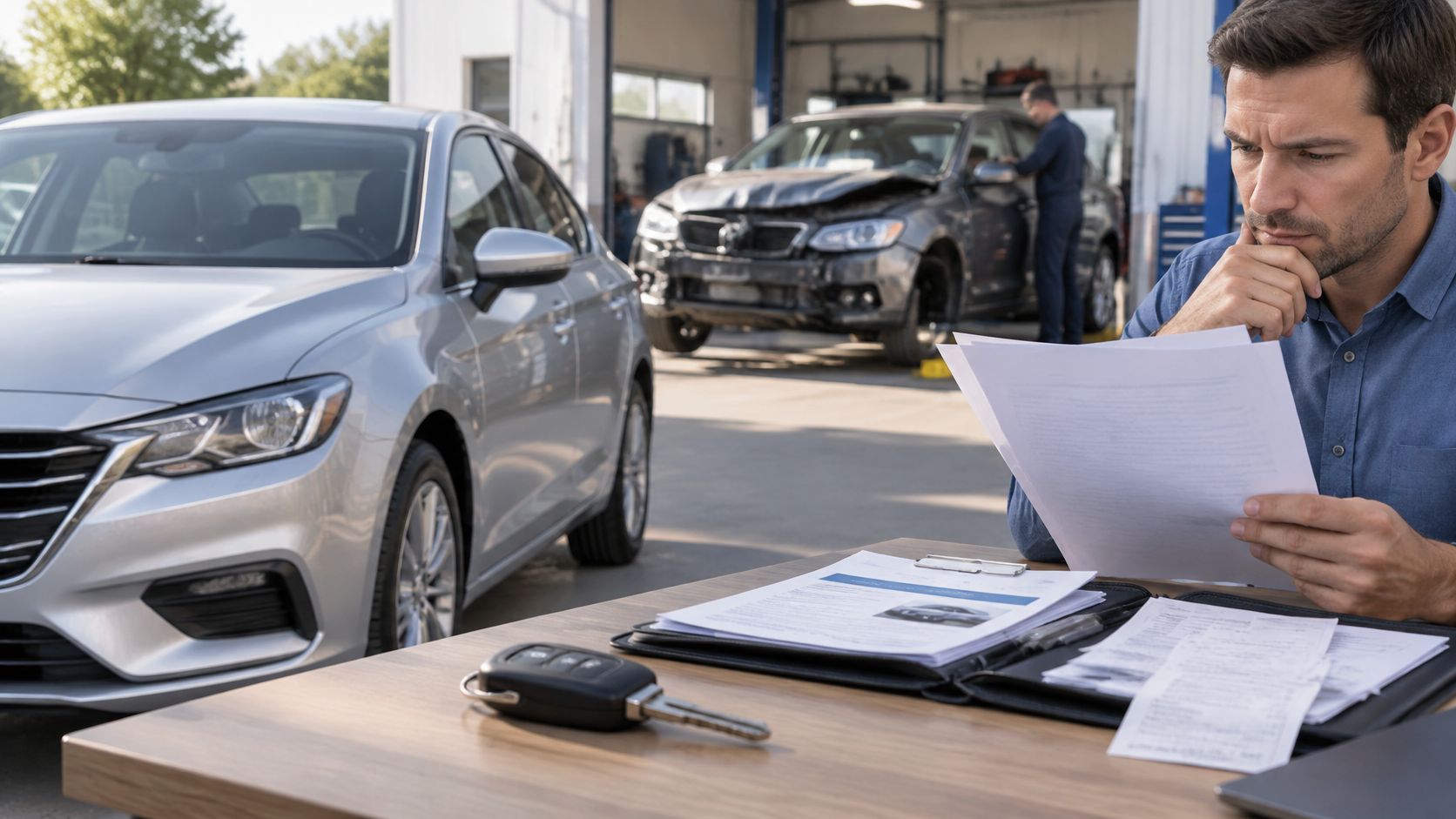
The line you hear after a crash is simple. The other driver hit you, so that driver's insurer pays for a rental until the repairs are done. That line is the most popular advice about who pays for a rental car after an accident, and it is only half true. The at-fault insurer may owe a reasonable rental later. Daily caps, a cutoff tied to a settlement offer, fees for damage to the rental itself, and the need to put a card down this week decide what you pay.
Fault still matters. So does the kind of claim. A liability claim against the other driver is not the same thing as an optional benefit on your own policy. A bill for a temporary car while yours is in the shop is not the same thing as a bill for dents you put in a car you rented. If you need a van for work gear or a vehicle with adaptive controls, the cap does not rise to match the invoice.
Read the row that matches your crash first. Then look at whose money has to move before anyone agrees who caused it.
Who Pays for the Rental in Each Scenario
In the United States, payment follows fault and the type of claim. The National Association of Insurance Commissioners separates a third-party liability claim from a first-party rental-reimbursement claim, and it confirms that your own insurer pays rental costs only when you bought that optional coverage.
| Scenario | Ultimate payer | Who often pays first | What usually limits payment |
|---|---|---|---|
| Other driver at fault and your car is in repair | At-fault driver's liability insurer | You, your rental coverage, or a direct bill if approved | Reasonable repair period only |
| Your car is a total loss | At-fault insurer if it agrees, often discretionary | You until an offer arrives | Often ends when a settlement offer is made |
| You caused the crash and bought rental reimbursement | Your insurer | Your insurer after approval | Daily cap and maximum days, not the full invoice |
| You caused the crash and have no rental coverage | You | You | No first-party rental benefit |
| At-fault driver is uninsured or underinsured | Your collision, rental reimbursement, or UM property damage if the state allows it | You or your insurer | State rules and your own limits |
| You damaged a car you rented | You, your collision policy, a credit-card benefit, or a damage waiver | You unless a waiver or insurer accepts the bill | Repair cost or fair-market value, plus possible loss-of-use and fees |
| You need a larger or adapted vehicle | Insurer only up to the daily and total cap | You pay the difference | Upgrade, taxes, and extra days above the cap |
Match the crash, not the slogan
Other driver at fault, and your car is being repaired. That driver's liability insurer should pay your rental-car cost for the reasonable period required to repair the vehicle. "Reasonable" tracks the shop, not the weeks you would prefer to keep the keys. If the shop can finish in ten days, a month-long rental is a hard sell.
Your car is a total loss. Rental payment is often discretionary, and it may end when the insurer makes a settlement offer. You can still be driving the rental, with no check in hand, and the obligation can already be treated as finished. Start looking at a replacement the day someone says "total."
You caused the crash. Payment exists only if you purchased rental reimbursement. Collision may fix your car. It does not, by itself, rent you another one. If you never bought the rental benefit, the invoice is yours.
The other driver has no insurance, or not enough. The practical sources are your collision coverage, optional rental reimbursement, or uninsured-motorist property damage where your state allows that coverage to pay for the car. There is no automatic third-party check.
You crashed a car you rented. That creates a damage bill. It is not a substitute-car bill. A waiver, your collision policy, or a card benefit may answer it. None of those is the same product as rental reimbursement on your own auto policy.
You need a larger or adapted vehicle. Needing an SUV for a wheelchair, a van for a crew, or hand controls does not raise the daily cap. The insurer pays up to the cap. You pay the upgrade, extra taxes, and days past the maximum.
Cash this week is a separate question
Before fault is accepted, you may need to use your own rental coverage, pay temporarily, or get insurer approval, then seek reimbursement through the liability claim or through subrogation. Mark the row that fits. Keep the rental agreement, the daily rate, taxes, receipts, the repair estimate or total-loss valuation, and the messages that show why those dates were necessary. The next decision is which pocket covers the first week.
Daily Limits That Shrink the Rental Bill
The rental counter prints one number. The policy pays another. Put your cap next to the quote before you pick a car class.
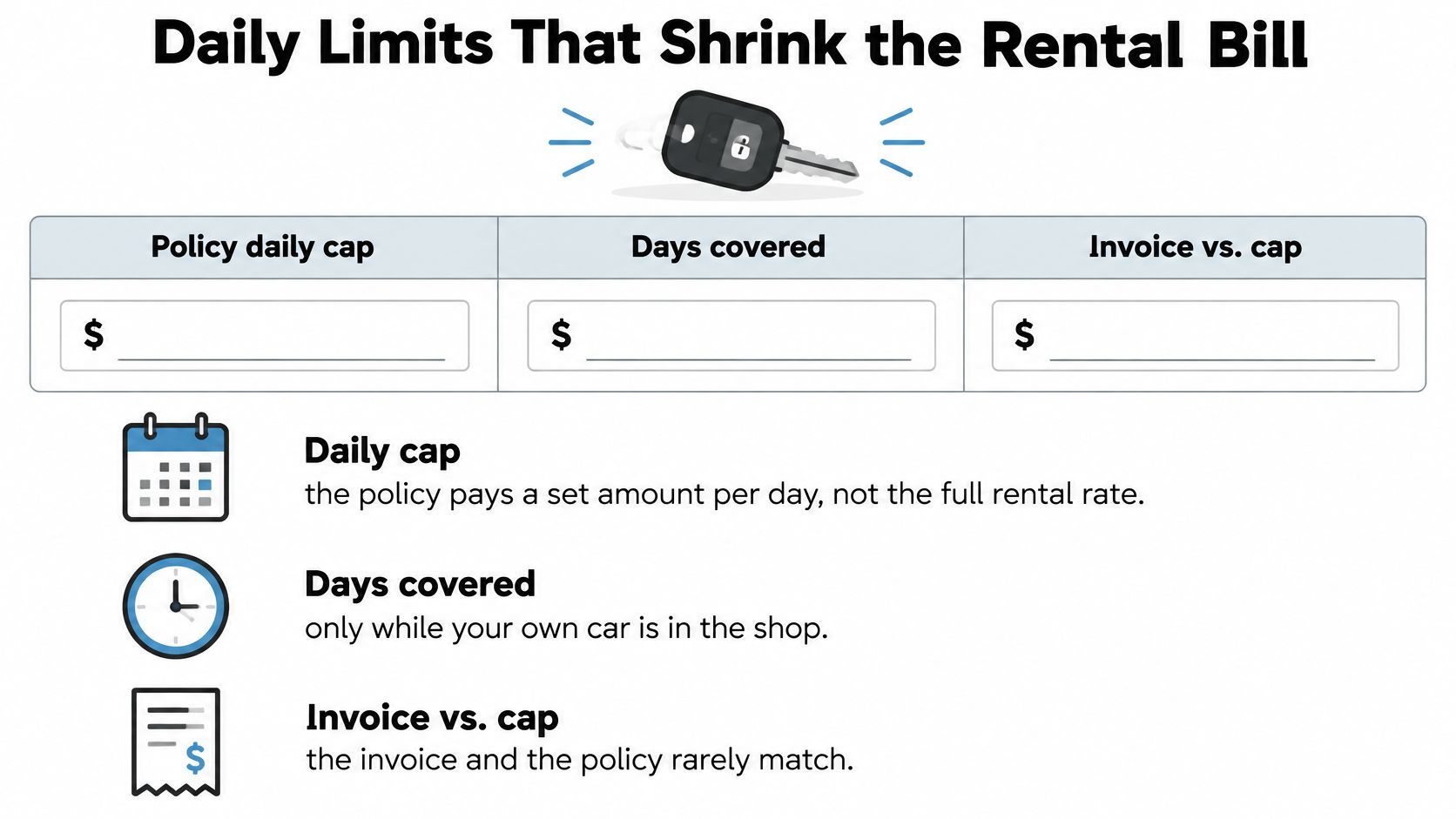
Rental reimbursement is usually an optional first-party benefit, not automatic protection on every auto policy. The National Association of Insurance Commissioners gives a representative limit of $20 per day with a $600 total maximum, so a policyholder could receive no more than 30 covered rental days at that daily limit when the loss qualifies. The same consumer guidance notes that Indiana's insurance consumer guide reports transportation-expense coverage commonly paying approximately $20 to $25 per day for a specified number of days. Travelers describes limits ranging from roughly $30 per day up to $100 per day, with total caps from about $900 to $3,000, and the customer pays costs above the selected limits.
| Source of the figure | Daily amount | Duration or total cap | What still falls on you |
|---|---|---|---|
| NAIC representative rental reimbursement | $20 per day | $600 total, about 30 days | Costs above $20 per day and after the maximum |
| Indiana consumer guide, transportation expense | About $20 to $25 per day | A specified number of days | Days outside that period and amounts above the daily rate |
| Common optional policy range | About $30 to $70 per day | Often 30 to 45 days | Repair deductible and any upgrade above the daily rate |
| Higher optional limits described by some insurers | About $30 to $100 per day | About $900 to $3,000 total | Every dollar over the selected limits |
| No rental reimbursement purchased | No daily benefit | None | The full rental invoice |
Why a nicer car still leaves a balance
The benefit generally applies when the insured vehicle is damaged by a covered loss and is being repaired. It is not a blank check whenever you want temporary transportation. Collision or other covered physical damage protection may pay to repair the insured vehicle. Rental reimbursement addresses the separate transportation expense. A deductible and the coverage limits can still shape the overall claim.
Say the declarations page shows $30 a day and the airport counter quotes $64 plus tax for the only van that fits your work tools. The insurer's first check follows the cap, not the invoice. Tax, a young-driver fee, an extra driver, and the $34 gap are yours unless a liability claim later treats a higher rate as reasonable. If the other driver is legally responsible, you may pursue that driver's liability insurer for reasonable rental costs, subject to state law and proof. Policy limits, not the rental company's full invoice, often decide what an insurer pays at the start.
Insurers also cut days when the car was safe to drive, the shop was not waiting on parts, or a total-loss offer is already on the table. A parts delay you can prove is a different conversation from a week you spent deciding whether to authorize the repair.
Circle the daily amount on your declarations page and subtract it from the quoted rate before you leave the lot. The difference is the bill you should expect to carry.
If the adjuster offers a rate that will not rent a workable car, use a written record of local prices when you negotiate with the insurance adjuster. Ask which vehicle class the rate is supposed to cover, and ask whether taxes sit inside the cap or on top of it. Then rent the cheapest car that still gets you to work and to medical visits, unless a written approval says otherwise.
Who Writes the Check Before Fault Is Clear
Many explanations imply that the at-fault driver's insurer hands you a car the next morning. A liability investigation can stall payment for days or weeks. The company that may owe the money and the person who advances it are not always the same.
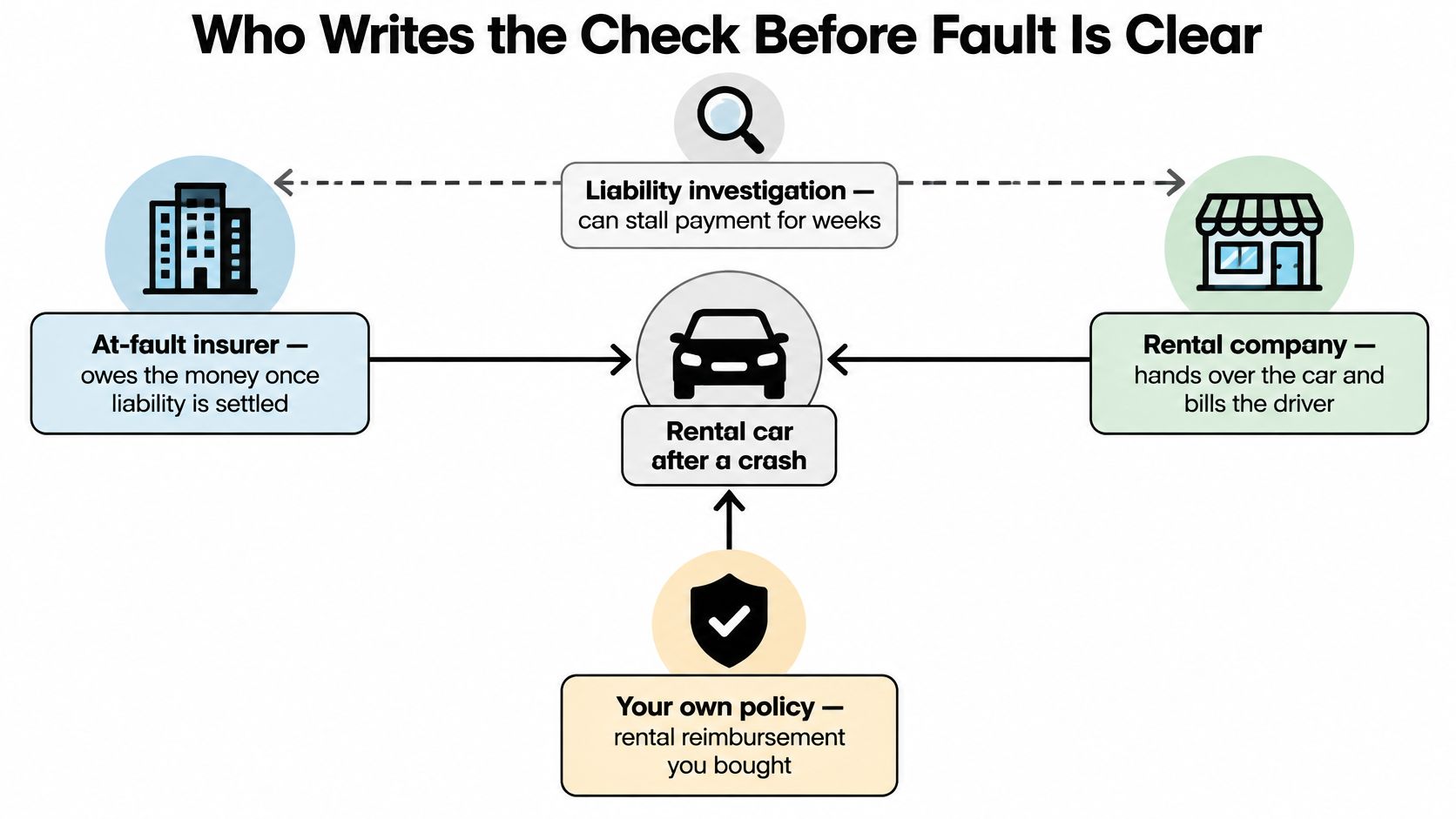
Progressive describes rental reimbursement as generally optional rather than legally required, with common limits as low as approximately $30 to $70 per day for 30 to 45 days. Using your own collision and that optional benefit can be faster. It can also mean a deductible, a daily cap, and a maximum number of rental days. Your insurer can seek recovery from the other insurer later. That recovery is not a promise that your deductible returns on a set date.
Direct billing is not automatic
A network rental agency may bill an insurer directly. An out-of-network rental usually means you pay and submit receipts. "We have a claim number" is not the same sentence as "we will pay this location." Ask which one you have, in writing, before the agent runs your card.
An injured worker can need a car for medical appointments or a shift before fault, coverage, or a workers' compensation question is resolved. Those trips do not wait for an adjuster's investigation. Workers' compensation and the auto claim are different files. A ride to the clinic may matter to both, and neither file automatically covers the rental counter.
Three moves, in this order
- Read your own declarations page. Note whether rental reimbursement is listed, the daily amount, and the maximum days. If it is missing, your insurer is not the first check.
- Ask the other insurer in writing. Ask it to name the daily rate it will accept and to say whether a named agency can bill it directly. A phone promise is hard to use when the counter wants a card.
- If neither answer arrives in time, rent only what you reasonably need for work and medical visits, and save every receipt. Waiting for perfect approval is rational when you can get a ride. It is a poor plan when you cannot reach a job site.
Name the pocket that covers the first week before you pick up the keys. Your rental benefit, a direct bill you have in writing, or your own card are the real choices. "The other insurer will get to it" is not a payment method.
If you pay first, you are not admitting fault. You are buying time. Send the receipts as soon as you have them so the later reimbursement is a file, not a memory.
Loss of Use Fees and Damage to the Rental
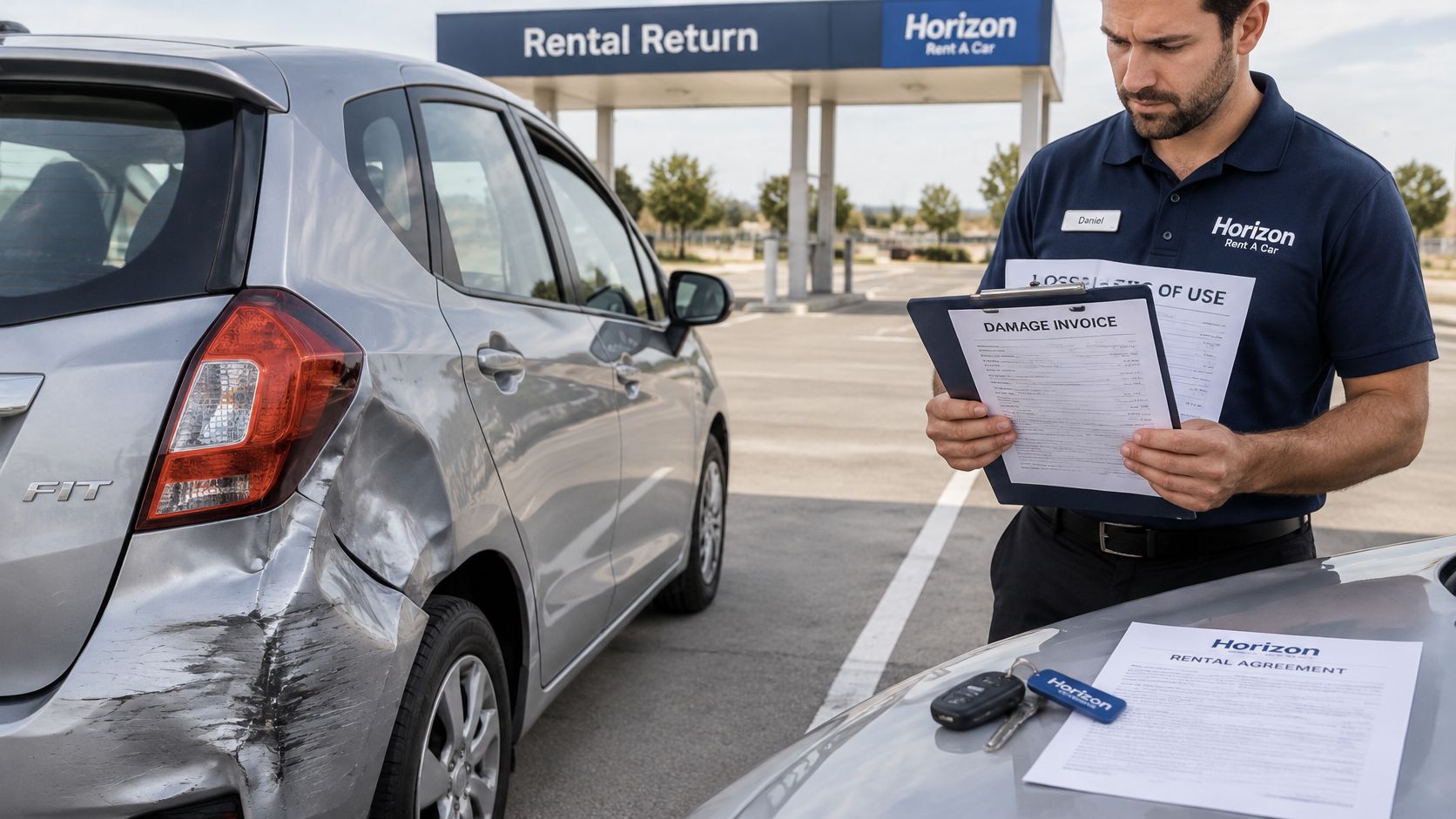
Damage to the rental vehicle is a second invoice. Rental reimbursement, when you bought it, pays for a temporary car while your own vehicle is being repaired. It does not pay the rental company for the car you bent.
Waiver, policy, or your card
A collision-damage waiver or loss-damage waiver is a contractual waiver, not an insurance policy. If you bought it and stayed inside the contract, the company may reduce or drop its claim for damage to its car. Exclusions are the trap. Waiver terms commonly exclude a prohibited driver, intoxication, unauthorized use, underbody or roof damage, and a failure to report.
Without a waiver, the renter may be responsible for repair costs, diminished or lost rental use, administrative fees, towing, and related charges. Personal auto collision may apply, with your deductible and only up to the policy limits. A credit-card benefit is usually secondary. It often covers the rented vehicle, not a substitute for your own car, and it may require that you declined the counter waiver and charged the full rental to that card. Read the card guide before you assume the metal in your wallet is a waiver.
The Minnesota Attorney General's car handbook illustrates a ceiling used in some jurisdictions. Liability for rental-car damage is limited to the reasonable repair cost or the vehicle's fair-market value, whichever is lower, with certain towing and storage charges potentially added. That ceiling is not a promise that every fee disappears. It is a reason to demand an itemized claim before you pay or authorize a charge on the card the company has on file.
What to do the day it happens
Report the crash promptly to police when the law or the contract requires it, to the rental company, and to every insurer that might apply. Ask for the itemized claim before you agree to a repair number. Loss of use on that invoice means the company says it could not rent that car to someone else while it was down. An administrative fee is a separate line. Do not treat a single lump sum as "the deductible."
A short walk-through of the waiver choice at the counter makes the second invoice easier to spot later.
Photograph the car at pickup and at return, including the roof, glass, and wheels. If the company later adds days of loss of use, ask for the repair timeline and the fleet rate it used. You can dispute a line you can see. You cannot dispute a charge that already posted with no paper behind it.
How to Get Reimbursed After You Rent
Reimbursement is a sequence. Skip a step and a fair rental becomes an argument about a missing page.
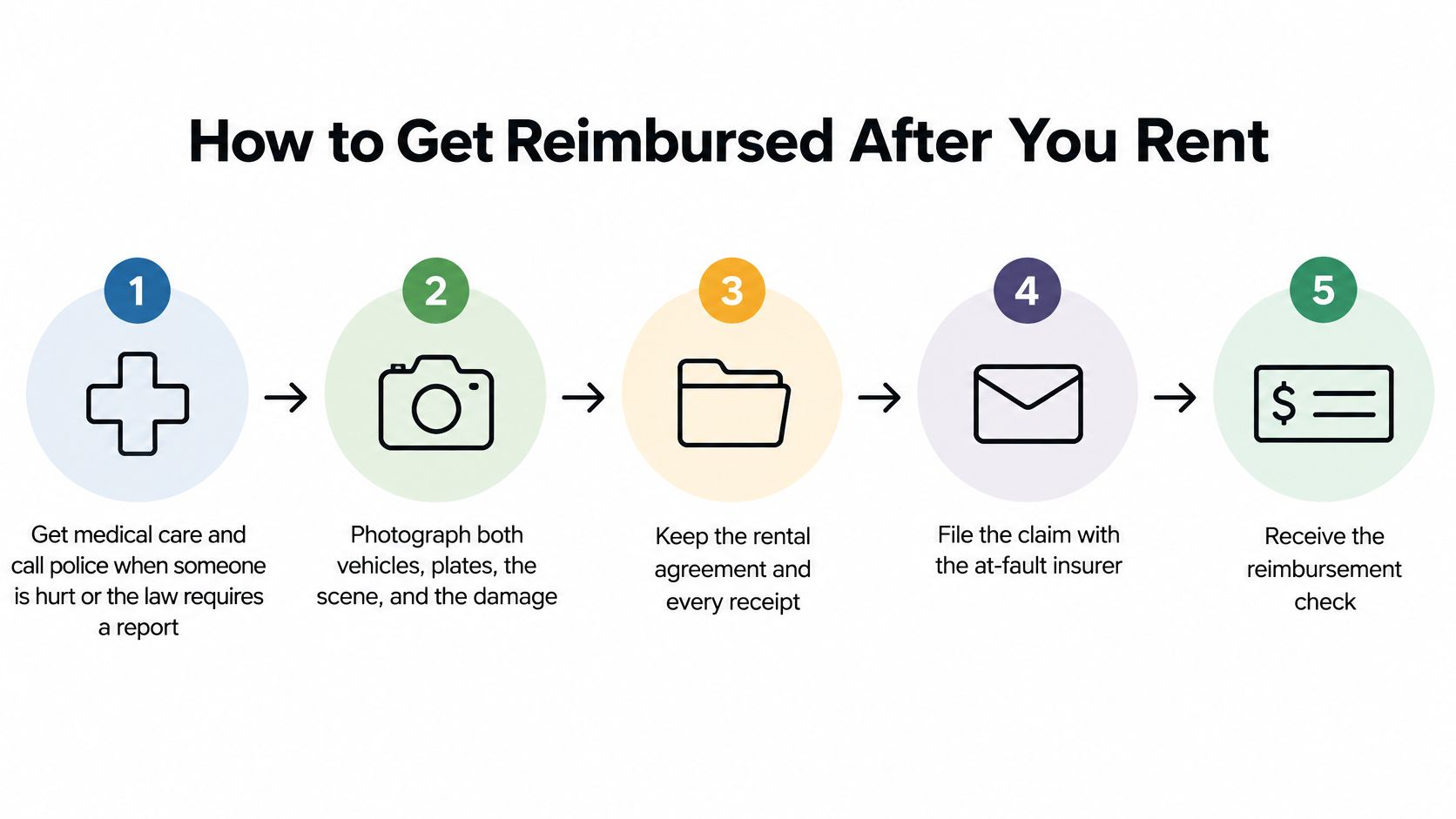
The sequence that gets a check
- Get medical care, and call police when someone is hurt or the law requires a report. Treatment comes first. A report also locks in names, plates, and a time of day that later emails cannot rewrite.
- Photograph both vehicles, the plates, the scene, and the damage that takes your car off the road. A drivable scratch and a car that will not steer support different rental periods. The photos are how you show which one you had.
- Notify both insurers the same day. Ask whether each will pay a rental, which daily rate it accepts, how many days it allows, and whether the agency can bill it directly. Write the answers down with the name of the person who gave them.
- Get written approval before pickup when you can safely wait. Approval is the reason a later denial is harder. If you cannot wait, the receipts from step 7 still matter, but you chose the rate without a ceiling in writing.
- Book at or under that daily rate unless work or a medical need requires more, and write the reason down. "Closest car to my old one" is weaker than "the clinic requires a vehicle I can load a wheelchair into, and the approved class had none."
- Return the car when repairs finish or a total-loss offer arrives. Rental payment often stops then. Extra days after the shop calls you, or after the offer lands, are the days insurers refuse first.
- Send the agreement, the rate, taxes, receipts, the repair estimate or total-loss value, and a note that links each day to the repair. A pile of paper without a timeline reads like a request for a favor. A timeline reads like a claim.
- If your insurer paid first, ask it to subrogate and to return the deductible after it recovers. Subrogation is your insurer collecting from the other insurer. Your job is to hand over the file, not to negotiate both companies against each other in the same week.
If you are opening the claim from scratch, the same paperwork habits in how to file an insurance claim keep the rental piece from getting lost inside the repair estimate.
When one day is denied
Ask which fact was missing. Do not resubmit the whole packet with a longer cover letter. A denial that says "day 12 was after the car was drivable" needs the shop's note that the part arrived on day 14. A denial that says "rate above the approval" needs the approval email or a written reason you could not rent inside it.
A complete packet beats a second argument about fault. Once liability is accepted, the remaining fight is dates, rate, and receipts.
Keep copies of what you sent and the date you sent it. If a week passes with no reply, forward the same packet to the adjuster and ask for the decision on the open days only.
Receipts Timelines and a Sample Claim Note
Build one claim file before you argue about another day of rental. Save the rental agreement, the daily rate, taxes, fuel and mileage charges, the repair schedule, notes of parts delays, total-loss paperwork, and every message that approves or refuses a day.
Why Massachusetts is a useful test
Responsibility in the United States depends on fault, state law, and the policies involved. In Massachusetts, a driver who is not at fault may open a third-party claim against the at-fault driver's property-damage liability coverage, which can include substitute transportation, according to the Massachusetts auto insurance claims FAQ. If you caused the crash, payment usually depends on whether you purchased optional substitute-transportation coverage. The insurer's obligation is limited by the policy's selected daily amount. Insurers are not required to provide a vehicle comparable to the damaged car. The state also warns that an insurer may not have to continue paying rental costs after it makes a settlement offer.
Those rules are not only a Massachusetts chart. They show the proof every state file needs. Written approval before you rent, exact rental dates, and proof the vehicle was reasonably necessary decide the cutoffs. The at-fault driver's insurer may ultimately owe reasonable rental expenses in a liability claim. You may still pay upfront, or use your own coverage, while fault and damages are investigated.
Once liability is accepted and the packet is complete, many carriers respond in days to a few weeks. Fault fights and total-loss talks take longer. Send the file as soon as the shop date or the offer date is known. Waiting until the rental company threatens a late fee only adds a second dispute.
Three dated notes
Use three short notes and keep copies. Put the claim number in the subject line.
- Ask the liability insurer to confirm the daily rate and whether it will pay the agency directly. Example: "Please confirm in writing the daily rate you will pay for a rental starting March 4, and whether Agency Name may bill you. I need a car for work shifts on March 5 and a medical visit on March 6."
- List the start and end dates and state what is attached. Example: "Rental dates were March 4 through March 18. Attached are the agreement, the daily rate, taxes, and the repair estimate showing completion on March 18."
- Dispute a cutoff by naming the shop's parts-delay dates and asking which day remains unpaid. Example: "Your note ends payment on March 12. The shop's March 11 email says the bumper arrived March 15 and the car was released March 18. Which of March 13, 14, 15, 16, 17, and 18 do you still refuse, and what fact is missing for that day?"
Do not argue "I needed a car" in the abstract. Argue a date, a shop note, and a rate someone already approved or refused.
If a message approves "a compact, up to 14 days," do not describe it later as approval for any car for as long as the shop takes. Quote the message. The cutoff lives in that sentence.
Decide When a Lawyer Should Step In
Stay with the insurers when liability is accepted, the daily rate sits inside the policy or the written approval, and the only task left is sending receipts and the repair timeline. That is paperwork. A corrected packet fixes a missing receipt or an unpaid day inside an accepted rate. Send that packet before you look for representation.
Ask a personal injury attorney to review the file when the dispute is no longer a missing page. The situations that justify that review are specific.
The other insurer denies a reasonable rental after it has accepted that its driver caused the crash, and it will not explain the refusal in writing.
It cuts off the car while yours is still not drivable, and the shop has dated the delay.
It refuses a vehicle you need for medical care, work, or adaptive equipment, and it will not say what class it will pay for instead.
It adds unexplained loss-of-use or administrative fees on a rental you damaged, and the itemized claim does not match the contract or your own collision deductible.
It uses the rental fight to push a low settlement for injuries. Signing a release to get the car paid can close the injury claim. Read what the release covers before you trade a week of rental for the rest of the case.
A crash during work can involve both an auto claim and workers' compensation. Those are not the same pot of money. Comp benefits address the injury under that system's rules. The rental may still sit on an auto policy or on the other driver's liability coverage. Bring the rental agreement, the denial, the daily cap, and the repair or parts-delay timeline to any review.
We offer a free Accident Claim Value Assessment that reviews the facts that can affect how an accident claim is handled, with immediate guidance and no contact details required. That review is a way to see whether the dispute is a receipt problem or something larger. If you later hire an attorney, what happens next gets discussed with that attorney first, and any fee is discussed before you decide to move forward. General information is not representation. Representation starts only after an attorney agrees.
Our guide on whether you need a lawyer after a car accident walks through that choice in more detail. If the only open item is one unpaid day inside a rate the insurer already accepted, send the corrected note first. If the insurer is using the rental to shrink an injury claim, or you cannot get to treatment because the car was cut off, a legal review is the practical next step, not a longer thread with the same adjuster.
AskLegally publishes plain-language guides on what to do after a car accident, including which rental costs to document and which insurer may respond. If you were hurt and you have not hired an attorney, you can sort the accident facts, a work-injury question, or the next practical step with free tools and straightforward guidance. Visit AskLegally when you are ready to see what information to gather before you talk with a lawyer.