
You're sore, your car is in a shop or a lot, and an adjuster is already calling with questions and maybe an offer. You don't know yet whether your pain will fade, whether you'll miss work next week, or whether that offer covers anything beyond the first bills. That's usually when people ask, why do I need a lawyer after a car accident, and the honest answer isn't always yes. Sometimes you don't. Sometimes signing without advice is the most expensive mistake in the whole claim.
When Legal Help Can Protect Your Claim
Consider a driver hit from behind on a Tuesday. By Thursday her neck hurts, she's missed a shift, and the other driver's insurer offers to pay the emergency room bill and the bumper if she'll sign a release. The offer sounds tidy. It also assumes her treatment is finished, her work loss has stopped, and no symptom will get worse. If any of that is wrong, the release can still close the claim.
A lawyer isn't automatically necessary, and representation isn't automatically the financially better choice. Fees, costs, and delay are real. What counsel can protect is optionality, the chance to understand fault, coverage, and future losses before you trade away claims you don't yet know you have.
The situation resembles roadside repair. A flat tire is a property problem you can often solve with a spare and a receipt. A cracked frame is different, because the visible damage doesn't tell you what else bent underneath. Bodily injury claims work the same way. The dent is easy to price. Continuing treatment, reduced earning capacity, and pain related losses aren't.
The Scales You Should Use
Put the decision on a set of scales. On one side sits what a lawyer might add, preserved evidence, a fuller damages file, someone to test the insurer's assumptions. On the other side sit legal fees, case costs, time, and uncertainty. If the claim is small, clear, and nearly finished, the second side can outweigh the first.
The stakes explain why guessing is risky. NHTSA reported an estimated 6,138,359 police-reported U.S. traffic crashes in 2023, injuring approximately 2,442,581 people and killing 40,901, and it separately estimated the total economic cost of U.S. traffic crashes at approximately $340 billion in 2019. Those costs include medical treatment, lost productivity, property damage, and insurance administration, not just twisted metal.
One rule outranks every legal tactic. Get medical evaluation first, especially after head impact, worsening pain, numbness, confusion, or symptoms that appear later. A lawyer can't diagnose you, and legal advice doesn't replace care. Early advice helps you avoid making permanent claim decisions while the medical picture is still forming.
Understanding When Counsel Adds Value
Crash severity and legal complexity aren't the same thing. A low speed collision can still produce a disputed claim if drivers tell different stories, a witness disappears, or symptoms emerge after the first examination. A harder impact can be legally straightforward if fault is admitted, coverage is adequate, treatment ends quickly, and the insurer pays documented losses without argument.
Counsel adds value when there's something material to investigate, prove, value, or negotiate. That includes disputed fault, substantial treatment, lost earning capacity, multiple responsible parties, an uninsured driver, or policy limits that may be too small for the losses. In those cases, an early offer built on initial records can omit future care and wage effects that haven't appeared yet.
It adds less when the job is mostly administrative. If no one's injured, liability is clear, repair estimates are documented, and the payment matches them, a lawyer may have little to improve. Representation is a decision tool, not a status symbol, and hiring one to process a simple property claim can shrink your net recovery.
Time belongs in that calculation. U.S. private-passenger auto-liability data showed that only 8.8% of represented claims closed within 90 days, compared with 66.5% of unrepresented claims, while 21.0% of represented claims remained open for more than two years, compared with 1.9% without an attorney. That doesn't prove lawyers cause delay, because serious and disputed cases are more likely to involve counsel. It does mean speed is a real tradeoff you should price in.
When a Car-Accident Lawyer May or May Not Add Value
| Claim Feature | Counsel May Add Value | A Claim May Be More Manageable Without Counsel |
|---|---|---|
| Fault | Drivers dispute what happened | Fault is admitted and documented |
| Injuries | Treatment continues or symptoms worsen | No injury, or care is complete and minor |
| Money at stake | Lost wages or future care are likely | Losses are limited to a repair bill |
| Coverage | Several policies or an uninsured driver | One insurer, adequate coverage |
| Insurer conduct | Pressure to sign or a low unexplained offer | Written offer matches documented losses |
The right question isn't whether lawyers are good or bad. It's whether counsel can materially improve your net outcome after fees, costs, risk, and time.
Ask that question before anyone promises you a bigger settlement. Gross recovery is the headline number. Net recovery is what's left for you.
Scenarios That Often Call for Legal Advice
Concrete facts beat general advice. If the other driver blames you, the unresolved issue isn't just manners, it's liability evidence. A lawyer can compare the crash report, vehicle damage, witness accounts, and any available video to test which version holds up. Without that work, you may negotiate against a fault finding you never challenged.
Serious or worsening injuries create a different problem, valuation. Ongoing therapy, specialist referrals, work restrictions, or possible permanent impairment make today's bills a poor measure of the claim. Delayed symptoms raise the same concern in quieter form, because an insurer may argue that pain appearing days later came from something else. Your treatment records and symptom timeline become central evidence.
The scenarios below are the ones that most often justify at least a consultation.
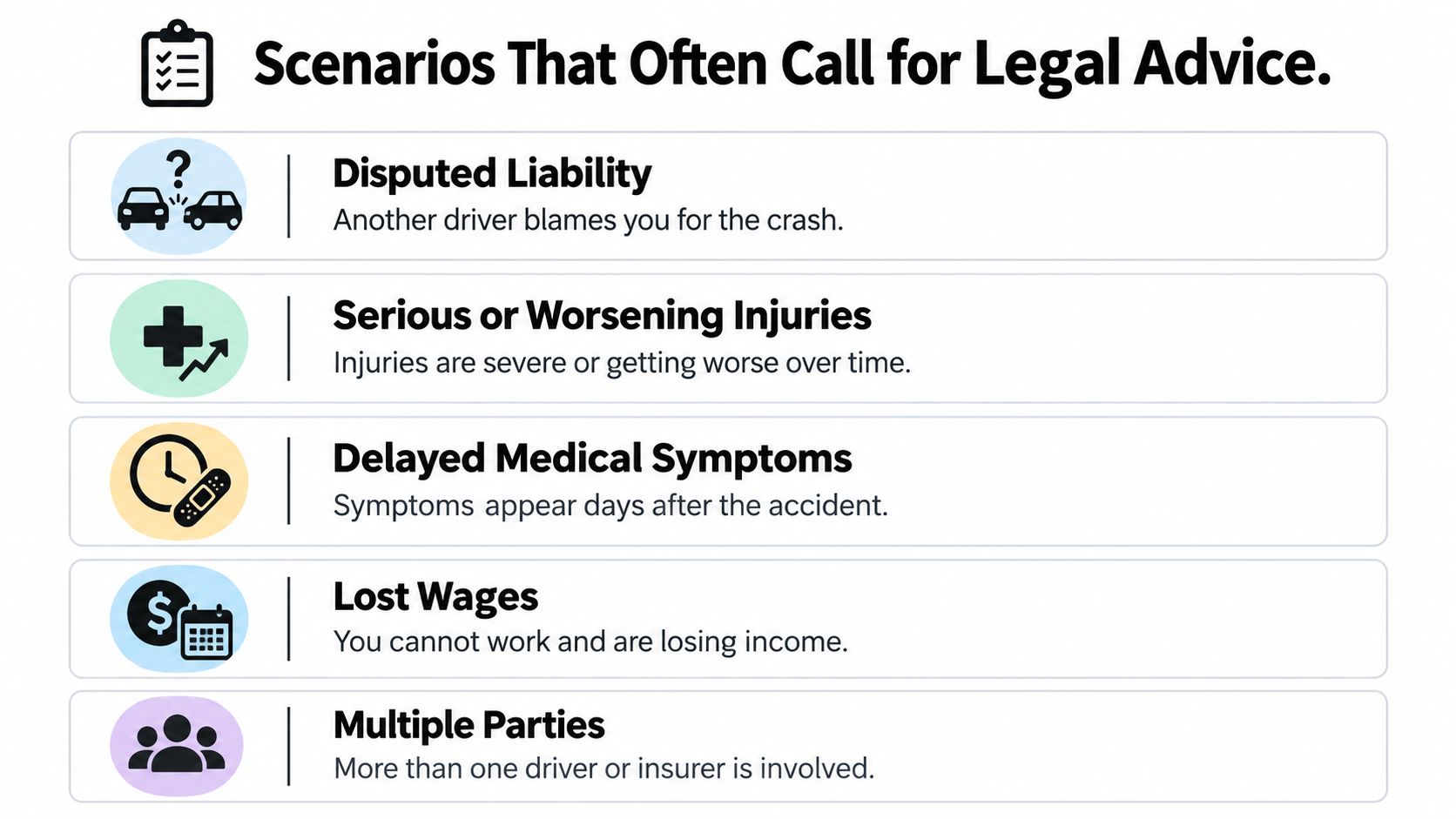
Lost wages need proof, not just absence. Pay records, employer confirmation, and medical restrictions connect missed work to the crash. Multiple vehicles or insurers multiply that paperwork, and each company may point at another. An uninsured or underinsured driver adds a coverage search, because your own policy may become relevant.
Pressure itself is a trigger. The NAIC advises accident victims to document communications, request written explanations of claim decisions, and avoid feeling rushed into settlement, and it identifies hiring an attorney as an option when the claimant and insurer disagree. If you're being pushed to sign a release or give broad statements before you understand the offer, slow down.
Now the counterexample. A parking lot tap with no injuries, clear fault, photographs, and a repair payment that matches a written estimate may not need counsel at all. Paying for representation there could cost more than it returns.
Use this trigger test instead of a blanket rule. Complexity, serious consequences, and missing information are strong reasons to consult. The mere presence of an insurer isn't.
What a Car-Accident Lawyer Actually Does
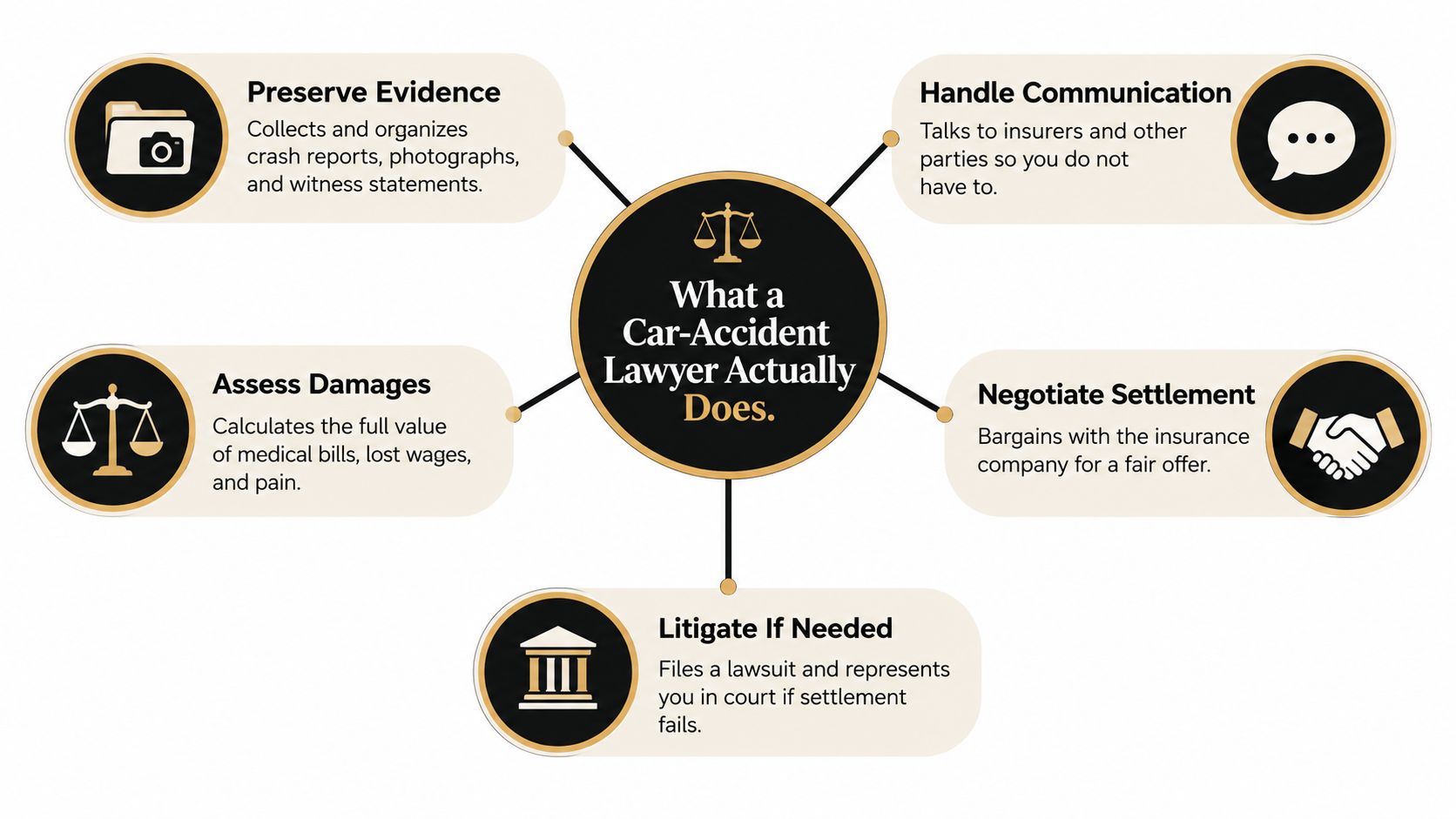
Strip away the advertising and the job has five connected parts. None of them is magic. Each one matters only if your claim has evidence to organize, losses to value, or resistance to overcome.
First comes preservation. A lawyer gathers crash reports, photographs, witness information, medical records, wage evidence, and policy details into a coherent file. That sounds clerical until you realize insurers pay documented claims more readily than they pay assertions.
Second comes liability and coverage analysis. Who caused the crash, what proof supports that, which policies apply, and are the limits enough? Those answers shape strategy early. A claim against an adequately insured driver looks nothing like one involving several defendants and competing carriers.
The diagram below maps those functions together.
Valuation Is Where Early Offers Often Fail
Third, the lawyer values current and future damages. That includes treatment already billed, care your doctors expect, lost income, reduced work capacity, and pain related losses where the law allows them. CDC data on 2012 motor-vehicle crash injuries estimated lifetime medical costs of $18 billion and lifetime work loss of $33 billion, with more than 75% of costs occurring during the first 18 months after injury. An offer made in week two can't capture that arc.
Fourth comes negotiation, usually through a formal demand that ties each loss to evidence. The adjuster on the other side investigates the loss, evaluates coverage, and decides what's payable. Your lawyer's job is to test those assumptions rather than accept them as neutral facts.
Fifth, where the law permits, counsel helps address medical liens and billing complications, then files suit if negotiation stalls. Litigation isn't the goal for most claims. It is a tool when an insurer won't pay a defensible value voluntarily.
Practical rule: A lawyer is an evidence organizer and advocate, not a medical provider and not a guarantor of a larger payout.
That distinction protects you from bad promises. If a lawyer guarantees an outcome before records are complete, treat the guarantee as a warning sign, not reassurance.
Act Quickly After the Accident
Start with your body, not your claim file. Get checked promptly, follow up if symptoms change, and don't assume feeling fine at the scene ends the inquiry. A 2025 peer-reviewed study found that loss or alteration of consciousness and post-traumatic amnesia predicted more severe traumatic brain injury among adults treated in emergency departments after motor-vehicle collisions, which is why early symptoms deserve medical attention rather than self reassurance.
The sequence below puts care ahead of paperwork, which is the correct order.
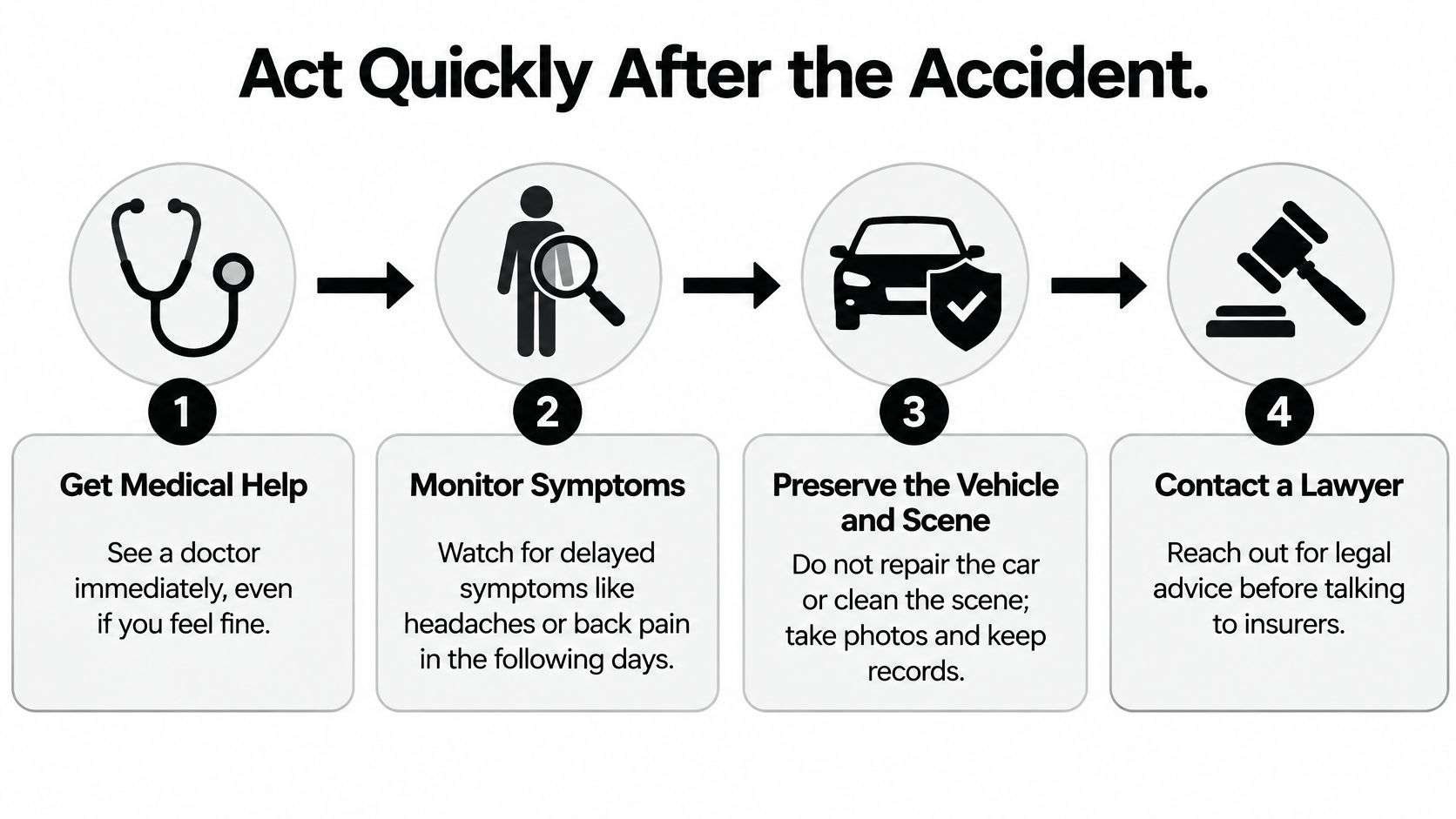
While you monitor symptoms, preserve what's perishable. Photograph vehicles and the scene where it's safe, keep the damaged car available for inspection, and save contact and insurance information for drivers and witnesses. Skid marks fade, vehicles get repaired, and memories soften. Contemporaneous records don't.
Build a simple claim folder from day one. Keep bills, receipts, prescriptions, work absence notes, and a short daily log of pain, limitations, and missed activities. Request available crash and medical records rather than relying on summaries from anyone else.
Protect Your Words and Your Deadline
Be careful with recorded statements and releases. You can report basic facts to your own insurer, but broad speculation about fault or how unhurt you feel can follow you for months. Ask for claim decisions in writing and log every call with dates and names.
Deadlines vary by place and claim type, so don't rely on a neighbor's timeline or a general internet answer. Check how long after an accident you have to file a claim and confirm the rule that applies where you live. Missing a local limitation period can end an otherwise valid claim.
The video below walks through early post accident decisions in plain language.
Contacting a lawyer early can prevent small omissions from becoming permanent gaps in evidence. It doesn't obligate you to sue anyone. It gives you a deadline check and a record plan while you focus on getting better.
Compare Lawyer Fees and Net Outcomes
A bigger settlement isn't the same as a better result. What matters is what remains after legal fees, case costs, medical bills, and lien deductions, and how long you waited to get it. Run that math before you sign anything, not after.
Most car accident lawyers use one of a few structures. A contingency fee takes an agreed portion of the recovery, typically only if money is recovered. Hourly billing charges for time regardless of outcome. A flat fee covers a defined piece of work. Separate expenses for records, experts, filing, or depositions may sit on top of any of these, and terminology varies by jurisdiction.
That distinction between fee and expenses matters. Ask who advances costs, who repays them if the claim fails, and whether expenses come out before or after the fee is calculated. Two agreements with the same headline fee can leave you with very different net amounts.
A Net Outcome Worksheet
Compare any offer you already have against a realistic represented path. List the gross amount, subtract fees, subtract case costs, then subtract medical or lien amounts that must be paid. If you want help structuring the damages side, how to calculate a car accident settlement breaks the categories into workable parts.
Then add the non cash costs. Delay has a price when bills are due now. Uncertainty has a price when liability is contested. Your own time has a price if you're handling calls, records, and deadlines alone while injured.
Be skeptical of simple claims that representation always raises or always lowers what claimants keep. Serious and disputed cases attract lawyers more often, so averages mix very different claims together. Your comparison should be specific to your injuries, your coverage, and your evidence.
Before signing a fee agreement, ask direct questions.
- Fee scope: Does the fee apply to property damage or medical payment recoveries, or only to the injury claim?
- Cost responsibility: Which expenses will I owe if there's no recovery?
- Timeline: What has to happen before a demand can be sent?
- Decision rights: Who decides whether to accept an offer or file suit?
Get the answers in writing. A clear agreement isn't paperwork to rush through, it's the price tag for representation.
Choose the Right Lawyer for Your Claim
Don't hire the loudest advertiser. Hire the lawyer who can explain your specific claim back to you in plain language. Relevant car accident and personal injury experience matters because coverage disputes, medical documentation, and damages proof follow patterns a generalist may not see quickly.
Ask who will manage your case day to day. A senior lawyer may lead strategy while associates or paralegals gather records and return calls, which is fine if you know it upfront. It's not fine if you discover it after weeks of silence.
Use the consultation as an interview, not a sales appointment. A good lawyer should discuss weaknesses as readily as strengths, including disputed fault, gaps in treatment, prior conditions, or low policy limits. If every answer sounds like a promise, keep looking.
- Evidence plan: Ask what records, photographs, or witness work the lawyer wants first.
- Damages view: Ask which loss categories the lawyer is evaluating and which ones look weak.
- Litigation triggers: Ask what insurer conduct would make filing suit worth discussing.
- Communication cadence: Ask how often you'll get updates and through whom.
Written fee terms belong in that same conversation, including how property damage and medical recoveries are treated. For a broader selection framework, how to find a lawyer and choose the right legal partner covers credentials and conflicts in more depth.
Treat a consultation as information gathering. It doesn't guarantee representation, and representation doesn't guarantee a favorable result. You're buying judgment and work, not certainty, so choose the person whose judgment you can examine.
Make Your Next Decision Safely
Run through four questions before your next call with any insurer. Are your injuries serious, worsening, or still undiagnosed? Is fault or coverage disputed by anyone? Does the offer account for more than immediate bills, including future treatment and time away from work? Is anyone pressuring you to sign before you can answer those questions?
If you answered yes to several, get legal advice before you sign. If your answers are all no, and the payment matches documented losses, handling the claim yourself may be reasonable. Both paths can be sensible. What isn't sensible is letting urgency make the choice for you.
No checklist can tell you whether litigation is worthwhile. That depends on evidence, damages, coverage, local rules, and your tolerance for delay and risk. Your next step might be a case review, an independent medical evaluation, or continued self handling with better documentation.
AskLegally offers a free case review that asks about the accident and injuries, assesses whether the situation may warrant attorney review, and may connect you with a lawyer who handles car accident claims. That's one option among others, including consulting a local lawyer you find independently. The point is getting your facts assessed, not committing to a lawsuit.
Don't sign a release to end the stress of an unfinished claim. Finish the medical and financial picture first, then decide.
Two safety points close this out. Seek urgent medical care for concerning symptoms, whatever your claim status is. And confirm your filing deadline under local law now, not when treatment ends, because those clocks can run while you're still recovering.
You don't need certainty to act wisely. You need records, time to understand your injuries, and advice proportionate to what's at stake. That's the answer to why do I need a lawyer after a car accident, sometimes you don't, and sometimes that advice is what keeps a bad week from becoming a long financial problem.
If you're unsure whether your injuries, disputed fault, or an insurer's early offer warrant legal help, AskLegally offers a free case review that looks at your accident facts and may connect you with a participating personal injury lawyer. Visit today to describe what happened, learn whether attorney review makes sense for your situation, and take your next step before deadlines or a rushed release narrow your options.