
Your car has been towed, your phone keeps ringing, and you're trying to decide whether the soreness in your neck needs attention. Meanwhile, the truck belongs to a company you've never heard of, and you don't know who has its camera footage or driving records. You don't need to solve the claim today. You need medical care, a clear record of what happened, and a way to stop important evidence from disappearing.
Knowing what to do after a truck accident means putting those tasks in the right order. Protect yourself first. Then document what you can safely obtain and get help preserving the records you can't access yourself.
Why Truck Crashes Need a Faster, Different Response
A truck crash needs a faster evidence response because what happens during the first week can determine which records survive. That's a practical priority, not a universal legal deadline. A recording can disappear before anyone finishes deciding who caused the collision.
Truck claims differ from ordinary car claims in several ways:
- Responsibility can extend beyond the driver. A motor carrier, maintenance provider, or cargo loader may have information relevant to the collision.
- Companies control much of the evidence. Dispatch messages, driver logs, inspection files, and camera recordings usually aren't available through your own insurance account.
- Early records aren't necessarily complete. Investigators may develop information that wasn't available at the roadside.
The Federal Motor Carrier Safety Administration's progress report recorded 167,028 large-truck crashes in 2022, including 75,577 injuries and 5,292 fatalities, and explains that states are expected to submit crash data within 90 days, while the data remain preliminary for 22 months.
That federal reporting timeline isn't a deadline for your claim, and it doesn't mean your police report will take that long. It means you shouldn't treat an early account as the entire investigation.
Practical rule: Start your own file immediately. Don't wait for an insurer or investigating agency to collect everything you'll need.
Get emergency help, preserve your own records, and promptly arrange written requests for company-held evidence. Those tasks protect different parts of the claim, and none replaces the others.
Immediate Steps at the Scene, in Order
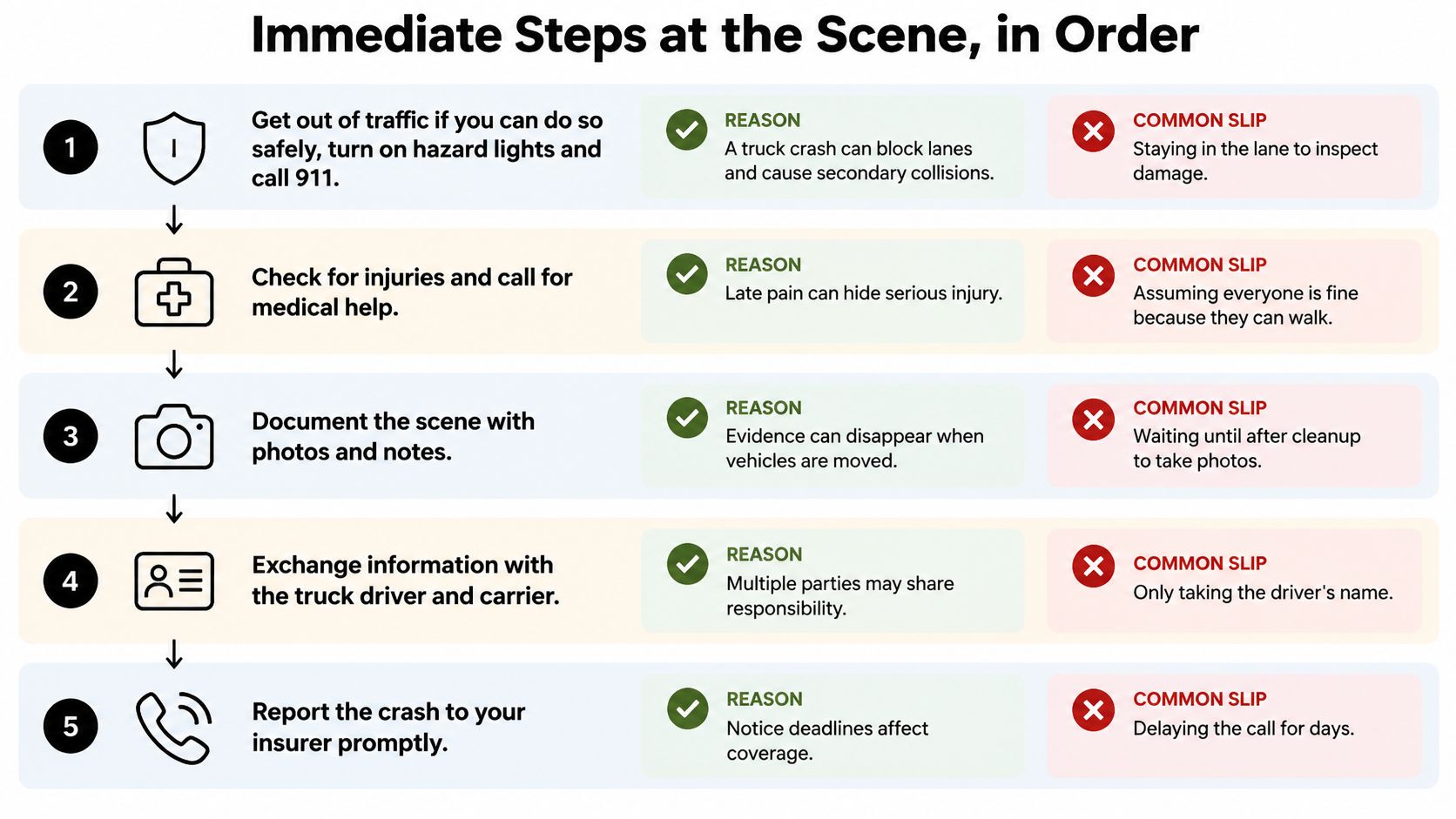
When a truck crash blocks traffic or leaves you hurt, the scene can change before you have time to collect details. Put safety and medical care first, then record what you can without putting yourself in danger. These seven steps keep the immediate priorities in order.
Move away from traffic if you can do so safely, switch on your hazard lights, and call emergency services. Stopped vehicles, debris, or spilled fuel may create further danger. Tell the dispatcher where you are and describe blocked lanes or visible hazards. Don't stand between vehicles to inspect damage.
Check for injuries and tell responders what hurts. Mention dizziness, confusion, a head impact, numbness, or pain, even if you can walk. Don't refuse an assessment because you're concerned about delaying traffic. Your health takes priority over gathering evidence.
Record the truck's identifying details. A driver's name alone may not identify every relevant business. If it's safe, capture the carrier name, USDOT number, tractor license plate, trailer number, driver's name, and license information. Photograph company markings rather than relying on memory.
Get the responding agency's name and the report number. Ask how to request the official crash report and whether supplemental material may become available. AskLegally's free Police Report Lookup tool helps users identify and request the official report after an accident. A report request requires contact and accident details.
Photograph the scene from a safe position. Vehicle movement and cleanup can change what is visible. Take wide views of vehicle positions, then record damage, road markings, signs, lighting, visible cargo, and visible injuries. Don't step into a live lane for a better angle.
Ask witnesses for their names and contact details. They may leave before an investigator speaks with them. Note where each person was standing or driving. Don't coach witnesses or argue about what they should have seen.
Exchange insurance information without debating fault. A roadside conversation is not a complete investigation. Answer officers truthfully, separate what you observed from what you're guessing, and avoid apologies that suggest responsibility you haven't established. Don't sign unfamiliar releases or settlement paperwork at the scene.
This numbered list of seven immediate steps after a truck accident can help you keep the sequence straight.
Before you leave
Check that you have the core scene details:
- Identification: Driver, carrier, tractor, trailer, and insurance information.
- Documentation: Photos, witness contacts, and the responding agency's report number.
- Health information: Symptoms you reported and where responders recommended you seek care.
If neck pain is your immediate concern, the Salt Lake City auto injury triage resource offers context. It does not replace an emergency assessment.
Don't endanger yourself to complete the checklist. If you're taken for treatment, ask someone you trust to organize the details already available. Starting your file later can make missing information harder to recover.
Evidence to Preserve Before It Disappears
| Evidence | Who usually holds it | Why it can disappear |
|---|---|---|
| Electronic records of duty status and supporting documents | Motor carrier | Required retention is limited; request the records and separate backup |
| ELD data on the truck | Driver's onboard ELD | Local device storage may cover only a short rolling period |
| GPS or telematics | Carrier or telematics vendor | GPS isn't automatically preserved after a crash |
| Engine control module or event data recorder | The truck itself | Repairs, diagnostics, or return to service can compromise event data |
| Dashcam footage | Driver or carrier | Loop recording can overwrite footage |
| Dispatch messages and bills of lading | Carrier and shipper | Ordinary business practices may discard records |
| Your photos, chronology, and receipts | You | Phone loss, deletion, or account problems can erase the only copy |
Under FMCSA's electronic logging device guidance, carriers must retain electronic records of duty status, supporting documents, and a separate backup for six months, but an onboard ELD may need to retain only the current 24-hour period plus the previous seven consecutive days; the rule doesn't create a general requirement to preserve GPS data after a crash.
Don't confuse log retention with preservation of every electronic record. A printed driving-log summary isn't the same thing as native electronic files, edit histories, or vehicle-event information.
Make the preservation request specific
A written request should identify the collision, tractor, trailer, and relevant dates. Ask for preservation of native-format ELD exports, edit histories, ECM or EDR downloads, telematics, camera footage, dispatch communications, bills of lading, inspection and maintenance files, and driver-qualification materials.
The request should also address the physical tractor and trailer. Ask that potentially destructive inspections, repairs, disposal, and data-changing diagnostics be coordinated before evidence is altered. You generally can't personally control a carrier's equipment, so prompt legal assistance matters more than an informal request to the driver.
Preserve your own vehicle too. Tell the insurer and storage facility that documentation or inspection may be needed before repairs or disposal, while asking how to avoid unnecessary storage charges.
Build a file you control
Start a written chronology while your memory is fresh. Record the location, weather, lane positions, traffic signals, impact sequence, symptoms, medical visits, missed work, and insurer contacts.
Keep original photo and video files, not just compressed copies sent through messaging apps. Save towing records, repair estimates, medical bills, explanation-of-benefits statements, and damaged personal items, with dated backups stored separately.
A preservation request protects the opportunity to investigate. It doesn't prove that the recipient caused the crash.
Aim to arrange the demand during the first week, sooner if footage or vehicle data may be lost. Local counsel can identify the recipients and applicable preservation procedures.
Medical Follow-Up When Pain Shows Up Late
Seek emergency help now for:
- Breathing difficulty or uncontrolled bleeding.
- Loss of consciousness, confusion, vision changes, or other neurological symptoms.
- Severe neck or back pain, weakness, or a worsening headache.
For other symptoms, arrange a prompt clinical assessment rather than deciding on your own that soreness is harmless. Tell the clinician how the impact occurred, which side was struck, whether you hit your head, and whether you wore a seatbelt. If you don't know the truck's speed, say so.
Bring your symptom notes to the appointment so you don't have to reconstruct everything from memory.

Use a symptom and function log
The entries below are hypothetical examples, not a diagnosis or recommended medication schedule.
| Field | What to record | Example entry |
|---|---|---|
| Date | Day and time of entry | Monday evening |
| Pain location and rating | Location and intensity on the clinician's suggested scale | Neck, 6 out of 10 |
| Sleep | Hours and quality | 4 hours, woke twice |
| Medication effects | Drug, prescribed dose, and side effects | Medication and dose copied from label; felt drowsy |
| Mobility | Walking, driving, and lifting limits | Cannot lift a grocery bag |
| Missed appointments and work | Dates missed and reason | Missed half shift, Day 5 |
A reassuring first test doesn't answer every possible injury question. Likewise, attending an appointment doesn't by itself establish that the crash caused every symptom. Clinicians assess diagnosis and causation using the history, examination, and appropriate testing.
Vehicle information has a different role: NHTSA's event data recorder overview explains how recorded vehicle information can support crash investigation and safety-system analysis. It doesn't replace medical assessment.
- Keep receipts: Save bills, prescriptions, and treatment-related expenses.
- Describe symptoms accurately: Don't exaggerate, minimize, or omit relevant prior problems.
- Limit public commentary: Avoid posting about the crash, symptoms, or activities, and don't delete existing material without legal advice.
For more context, review our guide to delayed symptoms after a car accident.
Say your neck becomes stiff several days after the collision. Waiting another week creates an unexplained treatment gap; contacting a clinician promptly creates an opportunity to assess the change. Book follow-up within days, not weeks, unless your clinician directs otherwise.
Insurance Calls, Statements and Releases to Handle Carefully
The first insurance call can set the scope of what gets reviewed later. Pause before giving a recorded statement, accepting a quick settlement, or signing a broad medical release. A helpful tone does not make a request routine.
Notify your own insurer as your policy requires. Give accurate basic facts, request a claim number, and ask what cooperation or documentation your coverage requires. Don't guess about whether you're uninjured or promise that you won't need treatment.
With the other insurer, focus on understanding the request before agreeing. The question is not how quickly you can close the claim, but whether you know what the proposed statement, payment, or release may affect. If you need help preparing, read this guide to negotiating with an insurance adjuster.
Use a calm, limited response
When the other insurer asks for a recorded interview or release, you can say:
I'm still getting evaluated. Please send your request in writing. I'll follow up after I review the documents.
This response gives you time to review a request from another party. It does not excuse you from obligations under your own policy.
Handle each request on its own terms:
- Recorded statement: Ask who wants it, what subjects it covers, and whether you should obtain legal advice first.
- Settlement: Determine whether the proposed payment closes property damage, injury claims, or both. Future treatment and wage loss may still be uncertain.
- Medical authorization: Review the providers, records, dates, and purpose. Don't sign an open-ended authorization without understanding its reach.
For example, neck pain may develop after the crash while an adjuster requests a recorded statement and signed release that afternoon. Request the documents, read what rights they affect, and get advice if their scope is unclear.
Track costs as carefully as conversations
Keep a call log with dates, names, claim numbers, requests, and what each person said. Confirm important conversations by email. Clear records help you track what you were asked to provide and what the insurer said about your claim.
Save receipts for towing, storage, rental transportation, damaged personal items, and travel to appointments. Ask in writing how the insurer will handle each expense. A receipt documents a cost; it doesn't guarantee reimbursement.
Deadlines That Start Before You Feel Ready
| Deadline | Typical timing | What it protects |
|---|---|---|
| Written chronology of the crash | Start immediately while details are fresh | Memory of time, weather, lane positions, and signals |
| Notice to your own insurer | As your policy requires, usually promptly | Coverage and policy rights |
| Carrier record retention for logs and backups | Request preservation before routine retention expires | Driver logs and supporting documents |
| Onboard ELD current-period data | Request immediately because local storage is short | Recent hours-of-service information |
| Notice to a government entity, if involved | Confirm the applicable jurisdiction's notice procedure immediately | Ability to pursue a claim against that entity |
| Personal injury statute of limitations | Confirm the filing deadline under the applicable jurisdiction's law | Right to file a lawsuit |
Calendar the earliest required action, not just the lawsuit deadline. A claim can become harder to prove while you still have time to sue.
There isn't a single nationwide deadline that safely answers every truck-accident question. Policy notice, evidence retention, government-claim procedures, and court filing rules address different obligations. Don't substitute an internet estimate for the rule governing your circumstances.
Turn requirements into dated tasks
Use a calendar and a simple deadline sheet. For each entry, record:
- The action: Report the claim, request records, obtain advice, or file required paperwork.
- The authority: Policy language, agency instructions, or an attorney's explanation of the applicable rule.
- The owner: You, a family member helping with paperwork, or retained counsel.
- The completion record: Confirmation email, delivery receipt, claim number, or filed document.
A reminder alone isn't proof that you completed a task. Save confirmation alongside the deadline entry.
If a public vehicle, public employee, or roadway condition may be involved, flag that issue during the initial legal consultation. Ask whether a separate notice procedure applies instead of assuming that an ordinary injury lawsuit deadline controls everything.
Don't wait for the report
A missing police report shouldn't stop you from notifying your insurer or seeking preservation advice. Provide the agency name and report number, identify what remains unavailable, and supplement the file when you receive it.
If a deadline may already have passed, get local advice rather than abandoning the claim yourself. Exceptions and procedural questions require individual review, and an insurer's informal explanation isn't a substitute for that assessment.
Set reminders to check unanswered requests and approaching dates. Your calendar should show what must happen next, not only the last possible day to act.
Decide Whether to Call a Truck Accident Lawyer Now
Call promptly when the problem is bigger than a straightforward property-damage claim. You don't need to know the claim's value before asking whether someone should help preserve evidence.
Consider the following questions before the consultation.

Seek a truck-accident attorney's assessment when:
- Injuries are serious or ongoing, or someone died.
- Fault is disputed, witnesses disagree, or essential footage is missing.
- Several businesses may be involved, including the carrier, maintenance provider, or cargo loader.
- The insurer disputes the injury or presses for settlement before your medical outlook is clear.
- Lost income keeps growing, or restrictions threaten your ability to return to work.
The reason to investigate beyond the driver isn't that every company must be liable. The FMCSA Heavy-Duty Truck Study fact sheet describes an approach combining police reports, post-crash inspections, investigations, and reconstructions to evaluate driver, vehicle, carrier, and environmental factors. A useful legal review should likewise ask what evidence is needed before drawing conclusions.
Know what a consultation should accomplish
Bring the report number, chronology, medical bills, symptom log, wage records, and insurer letters. Ask which records require immediate preservation, who should receive a letter, and whether an inspection is needed.
Also ask how fees and case expenses work, who will handle communications, and what uncertainties prevent a reliable valuation. A careful answer may identify missing information rather than offer an immediate settlement figure.
You may decide to handle the matter yourself if symptoms have fully resolved, responsibility is accepted, and no treatment or bills remain unresolved. Even then, read every release and preserve your documents. Our guide to whether you need a lawyer after a car accident can help you weigh that decision.
This video offers another way to consider your next steps.
The sooner the evidence is preserved, the more options remain for finding out what happened.
Don't delay a consultation because your folder isn't perfect. Send what you have, identify what's missing, and explain any urgent storage, repair, or insurer requests.
We offer a free case review for people who haven't hired a lawyer and can help connect them with participating personal injury attorneys. Visit AskLegally this week to describe the truck crash and request a review while time-sensitive evidence can still be sought. If you're still sorting out the facts, our free Accident Claim Value Assessment provides immediate guidance about factors affecting claim handling, with no contact details required.