
Think of a long term care attorney as the architect of your family's future. They don't just draft wills; they design a comprehensive blueprint to protect your life's savings from the crushing costs of care down the road.
These legal specialists are all about proactive planning. Their goal is to help you navigate the tricky legal and financial waters of aging, ensuring you can get quality care for your loved ones without watching your nest egg disappear. A key distinction here is that their work focuses on preserving your assets while you are alive, which is a different game entirely from traditional estate planning.
What a Long Term Care Attorney Really Does
Imagine you've spent a lifetime filling a reservoir with your savings. Suddenly, a long-term illness appears—it's like a massive crack forming in the dam, threatening to drain everything you've built. A long term care attorney is the engineer who inspects that dam years ahead of time, reinforcing it with legal structures to prevent a total washout.
Their role isn't just about paperwork; it's about strategic foresight. They look ahead, anticipate the financial squeeze that often comes with aging, and build a personalized plan to handle it. This approach is a world away from a last-minute, crisis-driven reaction, where your options are few and the stress is overwhelming.
The Architect of Your Financial Security
At the heart of their work is asset protection. A long term care attorney uses specific legal tools to shield your home, savings, and investments from being wiped out by nursing home or in-home care bills. This isn't about hiding money. It's about legally and ethically restructuring your finances so you can qualify for assistance programs without having to spend down every last penny.
This becomes absolutely critical when it comes to Medicaid planning. While Medicaid can cover long-term care costs, it comes with very strict income and asset limits. An attorney helps you:
- Legally structure your assets to meet the eligibility rules.
- Protect the "community spouse" (the one still at home) from being left with nothing.
- Carefully navigate the five-year "look-back" period to avoid penalties from improper asset transfers.
Planning like this is more important than ever. The demand for these specialized legal services is climbing as more families face these financial pressures. The global elder law service market, valued at around $15.2 billion in 2023, is expected to hit nearly $24.8 billion by 2032. You can discover more insights about this market growth and its drivers. This boom shows just how vital this kind of legal planning has become for families everywhere.
To give you a clearer picture, here's a quick look at the primary ways a long term care attorney protects your family and your assets.
Core Services a Long Term Care Attorney Provides
| Area of Focus | What It Involves | Why It Matters |
|---|---|---|
| Asset Protection | Using trusts, gifting strategies, and other legal tools to shield savings, investments, and property from care costs. | It allows you to qualify for assistance programs like Medicaid without having to first spend down your entire life savings. |
| Medicaid Planning | Navigating the complex application process and restructuring finances to meet strict eligibility requirements. | It secures a way to pay for long-term care, which can easily exceed $100,000 per year, preserving assets for the family. |
| Incapacity Planning | Drafting Powers of Attorney and healthcare directives to appoint trusted individuals to make decisions if you cannot. | It ensures your financial and medical wishes are followed and avoids costly, stressful court proceedings for guardianship. |
| Veterans Benefits | Helping eligible veterans and their spouses access benefits like the Aid and Attendance pension to help cover care costs. | It unlocks a valuable but often overlooked source of funding that can significantly reduce the financial burden on a family. |
This table just scratches the surface, but it highlights how these attorneys work to create a complete safety net for you and your loved ones.
More Than Just a Planner—a Guardian
Beyond the financial side, a long term care attorney puts essential legal safeguards in place to protect a person's dignity and independence. They make sure your wishes are respected if you ever become unable to make decisions for yourself.
Think of these legal documents as your voice when you can no longer speak for yourself. They empower the people you trust to manage your affairs and make healthcare decisions according to your explicit instructions, preventing family disputes and court intervention.
This involves creating and implementing the key legal documents that form the bedrock of any solid long-term care plan. These specialists aren't just trying to preserve wealth; they are dedicated to protecting a senior's rights, quality of life, and dignity. Their guidance gives families a clear roadmap, turning fear of the unknown into a structured, manageable plan for the future.
Navigating the High Cost of Long Term Care

For most families, the moment they see the actual price tag for long-term care is a rude awakening. It's a common, and frankly dangerous, assumption that Medicare or a standard health insurance policy will pick up the tab for a nursing home or round-the-clock home care.
Unfortunately, that's almost never the case. This misunderstanding leaves families staring down staggering bills that can completely wipe out a lifetime of savings in just a few short years.
The reality of the situation is often much harsher than anyone expects. We know that roughly 70% of people aged 65 and older will eventually need some kind of long-term care. And the cost is astronomical. In 2023, the median price for a private room in a nursing home was about $108,000 per year, with assisted living facilities hovering around $54,000 annually. Facing those numbers without a solid plan can be absolutely catastrophic.
This is exactly where a long term care attorney goes from being a "nice to have" advisor to an essential part of your team. They bring the strategic planning needed to tackle this financial threat head-on.
The Proactive Solution: Medicaid Planning
When those six-figure bills start rolling in, many people look to Medicaid for help. But here’s the catch: Medicaid is a needs-based program with very strict limits on income and assets. You can't just sign up. You have to legally prove you qualify, which is a complex process where an attorney's guidance is invaluable.
These lawyers specialize in Medicaid planning—the legal and ethical process of arranging your finances to meet the program's eligibility rules without first having to spend every last dollar you have. Think of it like a complex financial maze. One wrong turn could get you disqualified or hit with major penalties. An attorney is your guide, making sure every move is both strategic and compliant.
A huge part of this is protecting the healthy spouse who is still living at home, often called the "community spouse." Without a plan, they could be forced to spend down a couple's shared assets to practically nothing, destroying their own financial security. An attorney uses specific legal tools to shield a significant chunk of the couple’s nest egg and income for the community spouse.
Asset Protection: The Legal Toolkit
So, how do they do it? Long term care attorneys have a set of specialized legal tools designed specifically for asset protection. These aren't shady loopholes; they are well-established, ethical strategies that work within the framework of state and federal law.
It helps to think of your assets as valuables inside your house. An unexpected flood (the cost of care) threatens to wash everything away. An attorney’s job is to build legal "waterproof containers," like trusts, to keep your most important assets safe and dry, no matter how high the water gets.
One of the most powerful tools in their arsenal is the Irrevocable Trust. When you move assets like your home or investments into a properly drafted irrevocable trust, you're essentially taking them out of your direct ownership. After a set amount of time—known as the Medicaid "look-back" period, which is typically five years—those assets are no longer counted when determining if you qualify for benefits.
Other strategies an attorney might put into play include:
- Strategic Gifting: Planned gifts to family members can lower your countable assets, but the timing and structure are critical to avoid triggering penalties from the look-back period.
- Medicaid Compliant Annuities: In certain cases, a special type of annuity can be used to turn a countable asset into a protected stream of income for the community spouse.
- Life Estates: This legal arrangement lets you transfer ownership of your home to a loved one while keeping the right to live there for life, helping to preserve the property as a family asset.
To build a truly secure financial future, it's wise to also consider retirement income distribution planning. A smart plan for your retirement funds can work hand-in-hand with these legal strategies to give you complete peace of mind.
At the end of the day, a long term care attorney’s work is all about giving you options and control. They step into a situation that feels financially hopeless and turn it into a manageable plan. By understanding the threat and using the right legal solutions, they empower you to get quality care for your loved one while protecting the financial legacy you worked so hard to build.
Key Moments to Call a Long Term Care Attorney
Most people don't think about calling a specialized attorney until they're in the middle of a crisis. A loved one has a serious fall, a sudden diagnosis flips the world upside down, and panic takes over. While a long term care attorney is an absolute lifeline in an emergency, the best work—the kind that truly protects families—happens long before the storm hits.
The trick is to recognize the specific life events that should act as a signal to get professional advice. Waiting until you're forced to make impossible decisions under extreme stress is like trying to buy flood insurance while water is seeping under your door. Your options shrink dramatically, and the financial and emotional costs can be devastating.
Acting proactively, on the other hand, gives you the two things you need most: time and choice. It’s the difference between protecting a lifetime of assets and watching them disappear, all while ensuring your loved one gets the best care possible.
The Shift From Proactive Planning to Crisis Management
Families typically reach out to a long term care attorney at two very different times: before a crisis or right in the middle of one. Grasping the difference is crucial because the outcomes couldn't be more different.
When you hire an attorney proactively versus when you're already in a tough spot, the strategies and potential savings are worlds apart. This table breaks down what that looks like in the real world.
Proactive Planning vs Crisis Management
| Planning Stage | Common Triggers | Primary Benefits of Legal Counsel |
|---|---|---|
| Proactive Planning | Milestone birthdays (60+), retirement planning, early-stage diagnosis of a progressive illness. | Maximum asset protection, full use of the 5-year Medicaid look-back period, peace of mind, and more care options. |
| Crisis Management | Sudden hospitalization, a fall requiring rehab, a nursing home admission is imminent. | Damage control, preserving a portion of assets, navigating immediate Medicaid eligibility, preventing spousal impoverishment. |
As you can see, thinking ahead gives you and your attorney far more tools to work with, leading to a much better financial and emotional outcome for everyone involved.
Trigger Moments That Signal It's Time to Act
If you can spot these key moments, you can shift from a reactive scramble to a proactive strategy. If any of the following situations sound familiar, it's the perfect time to schedule a consultation with a long term care attorney.
- A Progressive Illness Diagnosis: When a family member is diagnosed with a condition like Alzheimer's, Parkinson's, or ALS, the need for future care is no longer a question of "if," but "when." Planning right away gives you the maximum amount of time to legally and ethically position assets for eventual Medicaid eligibility.
- Reaching a Milestone Age: Turning 60 or 65 is a natural reminder to get your long-term ducks in a row. It’s an ideal time to put a solid plan in place before any health issues pop up, making sure you can navigate the five-year look-back period without a problem.
- Early Signs of Needing Help: Have you noticed a parent struggling with daily tasks? Maybe they're forgetting to take their medicine, having trouble getting around, or showing signs of confusion. These are clear signals. This is the moment to start the conversation—not after a fall or hospitalization has already forced your hand.
- When One Spouse Needs Care: If one spouse suddenly needs nursing home care, the financial burden on the "community spouse" still living at home can be overwhelming. An attorney can step in with specific legal strategies to protect the healthy spouse's income and assets from being wiped out by care costs.
This visual shows just how much proactive legal planning can change the outcome for a family, saving them an incredible amount of time, money, and stress.
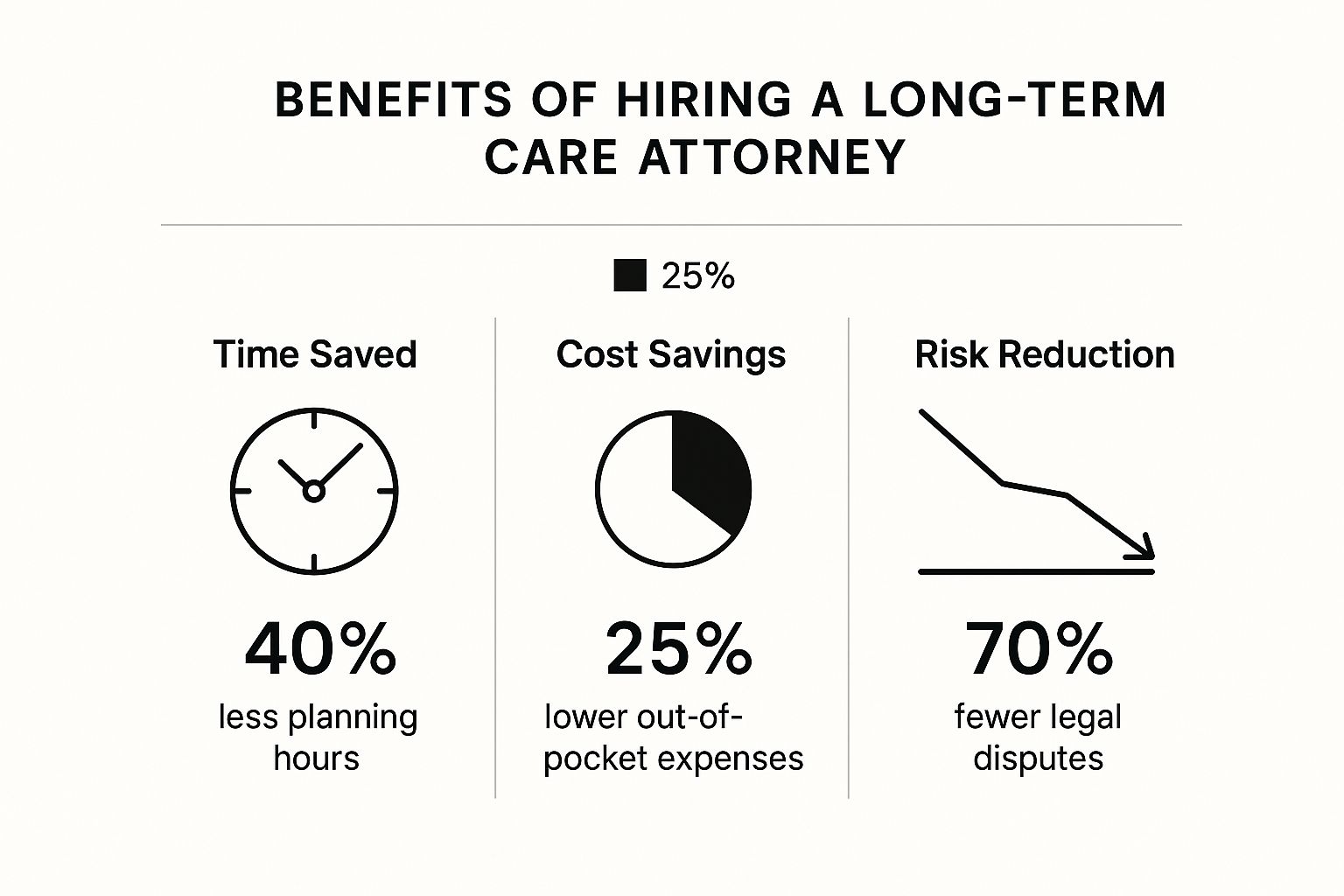
The numbers don't lie. Hiring an expert early on dramatically cuts down on out-of-pocket costs and helps you avoid expensive legal fights down the road.
The greatest benefit of early planning is control. You get to decide how your assets are used and who makes decisions for you, rather than having those choices dictated by a crisis or, worse, a court.
Even when things feel urgent, you still have to keep critical timelines in mind. For instance, if neglect or abuse contributed to the need for care, you'll have to navigate the lawsuit statute of limitations to hold the facility accountable. An attorney can guide you through these deadlines, but acting quickly is always the best defense for your family's future.
Protecting Seniors in a Complex World

The job of a long term care attorney used to be mostly about wills and trusts. That world is long gone. As our lives get more complicated, so do the risks facing older adults, and these attorneys have stepped up to become frontline defenders against challenges that simply didn't exist a generation ago.
They've evolved into something more like a comprehensive guardian. Their focus isn't just on protecting financial assets anymore; it's about safeguarding a senior's digital life, their personal dignity, and their basic human rights. It's a crucial shift needed to give seniors real security in every corner of their lives.
Safeguarding a Digital Legacy
Ever stop and think about what happens to someone's online world when they can no longer manage it themselves? We all have a surprising amount of digital "stuff"—online bank accounts, social media pages, email, cloud photo storage, and even cryptocurrency. Without a solid plan, all of that can vanish or, even worse, be stolen.
This is where a long term care attorney steps in to help create a digital estate plan. Think of it as a clear, legally sound roadmap for your online life. It spells out:
- Who gets permission to access your digital accounts.
- What should happen to your social media profiles—should they be closed or turned into memorials?
- Where to find all the necessary passwords and login info, stored securely.
This kind of planning is about preventing utter chaos for your loved ones. It ensures someone you trust can step in to pay bills online, manage important accounts, and save precious digital memories without breaking privacy laws or violating a website's terms of service. The critical importance of a power of attorney is central to this entire process.
A Fierce Advocate Against Elder Abuse
Perhaps the most critical role a long term care attorney plays is that of a shield against elder abuse. This isn't always as obvious as physical harm. It can be financial exploitation by a caregiver, emotional manipulation by a relative, or silent neglect in a nursing facility.
Elder abuse is a quiet epidemic that thrives behind closed doors. An attorney becomes the senior’s voice, wielding the law to uncover the truth, hold abusers accountable, and restore a person's safety and dignity.
These legal specialists are trained to act quickly and decisively. If they suspect financial abuse, they can go to court to establish a guardianship or conservatorship, freezing assets to protect them from theft. They can also file for protective orders to legally bar an abuser from contacting the senior.
And when neglect or abuse happens inside a care facility, a long term care attorney is the family's best weapon. They know the labyrinth of state and federal nursing home regulations inside and out. They use that knowledge to build a powerful case, fighting not just for compensation but for justice. They aren't just planners—they are fierce defenders for the elderly when they are at their most vulnerable.
How to Choose the Right Attorney for Your Family
Picking a long-term care attorney isn't just about hiring a lawyer. You're bringing someone into one of your family's most personal and financially critical moments. The right person isn't just a legal technician; they're a compassionate guide who can map out a clear path to protect your future.
This is one decision you absolutely cannot afford to get wrong. A general practice lawyer simply doesn't have the specialized toolkit for this job. You need an expert who lives and breathes the nuances of elder law, Medicaid rules, and asset protection day in and day out.
Look for Specialized Credentials
Your first step is to filter for specific qualifications that show an attorney is truly dedicated to this field. Think of it this way: you wouldn't ask your family doctor to perform open-heart surgery. The same logic applies here.
The gold standard in this practice area is the Certified Elder Law Attorney (CELA) designation. Awarded by the National Elder Law Foundation, this isn't just a certificate someone can buy. It's a hard-won credential that proves an attorney’s depth of experience, knowledge, and standing in the elder law community.
To earn it, an attorney must have:
- Years of hands-on experience practicing elder law.
- Passed a notoriously difficult written exam.
- Earned recommendations from other respected attorneys in the field.
Not every great long-term care lawyer is a CELA, but seeing those four letters is a powerful shortcut. It tells you immediately that you're talking to a verified specialist.
State-Specific Knowledge Is Non-Negotiable
While Medicaid is a federal program, each state runs its own version. This means the rules, asset limits, and application processes can be wildly different from one state line to the next. An attorney who’s a pro at navigating California’s system will be lost in New York.
Your attorney absolutely must have deep, practical experience with your state's specific Medicaid regulations. This isn’t a small detail—it is the single most important factor that determines if a plan succeeds or fails, a mistake that could cost your family hundreds of thousands of dollars.
When you're interviewing potential attorneys, ask them point-blank about their experience with your local Medicaid agency. A true professional will be able to talk confidently about the local quirks and challenges without skipping a beat.
Critical Questions for Your Consultation
Once you have a shortlist, the initial consultation is your chance to see if an attorney is the right fit. Don't be shy about asking tough, detailed questions. For more on this, check out our ultimate guide on how to find a lawyer.
Here are the essential questions you need to ask:
"What percentage of your practice is focused on elder law and long-term care planning?"
- Why it matters: You need someone who is completely immersed in this world, not a dabbler. You’re looking for an answer of 75% or higher.
"Can you walk me through your philosophy on asset protection?"
- Why it matters: This peels back the curtain on their strategic approach. Are they aggressive? Conservative? Creative? Their answer should feel right for your family's goals and risk tolerance.
"How do you structure your fees for this kind of work?"
- Why it matters: The best long-term care attorneys typically work on a flat fee basis for creating a complete plan. This is much better than a ticking hourly clock. Make sure you get total clarity on what that fee covers and what, if anything, costs extra.
"Who will be our main point of contact, and how does your firm handle communication?"
- Why it matters: Consistent, clear communication is everything. You need to know if you'll be speaking directly with the attorney or their paralegal and what to expect in terms of getting answers to your questions.
Red Flags to Watch Out For
Knowing what to look for is only half the battle; you also need to know what to run from. Be cautious of any attorney who:
- Guarantees results: No ethical lawyer can promise a specific outcome, especially when dealing with a government agency like Medicaid.
- Pressures you for a quick decision: This is a huge decision that requires careful consideration. A professional you can trust will give you the time and space you need.
- Is vague about fees: You should leave the consultation with a rock-solid understanding of every cost involved.
- Lacks empathy: This area of law is incredibly personal. Your attorney should be someone who listens and shows genuine compassion for what you're going through.
Frequently Asked Questions About Long Term Care Law

Stepping into the world of long-term care can feel like navigating a maze in the dark. It’s completely normal to have a ton of questions, and families often find themselves dealing with these complicated issues for the very first time, totally unsure of where to find good answers.
This section tackles some of the most common questions people have when they start thinking about hiring a long term care attorney. My goal here is to cut through the confusion and give you the clear, straightforward information you need to make the right moves for your family.
Elder Law vs. Estate Planning
So, what's the real difference between an elder law attorney and a regular estate planning attorney? People ask this all the time. While their worlds can overlap a bit, what they focus on is fundamentally different.
Think of a traditional estate planner as being focused on what happens after you're gone. Their main job is to draft wills and trusts to make sure your assets go to the right people when you pass away.
A long term care attorney, on the other hand, is all about protecting you and your assets while you're still living. Their expertise lies in planning for the possibility of becoming incapacitated and figuring out how to handle the staggering costs of care—using specialized tools like Medicaid planning that most estate planners just don't touch.
Understanding the Cost of Legal Help
Let's talk about money, because it’s a big deal for most families. The cost of hiring a specialist can vary depending on where you live and how complex your family’s situation is.
For this kind of work, lawyers generally use one of two fee models:
- Flat Fees: A lot of attorneys will charge a single, all-inclusive fee to create a complete long-term care plan. You can typically expect this to be somewhere between $5,000 and $15,000. The big plus here is that you know the full cost right from the start.
- Hourly Rates: If you just need ongoing advice, help with a crisis, or other specific tasks, the attorney might bill by the hour instead.
I know that initial number can feel like a lot, but it’s crucial to see it as an investment. A solid, well-designed plan can safeguard hundreds of thousands of dollars in family assets from being wiped out by nursing home bills. The return on that investment can be massive.
Think of it this way: spending a few thousand dollars on a solid legal plan is like buying an insurance policy that protects your entire life savings from a predictable financial disaster.
Is It Too Late to Plan?
One of the most common—and most tragic—myths out there is that once a loved one is already in a nursing home, it's too late to do anything to protect their assets. That is absolutely, 100% false.
Sure, planning years in advance gives you the most flexibility and options. But it is never too late to get professional help. An experienced long term care attorney can use strategies known as "crisis Medicaid planning" even after someone has moved into a facility.
These last-minute strategies can still preserve a huge chunk of a family's assets, especially for the healthy spouse still living at home. Please, don't just assume you've missed your chance. A single consultation can open your eyes to options you never even knew were on the table.
Preparing for Your First Meeting
Want to get the most bang for your buck out of that first consultation? Come prepared. Pulling together your key documents beforehand gives the attorney a crystal-clear snapshot of your situation from the get-go.
This means they can stop asking basic questions and start building a real strategy for you right away. A productive first meeting really sets the tone for a successful plan.
Here's a checklist of what you should try to bring:
- Financial Statements: Gather recent statements for everything—bank accounts, retirement funds, investment portfolios, property deeds, you name it.
- Existing Legal Documents: If you already have wills, trusts, or powers of attorney, bring copies.
- Proof of Income: This includes Social Security statements, pension documents, and anything else that brings in regular income.
- Insurance Policies: Got a long-term care insurance policy? Bring it along so the attorney can review the details.
Having all this ready helps the attorney give you a much more accurate assessment and start crafting a plan that actually fits your family’s specific needs.
If you are worried about the safety and well-being of a loved one in a care facility, you are not alone. AskLegally provides families with the information and resources they need to recognize the signs of nursing home abuse and neglect. We connect you with experienced nursing home abuse lawyers who will fight to protect your family's rights and dignity. Take the first step toward justice and peace of mind with AskLegally today.